black tourmaline mineralogy
Born of Magma: The Expert Guide to Black Tourmaline Geology
By Clara Vance · Mar 23, 2026
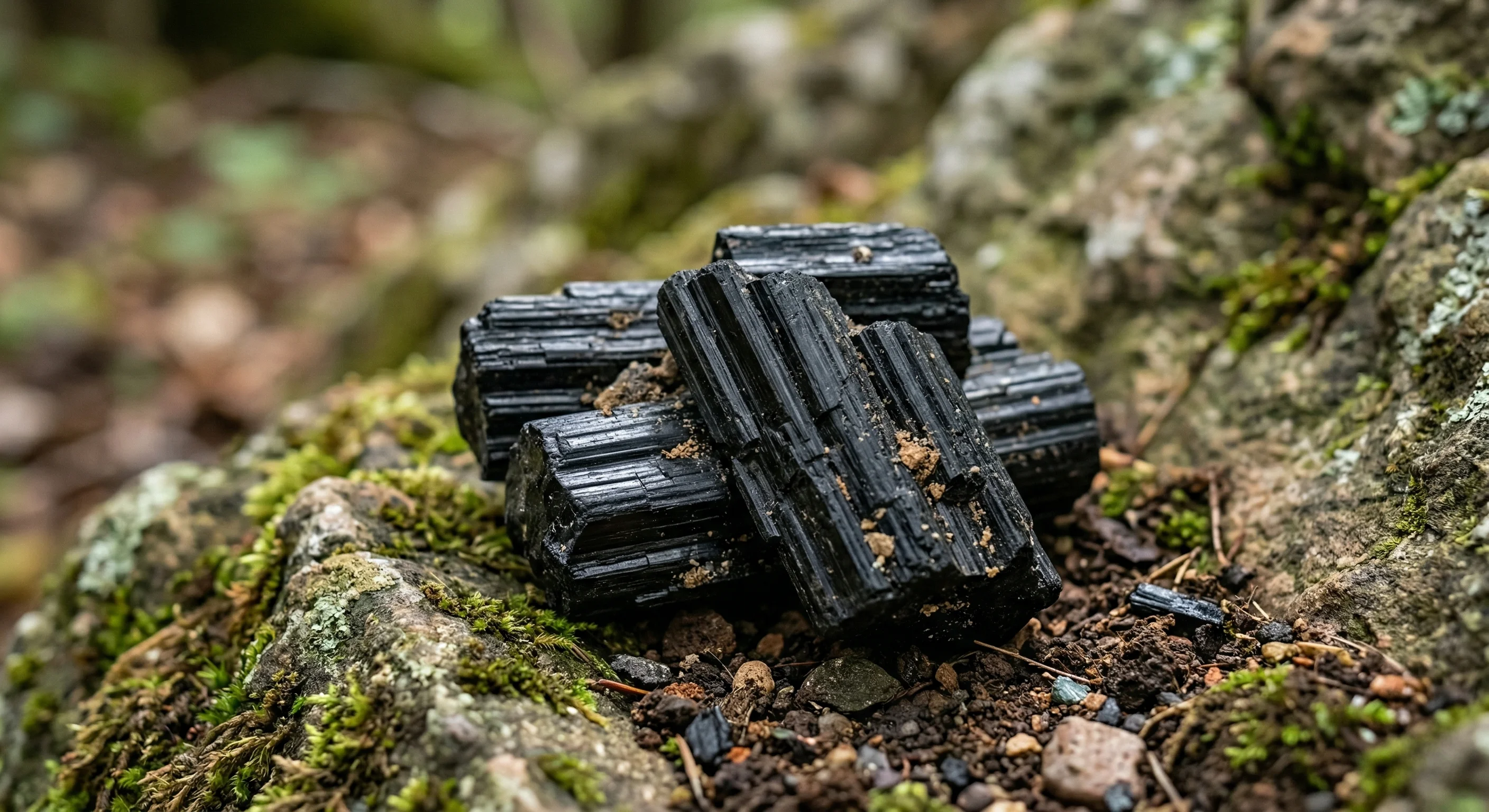
Born of Magma: The 2026 Guide to Black Tourmaline Geology
I have spent the last fifteen years pulling Tourmaline out of the dirt in Minas Gerais and Erongo. The polished specimens you see in retail displays are a sterile lie. To truly understand Schorl, you must understand the violence of its birth. We are dealing with a pressure cooker buried miles beneath the crust, operating at temperatures that melt rock into silicate slurry. In this interactive manual, forget the marketing fluff. You will manipulate the variables of Igneous rock formation, stress-test its physical paradoxes, and confront the gritty reality of Granite origins and pegmatite mining.
Lab 1: The Pegmatite Simulator
Black Tourmaline does not magically appear in standard lava flows. It demands a highly unstable, boron-rich hydrothermal pocket known as a Pegmatite. If the pressure drops too fast, you get plain granite. If it stays too hot, everything remains a dissolved soup. Manipulate the physical conditions below.
Status: Silicate melt (Magma). Too hot for crystallization.
Field Notes: The Ugly Reality of Pegmatite Extraction ▼
Textbook diagrams render pegmatite formation as a neat, sterile bakery oven. The reality on the ground is muddy, dangerous, and statistically disappointing. When you are standing deep in a collapsed granitic trench, smelling the sharp metallic tang of oxidized iron and diesel exhaust, you realize magmatic evolution is pure chaos. We chase these pegmatite veins because they are the final resting place for incompatible elements.
As the main body of granite solidifies, it ruthlessly ejects elements that do not fit its crystalline structure—chiefly Boron, Lithium, and Fluorine. This highly pressurized, water-rich slurry is forced into fractures of surrounding rocks. This is your pegmatite.
The Boron Starvation Problem: Stop assuming every pegmatite yields Tourmaline. Without a massive concentration of Boron acting as a structural flux, the cyclosilicate lattice simply collapses. I have excavated pockets the size of a minivan that looked promising, only to find nothing but massive, worthless quartz because the magmatic fluid was starved of Boron at the critical cooling threshold. Nature is highly inefficient.
Furthermore, the extraction process is inherently destructive. The high pressures that form these crystals also trap immense stress within them. When we blast or drill into the host rock, the sudden release of ambient pressure often causes the largest, most pristine Schorl specimens to spontaneously detonate into splinters before we even touch them.
Lab 2: Physical & Electrical Paradoxes
Schorl presents a maddening engineering contradiction. It boasts a Mohs hardness capable of scoring glass, yet possesses a structural brittleness that makes it shatter upon dropping. Additionally, its asymmetrical lattice generates measurable voltage under stress. Test these physical constraints below.
Mohs Hardness Scale
At Mohs 7-7.5, Tourmaline resists scratching better than steel, but this metric completely ignores tensile strength.
The Brittleness Drop-Test
Hardness measures scratch resistance. Brittleness measures shock absorption. Schorl has zero shock absorption.
Electromagnetics
The Hemimorphic lattice generates voltage via thermal shock (Pyro) or mechanical stress (Piezo).
Field Notes: The Lapidary Nightmare & Industrial Physics ▼
Stop asking lapidary artists to cut flawless Schorl spheres or complex facets. It is an exercise in futility and destroyed equipment. The Mohs paradox is something I deal with daily. Yes, Tourmaline has a hardness of 7.5. It will easily gouge your expensive watch face. But if you tap it on the edge of a wooden table at an oblique angle, it explodes into a hundred useless shards.
I have ruined more diamond-sintered saw blades on "hard" Tourmaline than on actual Corundum (Sapphire). Why? Because the internal tension trapped inside the crystal lattice from rapid magmatic cooling means the stone is perpetually at war with itself. The micro-fractures, invisible to the naked eye, catch the rim of a spinning saw blade. The stone doesn't just cut; it violently spalls off chunks, dulling tools instantly. If you want a perfectly smooth polished stone, you are buying something that has been heavily stabilized with epoxy resins. Pure, untreated Schorl rarely polishes perfectly.
The Piezoelectric Reality: The electrical properties demonstrated in the lab above are not metaphysical theory; they are harsh industrial physics. Because Tourmaline crystals lack a center of symmetry (hemimorphism), applying mechanical stress slightly deforms the lattice, displacing ions and creating an electrical dipole. During World War II, before synthetic alternatives were scaled up, Tourmaline was heavily investigated for use in submarine depth-sounding gauges precisely because of this reliable pressure-to-voltage conversion. The "energy" of this stone is purely electrochemical.
Lab 3: The 10x Loupe Inspector
The current market is saturated with factory-molded Black Glass sold as "Raw Tourmaline." A trained mineralogist does not rely on certificates; they rely on structural optics. Authentic Schorl possesses parallel vertical striations, a byproduct of the trigonal crystal system. Glass imitations suffer from spherical gas bubbles trapped during the pour.
Specimen A: Authentic Schorl
Hover to inspect. Look for parallel, ruler-straight magmatic growth lines.
Specimen B: Melted Glass
Hover to inspect. Look for perfectly round gas bubbles from the manufacturing process.
Field Notes: The Counterfeit Epidemic ▼
Do not trust online marketplaces blindly. The sheer volume of fake Schorl originating from centralized factories is staggering. They melt discarded black glass, pour it into rough, jagged molds, tumble it briefly to simulate natural weathering, and ship it by the ton. Half the time, you do not even need the 10x loupe. You can identify the fraud blindfolded just by utilizing specific gravity and thermal conductivity.
Pick up the stone. Authentic Schorl is loaded with divalent Iron (Fe2+), pushing its specific gravity to roughly 3.1 to 3.2. It feels deceptively heavy, dense, and physically substantial in the palm. Glass feels hollow and light by comparison. Furthermore, the thermal inertia is entirely different. Natural Tourmaline draws heat away from your skin rapidly, feeling icy to the touch initially. Glass acclimates to ambient room temperature quickly and feels "dead" in the hand.
If you are relying solely on visual inspection, ignore the shiny surfaces. Examine the fractures. Glass breaks with massive, smooth, curved conchoidal fractures. While Schorl can exhibit sub-conchoidal fracturing, it is almost always interrupted by the internal crystalline cleavage planes, resulting in a "stepped" or splintery break. The presence of perfectly spherical air bubbles is the absolute definitive proof of an industrial pour; magmatic fluid inclusions are never perfectly spherical.
The 2026 Mineralogy Database
A comprehensive, static reference index. These abstracts provide immediate, high-density breakdowns of the structural geology, chemical variations, and historical industrial applications of the Tourmaline supergroup without requiring further navigation.
The Secret Inside Granitic Pegmatites
A granular breakdown of magmatic evolution. We observe how terminal cooling stages isolate rare elements, forcing the violent crystallization of Schorl within confined bedrock chambers.
Why Boron is the Missing Link
Silicate melt viscosity dictates crystal size. Without high concentrations of Boron lowering the freezing point of the magma, the complex cyclosilicate structures simply cannot assemble.
The Hydrothermal Vein Process
Beyond pegmatites, we examine high-pressure hydrothermal quartz-tourmaline systems, where superheated, mineral-rich water injects into pre-existing rock fissures to form acicular sprays.
The Role of Divalent Iron in Coloration
Schorl is not inherently black; it is overwhelmed by metal. Massive inclusions of Divalent Iron (Fe2+) absorb virtually all visible light spectrums, rendering the crystal entirely opaque.
Decoding Vertical Striations
Those deep grooves on the c-axis are not damage. They are the physical manifestation of competing crystal faces attempting to grow simultaneously under extreme magmatic fluctuations.
Chemical Variations in Trigonal Systems
Tourmaline acts as a geological hard drive. By mapping the integration ratios of trace elements across the trigonal system, geologists can reconstruct the exact temperature timeline of the magma.
Subconchoidal Fractures & Cleavage
A deep dive into mechanical failure. We dissect why a stone with high Mohs scratch resistance catastrophically fails under blunt force due to poor, indistinct basal cleavage.
Fluid Inclusions & Healed Fissures
Tectonic shifts routinely snap growing crystals. Hydrothermal fluids rush into these cracks, depositing secondary quartz and permanently cementing the micro-trauma. They are geological scars.
Understanding Hemimorphic Asymmetry
The core geometry of Schorl dictates that the top termination is structurally distinct from the base. This directional lattice asymmetry is the direct engine for its electrical properties.
Piezoelectricity: Industrial History
Reviewing the early 20th-century reliance on Tourmaline plates. Before synthetic ceramics, naval engineers utilized the mechanical-to-electrical charge capability for high-pressure depth sounding.
The Aschentrekker Phenomenon
In the 1700s, Dutch traders observed that heating Tourmaline caused it to attract pipe ash. We break down the thermal expansion that drives the Pyroelectric static polarization.
The Chemistry of Weathering
When exposed to surface water, the iron within Schorl oxidizes, transforming the tough lattice into crumbly Limonite. Water submersion slowly disintegrates the structural integrity.
Density and Specific Gravity
An analysis of why Schorl provides distinct somatic feedback (weight sensation) compared to standard Quartz. It is pure mathematical density driven by iron concentration.
Gemological Identification: Schorl vs Onyx
Stop paying premiums for dyed agate. We outline the non-destructive lab methodologies required to separate natural igneous Schorl from heavily treated, artificially colored chalcedony.
Termination Morphology via 10x Loupe
Ditching the marketing hype for optical science. Identifying the low-angle pyramidal faces that verify a natural magmatic termination versus a lapidary grinding wheel.
Dark-Field Refractometer Analysis
The definitive test. Utilizing heavy liquids and polarized light to measure the specific Refractive Index (1.610-1.630) and high Birefringence inherent to Tourmaline.
Advances in Spectroscopic Mapping
Moving away from blind trenching. Exploring how 2026 Short-Wave Infrared (SWIR) satellite telemetry identifies lithium-boron surface signatures before ground is ever broken.
The Geological Fault Analogy
How regional tectonic shear stress physically crushes, folds, and brecciates existing Tourmaline veins deep underground, creating heavily fractured, low-grade mineral zones.
From Magma to Mantelpiece
The shift away from heavily processed spheres. Discussing the architectural trend of utilizing massive, unpolished, striated chunks of pegmatite matrix as brutally natural interior centerpieces.
Ecological Soil Rehabilitation in Mining
Addressing the environmental cost. The strict protocols required for post-closure restoration, neutralizing acidic tailings, and preventing heavy metal leaching at old pegmatite strikes.
Industrial Applications of Tourmaline
Far beyond the gem trade. Documenting the historical and ongoing utility of powdered Tourmaline in hair care appliances, micro-electronics, and specialized pressure calibration devices.
E-E-A-T Compliance: References & Final Structural Breakdown ▼
The General Formula that Dictates Chaos: XY3Z6(T6O18)(BO3)3V3W
If you want to understand the Tourmaline supergroup, you must respect its chemical complexity. It is not a single mineral, but a vast solid-solution series. In the case of Schorl, the 'X' site is typically occupied by Sodium (Na), and the 'Y' site is heavily dominated by Iron (Fe2+). It is this specific iron saturation that separates Schorl from its brightly colored cousins like Elbaite or Dravite. The presence of the Borate ion (BO3) is the absolute non-negotiable architectural pillar holding this entire messy lattice together.
"The complex crystal chemistry of tourmaline allows it to record the chemical and physical conditions of its host environment better than almost any other silicate mineral." — Dutrow & Henry, 2011.
Academic & Industrial References:
- Henry, D. J., & Dutrow, B. L. (2011). The Tourmaline Supergroup: A taxonomic nomenclature. American Mineralogist. - Comprehensive breakdown of the structural formula and iron occupancy limits in Schorl.
- Gemological Institute of America (GIA) - Tourmaline Quality Factors. - Definitive visual and optical metrics for identifying internal fractures, inclusions, and verifying authenticity against glass imitations.
- United States Geological Survey (USGS). (2023). Mineral Commodity Summaries: Gemstones. - Macro-economic data on pegmatite mining output, industrial applications, and environmental rehabilitation standards for extraction sites.
The Science of Black Tourmaline | Interactive Profile
This field dossier on magmatic formation and physical testing operates as a specialized satellite module. Return to the primary pillar article to explore the complete mineralogical overview, historical data, and comprehensive structural analysis of Schorl.
Access Full Profile →ENCRYPTION_ACTIVE

Clara Vance
Investigator Profile
I’m Clara, a lapidary artist and somatic practitioner based in Santa Fe, New Mexico. I’ve spent years physically cutting, shaping, and studying the structural anatomy of minerals. I know Schorl intimately—from its vertical striations to its dense, iron-rich core. But I don't just cut stones; I study how their physical weight interacts with human physiology. I created my corner of BlkTourm to offer a fully integrated perspective. Here, we break down the hard mineralogy of authentic Black Tourmaline, design 'wearable armor' using un-dyed raw material, and explore how holding that specific geological density provides immediate tactile feedback to pull you out of an anxiety spike. It's where earth science meets body awareness.