functional utility
Why Your Smart Home Needs Raw Black Tourmaline in 2026
By Clara Vance · May 12, 2026
Smart home field note
Why Your Smart Home Needs Raw Black Tourmaline in 2026
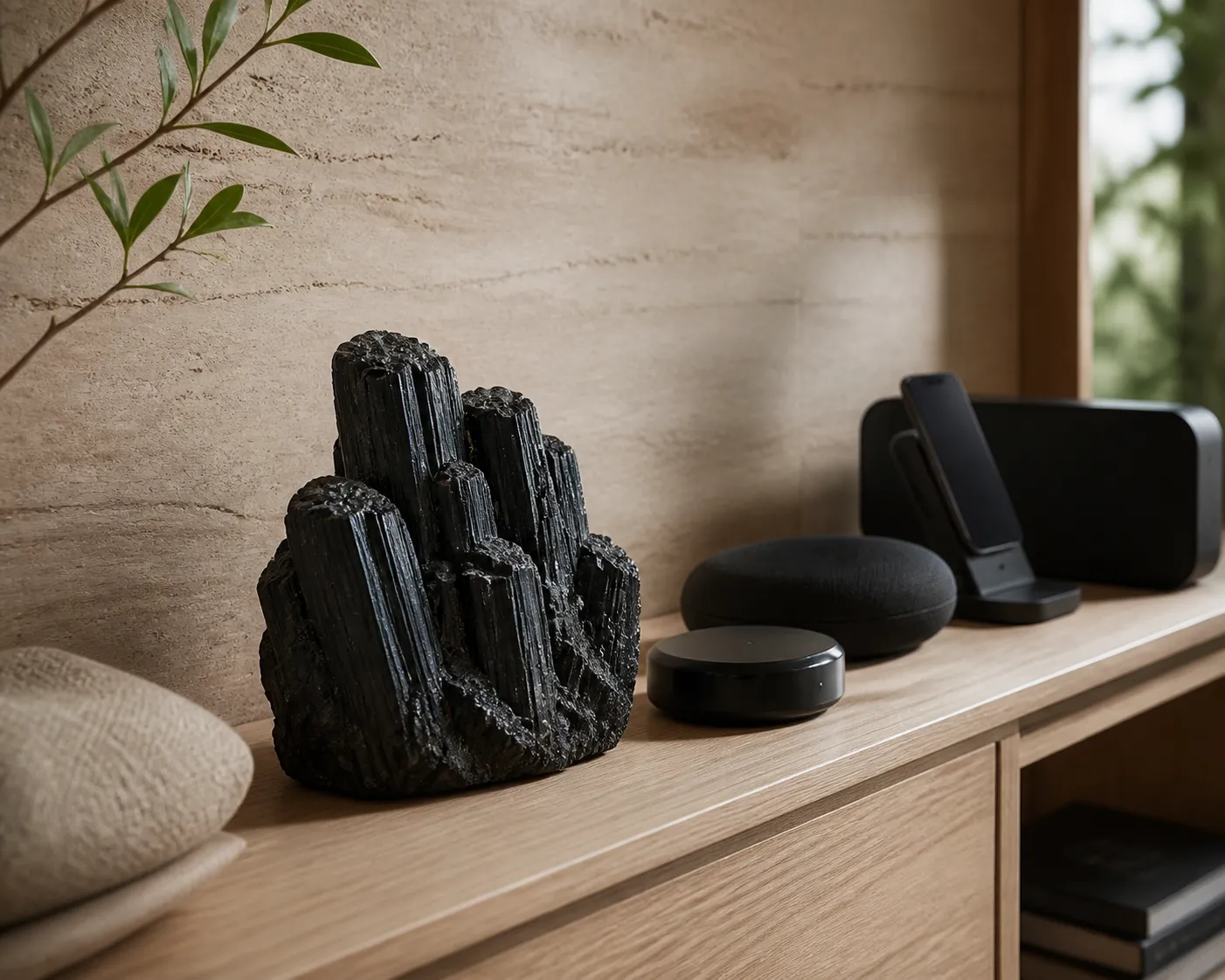
Yes—if “needs” is understood as a design and attention cue, not a technical requirement. In a device-dense home, Raw Black Tourmaline Clusters make the most sense as natural mineral decor: dark, tactile, irregular objects that counterbalance screens, routers, chargers, smart speakers, and glossy hardware.
What they should not be treated as is a reliable tool for EMF mitigation, radiation control, or device safety. The stronger reason to use raw black tourmaline in a smart home is visible and practical: it adds texture, weight, contrast, and symbolic grounding to rooms that can otherwise feel overly synthetic.
Why raw black tourmaline fits a smart home
Smart homes are usually built around convenience: fewer switches, more automation, faster charging, smoother interfaces. The visual result can be flat and repetitive—black screens, black speakers, plastic docks, cables, hubs, and indicator lights.
Raw black tourmaline brings in a different kind of black. It is not glossy hardware black. It is mineral black.
Black tourmaline is the familiar retail name; schorl is the more precise mineral name commonly associated with black tourmaline material. In raw form, it often appears opaque, rough, striated, and prismatic. Those ridges and uneven faces are the reason it works so well in a tech-heavy room. It interrupts the sameness of smooth manufactured surfaces.
That is the most credible “smart home” argument for it. A raw cluster does not make a connected home safer by sitting near electronics. It does, however, make the room feel less sealed inside a digital system. It adds friction in a good way: texture, irregularity, density, and a visible reminder that not every object in the room is software-shaped.
Some people also like black tourmaline because crystal traditions associate it with protection and grounding. That language explains why it is often placed near electronics or workstations. In this context, though, grounding is best understood as symbolic, visual, or emotional anchoring—not electrical performance.
Why raw works better than polished in this setting
Polished black stones can be beautiful, but they often blend into the same visual family as other dark accessories. A raw black tourmaline cluster is harder to mistake for a generic decor object. Its ridges, breaks, and clustered growth make it read as a mineral specimen.
That matters in a smart home. If the room is already full of smooth interfaces, the rawness is the point.
Raw clusters also communicate material identity more clearly than tumbled or polished pieces. A polished stone may suit a tray, pocket, bedside dish, or jewelry setting. A raw cluster is better when you want the object to hold space on a desk, shelf, console, or media unit.
There is a practical buying benefit too. Because raw tourmaline often shows its crystal habit more clearly, it can be easier to distinguish from other black stones that are sold with similar language online. If your interest is partly aesthetic and partly mineral-specific, raw is usually the more legible choice.
The EMF question, without the overreach
The answer changes depending on what you expect the cluster to do.
If you want a natural object that softens the look of a tech-heavy room, marks a work zone, or gives a connected space a more grounded feel, raw black tourmaline fits the job. If you want a measurable tool for reducing device emissions or changing the electrical behavior of a room, a loose mineral cluster is not something to rely on.
The confusion is understandable. Tourmaline is associated with real materials-science terms such as piezoelectric and pyroelectric. Those words describe properties that can matter in specific technical conditions. But that is not the same as saying a raw specimen beside a router changes the electromagnetic environment of a home.
A material can have interesting properties in specialized settings without becoming a household performance device.
So placement still makes sense—but as design, symbolism, and habit-building:
- Home office desk: a visual boundary between work hardware and the rest of the room
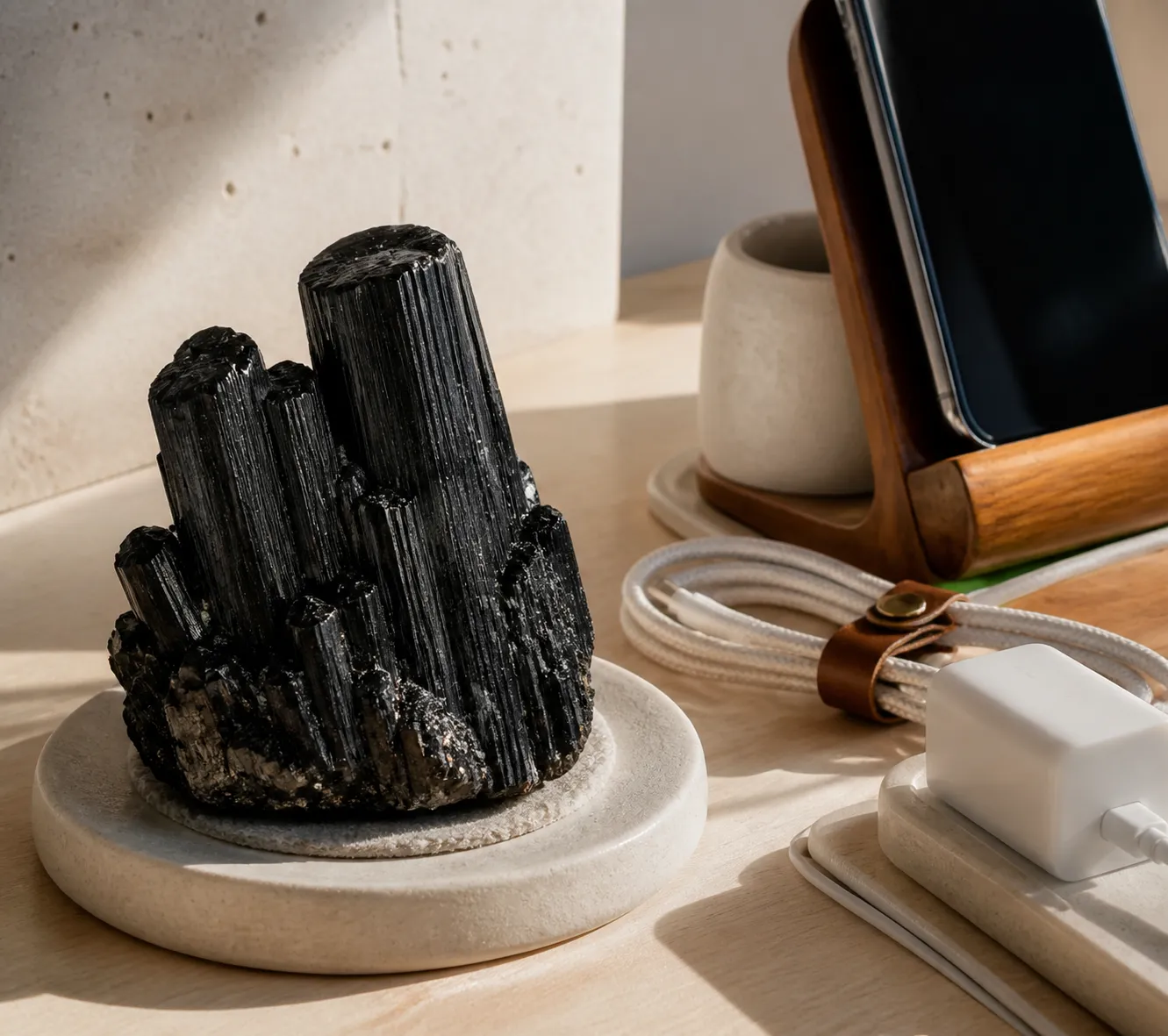
- Charging station: a rough natural contrast beside cables, docks, and adapters
- Entry console: a quiet transition object when you come home
- Media shelf: a way to break up black electronics and polished surfaces
- Bedside table: only if the piece is stable, not sharp-edged in a risky spot, and genuinely suits the room
The weakest reason to place black tourmaline near electronics is “because it will fix the electronics.” The stronger reason is “because it changes how the space looks and feels.”
For actual electrical safety, use ordinary evidence-based measures: proper ventilation, stable surfaces, cable management, manufacturer guidance, and safe power practices. Decorative minerals are not a substitute for those basics.
Black tourmaline vs. obsidian, onyx, and jet
Many shoppers looking for black tourmaline are really looking for “a black stone with grounding or protective symbolism.” That is why black tourmaline is often confused with obsidian, black onyx, and jet.
For smart-home decor, the differences are useful:
Black tourmaline
Usually looks striated, crystalline, and rugged in raw form. It often has long ridges or prismatic structure, so it reads as a mineral specimen.
Obsidian
Volcanic glass. It tends to look smoother and glassier, with fracture patterns that feel different from tourmaline’s ridged habit.
Black onyx
Usually seen cut or polished, so it often reads as formal decor or jewelry material rather than rough mineral texture.
Jet
Lighter in feel and has a softer, less crystalline visual character.
If you want a tactile object that stands apart from the smooth surfaces of a smart home, raw black tourmaline usually has the strongest visual contrast. The “raw cluster” part matters because that form preserves the texture that makes the material distinct.
How to use a cluster without treating it like a device
The cleanest way to use raw black tourmaline in 2026 is to treat it as an intentional object, not a hidden utility product.
A few simple rules help:
- Give it a base. Raw pieces can scratch furniture or shed small grit, so use a dish, coaster, tray, or felt pad.
- Choose stability over drama. Tall or narrow clusters can tip on crowded shelves or near vibrating speakers.
- Let the texture show. It works best where its rough surface contrasts with glass, aluminum, lacquer, wood, or plastic.
- Do not bury it in cables. That makes it look like a technical accessory, which it is not.
- Dust gently. Raw crevices collect dust more easily than polished stones. A soft brush or careful dry wipe is usually enough.
If you like ritualized placement, keep the meaning simple. A stone beside your monitor can mark the beginning of focused work. A cluster near the front door can act as a visual reset point. A piece on a media console can keep the room from feeling like a row of devices.
Those are real uses. They are aesthetic, symbolic, and behavioral—not mechanical.
Bottom line
Your smart home does not need raw black tourmaline as a technical safeguard. It may benefit from it as a design correction.
In 2026, connected homes are becoming cleaner-lined, more automated, and more screen-saturated. Raw black tourmaline offers something those spaces often lack: mineral texture, visual gravity, and a natural object that can anchor a room without pretending to optimize it.
If you like the cultural language around protection, that preference can sit alongside a clear boundary. A raw black tourmaline cluster can be a symbolic grounding object, a strong decor piece, and a useful visual marker in a connected home. It is not an evidence-backed EMF solution, and it does not replace ordinary safety decisions.
Used that way, it earns its place.
Sources
Sources and further reading
Reference links are limited to sources considered suitable for public citation in this page.