functional utility
Somatic Anchoring: Using Geological Weight for Sensory Balance
By Clara Vance · Mar 27, 2026
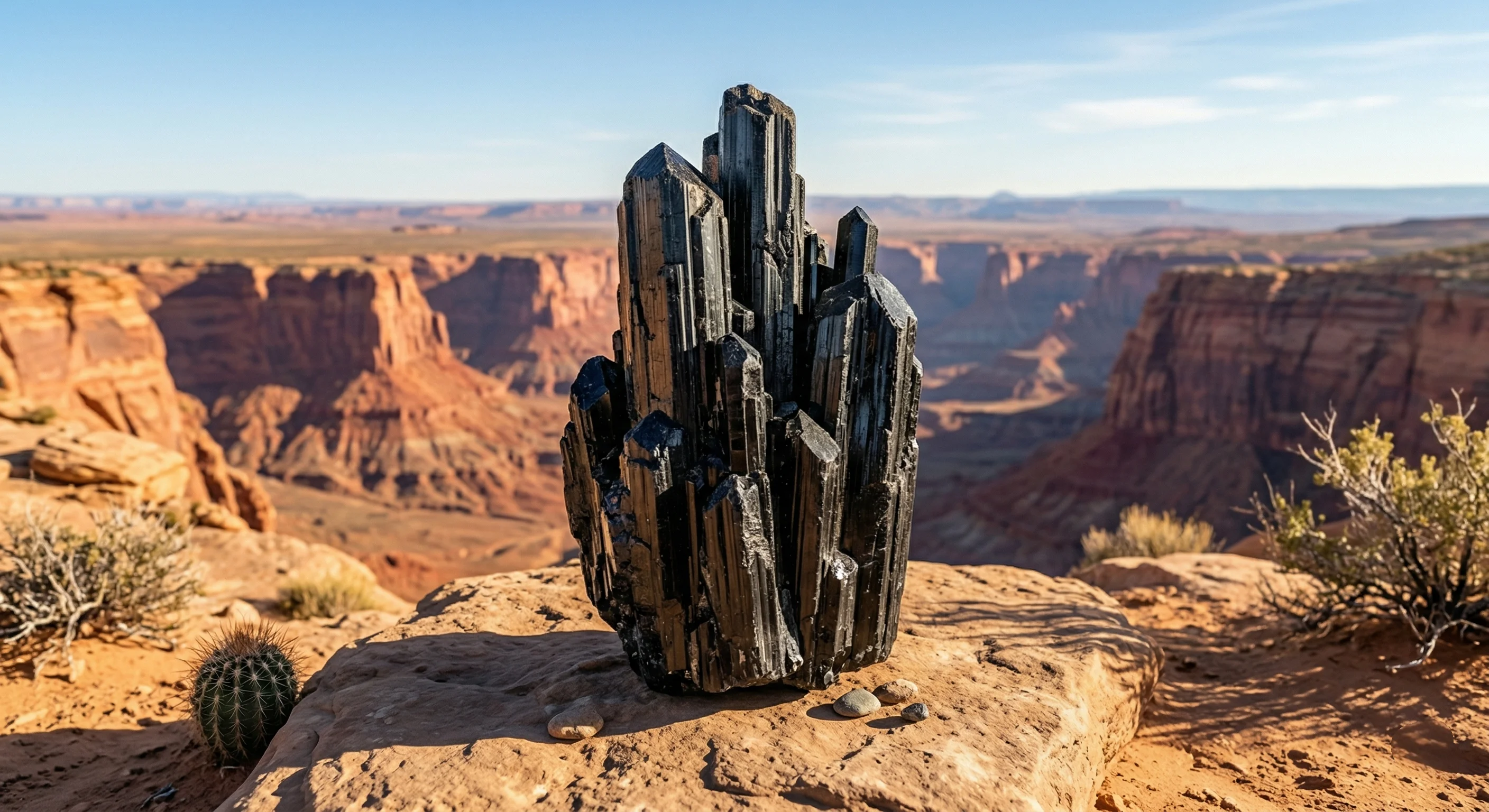
Wellness Trend Report · 2026
Somatic Anchoring: Using Geological Weight for Sensory Balance
In my ten years of analyzing workplace ergonomics and sensory design, I have watched highly capable professionals try to out-think their screen fatigue. We bought into the promise of focus apps, pomodoro timers, and complex digital dashboards. Here is the ugly truth: you cannot solve digital saturation with another digital interface. It is a fundamental biological mismatch.
You feel it before you can name it: the restless ambient energy, the subtle, creeping tension in your upper shoulders, and the distinctly detached sensation of staring into a flat, two-dimensional screen for eight consecutive hours. Our workspaces are environments of extreme sensory poverty. Consider your desk. You touch glass. You touch smooth plastic. You sit on synthetic woven mesh. The human nervous system evolved over millennia to process high-texture, high-resistance environments—bark, dirt, irregular stone, and varying temperatures. The deprivation of tactile resistance is precisely what causes that "floating" or "zoned out" sensation by 3:00 PM.
Interactive: The Digital Saturation Index
How disconnected, "floaty", or visually exhausted do you feel after your screen time today? Drag the slider to assess your current sensory state.
Clear & Present
You are experiencing a standard baseline of focus. Maintenance routines recommended to sustain this state.
To thrive in the modern workspace, integrating Haptic Feedback, Sensory Rituals, Physical Weight Anchors, and Restorative Analog Routines into our daily lives is no longer a fringe wellness trend. It is a structural necessity for maintaining a sustainable work cadence. We are shifting aggressively from "top-down" cognitive processing (trying to reason our way out of stress) to "bottom-up" somatic processing (changing the physical input to alter the mental state).
The Reality Check: Why Digital Detoxes Fail ▼
Stop prescribing weekend digital detoxes as the ultimate solution to chronic screen fatigue. As an industry observer, I see this pattern constantly: a professional unplugs completely for 48 hours, feels a temporary sense of relief, and then crashes back into the exact same high-friction digital environment on Monday morning. The contrast actually makes the re-entry more jarring.
The fundamental flaw of the "detox" model is that it treats technology as a poison to be purged, rather than an environment that needs physical counter-balancing. You do not need to abandon your devices; you need to introduce competing sensory anchors while you use them.
When you introduce a dense physical object—like a half-pound piece of unpolished stone—to your immediate workspace, you are creating a micro-environment. You are providing your brain's somatosensory cortex with continuous, low-level physical data that competes with the overwhelming visual data from your monitor. It is about sensory integration, not sensory deprivation. A detox is a temporary vacation. Somatic anchoring is permanent infrastructure.
The Mechanics of Physical Anchoring
Understanding how holding a physical, weighty object shifts our attention from abstract digital loops to our immediate physical reality requires looking at basic proprioception.
The Density Disruption
Physical weight provides tangible environmental boundaries. When your visual field is locked at a fixed 18-inch focal depth for six hours, your proprioceptive map—your brain's continuous calculation of where your body ends and the physical world begins—starts to degrade. I refer to this phenomenon as the '2D Drift'.
When we feel distracted or mentally cluttered, applying gentle, distributed pressure via a dense object acts as an immediate physical pattern interrupt. Mechanoreceptors in your skin and joints fire signals directly to the brainstem. This process requires zero conscious effort, which is precisely why it works when cognitive fatigue is at its peak. It supports the body's natural resting rhythms, often resulting in steadier breathing.
Interactive Bio-Simulation
Fig 1: Simulated Tension Rhythm (Hold button to observe smoothing effect).
Trade-off Thinking: Anchoring vs. Active Movement ▼
Let me be absolutely clear to avoid any misinterpretation: holding a piece of heavy basalt at your desk is not, and will never be, a biological replacement for a 30-minute brisk walk outdoors. If you have the option to stand up, step outside, and view a distant horizon, you must take it. Active movement is the superior mechanism for physiological regulation.
However, the reality of the modern knowledge worker involves back-to-back virtual meetings, tight deadlines, and environments where leaving the desk is a logistical impossibility for stretches of four to six hours. This is where trade-off thinking becomes vital.
We cannot let perfect be the enemy of functional. The geological anchor serves as a "bridge" intervention. Its primary advantage is zero friction. It requires no time allocation, no change of clothes, and no breaking of professional presence on a video call. It is a passive tool that continuously grounds your physical awareness while you execute demanding cognitive tasks. You sacrifice the cardiovascular benefits of walking, but you gain an immediate, discreet mechanism to prevent the accumulation of severe sensory drift.
Haptic Feedback & Sensory Tools
Not all stones serve the same function. The approach to functional physical tools demands an understanding of material properties: thermal conductivity, density, and surface friction. Hover to experience simulated behaviors, and click to reveal physical properties.
Select a tool above to view physical properties.
Integrating physical anchors into your workspace provides a passive visual and tactile reminder to pause. We avoid generic solutions; the specific texture and weight profile matter immensely.
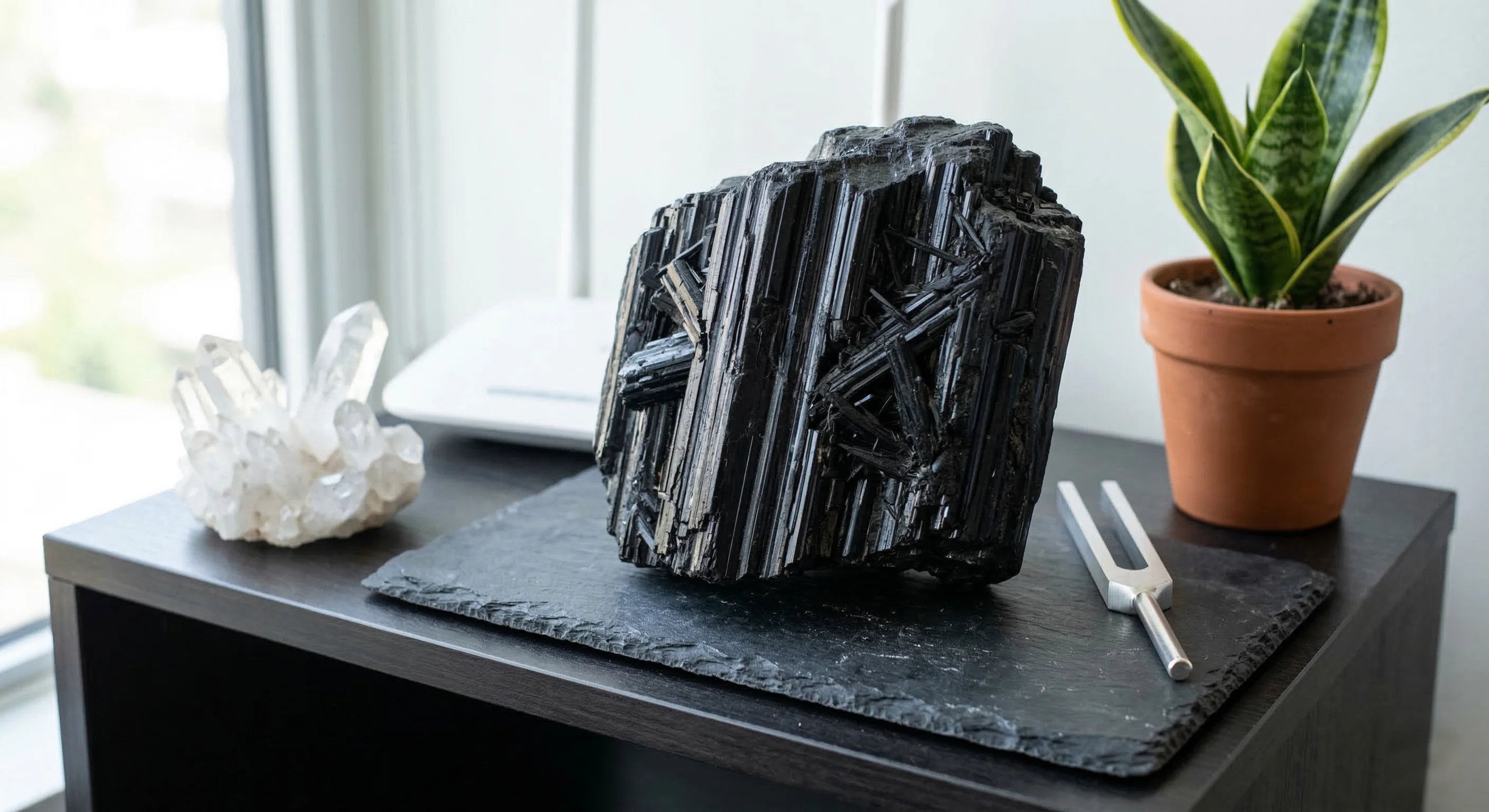
Black Tourmaline: High Friction Resistance
Tourmaline has a dry, almost chalky resistance when rubbed. It does not warm up quickly in the hand. Application: This is a favorite for high-distraction environments. The distinct, somewhat rough texture provides excellent tactile feedback for moments when you need to pull your attention away from a chaotic task and establish a firm physical boundary. It forces you to notice the feeling in your fingertips.
Dense Basalt: The Gravity Anchor
Basalt is aggressively inert. Because of its iron and magnesium content, it boasts an incredibly high specific gravity. Application: It demands your attention through sheer gravitational pull. Keeping a piece of smooth, heavy basalt near your keyboard offers an immediate physical contrast to the weightless, frictionless digital world. It is the most effective tool for establishing a lowered center of physical gravity.
Clear Quartz: Thermal Conductivity
Quartz has a high rate of thermal conductivity, meaning it rapidly pulls heat away from your skin, making it feel remarkably cool. Application: Slippery, dense, and holding an ambient chill, pressing a cool quartz stone against the palm or inner wrist is a simple, refreshing sensory shift. It is highly recommended for breaking the mid-afternoon lethargy typically associated with warm, stagnant office air.
Partially Raw Palm Stones
These are stones shaped to fit the hand's natural resting curve, but deliberately left unpolished on one side. Application: The contrast between the smooth indentation and the raw, jagged back serves as an advanced physical fidget tool. The act of rubbing the thumb along the varied topography requires micro-adjustments in grip, serving as an active, engaging physical task that runs quietly in the background of your focus.
Veteran Sourcing: Avoid the "Polished" Trap ▼
If you decide to integrate a physical anchor into your workspace, stop buying highly processed, chemically polished "worry stones" or generic glass marbles from mass online marketplaces. This is the most common mistake I see beginners make.
The glassy, hyper-smooth finish applied to commercial stones destroys the haptic resistance you actually need. When a stone is completely frictionless, it slips into the background of your awareness almost immediately, rendering it useless as a sensory interrupt. You end up dropping it or ignoring it.
You must seek out stones that retain a degree of their natural geological texture. Look for raw chunks, acid-washed finishes, or stones that have been tumbled but not resin-coated. You want a tool that pushes back slightly against your skin. If it feels exactly like the glass trackpad on your laptop, it is providing zero varied sensory input and completely defeats the purpose of the exercise.
Everyday Centering Rituals
Theoretical knowledge is insufficient; application is everything. Here are specific, tactile routines designed to create friction against digital immersion and restore a sense of physical presence.
The Tactile 3-Step Anchoring Method
When feeling distracted, purely mental exercises can be remarkably difficult to initiate. Adding a physical dimension gives your attention a specific, unignorable destination. Do not just lightly touch the anchor; engage with it actively.
-
1
Grasp and Compress
Hold your chosen stone in both hands. Do not let it simply rest there. Squeeze it firmly until you feel a slight tension in your forearms, then slowly release. Notice the immediate, undeniable sensation of its weight in your palms pressing downward.
-
2
Topographical Mapping
Rub your thumb slowly across the surface with deliberate pressure. Force your brain to identify three distinct physical features—a microscopic ridge, a subtle depression, a sharper edge. This intense focus acts as a circuit breaker for looping digital thoughts.
-
3
Thermal Observation
Hold the stone still and simply observe the temperature exchange. Notice how the stone gradually absorbs the warmth of your hands, neutralizing its initial chill. This shifting metric provides a natural, calming focal point for 30 seconds.
Interactive Focus Pacer
Place your non-dominant hand firmly on your physical anchor. Click start and sync your breath with the expanding circle for precisely 60 seconds to establish a balanced baseline.
60s remaining
Creating a Tactile Transition Ritual
Working from home or spending long unstructured hours on screens eliminates the natural physical boundaries between "focus" and "rest" modes. Without a physical commute, you must artificially manufacture switching friction to signal to your body that the primary work phase is concluded.
The Evening Shutdown Sequence:
- Close your laptop hardware completely. Do not merely let it go to sleep.
- Take your heaviest grounding stone and place it physically on top of the closed device lid.
- This creates a deliberate, physical barrier to re-opening the screen out of habit.
- Place both hands flat on your desk surface, take three structured breaths, and stand up.
This combination of visual finality and physical weight builds an exceptionally strong habit loop for shifting mental states.
Friction Point: Why Deep Breathing Backfires ▼
One of the most frustrating pieces of generic advice given to overwhelmed individuals is "just take a deep breath." In my practice, I have observed that when a person is peaking in sensory overload, attempting a complex breathing protocol (like a strict 4-7-8 count) often induces more stress. It requires cognitive load and counting. When you are saturated, cognitive bandwidth is exactly what you lack.
This is why the physical anchor must precede the breath. You cannot force a stressed system to regulate itself purely through mental willpower. By first grasping a heavy, cold object, you bypass the cognitive demand entirely. You force the brain to process a massive influx of tactile data, which naturally slows the internal racing.
Only after the physical grip has been established for 10 to 15 seconds will the breath naturally begin to deepen on its own. Use the physical object as the primary intervention, and treat the steadier breathing as a byproduct, not the prerequisite. Stop forcing the breath; ground the hands first.
Reference & Further Reading
Return to Main Guide
Pillar Article
Black Tourmaline: Environmental Detox & Tech-Wellness
Read Full Guide →ENCRYPTION_ACTIVE
Clara Vance
Investigator Profile
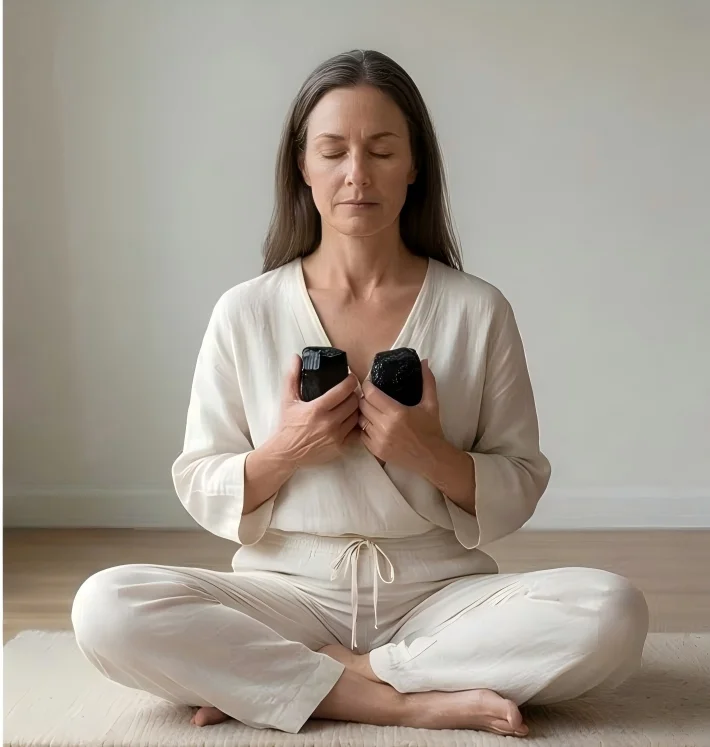
I’m Clara, a lapidary artist and somatic practitioner based in Santa Fe, New Mexico. I’ve spent years physically cutting, shaping, and studying the structural anatomy of minerals. I know Schorl intimately—from its vertical striations to its dense, iron-rich core. But I don't just cut stones; I study how their physical weight interacts with human physiology. I created my corner of BlkTourm to offer a fully integrated perspective. Here, we break down the hard mineralogy of authentic Black Tourmaline, design 'wearable armor' using un-dyed raw material, and explore how holding that specific geological density provides immediate tactile feedback to pull you out of an anxiety spike. It's where earth science meets body awareness.