Material reading
Biophilic Brutalism: The Aesthetic of High-Contrast Mixed Metal Jewelry
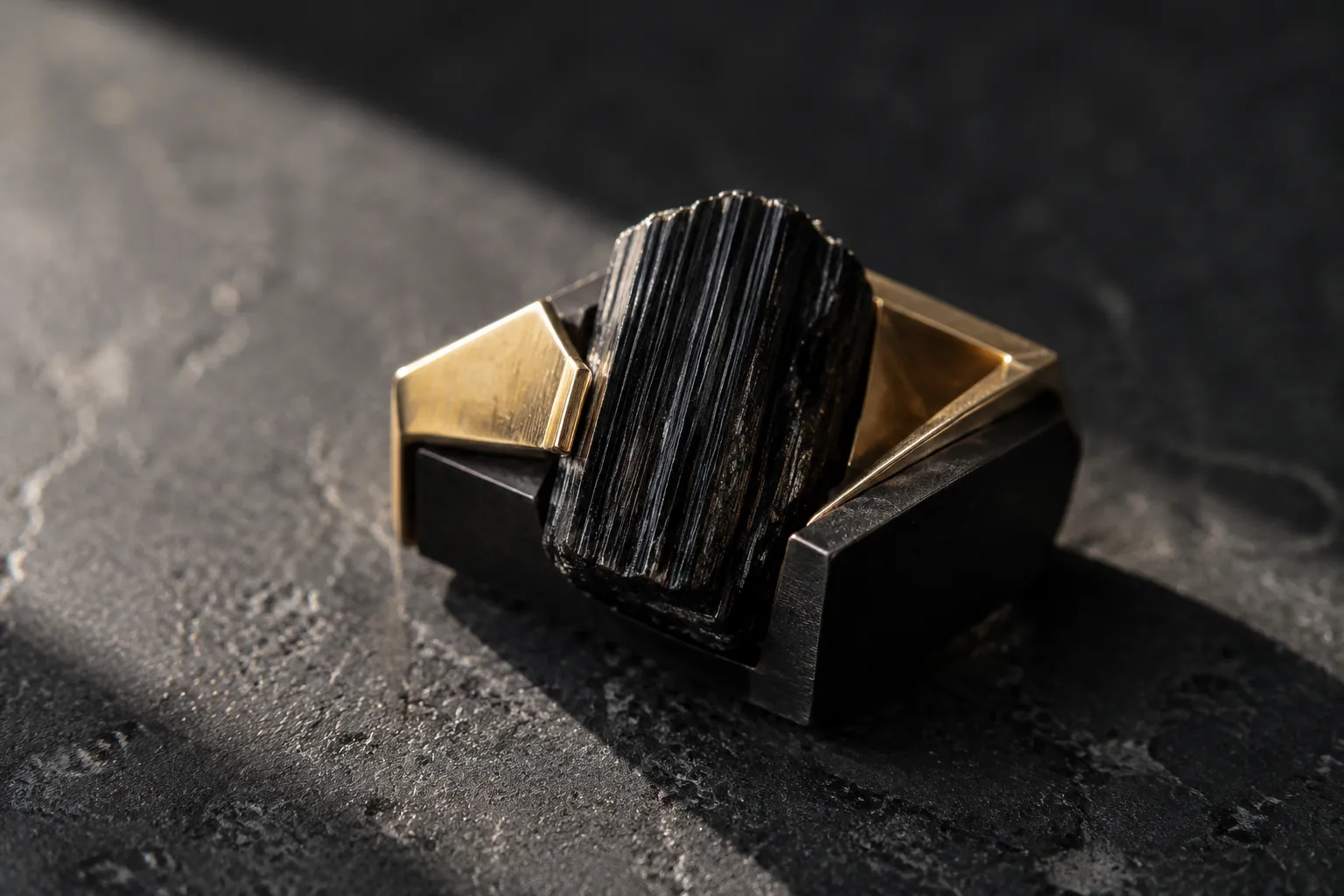
A raw black tourmaline crystal against warm gold does not read like delicate nature jewelry. It reads like stone forcing its way through structure. Biophilic brutalism jewelry uses that tension on purpose: high-contrast mixed metals, dark patina, raw minerals, angular forms, and organic surface cues make a piece feel both severe and alive.
The aesthetic works when the metal behaves like architecture and the mineral interrupts it like terrain. 18K gold may sit beside oxidized silver or blackened metal; rough tourmaline, bark texture, nugget-like surfaces, or asymmetric edges keep the piece from becoming purely industrial. The result is wearable sculpture, not a wellness promise, not a guarantee of material performance, and not simply “nature-inspired” decoration.
broader context
Start with the main black tourmaline page
This narrower page works best after the broader black tourmaline context page.
What makes mixed-metal jewelry feel biophilic brutalist?
Biophilic brutalism is a hybrid design phrase. Brutalism is associated with raw structure, exposed material, mass, and geometric force. Biophilic design language points toward natural materials, organic cues, texture, light, and living systems. When the idea is brought down to jewelry scale, it becomes less about buildings and more about how a small object holds contrast.
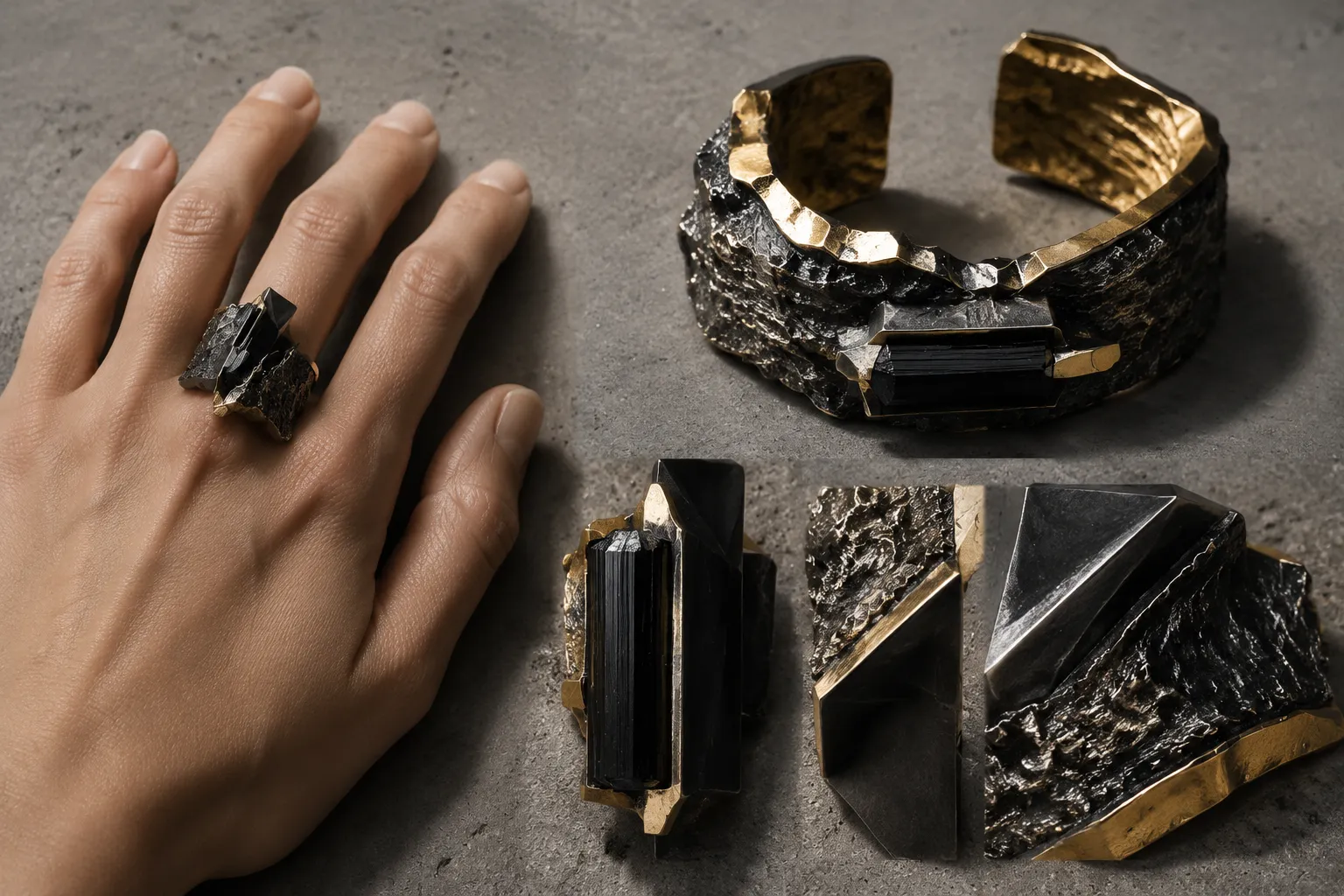
The brutalist side shows up as weight, sharp silhouettes, visible construction, rough metal surfaces, blocky settings, angular forms, and darkened finishes. A ring may look like a fragment of metalwork rather than a polished ornament. A cuff may use heavy planes, cutouts, ridges, or abrupt joins. A pendant may hang like a small architectural shard.
The biophilic side appears through raw minerals, asymmetry, striated surfaces, bark-like finish, nugget texture, stone-like irregularity, and forms that suggest strata, roots, cliffs, seed pods, or weathered surfaces without turning literal. This is where raw black tourmaline jewelry fits naturally: schorl, the black tourmaline variety, can bring dark mineral presence and visible crystal habit into the composition.
Mixed metal contrast sharpens the whole reading. Warm 18K gold can make blackened metal look deeper. Oxidized surfaces can make gold look warmer. Cool white metal beside a dark stone can feel more industrial, while gold beside a raw mineral can feel more elemental. In this aesthetic, contrast is not only color; it is temperature, finish, texture, and shape.
A useful test is simple: if the piece feels like a small collision between structure and terrain, it is moving toward biophilic brutalism. If it only has a leaf motif or a polished gemstone in a conventional setting, it may be nature-themed, but it is speaking a different visual language.
The four tensions that create the look
1. Warm metal against dark mass
High contrast mixed metal jewelry often depends on value difference: light against dark, reflective against matte, warm against cool. In biophilic brutalism, that contrast is usually intensified by blackened metal, oxidized silver, dark raw minerals, or deep patina.
18K gold is especially effective because it reads as warm and luminous. Set beside blackened metal, it can feel less decorative and more structural, like light catching the edge of a dark wall. The gold does not need to dominate. A small ridge, bezel, rivet, prong, or fractured plane can be enough to create tension.
This is different from ordinary two-tone jewelry, where the goal is often polish and balance. In brutalist mixed metal jewelry, contrast can be deliberately uneven. The blackened area may feel rougher. The gold may appear embedded, interrupted, or partly swallowed by the darker form. The point is not smooth harmony; it is controlled friction.
2. Raw minerals against worked metal
Raw minerals bring irregularity that metal cannot fully imitate. A cut and polished stone can be beautiful, but a rough mineral surface has a different role: it interrupts the designed object with geological texture.
Black tourmaline is visually useful here because dark color, striated habit, and prismatic form can read as severe without feeling synthetic. Gemological sources are the stronger place to ground tourmaline as a gemstone material; commercial crystal language often mixes mineral vocabulary with belief-based claims, so it should not carry factual weight here.
For this jewelry aesthetic, the cleaner statement is visual: raw black tourmaline contributes dark, uneven, mineral texture. It can make an industrial geometric jewelry form feel less manufactured and more connected to stone, fracture, and surface.
Other raw minerals can work in the same design language when they create tactile contrast. The key is not simply “rough stone.” It is the relationship between roughness and construction: a mineral lodged in a rigid frame, a crystal crossing a clean metal line, or an irregular edge pushing against a sharp geometric setting.
3. Industrial geometry against organic irregularity
Angular forms in jewelry create the brutalist skeleton. Squares, slabs, spears, wedges, broken rectangles, heavy bezels, and asymmetric blocks all help a small object borrow from architectural mass. A sculptural brutalist jewelry piece does not have to be huge, but it often feels spatial: it has planes, voids, shadows, and edges.
Nature integration changes the reading of those planes. Instead of a perfectly machined object, the piece may include softened erosion, bark texture, mineral ridges, lava-like cavities, or a surface that looks cast, hammered, carved, or weathered. Jewelry terminology around brutalist work often includes textured finishes, geometric forms, bark-like effects, and nugget-like surfaces. Used carefully, that vocabulary helps name what the eye is seeing without turning one piece into a broad historical claim.
The strongest examples avoid both extremes. If the form is too smooth, it becomes minimalist industrial jewelry. If it is all roughness with no structure, it becomes raw mineral jewelry without the brutalist tension. Biophilic brutalism sits between those poles: nature meets structure, but neither side disappears.
4. Sculptural volume against body scale
Wearable sculpture still has to negotiate the body. A cuff, collar, statement ring, chain, or spear pendant can look architectural in a photograph, but jewelry is worn on skin, fingers, wrists, ears, or necklines. Public source material for this exact niche is limited on long-term comfort, stone security, finish behavior, and everyday wear, so broad performance claims should stay out of the answer.
A better way to discuss the aesthetic is by observable form. A ring may use a raised mineral cluster and heavy shank to create mass. A pendant may place a raw black tourmaline spear against a blackened backplate with a small 18K gold accent. A cuff may use oxidized recesses, polished high points, and bark texture to create a terrain-like surface.
Those are design readings. Durability, comfort, and wearability depend on the specific setting, alloy, construction, finish, stone condition, and wearer.
When is it brutalist, and when is it biophilic brutalist?
Not every brutalist piece with a dark finish is biophilic. Not every nature-integrated jewelry design is brutalist. The overlap depends on whether both systems are visible at once.
A piece leans brutalist when it emphasizes mass, rawness, exposed structure, industrial geometry, and material-forward surfaces. It may use rough casting, heavy silver, blackened recesses, abrupt angles, and an almost architectural silhouette.
A piece leans biophilic when it brings in natural cues through mineral texture, asymmetry, wood-like or bark-like finish, strata lines, organic contours, or references to growth and erosion. It does not need leaves, flowers, or vines. In this aesthetic, the natural reference often works better when it is less literal.
A piece becomes biophilic brutalist when the two readings depend on each other. The metal frame feels severe because the mineral is raw. The mineral feels more alive because the surrounding geometry is rigid. The gold feels warmer because it is set against blackened metal. The dark patina feels less flat because the surface carries texture.
This is why organic mixed metal jewelry can be close to the look, but not always identical. Organic mixed-metal work may be soft, flowing, and decorative. Biophilic brutalism is usually harder-edged. It keeps the mineral world in view, but it does not soften the whole object into prettiness.
Common confusion around black tourmaline, metals, and meaning
The biggest misunderstanding is to treat the phrase as a gemstone effect or spiritual result. Black tourmaline is often marketed with belief-based language around energy, cleansing, or emotional influence. That language is common in the market, but it should not be treated as evidence for what the jewelry does.
For this aesthetic question, black tourmaline matters because of material appearance: dark color, raw mineral presence, striated texture, and strong contrast with gold, silver, or blackened metal. Schorl before symbolism. The stone can support a grounded visual mood without requiring claims about health, energy, or personal transformation.
Another confusion is assuming that mixed metal is automatically suitable for every wearer. Nickel can trigger allergic skin reactions in some people, and mixed-metal pieces may involve alloys, plating, solder, base metals, or surface treatments that are not obvious from appearance alone. Readers with known metal sensitivity should check alloy details, nickel content, plating, and maker disclosures before wearing a piece. That is an alloy-awareness point, not a diagnosis and not a promise that any material will suit every person.
A third confusion is authenticity by quick consumer tests. Scratch testing raw tourmaline or finished jewelry is a poor idea because it can damage stones, patina, plating, and settings. Visual style is not material verification. A piece can look raw, black, and mineral-like without giving enough information to confirm exactly what the stone is. For higher-stakes purchases, documentation and a qualified gemological assessment matter more than surface impressions.
A compact checklist for recognizing the aesthetic
Use this as a style-reading checklist, not as a buying guarantee:
- High contrast: warm 18K gold, yellow metal, or polished highlights set against blackened, oxidized, or cool-toned metal.
- Raw mineral presence: rough stone, dark crystal, striations, fractured edges, or an unpolished surface that reads as geological.
- Industrial geometric structure: slabs, wedges, heavy bezels, angular silhouettes, exposed joins, or architectural planes.
- Nature-integrated texture: bark finish, nugget-like texture, strata lines, asymmetry, or erosion-like surfaces.
- Sculptural mass: the piece feels spatial and object-like, closer to wearable sculpture than a flat ornament.
- Separate proof point: comfort, alloy composition, stone identity, durability, value, and provenance need information beyond the style itself.
If most of the first five are present, the piece can reasonably be described as biophilic brutalism in jewelry terms. The aesthetic can be read from the surface; performance and material certainty cannot.
The evidence limit matters here
The available public material supports a style explanation more strongly than a construction guide. Design sources can frame brutalism as raw, structural, geometric, and material-forward. Biophilic design sources can support the idea of natural cues and nature connection in built environments, but those ideas should stay aesthetic when applied to jewelry. Gemological references can keep tourmaline grounded as a gemstone material. Jewelry terminology sources can help name bark, nugget, textured, and geometric finishes.
What the source pool does not strongly support is broad certainty about comfort, everyday durability, tarnish resistance, stone security, skin compatibility, pricing, rarity, or historical attribution for every piece using this look. Marketplace listings and social images are useful for seeing how people describe the style—organic mixed metal, sculptural, two-tone, raw black tourmaline, statement ring—but they are not independent verification.
So the clean answer stays visual and material: biophilic brutalism jewelry uses severe structure and organic interruption together. Blackened metal, oxidized surfaces, 18K gold, raw minerals, angular forms, and nature-integrated texture create the charge. The piece feels alive because the mineral refuses perfect geometry; it feels brutalist because the metal refuses softness.