Black Tourmaline & Lepidolite: Calming Neural Storms
A Black Tourmaline Lepidolite pairing works best as a symbolic boundary-and-softening practice. Black tourmaline gives the ritual a dense, grounding focal point; lepidolite brings a lighter visual and tactile cue for easing the pace. That is the useful answer. The limit belongs in the same breath: this pairing is not evidence-based anxiety care, and lepidolite's lithium-bearing mineral identity does not mean it acts like lithium medication or changes brain chemistry.
Used with that boundary, black tourmaline and lepidolite can support a personal routine for overwhelm, external stress, and an overactive mind. The stones give attention somewhere concrete to land. They do not guarantee a calmer nervous system.
broader context
Black tourmaline context note
This narrower page works best after the broader black tourmaline context page.
What the Pairing Means in Plain Terms
In crystal culture, black tourmaline is often given the role of boundary, weight, and protection. Readers may describe it as an "energy firewall," especially when they feel too porous around other people's stress or a busy room. Here, that phrase is most useful as metaphor: an energy firewall meaning is a chosen boundary image, not a proven force field.
Lepidolite usually carries the softer half of the pairing. It is commonly described in crystal language as calming or settling, especially when the mind feels too fast. Mineral references identify lepidolite as a lithium-bearing mica, which explains why lithium language often gathers around the stone. That mineral fact does not support claims that holding, wearing, or placing lepidolite works like a prescribed lithium product.
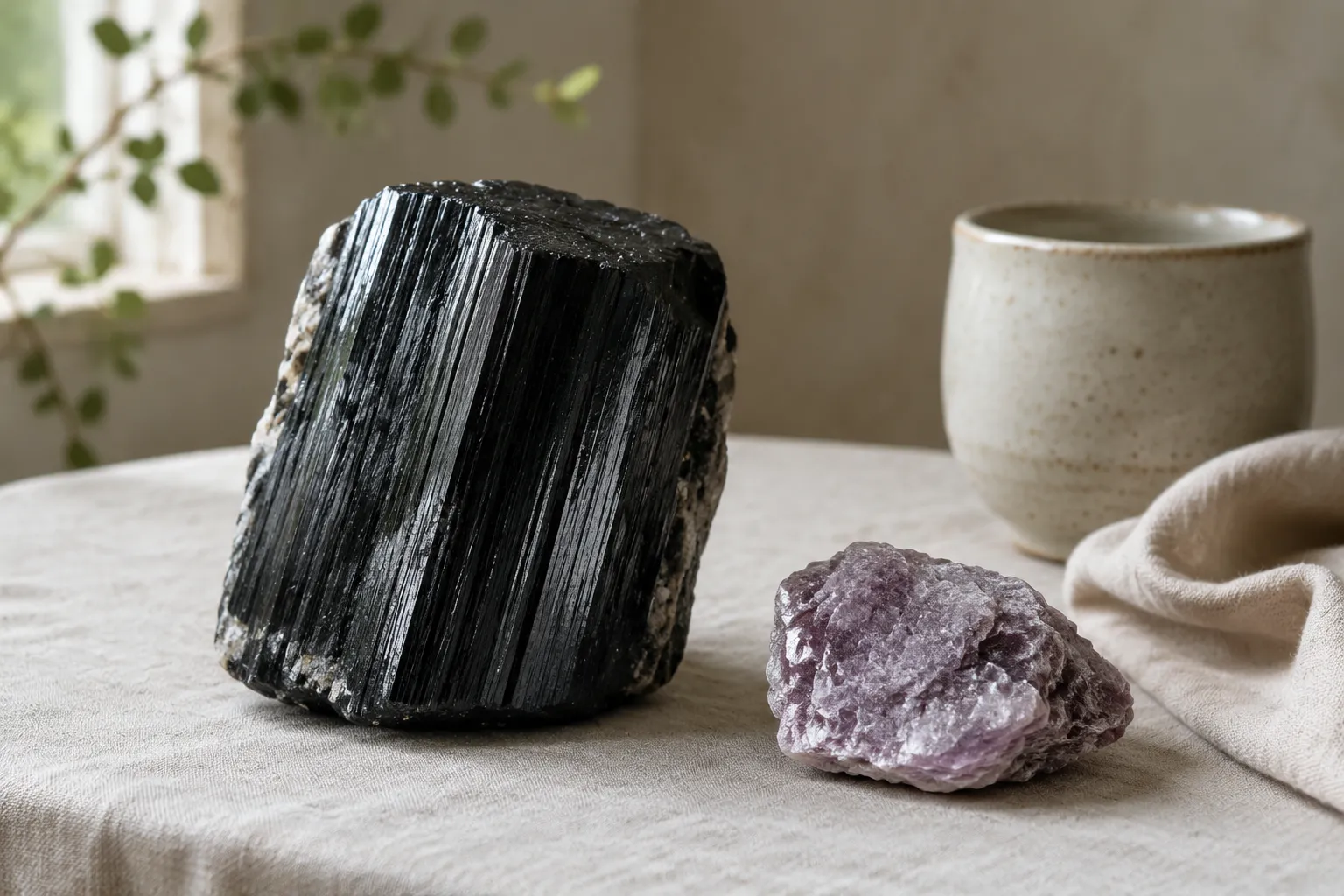
Together, the Black Tourmaline Lepidolite pairing becomes culturally legible as "firm edge plus soft landing." Black tourmaline, commonly represented by schorl, gives the hand a dark, striated, substantial object to return to. Lepidolite offers a lighter mica surface, often in lavender, pink, or purple tones. For a reader looking for a crystal pairing for overwhelm, that contrast is the practical value: it organizes intention.
The title phrase "calming neural storms" should be read in that same symbolic register. It names the felt experience of mental noise, not a neurological claim.
Why These Two Stones Are Often Placed Together
There is a mineral reason the pairing feels less random than some crystal combinations. Black tourmaline is commonly grounded in schorl, a tourmaline-group mineral. Lepidolite belongs to the mica group and is known as a lithium-bearing mica. Geology sources describe lepidolite in granite-pegmatite settings, and tourmaline can appear in related mineral contexts.
That does not mean every black tourmaline specimen and every lepidolite specimen formed together, or that the stones need to be "geologically matched" to have personal meaning. It means the lepidolite and tourmaline association has a real-world mineral context, not only a social-media pairing logic. A GIA inclusion case supports a narrow gemological point as well: lepidolite can be identified in association with tourmaline material through specialist methods. That is evidence for mineral identification and association, not for emotional effect.
For use at home, the pegmatite mineral context matters mainly as a grounding fact. It keeps the pairing attached to real minerals before symbolic meaning is added. Schorl before symbolism; mica before mood language.
The better ritual reason to use them together is simple. Black tourmaline can stand for "I am allowed to have an edge." Lepidolite can stand for "I can soften inside that edge." The pairing feels coherent when the reader wants both protection language and decompression, not when they expect the stones to do clinical work.
A Bounded Ritual for Overwhelm
A calming crystal ritual with these stones should stay simple, sensory, and non-medical. The stones are props for attention and intention setting. They are not substitutes for care, medication, therapy, emergency support, or diagnosis.
Start with black tourmaline
Place black tourmaline first. Notice its surface, weight, vertical striations, and dark mass. If the specimen is rough schorl, let the texture do some of the work: it gives the hand and eye a specific object to register. In symbolic terms, this is the boundary step. You might set an intention such as, "I am naming what is mine to carry and what is not."
Then bring in lepidolite
Then bring in lepidolite as the softer counterpoint. Its mica structure, color, and gentler visual presence can mark the shift from boundary to settling. A cleaner intention would be, "I am giving my attention one slower place to return." That wording matters because it does not ask the stone to fix anxiety or change the body. It asks the ritual to organize attention.
For a desk, place black tourmaline closer to the outer edge of the work zone and lepidolite nearer the notebook, lamp, or resting hand. In a bedroom or quiet corner, keep the pair visible but not visually loud. The point is not to build a dramatic protective grid. The point is to create a small cue that says: pause, sort, soften.
Wearing the stones together, or keeping them in the same tray, can be approached the same way. Bracelet stacking and pocket stones appear often in market language, but the practical principle is modest: if the combination helps you remember a boundary and a slower breath, it can be a meaningful personal object. That is enough.
What Changes the Answer
Everyday overwhelm
The pairing makes the most sense for everyday overwhelm, social residue, work noise, or a feeling of being too available to external stress. In those cases, a protective-feeling crystal pairing can be a personal ritual object, provided the claims stay realistic and the stones are not used to avoid needed support.
Severe or persistent distress
The answer changes when the situation moves into severe anxiety, panic, persistent distress, intrusive fear, dangerous thoughts, or symptoms that interfere with sleep, work, relationships, or basic safety. Government mental-health sources describe anxiety disorders as more than ordinary stress when fear or worry becomes persistent, intense, or impairing. In that territory, crystals should not be treated as the main response. Qualified mental-health support is the relevant next step.
Lithium language
The answer also changes if the reader is drawn to lepidolite mainly because of its lithium properties. Lepidolite is lithium-bearing as a mineral fact. That does not make it a passive dose, a mood tool, or a biochemical intervention. The lithium in a mineral specimen is not the same as a prescribed substance, and the presence of lithium in the mineral name should not be used to make health promises.
Fear-based compatibility claims
A third condition is fear-based compatibility language. Some crystal pages warn that stones can clash, create energetic static, or become too much together. For this pairing, the available material does not establish that black tourmaline and lepidolite are incompatible or magically corrective. If the pair feels too symbolically heavy, use one stone at a time. That is a preference adjustment, not a rule of mineral behavior.

Common Confusions Around Black Tourmaline and Lepidolite
Treating "energy firewall" as literal protection
In reader language, the phrase points to a felt boundary: less reactivity, less emotional spillover, more permission to pause. It should not be framed as black tourmaline absorbing harm, removing danger, or controlling other people's energy.
Turning lepidolite into a lithium shortcut
Lepidolite's lithium-bearing mica identity is a mineralogical description. It is useful for understanding why the stone appears in pegmatite and lithium-mineral discussions; it is not evidence for medicinal action through touch, jewelry, placement, or meditation.
Using anxiety language too loosely
Many readers say "anxiety" when they mean ordinary stress, anticipatory tension, sensory overload, or a crowded mind. The wording matters because anxiety can also describe serious, persistent, or escalating conditions. A crystal routine may sit beside journaling, breathing, music, a quiet room, or other self-care habits, but it should not be used as the deciding tool for mental-health care.
Assuming mineral facts prove energetic claims
Mindat-style mineral identity, GIA gemological identification, and educational geology sources can say what the materials are and where associations may occur. They do not verify that the Black Tourmaline Lepidolite pairing produces calm, shields a room, or changes emotional outcomes.
A Sensible Way to Use the Pair
Use the pairing when you want a physical reminder of two choices: establish a boundary, then reduce inner pressure. Keep the ritual short enough that it does not become another task to manage.
A practical sequence can be as simple as this:
- Hold or place black tourmaline and name the boundary you are practicing.
- Hold or place lepidolite and name the pace you want to return to.
- Add one ordinary settling action, such as slower breathing, writing one clear next step, dimming a light, or stepping away from a noisy input.
- Stop before the ritual becomes a test of whether the stones produced a result.
That last point is important. If the pairing becomes a scoreboard for anxiety, it can quietly add pressure. The better use is environmental and symbolic: texture on a desk, weight in the hand, color near a journal, a small object that marks the transition out of mental noise.
For interiors, black tourmaline tends to read as dark, architectural, and grounding. Lepidolite reads softer, more reflective, and more intimate. Together they can sit well in a biophilic interior where minerals are chosen for texture, mass, light, and personal meaning. The stones do not need a dramatic display; a low tray, shelf edge, or writing surface is enough.
The Bottom Line
Black Tourmaline Lepidolite is a coherent symbolic pairing when the reader wants boundary plus calm: black tourmaline as schorl, weight, and edge; lepidolite as lithium-bearing mica, softness, and a cue to slow the pace. The mineral facts support what the stones are and why they may be discussed together in real mineral contexts.
They do not prove anxiety outcomes, protection, mood stabilization, or lithium-like effects. Used with that boundary in place, the pairing can be a grounded intention practice for overwhelm: material in the hand, meaning kept modest, and care sought from the right place when distress is severe or persistent.