Energetic Filtration
Why “Shielding” Fails Empaths: The Shift to Energetic Filtration
Rigid shielding often fails empaths because it asks sensitivity to become a wall. For many sensitive people, that wall has to be constantly held in place: visualized, reinforced, defended, and checked. In crowded rooms, tense conversations, or emotionally charged spaces, that effort can start to feel brittle or draining.
Energetic Filtration offers a different model. Instead of trying to block everything, it treats the empath boundary as a responsive practice: notice what is present, sense what may be yours, let some information pass without taking it on, and choose the amount of contact that fits the moment. It is best understood as a reflective spiritual boundary framework, not as a neurological explanation or a guaranteed protection method.

broader context
Black tourmaline context note
This narrower page works best after the broader black tourmaline context page.
Why Shielding Can Feel Brittle
The common shielding image is easy to understand: imagine a bubble, wall, mirror, cloak, or hard edge around the body. For some readers, that image can be useful as a quick reminder that they have a boundary. The limitation appears when the image becomes the entire strategy.
A rigid energetic shield assumes the problem is contact itself. If the room feels intense, the shield must become stronger. If another person is upset, the shield must become thicker. If the empath still feels overwhelmed, the shield is treated as weak, broken, or poorly visualized.
That creates pressure. The sensitive person has to keep “performing protection” while also listening, working, parenting, commuting, or trying to stay present.
Checking loop
- “Is my shield up?”
- “Did something get through?”
- “Am I absorbing this?”
- “Did I fail to protect myself?”
For someone who already notices tone, posture, mood shifts, and emotional charge quickly, that extra checking can feel like more input, not less.
The deeper issue is that sensitivity is not only about “bad energy.” It can include attention, empathy, memory, body tension, social pattern recognition, personal history, and the ordinary fact that people respond to one another. Social neuroscience can support a careful point: empathy has embodied and relational dimensions. It does not confirm that empaths literally absorb another person’s energy.
Rigid shielding tries to solve intensity by sealing the person off. Energetic filtration starts with a different question: not “How do I block everything?” but “What am I noticing, what belongs to me, and what level of contact is wise right now?”
What Energetic Filtration Changes
Energetic filtration is a discernment-based empath boundary practice. It does not ask the reader to stop feeling. It asks the reader to sort contact more clearly.
In a shielding model, the boundary is imagined as a barrier. In a filtration model, the boundary is more like a living threshold. Some signals matter. Some are not yours to carry. Some can be acknowledged without being acted on. Some call for distance, a shorter conversation, a different seat, a pause before replying, or a return to the body.
Rigid Shielding
- “Keep everything out.”
- “If I feel it, my shield failed.”
- “Protection must stay strong.”
- “Other people’s states are dangerous.”
- “I need a perfect visualization.”
Energetic Filtration
- “Notice what is present without taking all of it in.”
- “Feeling something is information, not automatic responsibility.”
- “The boundary can adjust to the moment.”
- “Other people’s states may be real, but they are not automatically mine.”
- “I need a clearer relationship to sensation, attention, and choice.”
This shift helps with common energy absorption misconceptions. A sensitive reader may walk into a tense meeting and feel the jaw tighten, breath shorten, or stomach drop. In energy language, they may describe that as picking up the room. In body language, they may be noticing stress cues and responding internally.
Either way, the useful move is not to argue with the experience. The useful move is to separate observation from ownership.
Filtration language
- “I can sense tension here without becoming the tension.”
- “This feeling is present in my body, but I do not yet know whether it is mine.”
- “I can listen without solving.”
- “I can step back without making the other person wrong.”
- “I can return to my own pace before I respond.”
That is why filtration often feels less brittle than shielding. It does not collapse the moment something is felt. It expects contact. The practice is not “nothing gets through.” The practice is “what comes through is met with discernment.”
The Role of Somatic Grounding
Energetic filtration becomes more practical when it includes somatic grounding. Here, grounding means orienting attention toward the body, the senses, and the present environment. It is not a promise of emotional control. It is a way to give the boundary a real-world anchor.
A purely mental shield can float above the actual moment. A grounded energetic boundary asks the body to participate. The reader may notice the feet, the weight of the hands, the texture of a chair, the temperature of the room, or the distance between the body and another person.
These somatic grounding cues matter because the body often registers surroundings before the mind has finished explaining them.
Present moment grounding can also slow the jump from sensation to story. Without it, a sensitive person may move quickly from “I feel tightness” to “I absorbed their energy” to “I failed.” With grounding, there is a pause.
A small filtration sequence
- Pause before reacting.
- Locate the sensation in the body.
- Notice the room: light, sound, temperature, floor, space.
- Ask, “Is this mine, theirs, shared, or unclear?”
- Choose one next action: soften, speak, step away, let it pass, or return attention to the task.
This is not a worksheet or a care plan. It is a reflective spiritual boundary practice with a body-based anchor. Public health resources on mindfulness support modest, optional framing for contemplative practices; they do not support turning energetic filtration into a health-outcome claim or a substitute for qualified support when distress is intense or disrupting daily life.
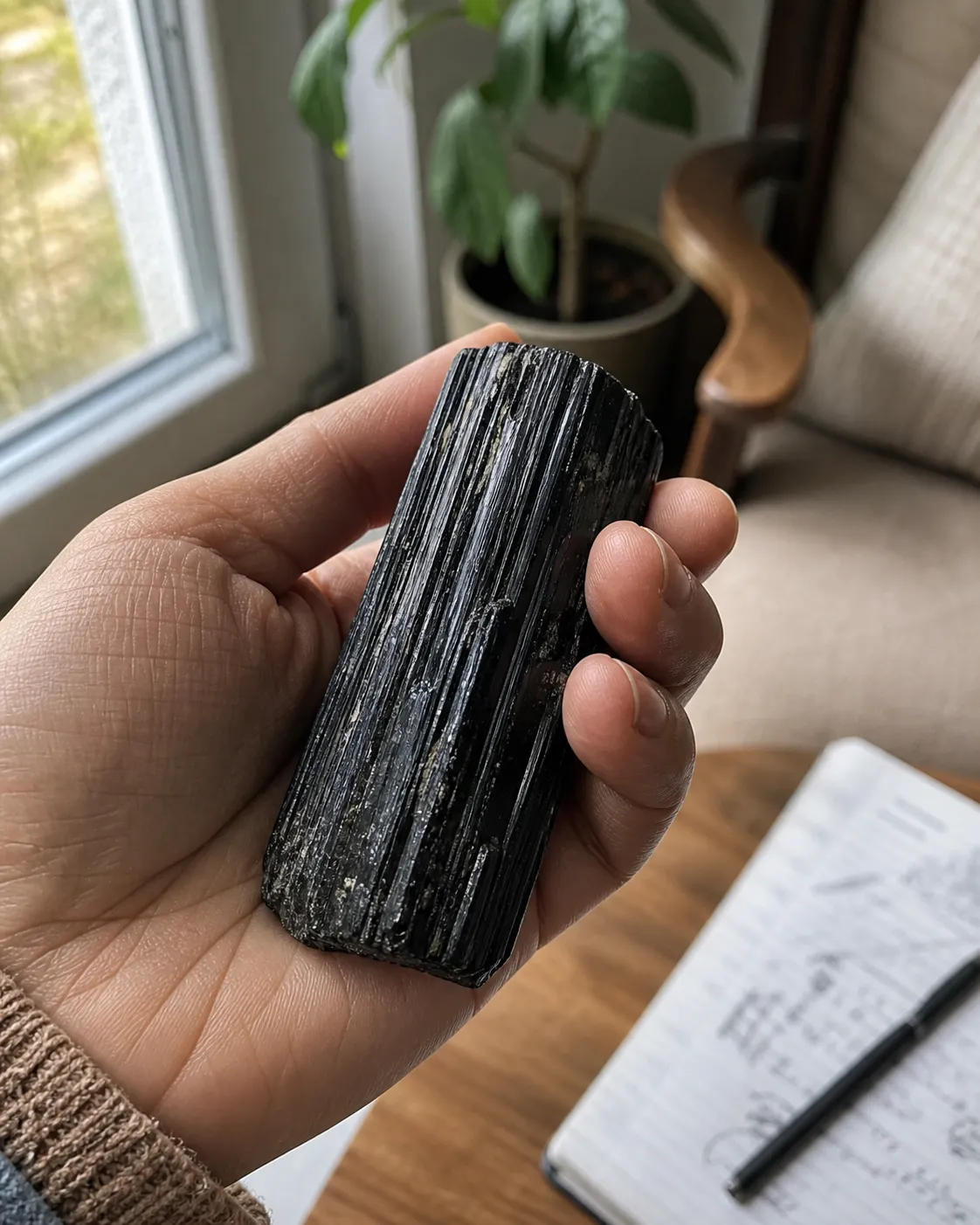
In the context of black tourmaline, this distinction matters. A stone can be used as a tactile grounding object, a placement reminder, or a symbolic boundary marker. Holding a dense, striated piece of schorl may help some readers remember weight, texture, and breath. But the object should not be framed as evidence of energetic protection. In this article’s frame, its value is practical and symbolic: it can cue the boundary, not replace discernment.
When Shielding Still Has a Place
Energetic shielding is not useless. It can be helpful as a temporary image when a reader needs a quick sense of separation. Before a difficult conversation, a crowded transit station, or a high-stimulation event, a simple boundary image may help organize attention.
The problem begins when shielding becomes the only available response.
A hard shield is poorly suited to situations that require nuance: caring without merging, listening without rescuing, staying open without becoming porous, or noticing tension without making it a personal assignment.
Shielding may also be less useful when the reader is already braced. If the shoulders are high, the breath is shallow, and attention is scanning for threat, adding a stronger wall image can increase the feeling of effort.
Filtration asks for less force: soften the jaw, feel the ground, notice the other person’s mood without naming it as yours, and let the next response be smaller.
There are exceptions. Some moments call for distance rather than filtration. If a setting is unsafe, manipulative, persistently overwhelming, or beyond the reader’s capacity, the most grounded boundary may be leaving, ending the exchange, seeking support, or changing the conditions. Energetic filtration should not become a spiritualized reason to tolerate harmful dynamics. A responsive boundary includes the right to reduce contact.
Common Confusions About Mirror Neurons and Empaths
Mirror neurons are often pulled into empath conversations as if they explain energy absorption. That is too much weight for the evidence to carry.
The available research can support a careful statement: human empathy has social and embodied dimensions. People respond to faces, voices, gestures, rhythms, and emotional cues. A sensitive reader may experience those cues vividly.
But the leap from “humans resonate with one another” to “my body is carrying their energy as an established mechanism” is not supported by the sources available for this page.
That distinction protects the practice from science-washing. Energetic filtration does not need to pretend to be neuroscience. It can remain what it is: a spiritually literate way to work with attention, sensation, symbolic boundary language, and choice.
The same caution applies to grounding. Grounding language can help readers describe present-moment orientation: body, senses, surroundings, breath, sound, weight, and contact with place. But grounding should not be inflated into a universal answer for distress. If a reader experiences recurring, intense, dissociative, unsafe, or life-disrupting distress, the responsible next step is support from a qualified professional, not a stronger visualization.
A More Responsive Boundary Model
The reason shielding fails many empaths is not that they are doing it wrong. It is that total blockage is a fragile goal for a person whose sensitivity is already relational.
Life includes contact. Rooms have moods. People carry stress in their voices and posture. The body notices more than the mind can sort immediately.
Energetic filtration works better as a framework because it does not punish the reader for noticing. It gives the noticing somewhere to go.
Four grounding questions
- What am I sensing in my body?
- What in the environment may be influencing that sensation?
- What part of this is actually mine to respond to?
- What amount of contact is appropriate now?
These questions keep the practice close to reality. They do not require a reader to deny sensitivity, and they do not ask the reader to justify it through borrowed neuroscience. They also avoid the fear-based edge that sometimes enters shielding for empaths: the idea that the world is constantly invading and the sensitive person must remain sealed.
Filtration is quieter. It says: stay in contact with yourself first. Let the body register the room without surrendering authority to the room. Let empathy inform you without assigning you every emotion nearby. Let symbolic tools, breath, stones, space, or touchpoints remind you of the boundary, but keep the final choice in discernment.
That is the useful shift. Shielding imagines safety as a wall that must not crack. Energetic filtration imagines boundary as an ongoing relationship between awareness, body, environment, and response. For sensitive readers, that difference can make the practice feel less like defense and more like grounded participation in the present moment.
FAQ
Is energetic filtration the same as shielding?
No. Shielding usually imagines a barrier around the person. Energetic filtration focuses on sorting what is noticed, what is yours to carry, and what response fits the moment.
Does energetic filtration mean I should stay open to everyone?
No. A responsive boundary can include distance, silence, leaving, or ending contact. Filtration is not forced openness.
Can black tourmaline be part of energetic filtration?
It can be used as a tactile reminder or symbolic boundary object. The important point is not that the stone does the work for you, but that it helps cue attention back to body, choice, and discernment.
What if grounding does not feel like enough?
If distress feels intense, recurring, unsafe, dissociative, or disruptive to daily life, energetic practices should not be the only support. A qualified professional can help assess what kind of support is appropriate.