Boundary visualization practice
The Semi-Permeable Aura: How to Practice Membrane Visualization
Energetic Membrane Visualization is a personal boundary exercise: you imagine an aura-like layer around your body that works more like a semi-permeable membrane than a wall. It allows care, warmth, useful information, and genuine connection to reach you, while giving less immediate access to urgency, projection, over-responsibility, and emotional noise that is not yours to carry.
Use it as a reflective cue, not as a guaranteed energetic effect or clinical support. The value is practical and symbolic: it can help you pause, organize attention, and remember that openness does not have to mean absorption.

broader context
Broader schorl guide
This narrower page works best after the broader black tourmaline context page.
The basic practice
Start in a low-stakes moment. This is easier to learn when you are not already flooded, arguing, or trying to manage someone else’s distress.
Sit, stand, or lie down in a way that lets you feel support beneath you: the floor, chair, bed, or ground. Take a few ordinary breaths. You do not need to force calm. Let your attention arrive in the body: feet, legs, pelvis, spine, shoulders, jaw, hands.
If breath focus feels uncomfortable, use contact instead: the weight of your body, the texture of your clothing, or the temperature of the room.
Now imagine a membrane-like field around you. It may sit just beyond the skin, a few inches away, or about an arm’s length out. Keep it close enough that it feels like yours. It might look clear, smoky, pearly, dark, luminous, woven, liquid, mineral-like, or almost invisible. The exact image matters less than the function you give it.
“Let in what helps me stay present and connected. Slow down what pulls me into overwhelm, urgency, or responsibility that is not mine.”
Make the image semi-permeable. Instead of sealing yourself off, imagine tiny responsive openings, a soft mesh, or a living surface that can open and narrow. It does not need to fight anything. It simply helps you pause before taking something in.
Name what is welcome
- steady affection
- honest feedback
- warmth
- useful information
- beauty
- humor
- your own body signals
- connection that respects your pace
Name what does not get immediate entry
- other people’s panic
- pressure to fix everything
- emotional dumping without consent
- imagined obligations
- urgency that is not actually yours
- projection, blame, or performance demands
- the feeling that you must merge to prove you care
This is the center of the practice: choosing what to allow in and what to leave outside, in symbolic form. You are not proving that an aura membrane exists. You are rehearsing a boundary pattern.
Make it flexible, not rigid
A common mistake is turning boundary construction into a locked shield. That may feel useful for a moment, especially when you are exhausted, but the semi-permeable aura metaphor works because it avoids two extremes: total exposure and total shutdown.
If your membrane feels too hard, soften it. Give it texture rather than force. Try “responsive” instead of “impenetrable.” A responsive boundary can receive a friend’s concern without taking on their whole emotional state. It can hear a request without automatically saying yes. It can stay warm while still noticing limits.
If the image feels too vague, make it more concrete. Give it a color, edge, temperature, or sound. Imagine a fine mineral veil, a flexible skin of light, a woven net, or a smooth dark surface that does not automatically absorb what touches it.
If you use empath language, keep the aim modest. “Empath safety” here does not mean guaranteed protection from other people’s moods or behavior. It means a personal cue for remembering:
“I can care without absorbing. I can notice without becoming responsible. I can stay in contact with myself while I am in contact with others.”
Another useful phrase is:
“I am available for connection, not for over-identification.”
Let the membrane respond to that sentence. It may brighten, thicken, become more spacious, or simply become easier to sense.
Use it before real interactions
Once the image is familiar, try it before ordinary situations: opening your email, entering a busy store, answering a family message, joining a meeting, or visiting a place where you tend to become overly available.
Pause for ten to thirty seconds and ask:
-
What do I want to remain open to here?
Kindness, collaboration, accurate information, or the simple reality of the moment.
-
What do I not need to take into my body as mine?
Someone else’s impatience, disappointment, stress, or need for immediate reassurance.
-
What is one grounded action I can take if I feel too porous?
Slow your reply, put both feet on the floor, ask for time, leave the room, decline a request, or contact a trusted person.
This keeps the membrane-like aura exercise tied to behavior. It becomes less useful when it replaces action. It becomes more useful when it helps you notice the difference between feeling something and needing to carry it.
During the interaction, use the image lightly. You do not have to keep a detailed visual running in your mind. Touch the idea briefly:
“Membrane, not wall. Connection, not absorption.”
If the image helps, continue. If it distracts you, drop it and return to ordinary grounding.
Afterward, check what happened. Did you answer more slowly? Did you notice your own needs sooner? Did you stay warmer than you would with a hard boundary? Did you become flooded anyway? None of these outcomes makes you spiritually strong or weak. They simply tell you whether this reflective boundary practice was useful in that situation.
Close the visualization
Closing matters. Without a closing step, some people keep scanning themselves, wondering whether the membrane is still “working.” That can turn a grounding image into another form of vigilance.
To close, bring the membrane closer to the body until it feels settled and ordinary. You might imagine it resting at the surface of the skin, dissolving into the breath, or becoming a quiet inner boundary rather than a visible field.
“This practice is complete for now. I return to the room, my body, and the next practical step.”
Notice three physical details: one thing you see, one thing you feel through touch, and one sound. Move your hands, stretch your neck, drink water, or stand up. The point is to return from the visualization into the real environment.
If the practice makes you feel spaced out, unreal, numb, frightened, panicky, or more preoccupied, stop using it for now. Choose simpler grounding: feel your feet, name objects in the room, open your eyes, talk to someone trustworthy, or do a concrete task. A visualization should be optional and stoppable.
What this practice can and cannot claim
Energetic Membrane Visualization is strongest when used as a personal boundary visualization exercise. It can help you describe what you want to practice: selective openness, functional containment, and a more deliberate response to other people’s emotional intensity.
Functional containment does not mean suppressing emotion. It means holding your own center long enough to ask: What belongs to me? What needs care? What needs communication? What can be released?
The evidence boundary is simple. Publicly available material supports adjacent ideas more readily than it supports literal aura claims: imagery can be used reflectively, boundary language appears in relational and body-oriented practices, and spiritual traditions have long used aura vocabulary. That does not verify a literal semi-permeable aura or show that visualization can stop harm. In this article, aura language is practice language, not a factual mechanism.
Do not rely on this exercise when a situation calls for practical support: abuse, harassment, coercion, medical distress, severe panic, dissociation, or immediate danger. In those cases, external help matters: trusted people, appropriate professional support, direct safety planning, emergency resources when needed, and clear real-world boundaries.
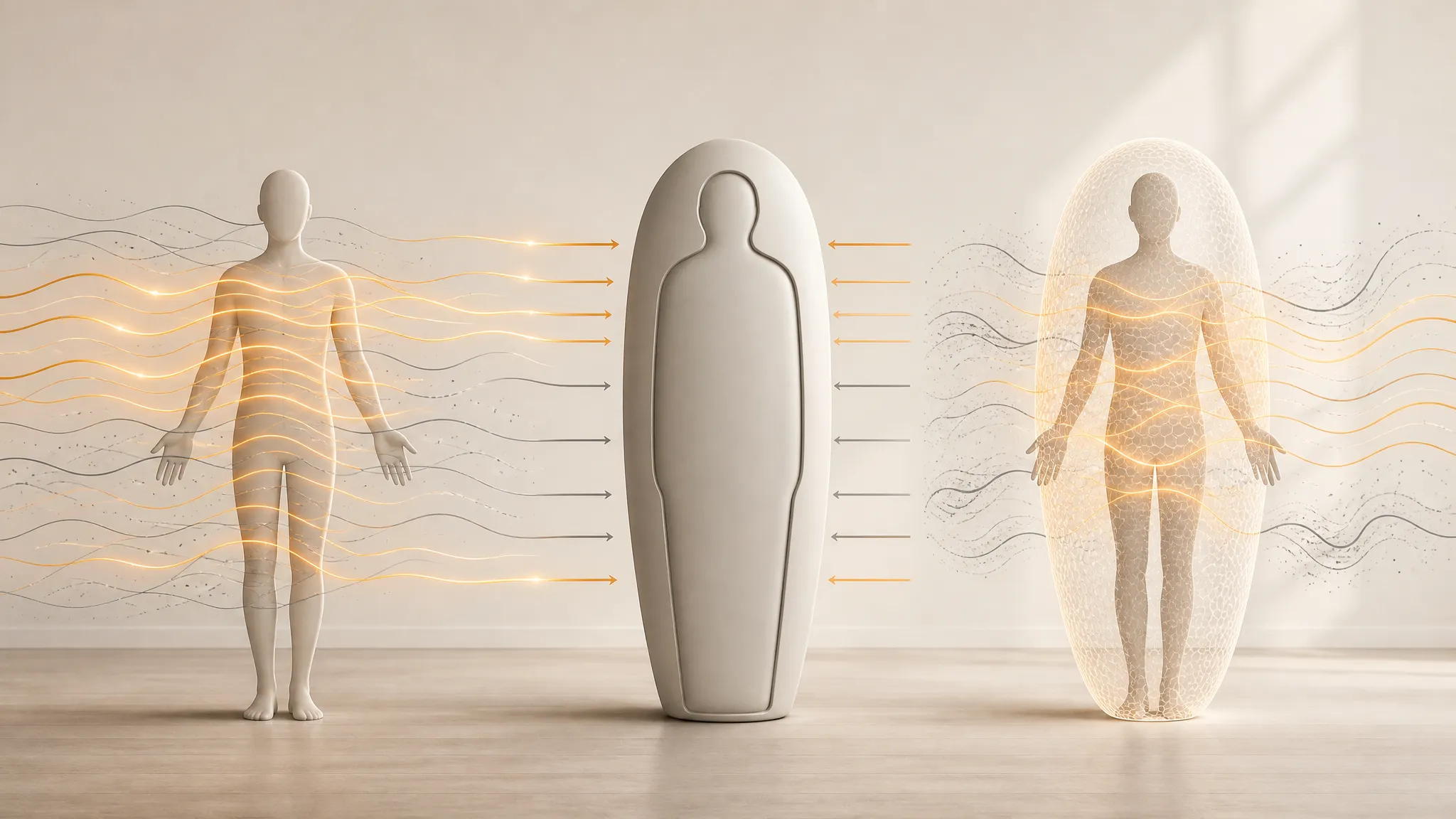
Membrane, shield, or shutdown?
Shield
A shield says, “Nothing gets in.” That may sound appealing when you are exhausted, but if it becomes the only model, it can train isolation or numbness.
Fully open field
A fully open field says, “Everything gets in.” That may feel compassionate, but it often leads to over-responsibility, emotional merging, or resentment.
Semi-permeable membrane
A semi-permeable membrane says, “Some things may enter; some things pause; some things are not mine to carry.”
That is why the metaphor works for a modest empath boundary exercise. It preserves care while giving you a way to practice discernment.
The membrane is also different from pretending not to be affected. If someone’s words hurt, if a room overwhelms you, or if a relationship repeatedly leaves you depleted, the goal is not to visualize harder. The goal is to notice accurately and choose the next grounded response. Sometimes that response is rest. Sometimes it is a conversation. Sometimes it is leaving. Sometimes it is getting help.
A short script
Use this as written, or change the words until they feel natural:
I feel the support beneath me.
I notice my breath, my hands, and the space around my body.
I imagine a soft, semi-permeable membrane around me.
It is not a wall. It is not a performance.
It allows warmth, truth, care, and useful information to reach me.
It slows urgency, projection, pressure, and responsibility that is not mine.
I can care without absorbing.
I can listen without merging.
I can choose what I allow in and what I leave outside.
This boundary can soften, strengthen, open, or narrow as needed.
For now, it helps me stay connected to myself.
When I am ready, I let the image settle and return to the room.
The best version is not the most mystical one. It is the one that helps you pause, stay embodied, and act with clearer limits.
When to skip it
Skip or simplify the practice if you are using it to avoid a necessary conversation, remain in an unsafe situation, override your body’s warning signals, or judge yourself for being affected by others. Also skip it if the image becomes obsessive, frightening, or too difficult to close.
A semi-permeable aura visualization is most useful when it stays humble: a symbolic boundary, a pacing tool, and a reminder that sensitivity does not require total exposure. Open enough for life to reach you; contained enough that not everything gets to move in.