Energetic pacing
Energetic Pacing: Managing Nervous System Responses to New Crystals
If a new crystal leaves you anxious, wired, heavy, restless, or physically unsettled, do not force longer contact just to “adjust” to it. Treat the experience as a cue to slow down.
A nervous system crystal response is best understood here as reader language for a felt pattern: you introduced a meaningful object, noticed body sensations, and want a calmer way to relate to it. Start with short exposure windows, keep the stone off your body at first, avoid sleeping with it until you feel steady, and track what else was happening around the same time. Your sensations deserve attention; the crystal does not need to be treated as the confirmed physical cause.
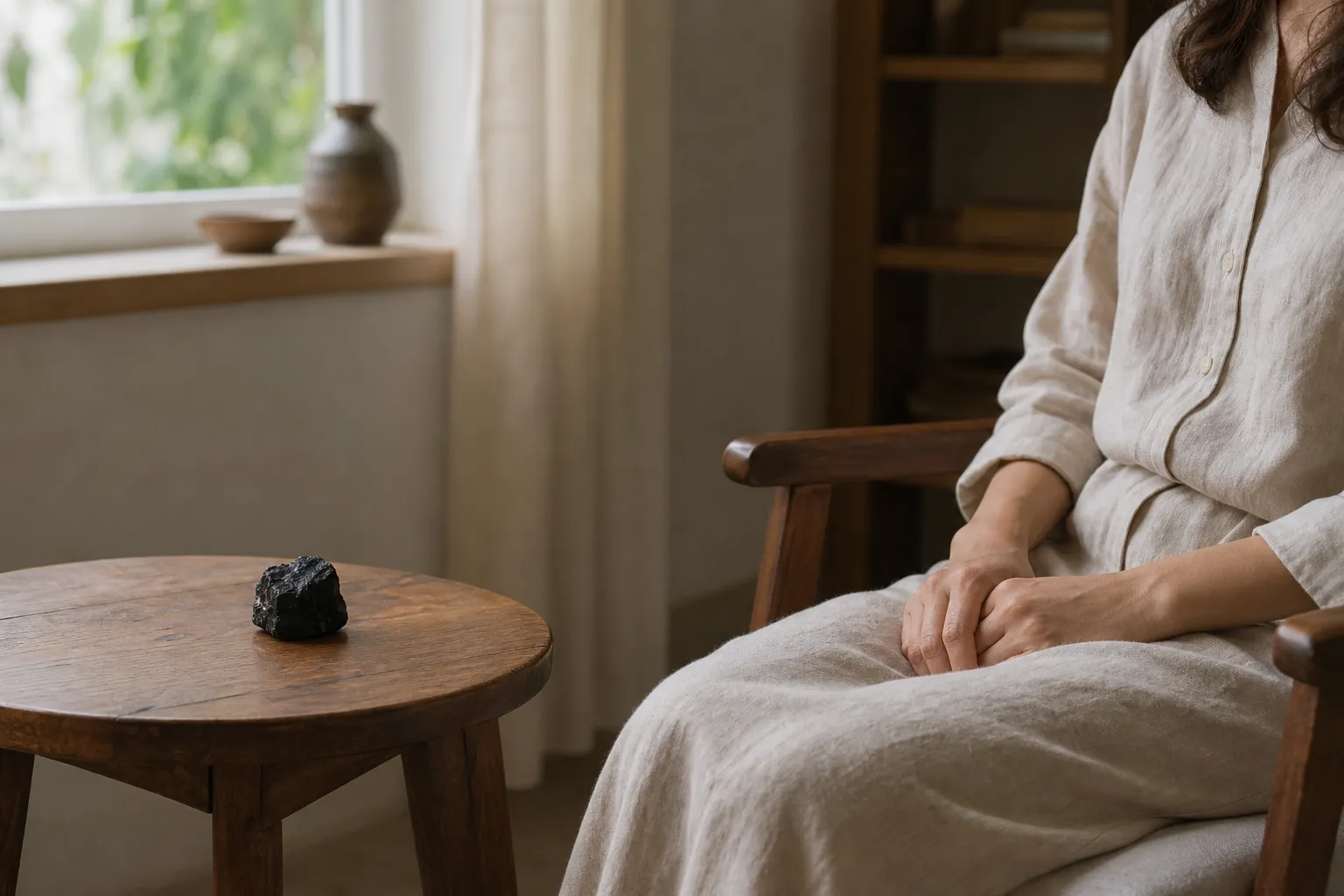
broader context
Black tourmaline context note
This narrower page works best after the broader black tourmaline context page.
When a new stone feels intense, reduce contact first
Crystal communities often use words like “energy,” “overload,” “activation,” or “too strong.” Those words can be useful if they help you describe what you are feeling. They become less useful when they turn a moment of discomfort into a fixed conclusion.
A gentler first move is simply to reduce the intensity of contact.
Try:
- Holding the crystal for 2–5 minutes instead of carrying it all day.
- Placing it across the room instead of on your body.
- Keeping it out of bed until you know how you feel around it.
- Using it during a calm part of the day, not during a stressful commute, argument, deadline, or already anxious evening.
- Taking a full day or more away from it if the experience feels too charged.
This is ordinary self-monitoring, not a clinical protocol. If you are under-slept, caffeinated, hungry, emotionally loaded, overstimulated, or in a noisy environment, almost anything new can feel louder: a scent, a sound, a social demand, a ritual object, or a body sensation you keep checking.
A new stone may become the focus because it is symbolic and unfamiliar. That does not make your anxiety imaginary. It means the interpretation should stay open.
A simple pacing sequence for crystal overstimulation
If you experience the stone as energetically overwhelming, lower the intensity before adding more meaning.
1. Stop direct contact
If you are wearing the crystal, take it off. If it is in your pocket, place it on a table. If it is under your pillow, move it out of the sleeping area.
Do not immediately replace it with several other stones. Adding more objects makes it harder to tell what is helping, what is neutral, and what is keeping your attention locked on the sensation.
2. Give your body a neutral reset
Choose one low-effort grounding action:
- Feel both feet on the floor and name five visible objects in the room.
- Unclench your jaw, lower your shoulders, and lengthen your exhale.
- Drink water or eat something simple if you have skipped food.
- Move into a quieter, dimmer, less crowded space.
- Put your attention on a stable surface: a chair, wall, table, or blanket.
These somatic pacing techniques are not about “fixing” the crystal’s energy. They reduce overall arousal so you can read the situation more clearly.
3. Wait before deciding what it means
When your heart is racing, your chest feels tight, your thoughts speed up, or your stomach drops, interpretation often arrives too fast. It is easy to think, “This stone is incompatible with me,” “I absorbed too much energy,” or “Something is wrong.”
Ask a plainer question first: what else was happening?
- Did the sensation begin before or after contact with the stone?
- Did you drink caffeine, skip food, sleep poorly, or go through stress?
- Were you reading alarming crystal content online?
- Did someone describe the stone as “powerful,” “intense,” or “too much”?
- Are you checking your body repeatedly for signs of a reaction?
The goal is not to dismiss your experience. The goal is to separate spiritual interpretation from body safety, context, and timing.
4. Reintroduce only if you want to
After a break, you can leave the crystal alone, keep it as a display object, give it away, or try again slowly. There is no requirement to “work through” discomfort to prove sensitivity, compatibility, or readiness.
If you do reintroduce it, make the next contact smaller than the one that felt overwhelming:
- One minute in the hand.
- On a desk, not on the body.
- Daytime only.
- No sleeping with a new stone yet.
- One crystal at a time.
If the same anxiety-like sensations return, pause again. That may be enough information for your personal use decision, even if the cause remains uncertain.
When the answer changes
Mild unease, restlessness, emotional sensitivity, or a “new stone feels intense” impression can often be handled by reducing contact and observing. If the experience is more severe, persistent, or physically alarming, the priority shifts away from crystal interpretation.
Do not explain the following only as crystal energy:
- Chest pain or pressure.
- Fainting or feeling close to fainting.
- Shortness of breath.
- Severe or persistent heart palpitations.
- Sudden, intense panic-like symptoms that feel unmanageable.
- Symptoms that interfere with sleep, work, driving, eating, or basic daily function.
- A new pattern that is unusual for you.
Searches like “heart palpitations crystals” often come from a real moment of fear. It is understandable to look for meaning if the symptom began around the same time as a new stone, ritual, or belief. Still, body-alarming symptoms deserve appropriate medical or mental-health support rather than a crystal-only explanation.
The same boundary applies if the crystal becomes part of avoidance. If you feel unable to leave the house without it, keep buying more stones to manage distress, or feel unsafe unless a particular crystal is nearby, the issue is no longer just “which stone works for me.” Step back and look at the anxiety pattern itself.
Common confusion: meaning is not the same as mechanism
Crystals can be meaningful objects. People wear them, carry them, place them in rooms, use them in rituals, and associate them with protection, grounding, beauty, memory, identity, or intention. Research on contemporary crystal use also shows that people often relate to stones through personal meaning, intuition, and spiritual language.
That is different from saying a crystal has been shown to produce a specific nervous-system effect.
For this page, hold two ideas at once:
- Your discomfort is real enough to respond to.
- The cause may be mixed, uncertain, or not the crystal itself.
Expectation can matter. If you were told a stone is high-energy, purging, activating, or incompatible with certain people, you may watch your body more closely around it. That attention can make ordinary sensations feel louder. If you already view crystals as powerful ritual objects, the setting may also shape how you interpret shifts in mood, tension, or calm.
This does not mean you are “making it up.” Bodies and minds respond to context, expectation, memory, attention, fatigue, and environment. A crystal can be part of that context without being the only explanation.
A more useful question is not, “Is this crystal definitely doing this to my nervous system?” Try: “Does my body settle when I reduce contact, and can I relate to this object without fear?”
Sleeping with a new stone: start with distance
Sleeping with a new stone is one of the easiest ways to overdo the experiment. Sleep is already affected by stress, light, noise, temperature, late meals, screens, caffeine, worry, and changes in routine. If you place a new crystal under your pillow and then wake up anxious or restless, the night gives you too many variables to read clearly.
If you are prone to anxiety from new stones, do not begin with overnight contact. Try a daytime window first. If that feels neutral, place the crystal somewhere visible but not touching you. If that remains neutral over time, you can decide whether closer placement is worth trying.
If sleep gets worse after introducing the stone, remove it from the bedroom for several nights and observe what changes. Do not keep testing it every night if the test itself makes you vigilant.
A bedroom should feel safe and low-demand. Any crystal that turns the room into a body-checking exercise may be better kept elsewhere.
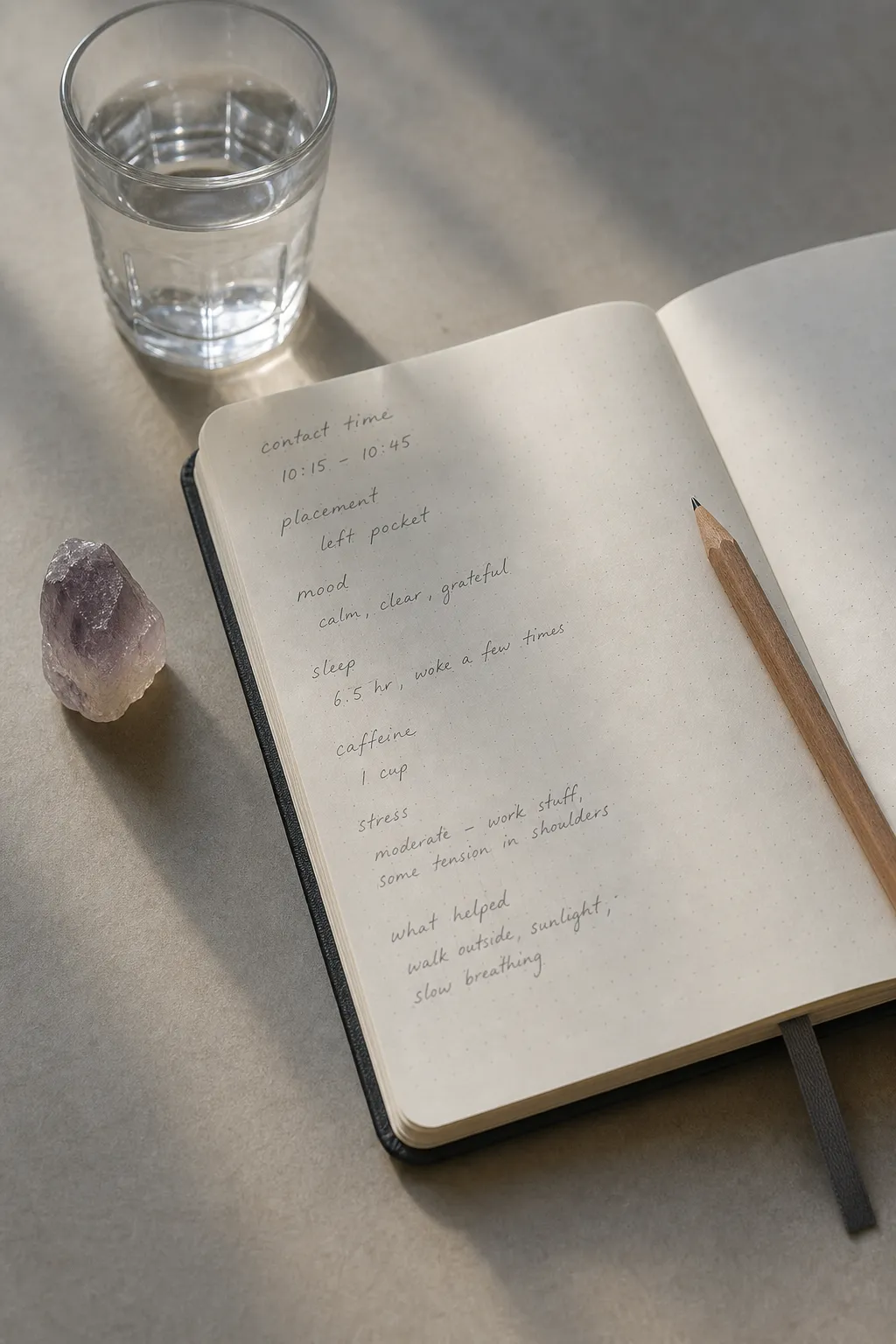
Track the context, not every sensation
A short note can help you see patterns, but it should not become constant symptom surveillance. Keep tracking light and factual.
A useful entry might be: “Held stone for five minutes after work. Already tired and had coffee late. Felt buzzy and tense. Put it on shelf, ate dinner, felt better.”
That note leaves room for interpretation without forcing certainty. It also helps you notice whether pausing crystal exposure is enough, or whether similar sensations are appearing across other parts of life.
If tracking makes you more anxious, stop tracking. The point is clarity, not control.
A calm way to decide what to do next
After a pause, choose one path.
Keep it as a visual object.
You may enjoy the mineral, color, texture, or design presence without wearing it or using it in ritual.
Reintroduce slowly.
Use short crystal exposure windows, daytime contact, and one variable at a time.
Set it aside indefinitely.
No stone is necessary enough to justify repeated distress.
Look beyond the crystal.
If the same sensations appear in other situations, focus on the broader stress pattern rather than trying to solve it through stone choice.
Grounding with new crystals does not have to mean finding the perfect mineral. It can mean reducing stimulation, orienting to the room, letting your body settle, and choosing not to intensify a ritual when you are already overloaded.
Energetic pacing is a consent-based relationship with an object: you decide the amount, timing, distance, and meaning. Slower is not failure. Here, slower is the safest way to stay curious without handing your body’s signals over to fear.