How High-Density Minerals Act as Somatic Anchors for Overwhelmed Nervous Systems
A high-density mineral can act as a somatic anchor tool in one modest way: it gives the hand something clear to feel. Its weight, coolness, surface, edges, and visual presence may help some people bring attention back to the body when thoughts feel scattered or the environment feels too intense.
The mineral is not doing nervous-system care. It is not a replacement for somatic therapy, mental-health support, or crisis help. Its possible usefulness comes from being a tangible cue: Here is my hand. Here is pressure. Here is temperature. Here is one object I can choose to notice right now.
The anchor is the contact, not a special mineral effect.
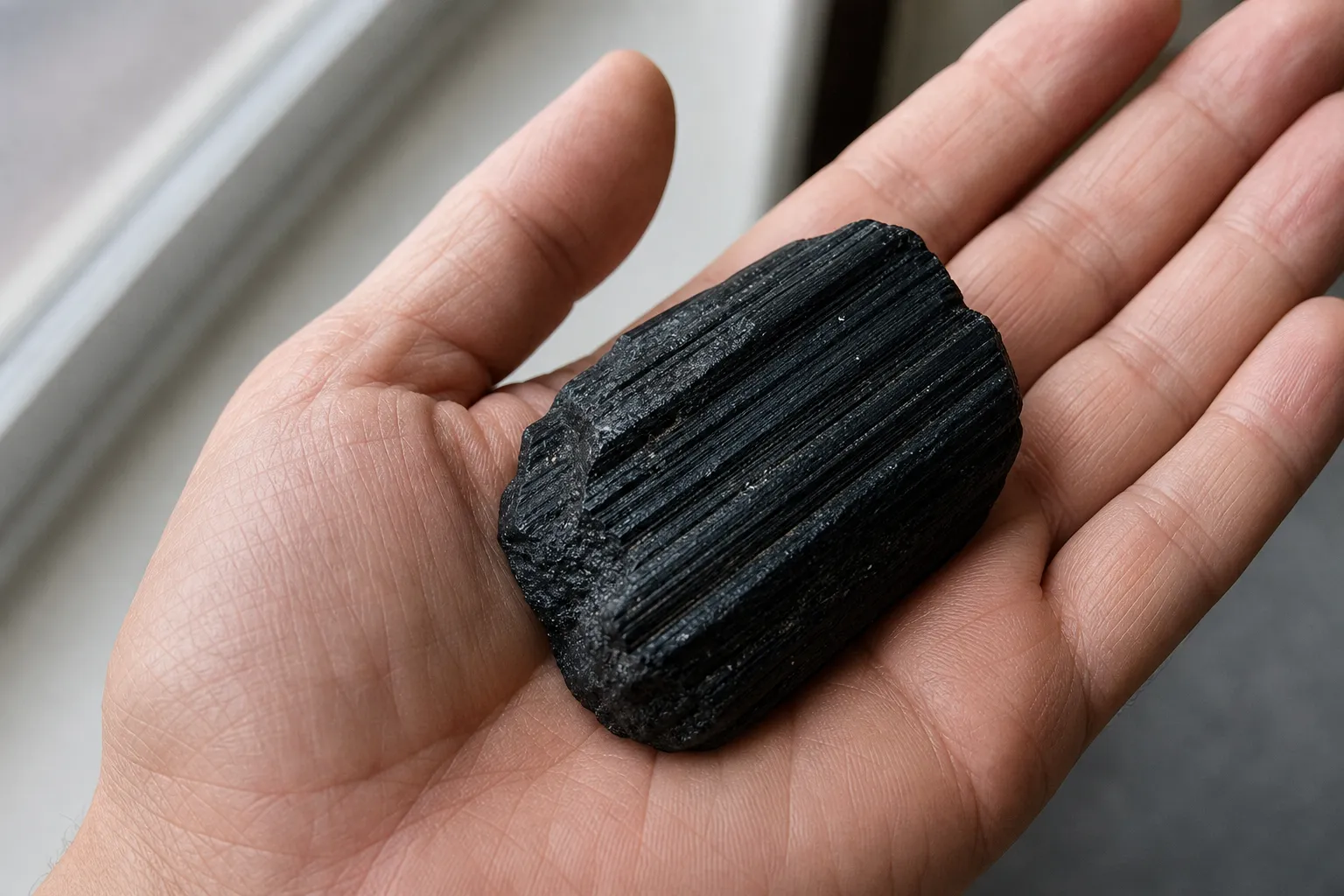
What a Dense Mineral Can Actually Offer
When people use a dense object for grounding, they are usually describing a sensory relationship rather than a medical mechanism. A stone in the palm can offer several kinds of immediate feedback:
Weight
The object presses into the hand and gives the muscles something to register.
Temperature
Many mineral objects feel cool at first, then gradually warm with the hand.
Texture
Polished, matte, ridged, chipped, or striated surfaces give the fingertips something specific to notice.
Shape
Edges, planes, curves, points, or a palm-sized mass can make the object easy to locate by touch.
Visual focus
A dark or dense-looking mineral can become one thing to look at when attention feels pulled outward.
Choice
Picking it up, putting it down, turning it, or shifting grip gives the person a small physical action they can control.
In body-oriented therapy language, grounding is often connected with weight, support, contact with the floor, and present-moment orientation. That does not mean a mineral has been validated as a therapeutic device. It means the language of “weight,” “support,” “contact,” and “presence” overlaps with ordinary sensory experience.
The simplest version is hand contact grounding: hold the object and notice what is already happening. The hand is touching. The object is pressing back. The surface has a temperature. The fingers have positions. The wrist, arm, shoulders, and breath may become easier to notice because attention has a physical place to land.
Why Weight, Texture, and Temperature Can Feel Anchoring
Touch is not just “skin sensation.” Through touch, people perceive shape, warmth, pressure, weight, and surface quality. A high-density mineral object may feel more substantial than a lightweight item of the same size, which can make it easier for some people to keep attention on the hands.
That is where the word “anchor” is useful, as long as it stays small. The object does not anchor the nervous system in a clinical sense. It anchors attention by being concrete.
A quiet use might look like this
- Place the mineral in one hand.
- Let the hand feel its weight before trying to change anything.
- Notice whether it feels cool, warm, smooth, rough, flat, sharp, heavy, or balanced.
- Shift it slowly from one hand to the other.
- Look around the room and name a few ordinary details.
- Put the object down if it becomes irritating, distracting, or emotionally loaded.
The value is not in doing the sequence perfectly. If it helps, it helps by giving attention a route back to ordinary sensation. “Notice your body” can feel too abstract when someone is overwhelmed. “Feel this object in your hand” is more specific.
Conditions That Change Whether It Helps
A mineral grounding object is not automatically supportive. Its usefulness depends on the person, the setting, and the object itself.
The object should feel safe enough to hold.
A sharp, crumbly, dusty, splintering, or unknown specimen is not a good tactile cue object. Avoid anything that sheds, cuts, stains, irritates skin, or raises obvious handling concerns. Smooth and stable is usually better than dramatic and fragile.
The weight should be noticeable, not burdensome.
A dense object for grounding should not strain the hand or wrist. If it makes someone grip hard, brace, or tense up, it may be adding demand instead of helping attention settle.
Texture should invite attention, not fixation.
Some people prefer a smooth surface because it is predictable. Others like ridges or natural planes because the fingers have more to explore. Neither is universally better. The question is whether the surface helps attention return to the hands without increasing agitation.
The person should stay in choice.
A somatic anchor works best as an option, not a rule. If the object becomes something a person feels they must hold to get through the moment, it may stop being flexible. The anchor should support agency, not become another test.
The setting matters.
A mineral held during a quiet pause at a desk is different from a self-directed object practice during severe panic, dissociation, self-harm urges, trauma symptoms, or persistent distress. In those situations, the object may be too small a support. Qualified mental-health help or emergency support may be needed.
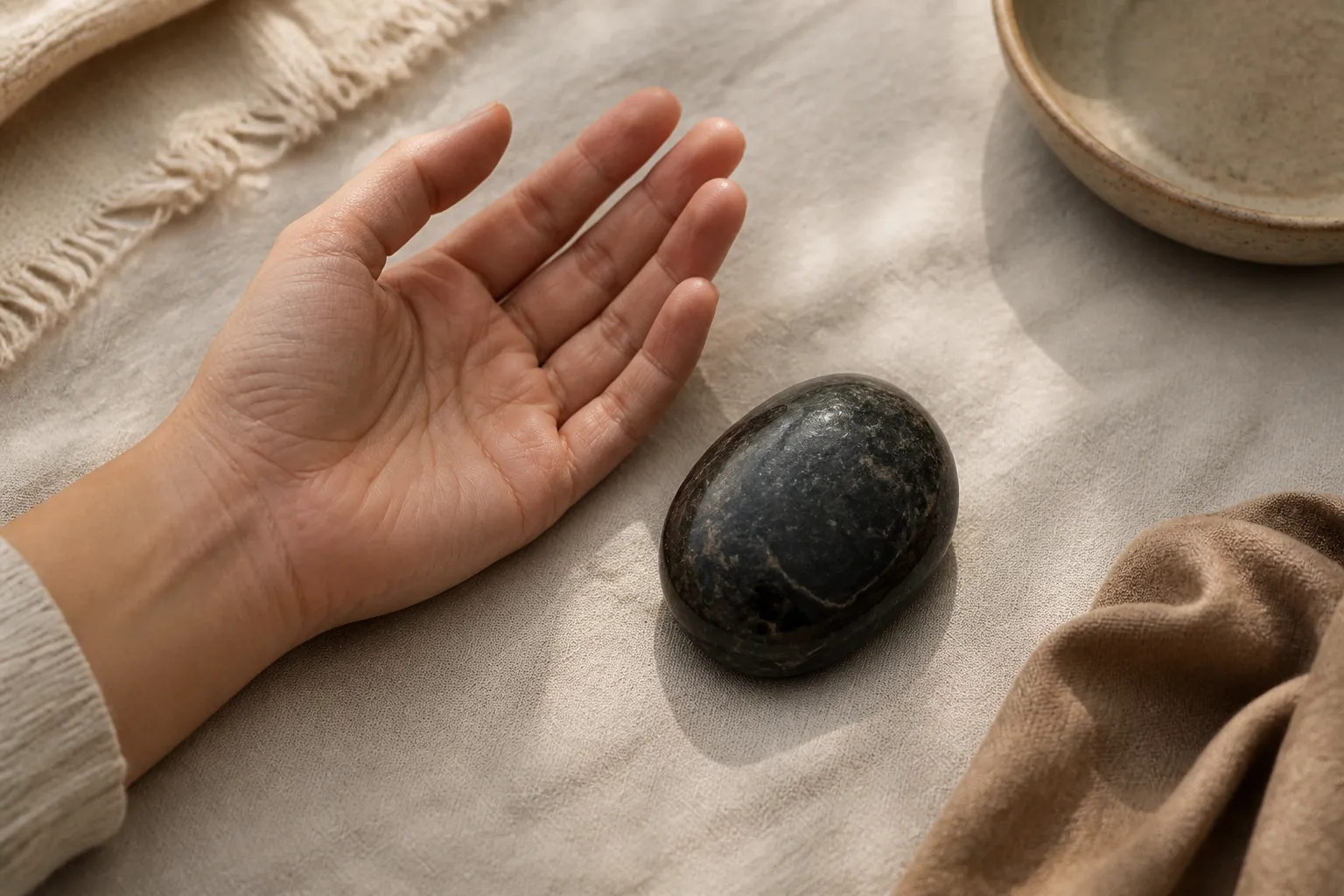
A Low-Claim Way to Use One
A cautious use of a mineral as an object-based somatic anchor is short, physical, and ordinary. It does not need spiritual language, clinical certainty, or an elaborate ritual.
Try this version:
- Hold the object with a grip loose enough that the hand can still move.
- Name three physical qualities: “cool,” “heavy,” “smooth,” “edged,” “small,” “solid.”
- Let the object rest against the palm instead of squeezing it to force a result.
- Notice the contact points: fingertips, palm, thumb, wrist, lap, or table.
- Look away from the object and orient to the room: floor, wall, doorway, light, sound.
- Check whether holding it feels present, neutral, or steady enough.
- Stop if it becomes uncomfortable, obsessive, or emotionally charged.
This keeps the practice within its reasonable boundary: tactile feedback grounding. The object can remind some people to pause, feel the hands, and notice the present environment. It should not be described as changing the nervous system, resolving trauma, stopping panic, or producing a dependable clinical outcome.
If someone is already working with a somatic therapist, that relationship may include structured attention to sensation, movement, breath, support, and orienting. A self-chosen mineral is not the same thing. It may be a personal grounding object used outside sessions, or something to discuss with a clinician, but it should not be treated as a clinical tool by default.
Common Confusion: Mineral Energy vs. Physical Cue
Three ideas often get blurred together:
- A mineral has physical properties: mass, surface, shape, temperature, texture.
- A person may attach personal meaning to an object.
- Marketing language may present a stone as producing health or nervous-system outcomes.
Only the first two belong in a careful explanation here. A high-density mineral object can be physically noticeable. It can also carry personal meaning because it is familiar, beautiful, dark, plain, heavy, or connected with a certain place or moment. That meaning may make the object easier to remember and use.
That still does not show that the mineral itself creates a clinical effect.
A grounded description would be: “This object may help me notice my hand and the room.” A stronger claim, such as saying the mineral changes the nervous system, goes beyond what the available evidence supports.
This matters with black minerals and other objects casually described as grounding stones. Their visual density and hand feel can be compelling. But symbolism is not clinical evidence. A dark, heavy object may feel steady to one person and unpleasant to another. The practical question is not what the stone is supposed to do; it is what happens when this person holds this object in this moment.
The Limits of a Somatic Anchor Tool
A tactile cue object is small by design. It can be part of a pause, not the whole support system.
The available evidence is indirect. Research can support general ideas such as grounding language, body awareness, tactile perception, physical support cues, and sensory orientation in some body-oriented contexts. It does not directly establish that high-density minerals regulate overwhelmed nervous systems. It also does not establish which minerals are safest, which density is ideal, how long to hold them, or who should avoid specific specimens.
So the clean answer is this:
A dense mineral may function as a somatic anchor when it gives the body a clear, chosen, tolerable point of contact. It may help some people return attention to the hands through weight, texture, temperature, and visual focus. It works, if it works, as a tactile cue and personal reminder—not as proof of a mineral-specific nervous-system effect.
If the object helps you feel present enough to take the next ordinary step—stand up, feel the floor, drink water, text a trusted person, step outside, or reach out for support when needed—that is the right scale for the tool. Keep it simple. Keep it optional. Let the hand decide whether the anchor is useful today.