Bounded mineral answer
Piezoelectricity Explained: How Pressure Generates Charges in Schorl
A black tourmaline surface can feel dense, ribbed, and quietly physical in the hand, but the electrical question is much narrower than that felt presence. The Piezoelectric Effect means that certain crystals can generate electrical charge when mechanical pressure or stress is applied. In plain terms, pressure slightly shifts the internal balance of positive and negative charge inside a suitable crystal structure, creating polarization and, under the right conditions, a measurable voltage.
For schorl, the black tourmaline mineral, the careful answer is this: general piezoelectric physics explains how pressure-generated charge can happen in some crystals, and mineral references identify schorl as a tourmaline-group mineral. The available public sources do not provide schorl-specific output measurements, practical power claims, or body-effect evidence. Schorl belongs in the explanation, but not as a promised power source.
broader context
Broader schorl guide
This narrower page works best after the broader black tourmaline context page.
How Pressure Becomes Electrical Charge
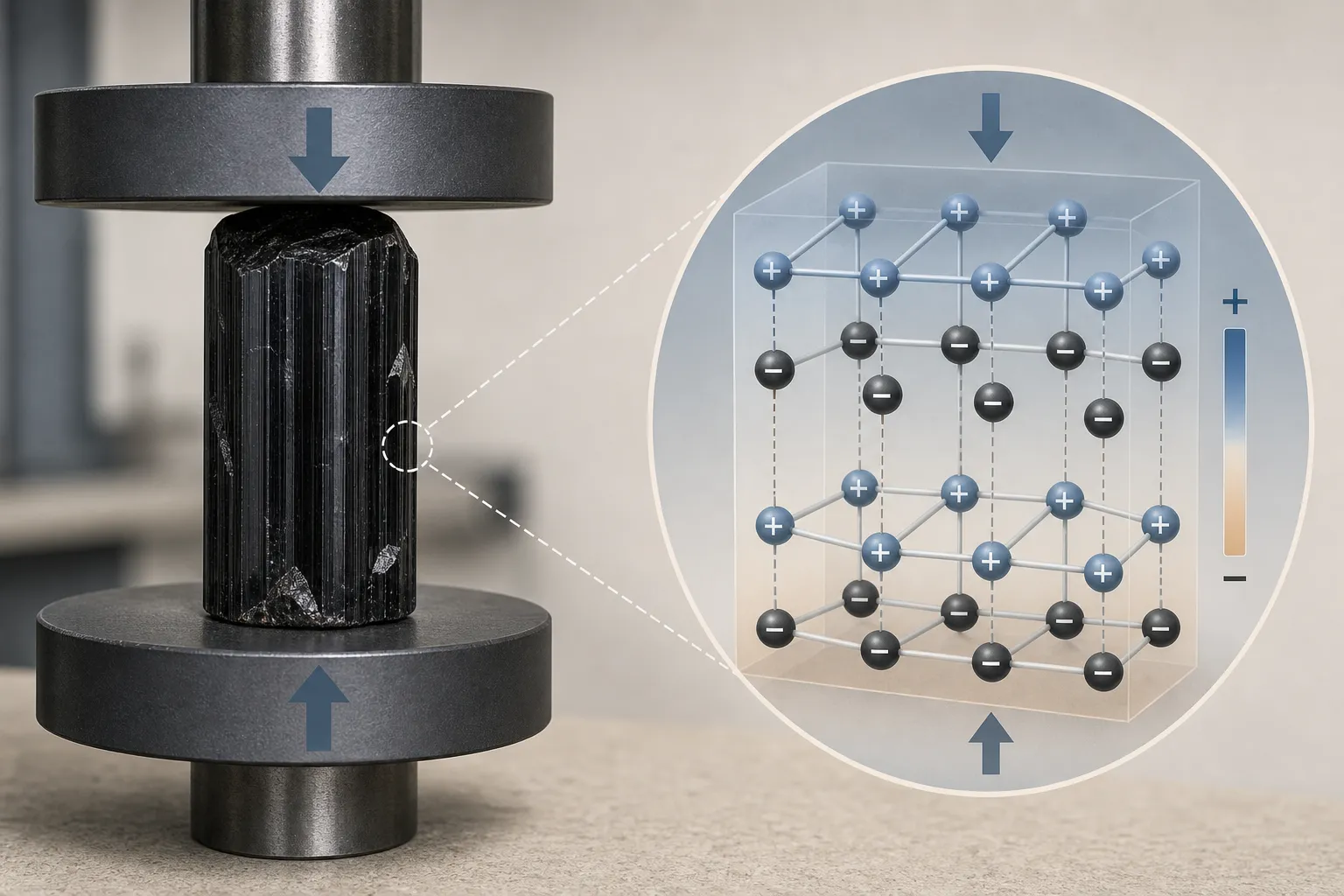
Piezoelectricity is not electricity hidden inside a crystal waiting to leak out. It is an electrical response caused by mechanical stress in crystals whose internal structure allows charge separation. When compression, bending, tension, or other stress changes that structure even slightly, the centers of positive and negative charge no longer line up in the same way. That imbalance is polarization.
The pressure-to-charge mechanism is best understood as a small internal shift, not a dramatic spark. A piezoelectric crystal has an ordered arrangement of atoms or ions. When pressure changes that arrangement, the charge distribution changes with it. If the crystal is connected under suitable measurement conditions, that changed polarization can appear as voltage.
That is why “pressure-generated charge” is more accurate than the loose phrase “crystal electricity.” The casual phrase can suggest something broader than the evidence supports. The effect is not stored battery power, not a general property of every mineral, and not an invisible force radiating from a specimen. It is a structure-dependent response to stress.
Basic pressure-to-charge sequence
- Mechanical pressure applies stress to the crystal.
- The internal charge balance shifts.
- The crystal develops polarization.
- A voltage or electrical charge response may be measurable under suitable conditions.
That sequence is the core of the Piezoelectric Effect. It answers the physical question without turning schorl into a device, a household power source, or a body-directed claim.
Where Schorl Fits
Schorl is the black, iron-rich member commonly meant when people say black tourmaline. Mineral databases place it within the tourmaline group, a family known for complex borosilicate structures. For this page, schorl gives the pressure-to-charge question a bounded mineral context: a real black tourmaline specimen, not “all crystals” as a category.
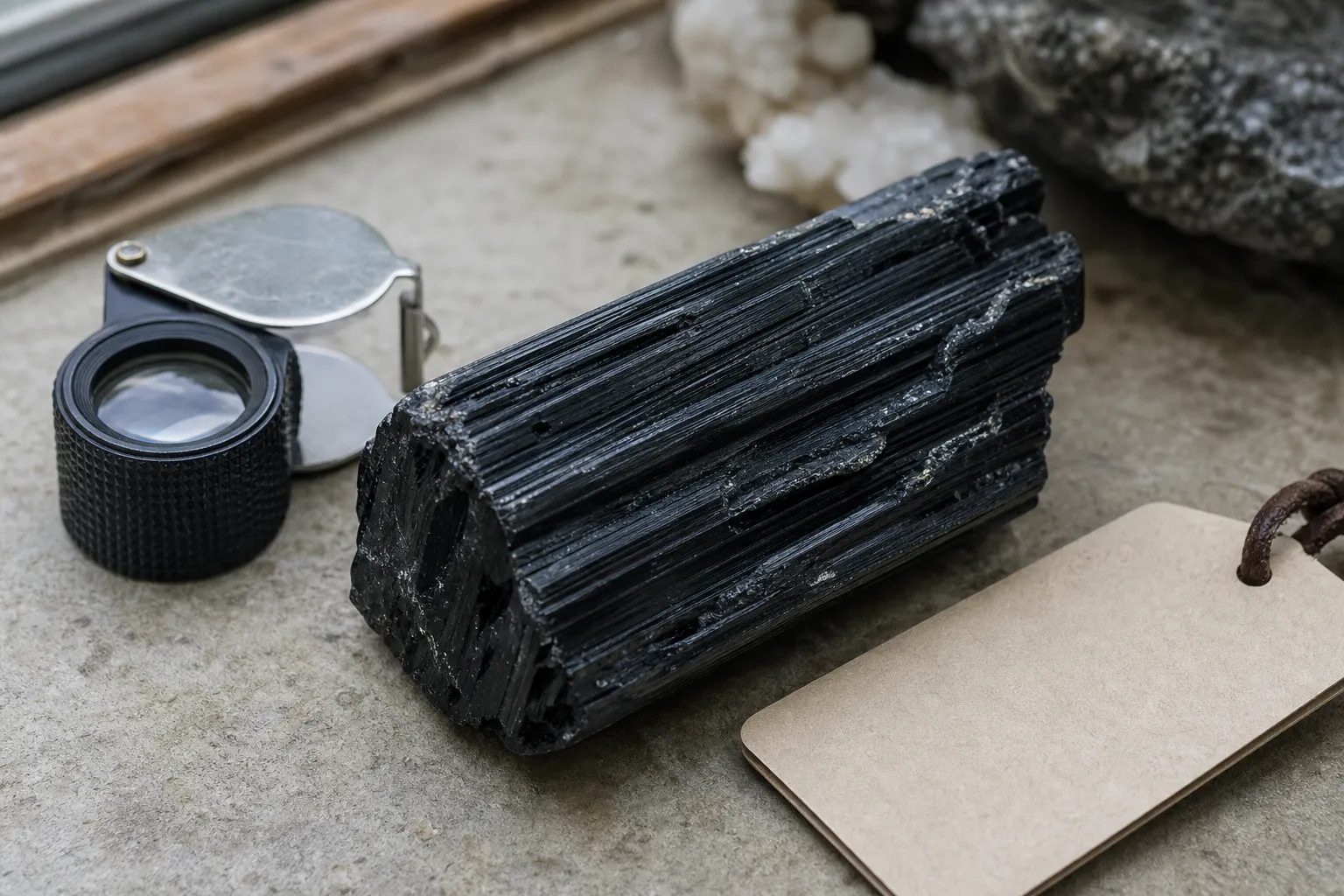
That distinction matters. A piece of schorl may show the visual language people associate with black tourmaline: dark color, lengthwise striations, prismatic habit, fractured surfaces, and noticeable weight for its size. Those features help place the specimen in mineralogical context. They do not, by themselves, prove a measured piezoelectric output.
The available sources support two separate claims. First, piezoelectricity is a recognized effect in certain crystals under mechanical stress. Second, schorl is a tourmaline-group mineral. What the available material does not provide is a tested number for how much charge a particular schorl specimen produces under a particular pressure.
That boundary keeps the answer useful. Schorl can be discussed in relation to piezoelectricity, but a mineral identity reference is not the same as a lab measurement of voltage from mechanical pressure.
What Changes the Answer in Real Specimens
The direct mechanism is simple. The real-world answer is more variable. A phrase like “schorl piezoelectricity” can sound as if any black tourmaline specimen will behave in a clear, visible, useful way when pressed. The evidence does not support that jump.
Factors that affect detection
- Crystal structure: Piezoelectric behavior depends on internal symmetry and charge arrangement, not appearance alone.
- Direction of stress: Pressure along one direction may not produce the same response as pressure along another.
- Specimen condition: Natural crystals can include fractures, inclusions, mixed growth, weathered surfaces, and irregular terminations.
- Contact and measurement: A voltage response is not the same as a visible spark; it usually requires suitable equipment.
- Scale of output: A detectable charge does not mean useful power for household or device-level purposes.
This is the practical difference between a physics definition and an everyday object on a shelf. The definition explains the effect. The specimen introduces variability. A natural schorl crystal in an interior, on a desk, or in a collection should not be treated like an engineered component.
Engineered piezoelectric ceramics and sensors are designed around controlled composition, geometry, electrodes, and repeatable performance. They are useful contrast examples, but they should not become the center of a schorl explanation. Black tourmaline is a mineral specimen first; any piezoelectric discussion should stay tied to structure and evidence limits.
Common Confusion Around “Crystal Electricity”
The phrase “crystal electricity” often gathers several different ideas into one loose label. Some come from physics, some from consumer language, and some from symbolic or wellness settings. For schorl, the cleanest reading is narrower: electrical charge in crystals may be generated when mechanical stress changes polarization.
That does not mean the crystal stores electricity like a battery. A battery contains chemical systems designed to deliver sustained electrical energy. A piezoelectric response is different; it is tied to stress and deformation. When the stress changes, the electrical response changes.
It also does not mean every crystal produces a meaningful voltage when pressed. Piezoelectricity depends on structure. Crystal habit, color, shine, or popularity in gemstone markets does not automatically establish a measurable effect. A black, striated mineral can be visually convincing as schorl while still requiring separate evidence for any electrical claim.
There is one more step to avoid. If a crystal can produce voltage under pressure, some readers assume it must directly affect the body or the room. The source material for this page does not support that move. Somatic grounding language may describe how a person uses a dense, textured object as a non-medical attention cue, and biophilic interiors may treat black tourmaline as a dark mineral accent with mass and surface presence. Those are context and interpretation, not evidence of electrical action in a living space.
For this page, “crystal electricity” should be translated back into physical terms: mechanical stress, charge separation, polarization, and possible voltage. Schorl stays before symbolism.
The Useful Limit: Charge Is Not Practical Power
The most important limit is the difference between “can generate charge” and “can provide useful power.” Piezoelectricity explains an electrical response under stress. It does not automatically imply that a crystal can run electronics, supply household electricity, or work like a small generator.
The curated evidence for this page does not include schorl-specific measured output, device testing, field observations, or long-term performance data. Without those, it would be misleading to describe black tourmaline as a practical electricity source. It is more accurate to say that the general pressure-to-charge mechanism can be explained in relation to piezoelectric materials, while schorl remains the mineral context.
The reader’s question can be answered without turning a specimen into an improvised test object. For a black tourmaline piece used in a room, on a shelf, or in a collection, the grounded approach is to observe its crystal habit, surface, weight, and placement, then keep electrical claims within what the evidence can support.
A useful checkpoint is this: piezoelectricity is a real physics term, but “real” does not mean “large,” “useful,” body-directed, or guaranteed in your specimen. Each stronger claim would require a different kind of evidence.
Short Answer
If you are holding a piece of schorl and wondering what pressure does electrically, the answer is not that the stone is full of accessible power. The better answer is that in piezoelectric materials, mechanical stress can disturb charge balance and create polarization. Under suitable conditions, that polarization can be detected as electrical charge or voltage.
For schorl specifically, the available public material is enough to place it in the tourmaline mineral context and to explain the general mechanism with care. It is not enough to claim a measured voltage for your specimen, compare it directly to engineered ceramics, or attach body-effect promises to the mineral.
That keeps the question useful. Black tourmaline can remain a real object with texture, mass, striations, and mineral identity; piezoelectricity can remain a real pressure-to-charge effect; and the space between them can stay clear.