Mohs Hardness 7.5: The Durability of Black Tourmaline Explained
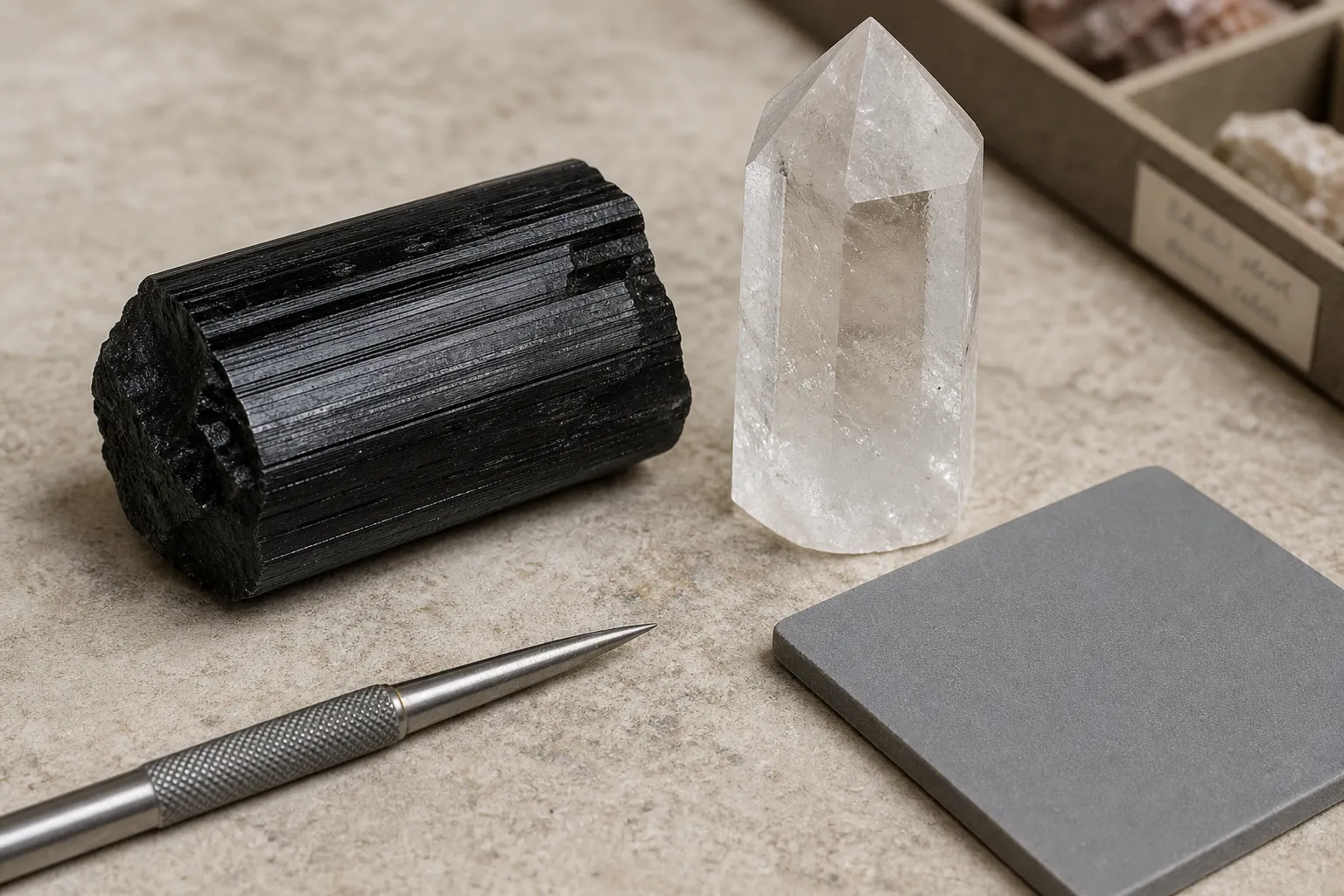
Black tourmaline, mineralogically known as schorl, is usually reported around Mohs 7 to 7.5. In plain use, Schorl Mohs hardness means black tourmaline has good scratch resistance compared with many softer minerals, and it sits close to or slightly above quartz on the Mohs scale.
That is a useful durability advantage for jewelry and handled crystals. It does not make the stone scratch-proof, impact-proof, or maintenance-free.
The practical answer: black tourmaline is hard enough to resist many casual surface marks, but real wear also depends on toughness, fractures, polish quality, setting design, storage, cleaning, grit, and impact.
broader context
Black tourmaline context note
This narrower page works best after the broader black tourmaline context page.
What Mohs hardness 7.5 actually measures
Mohs hardness is a comparative scratch-resistance scale. A mineral with a higher Mohs number can scratch a mineral with a lower number under the right conditions. The lower one generally cannot scratch the higher one.
That makes the Mohs scale useful for mineral identification and surface-scratch comparison. It is not a complete durability score.
For black tourmaline, the useful point is simple: schorl is toward the harder end of common collector and jewelry minerals. Whether a source lists it near 7 or 7.5, the practical meaning is similar. It is relatively hard, especially compared with calcite, fluorite, apatite, many glasses, and softer decorative stones.
Mohs numbers are also not evenly spaced. A 10 is not just “a little higher” than a 9 in the way marks on a ruler are evenly spaced. So Mohs hardness 7.5 should be read as “around or above quartz in scratch comparison,” not “close to diamond-like.”
Use the table as a comparison guide, not a promise about every stone, polish, or wearing situation.
Why quartz dust matters
Quartz matters because it is common. It can appear in sand, dust, soil particles, outdoor grit, and household debris. Since quartz is Mohs 7, it is a useful reference point for everyday abrasion.
Because black tourmaline is commonly placed around Mohs 7 to 7.5, it has better scratch resistance against quartz than many softer stones do. That is why a schorl hardness range near 7.5 sounds reassuring for jewelry wear.
The limit: “around or above quartz” does not mean quartz-containing grit can never affect a polished black tourmaline surface. Real-world abrasion depends on pressure, repeated movement, particle shape, mixed grit, surface finish, and whether the stone has tiny fractures or exposed edges.
Practical distinctions
- A quick wipe with clean fabric is different from rubbing grit across the stone.
- Sand or dust under pressure can act like an abrasive, especially on polished surfaces.
- A higher-than-quartz rating improves resistance, but it does not remove all abrasion risk.
- Household dust is not a pure mineral sample; mixed grit may include harder particles.
For a handled crystal, avoid gritty trays, sandy pockets, dusty windowsills, and rough storage surfaces. For jewelry, do not treat a black tourmaline ring or pendant as maintenance-free just because the mineral is fairly hard.
Hardness versus toughness in jewelry wear
“Durable” means more than “hard.” In gem and mineral care, three ideas matter:
Hardness
Resistance to scratching.
Toughness
Resistance to breaking, chipping, or fracturing.
Stability
Resistance to change from heat, light, chemicals, and environmental exposure.
Black tourmaline’s Mohs hardness only answers the first point. A stone can resist scratches and still chip from a sharp knock. A polished surface can stay glossy in careful use but become worn if stored loose against harder gems.
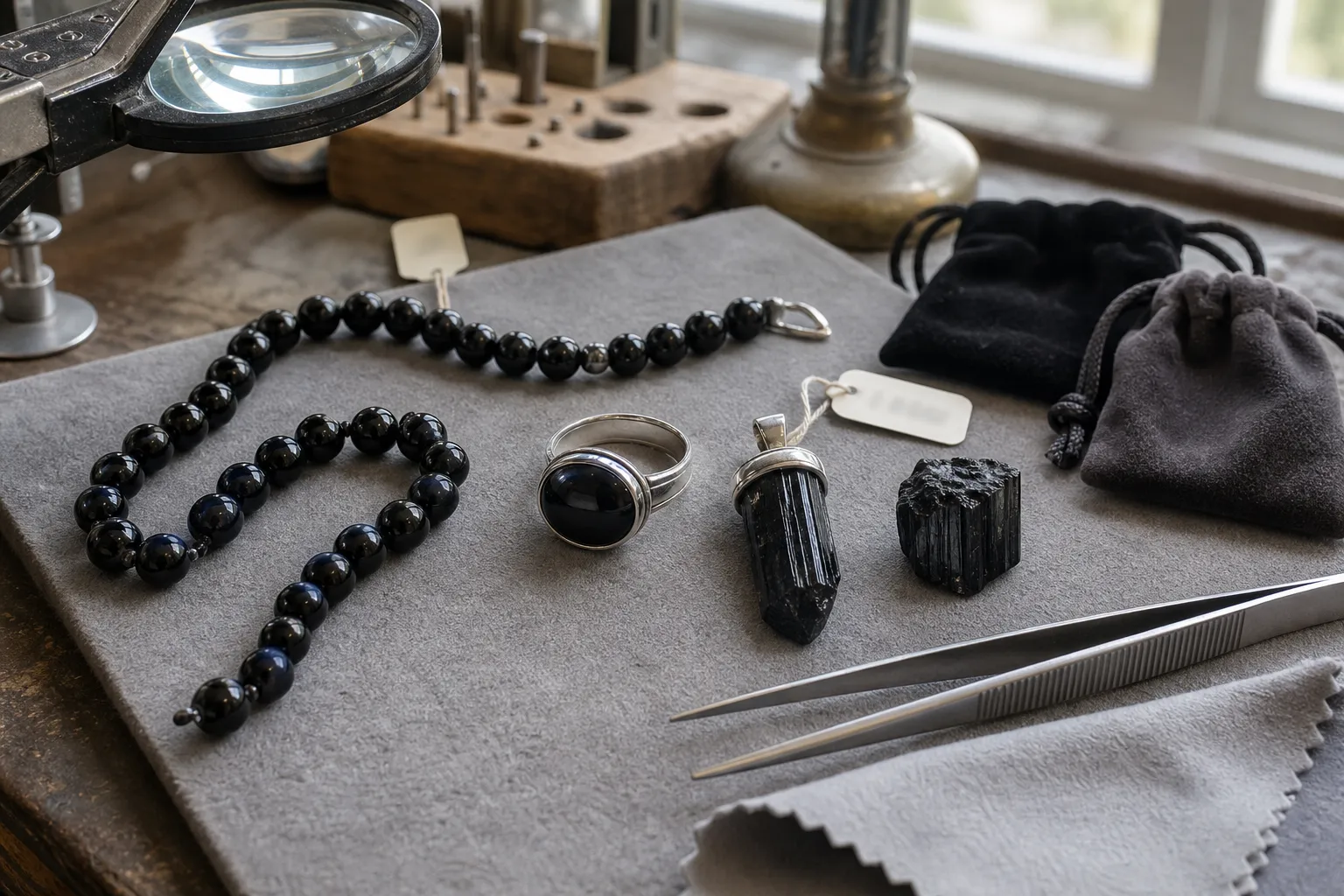
This matters because black tourmaline appears in many forms:
- Faceted stones
- Cabochons
- Beads
- Rough or striated crystal pieces
- Crystal points
- Rings, pendants, bracelets, and decorative objects
The same mineral hardness does not make all of those equally durable in use. A smooth cabochon protected by metal has different risks from a tall exposed crystal point. A pendant usually sees fewer direct impacts than a ring face. A bead bracelet may rub against surfaces and neighboring beads more often than a display specimen.
Those are conservative wear examples, not black-tourmaline-specific long-term testing claims. The stronger evidence supports schorl’s mineral identity, reported hardness range, and the general gemstone-durability framework. It does not prove that every black tourmaline jewelry design will perform the same way over years of use.
What “mineral stability” means here
Here, mineral stability is being used in the material and gemological sense. It means how a mineral holds up under ordinary environmental conditions, not any symbolic or wellness effect.
Schorl is a recognized tourmaline mineral, and mineral references describe it as a stable mineral species in the ordinary descriptive sense. That does not mean every black tourmaline object is equally durable. A specific crystal or gem may have fractures, attached matrix, weathered areas, surface coatings, repaired sections, or inclusions. Those features can change how it behaves during handling.
For most owners, the bigger risks are mechanical: knocks, pressure, abrasive grit, exposed edges, and poor storage. Harsh cleaners and ultrasonic cleaning deserve caution with mounted or fractured stones because cleaning methods can interact with cracks, settings, fillers, or surface condition.
A hard mineral can still have vulnerable shape. Long crystals, sharp terminations, ridges, and exposed corners concentrate stress. Polished beads or cabochons reduce some of that geometry risk, but they can still abrade if tossed loose with harder stones.
What Mohs 7.5 means for black tourmaline jewelry
For jewelry, Mohs hardness around 7.5 is a favorable starting point. It suggests black tourmaline can handle more surface contact than softer stones and should resist many casual scratches better than minerals below quartz.
The realistic limit is that jewelry wear is repetitive and uneven. Rings are more exposed because hands hit desks, counters, door frames, bags, and tools. Bracelets slide and knock against surfaces. Pendants and earrings are usually less exposed, though they can still strike chains, clasps, or other jewelry in storage.
Conservative care approach
- Store black tourmaline separately from harder gems such as sapphire, ruby, and diamond.
- Avoid loose storage where polished stones rub together.
- Keep grit out of pouches, trays, pockets, and polishing cloths.
- Protect exposed points and sharp edges, especially on rough crystal jewelry.
- Avoid hard impacts, even if the surface resists ordinary scratches.
- Use gentle cleaning, especially for set stones or pieces with visible fractures.
This does not mean black tourmaline is fragile like a very soft mineral. It means “scratch resistant” is not the same as “careless-wear resistant.”
If a seller describes black tourmaline as indestructible, scratch-proof, or suitable for every daily-wear condition, that goes beyond what Mohs hardness can support. The better wording is: black tourmaline is relatively scratch resistant, but not scratch proof.
Common confusion around schorl hardness
One common mistake is treating Mohs 7.5 as a fixed value for every black tourmaline object. Mineral references may report hardness as a range, and specimens vary in condition. A clean crystal face, polished cabochon, fractured bead, and rough point can all be schorl while having different practical wear risks.
Another mistake is comparing black tourmaline too closely with diamond because both are “hard.” Diamond defines the top of the Mohs scale at 10. Black tourmaline does not behave like diamond simply because 7.5 sounds high.
There is also a naming issue. “Black tourmaline” is the familiar market name, while the mineral name usually relevant to this durability question is schorl. For hardness and scratch resistance, schorl references are the better evidence base.
Quartz dust can also be overstated in both directions. It is fair to say black tourmaline has better scratch resistance than many softer materials because it sits around or above quartz. It is not fair to say quartz-bearing grit can never dull, abrade, or mark a surface under pressure and repeated movement.
Bottom line
A Mohs hardness around 7.5 makes schorl black tourmaline a relatively hard mineral with good scratch resistance, especially compared with stones and materials below quartz.
The boundary is just as important: Mohs hardness measures scratch resistance, not total jewelry durability. Black tourmaline can still chip, fracture, abrade, loosen in a setting, or show wear if it is struck, stored poorly, rubbed with grit, or made into a design with exposed points and edges.
For practical use, treat black tourmaline as durable enough for careful jewelry and crystal handling, but not indestructible. Its hardness is a strength; thoughtful storage and impact avoidance still matter.