black tourmaline mineralogy
The 2026 Mineralogical Guide to Schorl: Beyond the Black Stone
By Clara Vance · May 08, 2026
Mineral data field guide
The 2026 Mineralogical Guide to Schorl: Beyond the Black Stone
Schorl is the mineralogical name for the common black, iron-rich member of the tourmaline group. In everyday listings, the same material is often called black tourmaline. Schorl mineral data is the more exact layer: composition, crystal structure, habit, hardness, cleavage, fracture, and geological occurrence. The main limit is simple: black color is not enough. A dark stone may look tourmaline-like, but confident identification depends on several traits lining up.
broader context
Black tourmaline context note
This narrower page works best after the broader black tourmaline context page.
What schorl means in mineral data
Schorl is a tourmaline group mineral. Tourmalines are boron-bearing cyclosilicates, which means they are not defined by color alone. They belong to a chemically complex mineral family with a ring-silicate structure and several structural sites where elements can substitute.
The ideal schorl formula is commonly given as:
NaFe²⁺₃Al₆(Si₆O₁₈)(BO₃)₃(OH)₃(OH)
You may also see the same composition written in a compact form:
NaFe²⁺₃Al₆(BO₃)₃Si₆O₁₈(OH)₄
Both versions describe the same basic identity: schorl is a sodium-bearing, iron-rich, aluminum-bearing tourmaline with borate and hydroxyl components in its structure. Its iron-rich composition is one reason it is commonly black, bluish-black, or brownish-black.
In mineralogical use, schorl is more precise than black tourmaline. In retail or decor use, black tourmaline is the name more people recognize. The terms overlap often, but they are not perfect synonyms in every technical setting. If the specimen has not been tested, the name should be treated as a well-supported description only when its visible traits and context fit the mineral data.
Physical traits that help identify schorl
A schorl specimen is usually read through a group of features, not one single sign. The more features that agree, the stronger the identification becomes.
Typical schorl characteristics include:
- Color: black, bluish-black, brownish-black, and occasionally greenish-black.
- Luster: commonly vitreous to resinous on cleaner crystal faces.
- Transparency: often opaque in thicker hand specimens.
- Crystal system: trigonal, as part of the tourmaline structure.
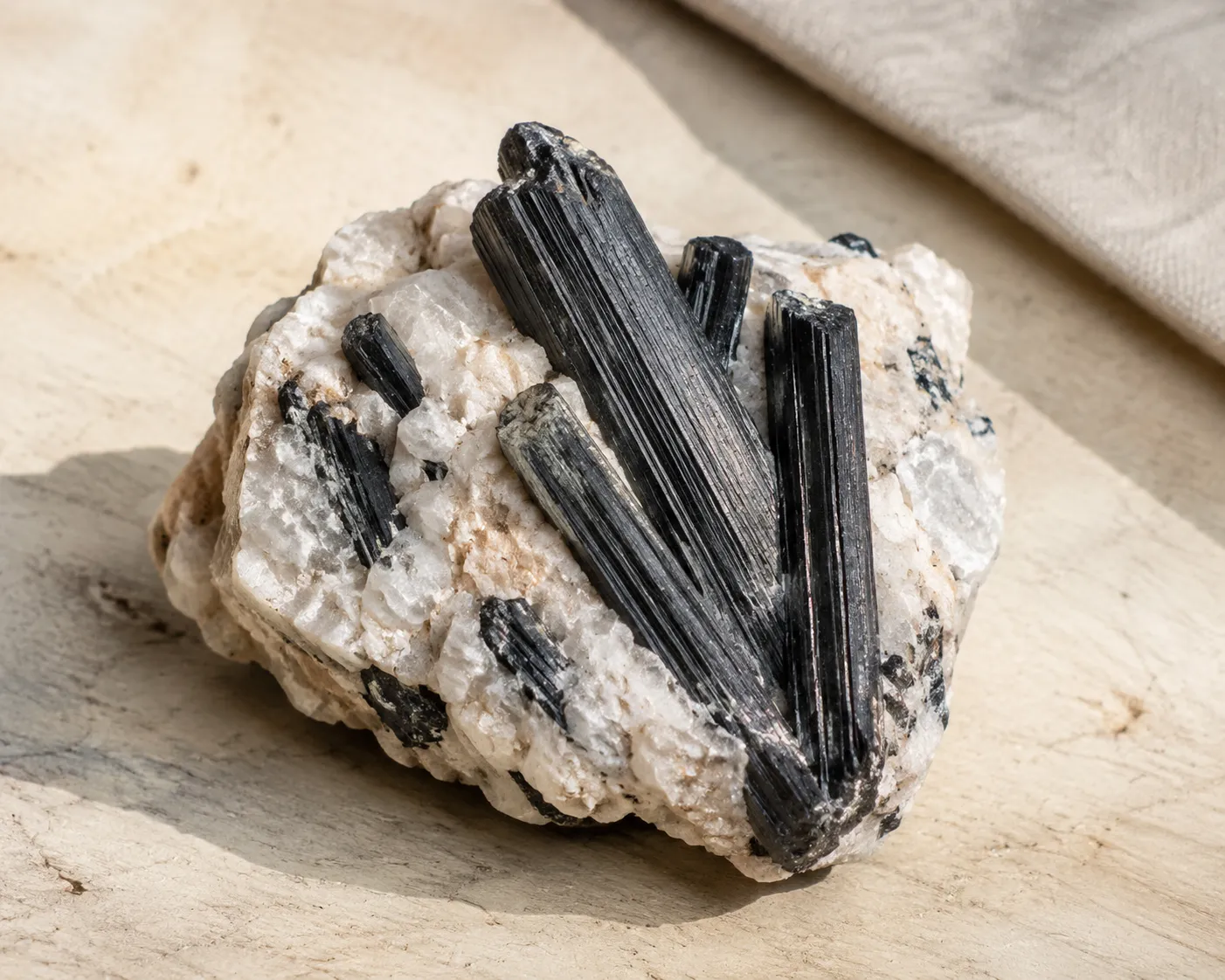
- Crystal habit: commonly elongated prismatic crystals.
- Surface texture: strong lengthwise or vertical striations on prism faces.
- Hardness: about 7 to 7.5 on the Mohs scale.
- Cleavage: poor or indistinct.
- Fracture: uneven to subconchoidal.
- Tenacity: brittle.
The vertical striations are one of the most useful visual clues. Natural schorl often shows long grooves or ridges running parallel to the crystal length. Many crystals also have a rounded triangular or three-sided tendency in cross-section, reflecting the trigonal structure.
Those clues still have limits. Obsidian, onyx, hematite, jet, smoky quartz, dark amphiboles, and other materials can all look “black stone” enough to confuse a non-specialist. Some are glassy, some are metallic-looking, some are softer, and some are heavier. Color alone does not settle the question.
A practical field reading is stronger when several details appear together: black color, prismatic habit, lengthwise striations, brittle broken edges, a quartz or feldspar matrix, and hardness consistent with tourmaline. Once a piece is polished, tumbled, bead-cut, dyed, coated, or mounted in jewelry, many natural clues become harder to see.
Geology and composition: why schorl is not just a color word
Schorl occurs in several geological settings, especially where boron-rich fluids interact with suitable host rocks. Mineral references commonly describe schorl from granite pegmatites, hydrothermal veins, and metamorphic rocks. Depending on locality, it may occur with quartz, feldspar, mica, albite, beryl, garnet, cassiterite, and other minerals.
That context explains many familiar specimens. A black prismatic crystal growing through white quartz or feldspar is a common schorl presentation. Other pieces may appear as radiating sprays, fibrous aggregates, clusters, broken columns, or more massive material.
The chemistry can also vary. The ideal formula is a reference point, not a statement that every natural crystal is chemically identical. Tourmalines are substitution-rich minerals. Their nomenclature depends on structural-site chemistry, not only appearance. Related species and compositional variation can blur the simple retail category.
This is where the distinction between schorl mineralogical name and black tourmaline matters most. Schorl is a specific iron-rich tourmaline species. Black tourmaline is a broader common phrase used for dark tourmaline-like material. In ordinary collecting, jewelry, and interior use, the overlap is usually practical. In mineral data, the distinction is important.
One nearby name also causes confusion: schorlomite. Schorlomite is not schorl. It is a different mineral and should not be used as a synonym for black tourmaline.
What changes confidence in real-world identification
The direct answer is that schorl is the mineralogical black tourmaline name most readers are looking for. What changes the confidence of that answer is the condition of the specimen.
A rough natural crystal with clear vertical striations and a prismatic form is easier to evaluate than a polished black bead. A matrix specimen with quartz or feldspar may preserve growth context. A broken cluster may still show habit and surface texture. A tumbled stone may show little beyond color, weight, and luster, which is much less diagnostic.
Several practical conditions matter:
Surface condition
Natural crystal faces carry the most useful visual information. Striations, terminations, growth lines, and broken edges can be reduced or removed by polishing. Coatings and resin treatments can also change luster and hand feel.
Shape
Schorl commonly forms elongated prismatic crystals, but it can also appear fibrous, radial, massive, or broken. A perfect wand-like shape is not required. A generic black pebble shape, however, gives fewer clues.
Matrix
Quartz, feldspar, mica, albite, and other pegmatite-related minerals can support a schorl interpretation when the crystal habit also matches. Matrix is context, not proof by itself.
Hardness versus toughness
Schorl’s Mohs hardness means it resists scratching better than many softer minerals. It does not mean the crystal is resistant to chipping or snapping. A hard mineral can still be brittle. Long prismatic crystals, sharp terminations, thin sprays, and fractured clusters may break under impact or pressure.
For jewelry and interiors, that distinction matters. A polished schorl bead may handle wear differently from a raw crystal point in an exposed ring. A display cluster may look sturdy while still having fragile projecting crystals. For ordinary care, avoid drops, crushing pressure, and unstable placement.
Electrical properties, grounding language, and design use
Tourmaline is often described as pyroelectric and piezoelectric. These are real physical behaviors: under certain conditions, tourmaline can develop electrical effects related to heat or pressure. They are part of tourmaline’s scientific interest.
The common misunderstanding is to stretch those physical properties into broader personal or room-level promises. Pyroelectric and piezoelectric behavior does not demonstrate that a piece of schorl produces measurable wellness, safety, or environmental effects in a home.
That does not make symbolic use meaningless. Some people use black tourmaline as a grounding object, a boundary symbol, a meditation-room element, or a visual anchor on a desk or entry table. That belongs to subjective, cultural, spiritual, or design language. It is not the same category as crystal composition, Mohs hardness, cleavage, or fracture.
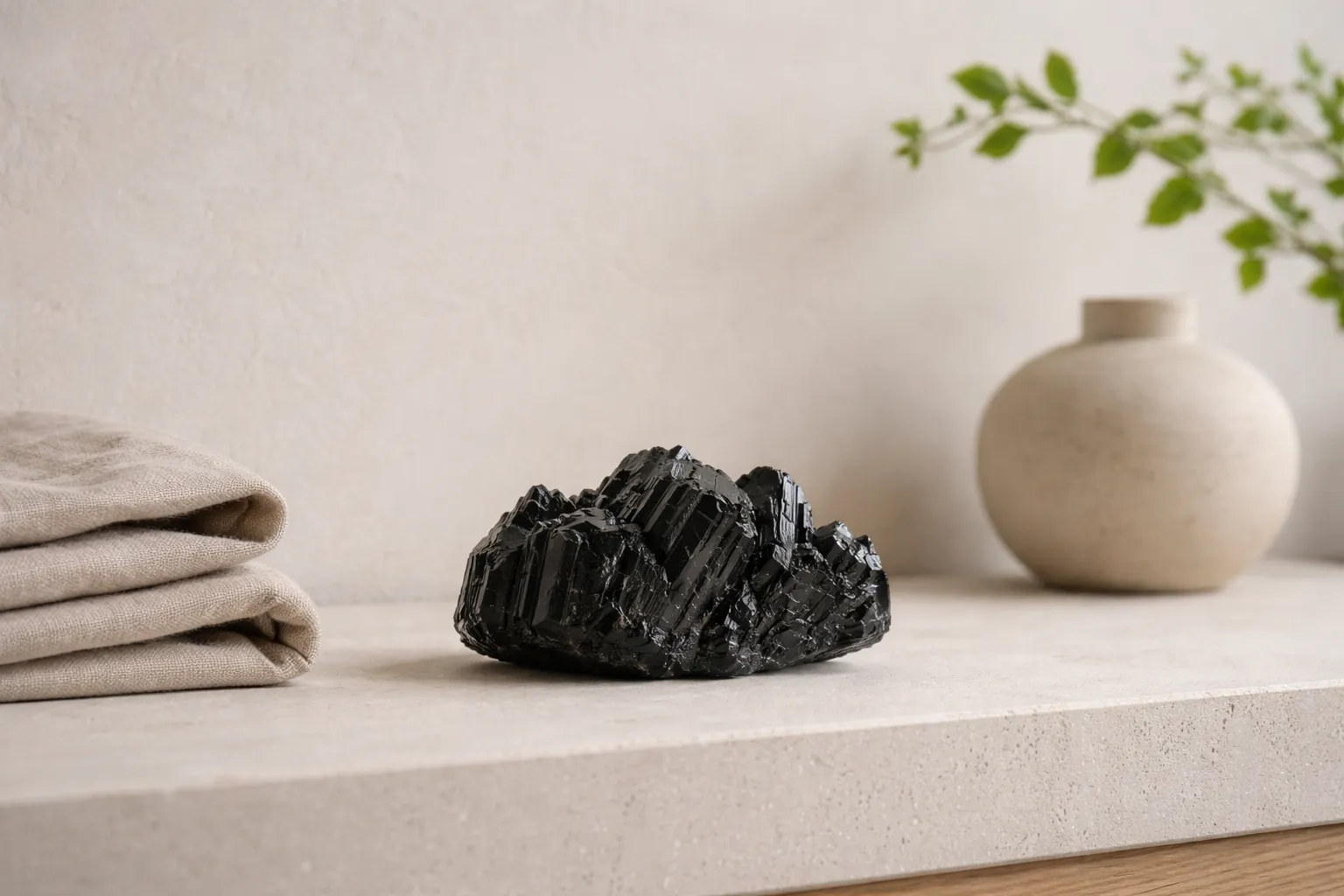
For interiors, the most grounded reading is material-based. Schorl is dark, textured, visually heavy, and often architectural in form. A black striated crystal can create contrast against pale stone, wood, linen, plaster, or matte ceramic. It may make a shelf, desk, or entry surface feel more visually settled. That is a design effect, not a mineralogical measurement.
Quick checklist for reading schorl mineral data
Use this checklist when comparing a specimen description to schorl mineral data:
- Does the listing use schorl, or only the broader phrase black tourmaline?
- Is it described as a tourmaline group mineral?
- Is the formula close to NaFe²⁺₃Al₆(Si₆O₁₈)(BO₃)₃(OH)₃(OH)?
- Are prismatic crystals or vertical striations visible?
- Is the hardness given around Mohs 7 to 7.5?
- Does the description mention poor or indistinct cleavage and uneven to subconchoidal fracture?
- Is the occurrence plausible, such as pegmatite, metamorphic, or hydrothermal setting?
- Are symbolic or grounding statements kept separate from mineral facts?
- If the piece is polished, dyed, coated, or bead-cut, is the identification supported by more than color?
This checklist does not replace formal mineral identification. It keeps the question narrow: is the object being described as schorl because it fits the mineral data, or because it is simply a black stone in a retail category?
Minimal FAQ
Is schorl the same as black tourmaline?
Usually, yes in everyday use. Schorl is the mineralogical name for the common black, iron-rich tourmaline species. Black tourmaline is the broader common or retail phrase. The terms overlap, but schorl is more specific.
Why does schorl often have vertical striations?
The lengthwise striations reflect how tourmaline crystals grow along prismatic faces. They are a common clue in natural schorl crystals, but they are not enough on their own for identification.
Is schorl durable enough for jewelry?
It is hard enough to resist many scratches, but it is brittle. Exposed points, raw crystals, and fractured pieces can chip or break. Protective settings and lower-impact use are more sensible than relying on hardness alone.
Schorl is more than a black stone because its identity rests on tourmaline-group chemistry, trigonal crystal structure, prismatic habit, and specific physical properties. The useful boundary is just as important: mineral data describes what schorl is, while grounding language describes how some people choose to relate to it. Those readings can coexist, but they should not be treated as the same kind of claim.
Sources
Sources and further reading
Reference links are limited to sources considered suitable for public citation in this page.