Decoding the Borosilicate Structure of Modern Black Tourmaline
Black tourmaline is usually discussed in mineralogy as schorl, the iron-rich black species within the tourmaline group. In plain chemical language, ideal schorl can be described as a Sodium iron aluminum borosilicate. Its commonly cited ideal formula is:
NaFe²⁺₃Al₆(BO₃)₃Si₆O₁₈(OH)₄
That formula is useful, but it is not a laboratory result for every black crystal sold as “black tourmaline.” It is an idealized mineral formula: a clean model that shows the defining structure and chemistry of schorl.
The short version is this: modern black tourmaline, when it is schorl, is understood through a borosilicate crystal lattice built from Si₆O₁₈ silicate rings, BO₃ borate groups, and several lattice sites that can hold sodium, iron, aluminum, hydroxyl, fluorine, oxygen, or related substitutions. The structure explains why “sodium iron aluminum borosilicate” is a meaningful identity phrase, while natural variation explains why real specimens rarely behave like perfectly pure textbook end-members.
broader context
Start with the main black tourmaline page
This narrower page works best after the broader black tourmaline context page.
Why Schorl Fits the Sodium Iron Aluminum Borosilicate Label
A reader may first meet black tourmaline in a crystal shop, a jewelry listing, or an article calling it a protective stone. Mineral chemistry uses a different kind of language. It is not describing symbolism or retail meaning; it is describing the internal architecture of the mineral.
The useful translation looks like this:
Black tourmaline
The common name used for dark tourmaline specimens
Schorl
The iron-rich black tourmaline species most often meant by that name
Sodium iron aluminum borosilicate
A simplified description of ideal schorl chemistry
Tourmaline group
The broader mineral group sharing a related borosilicate lattice
The ideal schorl formula can also be written in a site-aware way:
XNa YFe²⁺₃ ZAl₆ (Si₆O₁₈)(BO₃)₃ V(OH)₃ W(OH)
This style makes the structure easier to read. Sodium is associated with a larger site in the lattice. Iron is central to schorl’s identity. Aluminum occupies major octahedral positions. Silicon forms the ring-silicate unit. Boron is present as borate groups. Hydroxyl completes key anion positions.
So the phrase Sodium iron aluminum borosilicate is not just a decorative chemical label. It says that schorl is a crystalline borosilicate mineral with ordered internal sites, not simply “a black rock.” The caution is that the phrase is shorthand, not a specimen-by-specimen assay.
What the Crystal Lattice Is Doing
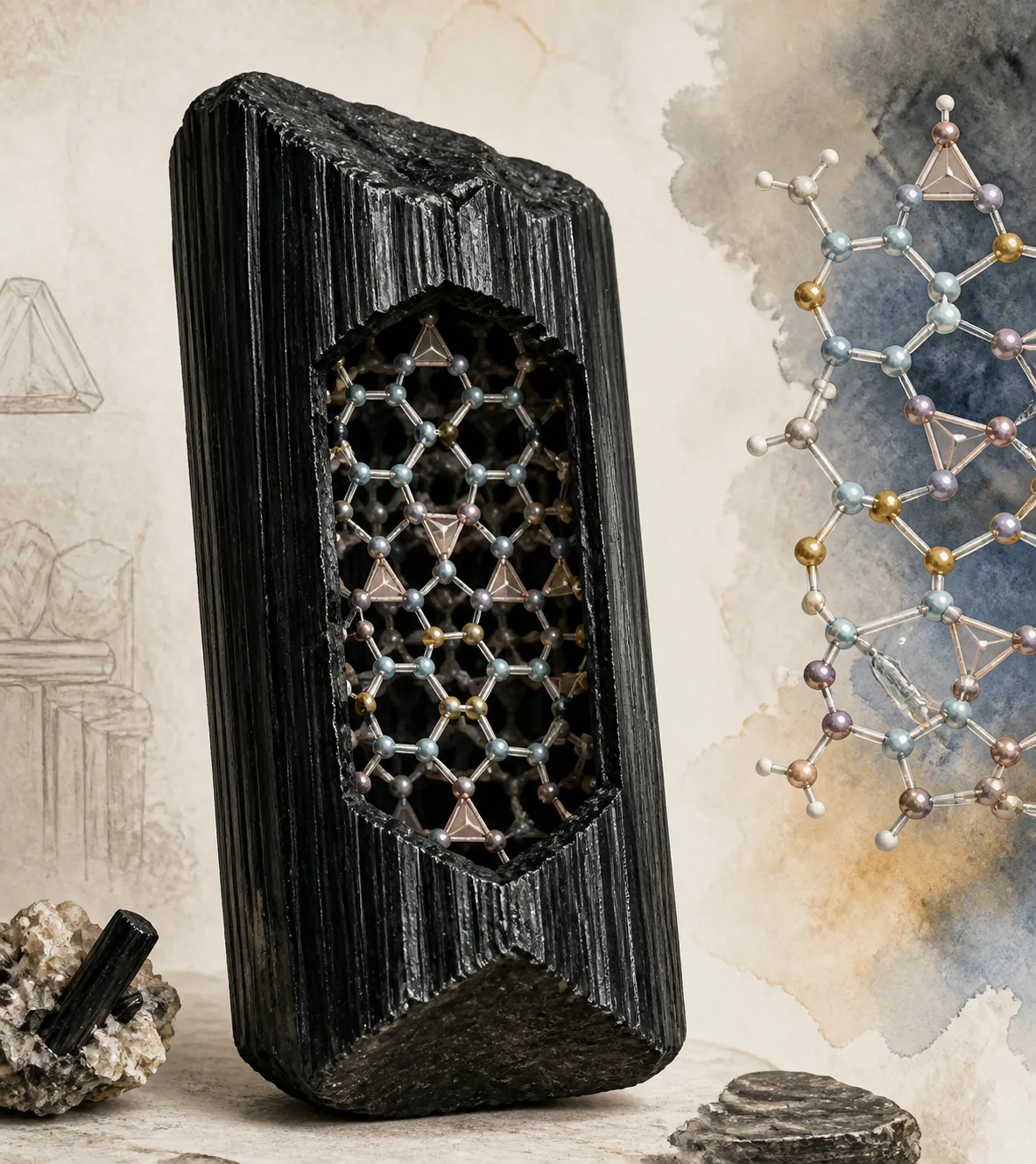
A rough black tourmaline crystal often gives a visible hint of its structure: long columnar growth, lengthwise striations, and sometimes a triangular cross-section. Those features do not confirm exact chemistry on their own, but they help connect the stone in hand to tourmaline’s internal order.
Tourmaline is commonly described as a cyclosilicate, or ring silicate. In this structure type, silicon-oxygen tetrahedra link into rings. The important tourmaline unit is the Si₆O₁₈ ring, made from six linked silicon-oxygen tetrahedra.
Schorl is also a borosilicate, because boron is built into the structure as BO₃ groups. Boron is not just a trace idea added to a silicate; it is part of the tourmaline framework.
A simplified structural map looks like this:
Si₆O₁₈ silicate rings
The ring-silicate backbone of the tourmaline structure
BO₃ groups
The borate units that make tourmaline a borosilicate
X site
A larger position commonly associated with Na in ideal schorl
Y site
The site where Fe²⁺ is central to ideal schorl chemistry
Z site
Aluminum-rich octahedral positions in the ideal model
V and W positions
Anion positions involving OH, F, or O depending on composition
This is the chemical mechanics behind the shorter label. Sodium, iron, aluminum, boron, silicon, oxygen, and hydroxyl are not merely ingredients mixed together. They sit in a repeating crystal lattice with site rules.
It is also why “borosilicate” in black tourmaline should not be confused with borosilicate glass. The word overlaps because both involve boron and silicon chemistry, but schorl is a naturally crystalline mineral with an ordered lattice. Glass does not have the same long-range crystal structure.
Why the Ideal Formula Changes in Real Black Tourmaline
The easiest mistake is to treat the formula as if every black tourmaline crystal must match it perfectly. Mineral formulas often describe an ideal end-member. Natural specimens can vary through substitution, vacancies, oxidation state, and solid solution.
Tourmaline is especially flexible because its structure has several sites that can accept different ions within limits. Mineralogical references often represent the broader tourmaline structure with a generalized formula such as:
XY₃Z₆(T₆O₁₈)(BO₃)₃V₃W
That notation is not meant to make the mineral look more obscure. It shows that different positions in the lattice have different chemical jobs.
- X may include Na, Ca, K, or a vacancy.
- Y may include Fe²⁺, Mg, Mn, Al, Li, Fe³⁺, or other cations depending on the tourmaline species and specimen.
- Z is commonly aluminum-rich, though substitutions can occur.
- T is mainly silicon in the ring-silicate unit.
- V and W may involve OH, F, or O.
In ideal schorl, the defining emphasis is on Na, Fe²⁺, and Al within a borosilicate ring structure. In a real black crystal, some sodium may be absent from the X site, some aluminum may occur where iron is expected, iron may distribute across more than one octahedral site, and fluorine or oxygen may partly replace hydroxyl in specific positions.
Those changes do not make the lattice random. They happen within structural constraints: ionic size, charge balance, bond lengths, and site geometry all matter. This is why a specimen can be structurally schorl-like without matching the clean formula atom for atom.
For a structure-focused reader, the key point is simple: Sodium iron aluminum borosilicate is an accurate shorthand for ideal schorl, but measured composition is a separate question.
Iron, Color, and Site Chemistry
Black tourmaline’s dark appearance is commonly linked with iron-rich chemistry, and schorl is the familiar iron-rich black tourmaline species. Still, color is less precise than structure. A dark crystal may look convincing, but appearance alone cannot confirm exact site occupancy, oxidation state, or end-member purity.
Iron in schorl is not just “black pigment.” In the ideal formula, Fe²⁺ belongs to the Y-site part of the lattice. In natural tourmalines, iron behavior can be more complex, including distribution across crystallographic sites in some specimens. The placement of iron depends on the same structural rules that govern the rest of the lattice.
A practical way to read the formula is:
- Na marks the large-site alkali component in ideal schorl.
- Fe²⁺ carries the iron-rich character central to schorl.
- Al fills major octahedral positions and helps stabilize the structure.
- Si₆O₁₈ names the ring-silicate backbone.
- BO₃ identifies the borosilicate nature of tourmaline.
- OH, F, and O variation explains why natural specimens can differ from a single simplified ending.
That is enough for this question. Related tourmaline names, such as fluorine-bearing or magnesium-rich species, can illustrate site substitution, but they are not the center of the answer here. The focus is black tourmaline as schorl: an idealized sodium iron aluminum borosilicate with natural compositional variation.
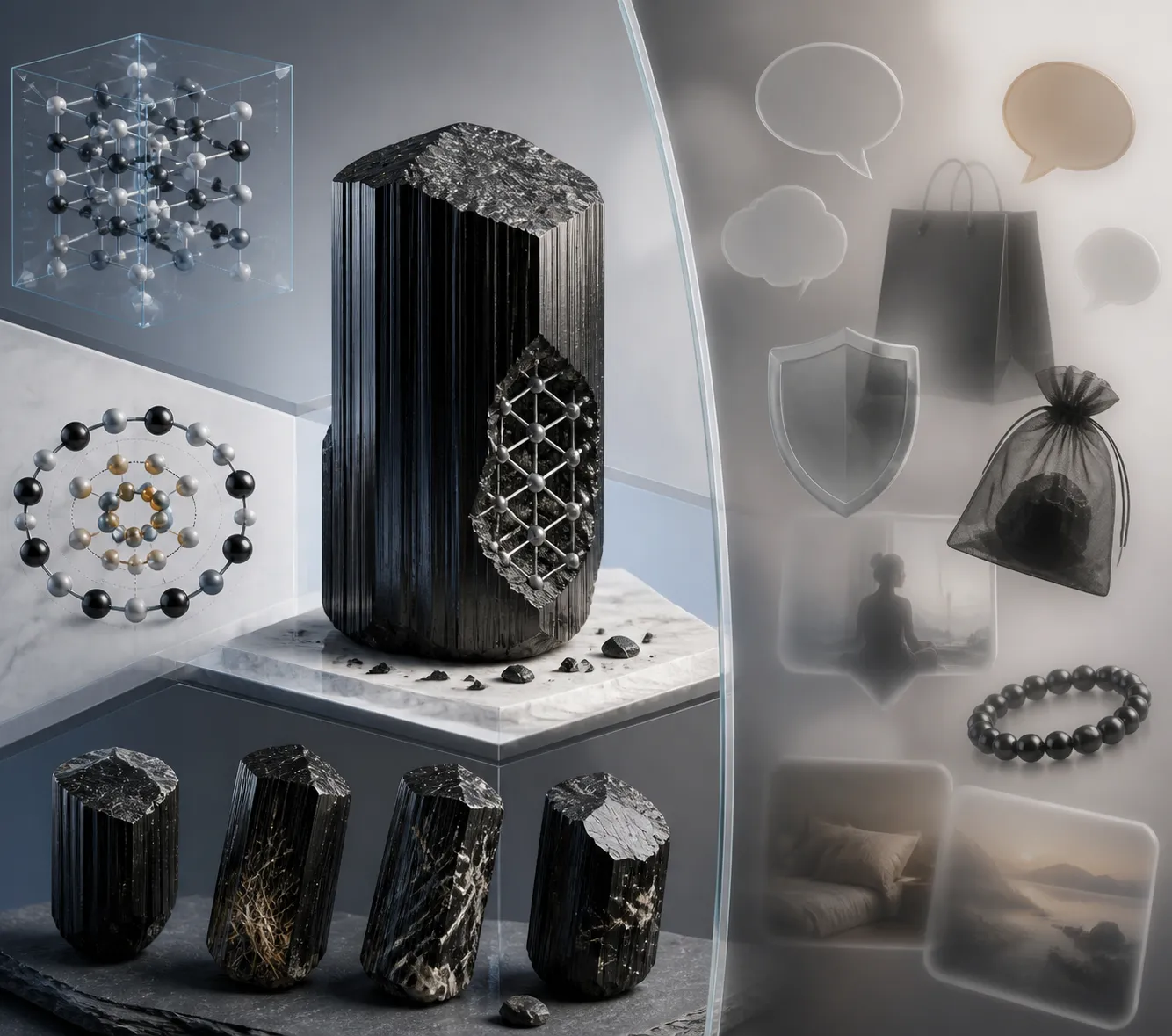
Where Common Black Tourmaline Claims Separate from Mineral Structure
Black tourmaline is often surrounded by cultural, retail, and metaphysical language. That language may be meaningful to some users as symbolism or personal practice, but it is separate from the mineralogical structure.
A clean separation helps:
“Black tourmaline is schorl”
Often true in common mineral and retail use, though exact identity depends on the specimen
“Schorl is a sodium iron aluminum borosilicate”
A useful idealized chemical description
“Tourmaline contains Si₆O₁₈ rings and BO₃ groups”
A structure statement about the borosilicate lattice
“Every black crystal is pure schorl”
Too strong; natural tourmaline can show substitutions and solid solution
“Darker color means stronger personal effect”
A cultural or commercial claim, not a mineral-structure conclusion
“Electrical crystal properties prove personal protection”
A misuse of material-property language
Tourmaline can show pyroelectric and piezoelectric behavior, meaning it may produce electrical responses under temperature or pressure changes. Those are crystal properties. They do not, by themselves, establish health-outcome claims, spiritual-effect claims, or claims about shielding people from everyday electromagnetic sources.
The lattice explains mineral behavior. It does not turn symbolic or marketing language into mineralogical evidence.
A Practical Reading of the Formula
If you are reading a black tourmaline label, the chemistry can be understood in three layers.
First, black tourmaline schorl gives the likely mineral identity: an iron-rich black tourmaline. Second, Sodium iron aluminum borosilicate gives the simplified chemistry of ideal schorl. Third, the formula and lattice language explain why variation is expected: tourmaline has multiple sites, and those sites can accept substitutions within structural limits.
A concise version would be:
Schorl is the common black tourmaline species. Its ideal chemistry can be summarized as a sodium iron aluminum borosilicate, built from Si₆O₁₈ silicate rings, BO₃ groups, and site-based Na, Fe, Al, OH/F/O chemistry. Real specimens can vary, so the formula is a model unless supported by analysis.
That reading keeps the stone-in-hand appearance connected to the crystal lattice without turning the formula into a purity promise.
The Boundary of the Answer
The borosilicate structure of modern black tourmaline is best understood through the ideal schorl model: sodium, ferrous iron, aluminum, Si₆O₁₈ silicate rings, BO₃ groups, and hydroxyl-bearing lattice positions arranged in the tourmaline structure. This is why Sodium iron aluminum borosilicate is a meaningful phrase for schorl.
The limit is just as important: tourmaline chemistry is naturally flexible. A black specimen may contain vacancies, substitutions, mixed Fe/Mg/Al behavior, or OH/F/O variation while still appearing and classifying close to the schorl field. The ideal formula gives the mineralogical target. It does not replace measured analysis of a specific stone.
For this single question, the useful decoding is straightforward: black tourmaline is not defined by color alone, and schorl is not defined by retail language. Its identity rests in a complex borosilicate crystal lattice whose ring structure and site chemistry explain both the ideal formula and the variation seen in natural material.