black tourmaline mineralogy
Why is Black Tourmaline So Dark? The Science of Divalent Iron
By Clara Vance · May 09, 2026
Why is Black Tourmaline So Dark? The Science of Divalent Iron
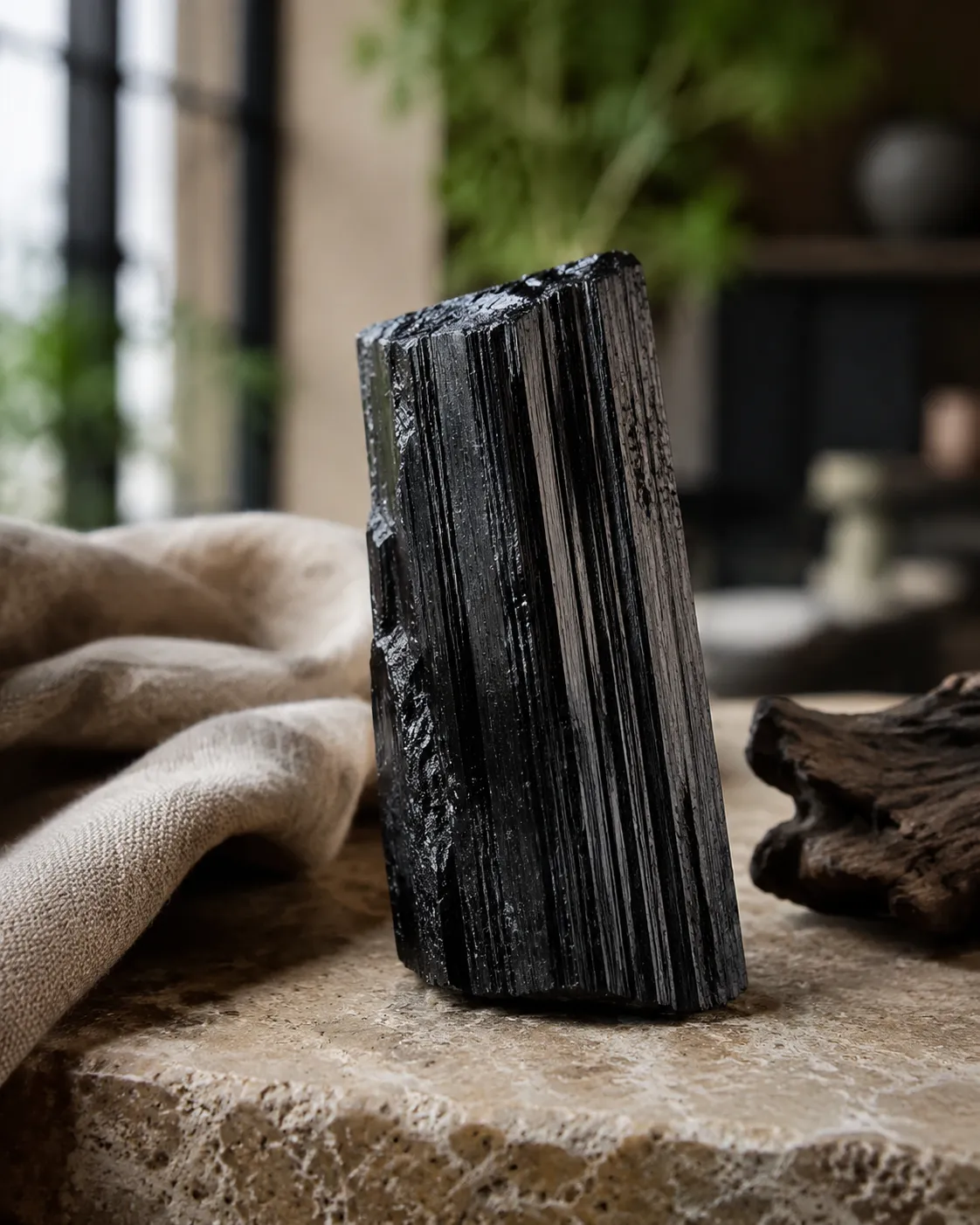
Black tourmaline looks so dark because it is usually schorl, the iron-rich end member of the tourmaline group. In schorl, iron is part of the mineral’s chemistry, and that chemistry helps the crystal absorb a large share of visible light. Divalent iron, written as Fe2+ or ferrous iron, is especially important, along with Fe2+–Fe3+ interactions that can deepen the apparent blackness.
The short version is simple: the darkness comes from the crystal itself, not just from a coating or a stained surface. The color is built into the structure and into the way that structure interacts with light.
broader context
Broader schorl guide
This narrower page works best after the broader black tourmaline context page.
The short answer: the darkness comes from the crystal itself
The color of black tourmaline is not just a surface effect. It comes from the way iron is built into the tourmaline structure and how that structure interacts with light.
In simple terms, schorl absorbs broadly across the visible range. Instead of reflecting a strong red, green, or blue band back to the eye, it absorbs so much light that the specimen reads as black, dark brown-black, or nearly opaque.
A few terms make the science easier to follow:
- Fe2+ means divalent iron, also called ferrous iron.
- Fe3+ means ferric iron.
- Intervalence charge transfer is a light-absorption process involving ions in different oxidation states, often discussed with Fe2+ and Fe3+.
- d-d transitions are another type of iron-related absorption that can contribute to dark color in minerals.
For schorl iron content, the important point is not that every specimen has identical chemistry. It is that iron-rich structure gives black tourmaline a strong internal reason to absorb light.
Why schorl is black while other tourmalines are not
Tourmaline is a mineral group, not a single color. Schorl is the iron-rich black member, while other tourmalines may be green, blue, pink, brown, or colorless depending on their chemistry.
That is why black tourmaline and tourmaline should not be treated as interchangeable when asking about color. The black appearance is closely tied to schorl’s iron-rich composition, especially Fe2+ in the crystal structure. Other elements and oxidation patterns can shift tourmaline toward different visible colors.
This is where the distinction between idiochromatic and allochromatic color helps:
- Idiochromatic color comes from essential chemical components of the mineral.
- Allochromatic color comes from trace impurities, defects, or secondary effects.
Black tourmaline is better understood as mostly idiochromatic. Its darkness is not usually explained as a small accidental impurity. It is tied to the iron-rich chemistry of schorl itself.
Why some pieces look brown-black and others look nearly opaque
Not every black tourmaline specimen looks exactly the same. A crystal may appear charcoal black, dark brown-black, or almost lightless depending on several variables.
Iron content and oxidation state
Higher iron content generally supports stronger visible-light absorption. The balance between Fe2+ and Fe3+ also matters because the two forms of iron do not absorb light in exactly the same way. When both are present in the structure, charge-transfer behavior can add to the depth of color.
This does not mean a darker piece is automatically better or more authentic. It means the specimen may be absorbing light more strongly because of its chemistry, thickness, orientation, or a combination of those factors.
Crystal thickness and orientation
A thin chip of a dark mineral can transmit more light than a thick crystal. That is a basic optical effect, not a contradiction.
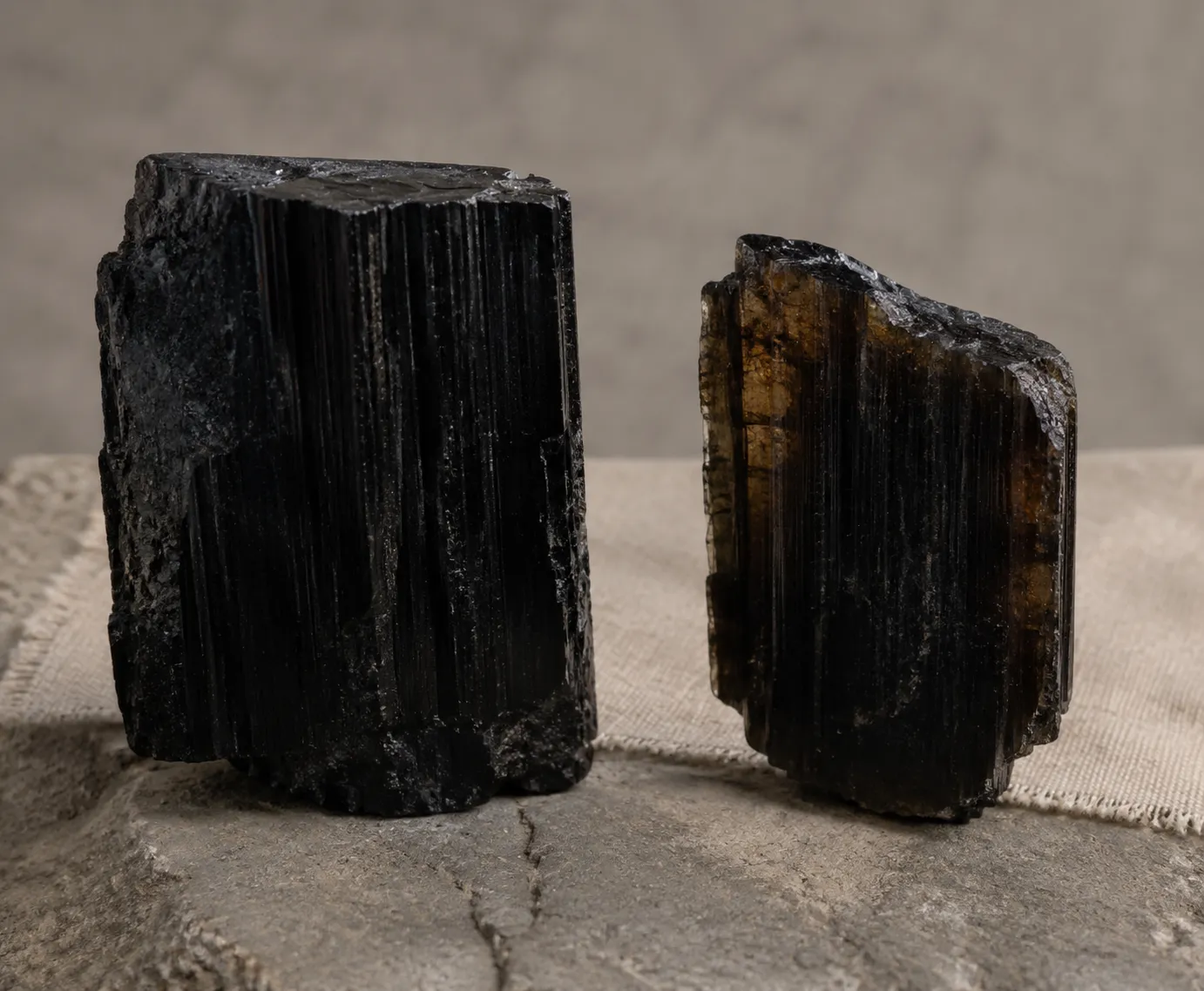
Tourmaline can also show different appearances depending on viewing direction, especially under polarized light. In a hand specimen, this may be subtle. In thin edges or broken areas, the same piece that looks black from the front may show brown, blue, or greenish hints when backlit.
Zoning and uneven absorption
Some schorl crystals are zoned, meaning the chemistry is not perfectly uniform throughout the crystal. Backlit edges, fractures, or thin areas may reveal lighter tones. That does not automatically make the stone fake. A black body color and a translucent colored edge can both belong to the same natural specimen.
What darkness can and cannot prove
People often fold three separate questions into one:
- Is this really black tourmaline?
- Why is it so dark?
- Does the stone have a symbolic or personal meaning?
Only the second question is answered by the iron-color science.
For identification, visual clues can be useful but limited. Natural black tourmaline often shows:
- lengthwise striations on crystal faces
- a vitreous to slightly resinous luster
- a dense feel for its size
- black to dark brown-black color, sometimes with lighter edges in strong light
Those clues are not laboratory proof. A polished piece can look very uniform, and a natural crystal can appear almost featureless from some angles. At the same time, a plastic-like surface, painted-looking chips, or unusually lightweight material may be reasons to look more closely.
The color explanation should stay separate from belief or wellness language. Black tourmaline is often described with words such as grounding, protection, or shielding. Those are symbolic, traditional, or subjective ways people talk about the stone. They are not the same as mineralogical evidence.
The material explanation supports iron-based light absorption; it does not establish emotional, spiritual, or environmental outcomes.
If a description moves from schorl is dark because of Fe2+ to a guaranteed effect claim, it has left the field of mineral color science.
The practical limit of the science
The main answer is stable: black tourmaline is dark because iron-rich schorl absorbs visible light strongly, with divalent iron and iron-related interactions playing a central role.
The exact details vary by specimen. Different deposits can produce different iron levels, Fe2+/Fe3+ balances, site occupancies, zoning patterns, and crystal thicknesses. That is why two genuine pieces of black tourmaline may not look identical.
A careful summary is:
- Black tourmaline is dark because schorl absorbs visible light strongly.
- Iron, especially Fe2+, is a major reason for that absorption.
- The black color belongs to the internal crystal chemistry, not just the surface.
- Visual darkness alone does not prove identity.
- Symbolic or personal meanings should be kept separate from the physical color mechanism.
So the answer is bounded, not absolute. The mineral science explains why schorl is dark, while the exact shade and opacity still depend on chemistry, oxidation state, zoning, and crystal thickness.
FAQ
Is black tourmaline black because of iron or because it is opaque?
Both ideas are connected. The iron-rich structure causes strong light absorption, and that strong absorption makes the stone appear very dark or opaque in many specimens.
Does every black tourmaline contain the same amount of Fe2+?
No. Schorl can vary in total iron content, Fe2+/Fe3+ balance, and internal zoning. The shared result is a dark appearance, but the exact chemistry is not identical in every sample.
Can real black tourmaline show brown or greenish edges?
Yes. Thin edges, fractures, or backlit areas may show brown, blue, or greenish tones. That can happen because the light path is shorter or because the crystal is chemically zoned.
Black tourmaline is so dark because schorl is an iron-rich tourmaline whose crystal structure absorbs light very efficiently, especially through Fe2+-linked processes. The main limit is that individual samples vary, so the exact shade and opacity depend on chemistry, oxidation state, zoning, and crystal thickness.
Sources
Sources and further reading
Reference links are limited to sources considered suitable for public citation in this page.