You’re Ruining Your Crystals: The Safest Way to Clear Black Tourmaline
The safest way to clear black tourmaline with smoke is a brief, low-contact Smoke Cleansing Reset: dust the stone first, use a small amount of sage, Palo Santo, or another smoke source only if it fits your practice, pass the crystal near the smoke for a few slow moments, keep it away from flame and prolonged heat, ventilate the room, and fully extinguish the ember.
That is enough. More smoke, more time, direct flame, oils, salt, soaking, or dramatic heat does not make the reset “stronger” in any supported way. For black tourmaline, the safer ritual is the quieter one: minimal contact, clean handling, a heat-safe dish, and a clear line between symbolic clearing and physical cleaning.
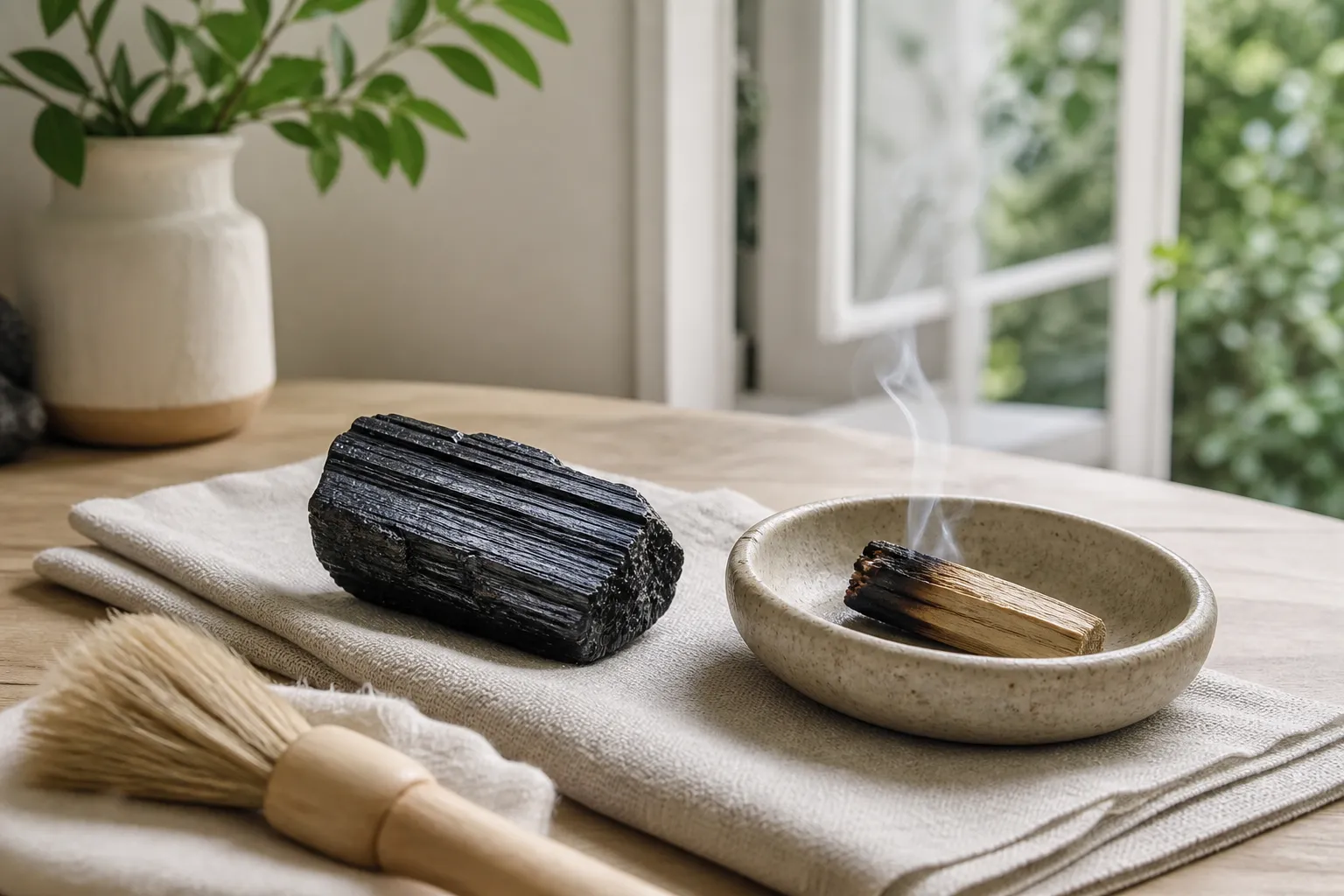
The safe smoke-cleansing method for black tourmaline
Think of this as crystal maintenance, not a test of devotion. Black tourmaline is commonly associated with schorl, a real mineral material; in crystal traditions, it is also often treated as a grounding or protective stone. Those are different kinds of language. Mineral facts can guide gentle handling. Smoke cleansing belongs to personal or spiritual practice.
A simple black tourmaline smoke cleansing can look like this:
-
1. Remove dust first.
Use a soft dry cloth, a clean makeup brush, or a very soft paintbrush. Smoke is not a substitute for dusting. If the crystal has grit in grooves or striations, brush gently rather than scrubbing.
-
2. Set up a heat-safe dish.
Use ceramic, stone, metal, or another heat-safe surface for ash and embers. Keep paper, curtains, bedding, dried botanicals, oils, sprays, and loose fabric away from the burning material.
-
3. Ventilate before you begin.
Open a window if outdoor air is suitable, or choose a room with good airflow. Research on incense and burned aromatic materials shows that indoor burning can add fine particles and other compounds to the air, especially in poorly ventilated spaces. The practical takeaway is moderation, not alarm.
-
4. Use a small smoke source.
Sage and Palo Santo are common in contemporary crystal-cleansing language, but neither is required. If you use either, let a small amount smolder rather than burn heavily.
-
5. Keep the crystal out of flame.
Do not pass black tourmaline through a flame. Hold it beside or above the smoke path, away from the hot tip of the herb bundle or wood stick.
-
6. Keep the reset brief.
Ten to thirty seconds is usually enough for the ritual gesture. If you want a slower moment, pause with the stone near the smoke instead of adding more burning material.
-
7. End cleanly.
Place the crystal on a clean surface. Put out the sage or Palo Santo fully in the heat-safe dish. Do not leave a smoldering bundle unattended. Let the room air out afterward.
If intention-setting is part of your practice, keep it plain: “I’m resetting this stone for grounded use,” or “I’m clearing the old association and returning it to neutral.” That kind of phrase can be meaningful as ritual language. It should not be confused with proof that smoke changes the mineral or removes measurable contamination.
Why brief and low-contact is safer than “stronger” cleansing
The common mistake is assuming black tourmaline needs an intense clearing because crystal shops and practitioner language often describe it as absorbent, protective, or “heavy” after use. If that metaphor matters to you, the method can still stay gentle.
A low-contact smoke reset is safer for three reasons.
It avoids unnecessary heat.
Black tourmaline does not need direct flame to be included in a smoke ritual. Holding a crystal in flame can heat the surface unevenly, leave soot, or stress fractures, inclusions, rough terminations, or attached matrix. Even when the stone feels sturdy, good maintenance does not test its limits.
It avoids unnecessary wet or chemical contact.
Some crystal-cleansing advice recommends soaking, salt water, oils, sprays, or alcohol-based products. For this question, none of that is needed. Smoke cleansing, done briefly and away from flame, is a low-contact ritual option. Physical care can stay dry and simple unless you have reliable, specimen-specific guidance.
It limits indoor smoke.
Studies on incense are not the same as studies on one short sage or Palo Santo ritual. Still, they support a sensible boundary: burning aromatic plant or wood materials indoors can produce particles and gases, and ventilation matters.
The safer principle is simple: use the least smoke that still completes the ritual for you.
Sage, Palo Santo, and when not to burn anything
Sage smoke cleansing and Palo Santo smoke cleansing are both common in the modern crystal-maintenance world. They are not identical in scent, sourcing, cultural context, or personal meaning, but the same practical rule applies: if you burn it indoors, keep it brief, controlled, and ventilated.
A few boundaries help:
- Sage is optional. Many people use “sage” broadly, and commercial smoke bundles may contain different plant species or mixed materials. If you use sage, buy from a source you trust and avoid treating it as a context-free commodity.
- Palo Santo is optional. Palo Santo is widely sold for cleansing rituals, but popularity does not make it necessary. Choose reputable sourcing if you use it, and avoid burning a large piece for a small crystal reset.
- Do not rank one as automatically safer. The available indoor-air research is mostly about incense and burned aromatic materials in general, not a clean sage-versus-Palo-Santo comparison. The better statement is: any indoor smoke should be minimized and ventilated.
- Skip smoke when the household makes it a poor fit. Avoid burning materials around babies, children, pregnancy, pets, people with asthma, COPD, allergies, migraines, respiratory sensitivity, or anyone who does not want smoke in the space. Also follow rental rules, building rules, shared-ventilation limits, and smoke alarm requirements.
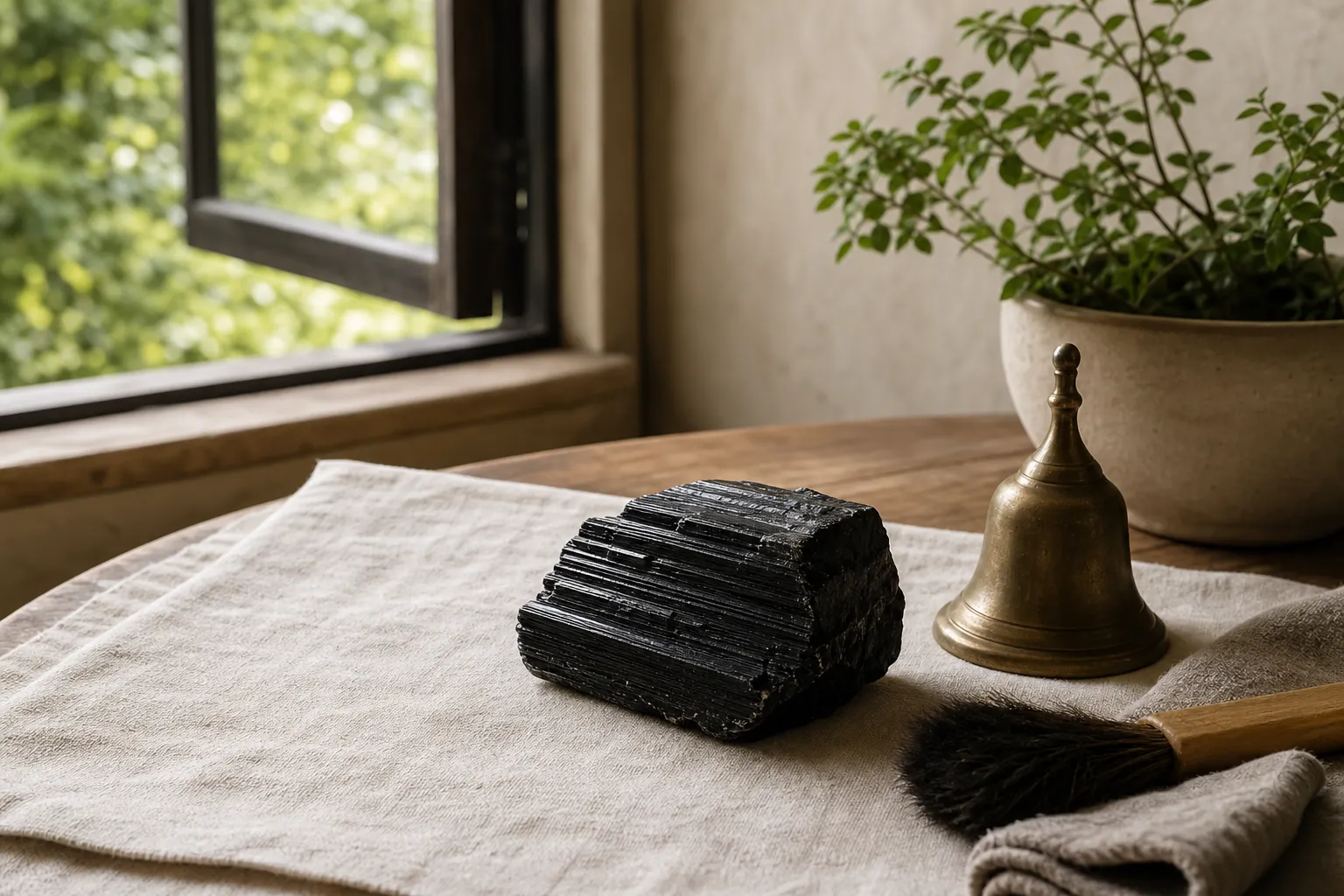
Non-smoke alternatives can serve the same symbolic purpose. Place black tourmaline on a clean cloth, ring a bell nearby, use breath and visualization, set it by a window away from harsh heat, or simply hold it and restate its purpose. These are personal ritual choices, not guaranteed energetic methods. Their practical advantage is clear: no flame, no ash, no indoor smoke.
What smoke cleansing does not do
A Smoke Cleansing Reset is not physical cleaning. It does not sanitize a crystal or remove skin oils, packaging residue, mold, dust, or measurable contamination. If your black tourmaline is dusty, dust it. If it has residue from storage or handling, use the gentlest physical care appropriate to the specimen and avoid soaking or harsh products unless you have reliable material-specific guidance.
This distinction matters because black tourmaline often has grooves, striations, broken terminations, attached matrix, or naturally rough surfaces. Smoke may make the stone feel ritually reset, but too much can leave odor or soot. A smoky crystal is not necessarily a cleaner crystal.
It also does not need a rigid schedule. Some practitioners reset a daily-carried stone more often than a display piece, but that is a convention, not a rule. A practical rhythm is to do it when you bring the stone home, change its use, move it into a new room, finish a period of frequent handling, or want a simple transition ritual.
Avoid turning maintenance into anxiety. Black tourmaline does not need to be rescued every few days because it is “full.” If that language is part of your belief system, treat the reset as a symbolic pause rather than an emergency procedure.
A quick check before you light the smoke
Before doing a ventilated smoke cleansing, ask:
- Is the crystal dry, cool, and free of loose dust?
- Is there a heat-safe dish for ash and embers?
- Is the space ventilated?
- Are pets, children, and smoke-sensitive people away from the smoke path?
- Is the stone kept away from direct flame and hot embers?
- Is the burn small enough to extinguish quickly?
- Are you clear that this is a ritual reset, not physical cleaning?
If any answer is no, choose a non-smoke reset instead. That is not a lesser ritual; it is the better fit for the room you are actually in.
The bottom line
For black tourmaline, the safest Smoke Cleansing Reset is brief, ventilated, and low-contact. Dust the stone first, use sage or Palo Santo only if it fits your practice and sourcing values, keep the crystal out of flame, let smoke pass around it for a short moment, and extinguish everything fully.
The ritual can be meaningful without being excessive. For crystal maintenance, restraint is the point: less heat, less smoke, less contact, and fewer unsupported claims.