Material setting note
Why Bezel Settings Are the Safest Choice for Tourmaline Jewelry
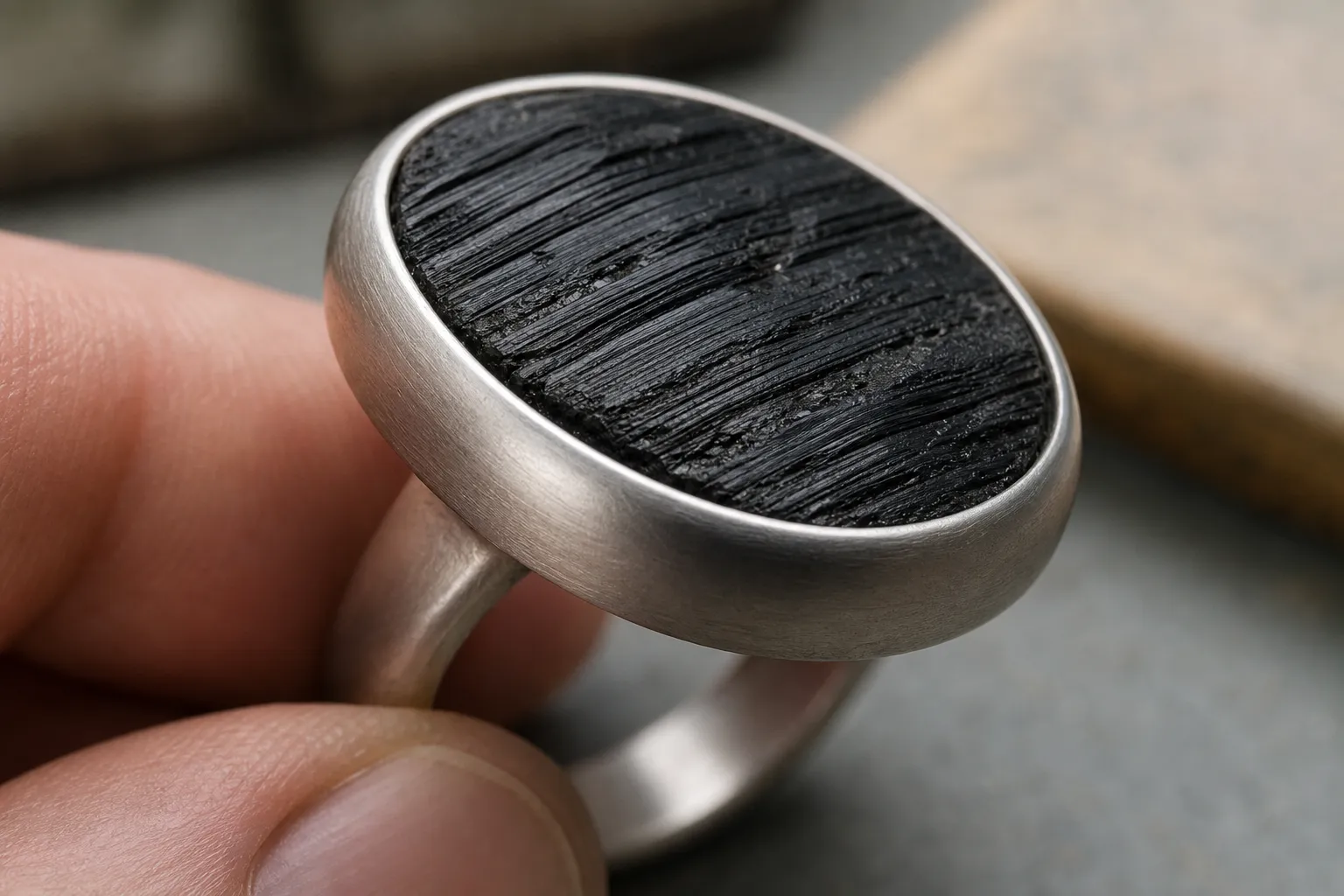
A black tourmaline bezel setting is often the safest practical choice because the metal rim covers more of the stone’s edge, leaves less crystal exposed, and gives fabric, hair, and hard surfaces fewer places to catch. It does not make tourmaline unbreakable. It simply changes where daily contact lands.
For a schorl ring, pendant, or small crystal-set piece, the logic is plain: fewer exposed corners, fewer raised prongs, and less direct edge impact usually make a more forgiving mounting for fragile tourmaline jewelry. The available material for this page does not include bench testing, repair records, or authoritative wear studies, so the answer stays within cautious jewelry-setting logic rather than a universal durability claim.
broader context
Start with the main black tourmaline page
This narrower page works best after the broader black tourmaline context page.
The Bezel Protects the Edge First
In jewelry, damage often starts at an exposed edge. A pointed termination, stepped cut, thin rim, uneven side, or raised crystal surface gives the outside world more geometry to hit. If that edge sits above the metal, it may meet tabletops, door frames, sink edges, jacket zippers, and bag hardware before the setting does.
A bezel changes the first point of contact. The metal is shaped around the stone and rises along its perimeter. A full bezel continues around the whole edge; a partial bezel protects selected sides while leaving other areas open. The more continuous the coverage, the more the setting can act as a small buffer between the mineral and ordinary wear.
That matters for black tourmaline, also called schorl in mineralogy. The material is often valued for dark mass, ridged crystal habit, striations, and raw surface character. Those qualities can also create high points and less forgiving edges. A bezel does not erase that material reality, but it can reduce how much of the stone stands unprotected.
Rings need this more than many pendants. A ring meets steering wheels, counters, handles, pockets, tools, and soap dishes all day. A protective mounting for tourmaline is not only about holding the stone tightly; it is also about asking the metal, not the mineral, to take more of the first contact.
Why Bezels Usually Snag Less
Snagging is more than an annoyance. If a prong catches on knitwear, hair, a towel loop, or a bag lining, the pull can stress the metal. If the stone has open corners, that same movement may shift pressure toward a vulnerable point.
A bezel has fewer projecting parts than many open prong settings. Its rim is usually smoother, lower, and more continuous, with fewer hooks for fabric to grab and fewer small metal arms that can bend out of place. For secure crystal settings, this is the everyday advantage: less drama, fewer catch points.
This is especially useful for schorl ring mountings with a raw or irregular stone. A natural-looking black tourmaline piece may have an uneven outline, textured sides, or a surface chosen for character rather than symmetry. A well-made bezel can frame that irregularity so the hand feels a smoother perimeter than the crystal alone would offer.
Open settings can still be appropriate. They show more of the stone, admit more light around transparent gems, and can make a piece feel lighter. Black tourmaline is often chosen for opacity, texture, depth, and weight rather than sparkle, so a bezel can be both a practical and visual fit: a contained frame around a dark mineral surface.
What Makes a Bezel More Protective
Not every bezel gives the same protection. The word can describe anything from a low rim around a cabochon to a decorative lip around a tall crystal point. The safer choice depends on the stone’s form, the height of the mounting, and how the jewelry will be worn.
A more protective bezel usually:
- Covers the stone’s perimeter without leaving thin corners exposed.
- Rises enough to shield the edge without making the whole piece bulky.
- Feels smooth enough for fabric to pass over it.
- Holds the stone without pressing visibly fragile points.
- Matches the use case, with more coverage for rings and lighter coverage often acceptable for pendants.
A less protective bezel may still look like a bezel in photos. A shallow decorative rim that barely touches the edge does little for edge coverage. A tall crystal in a low cup can still take direct knocks at the top. A partial bezel may protect two sides while leaving two corners open. That may be a valid design choice, but it changes the protective value.
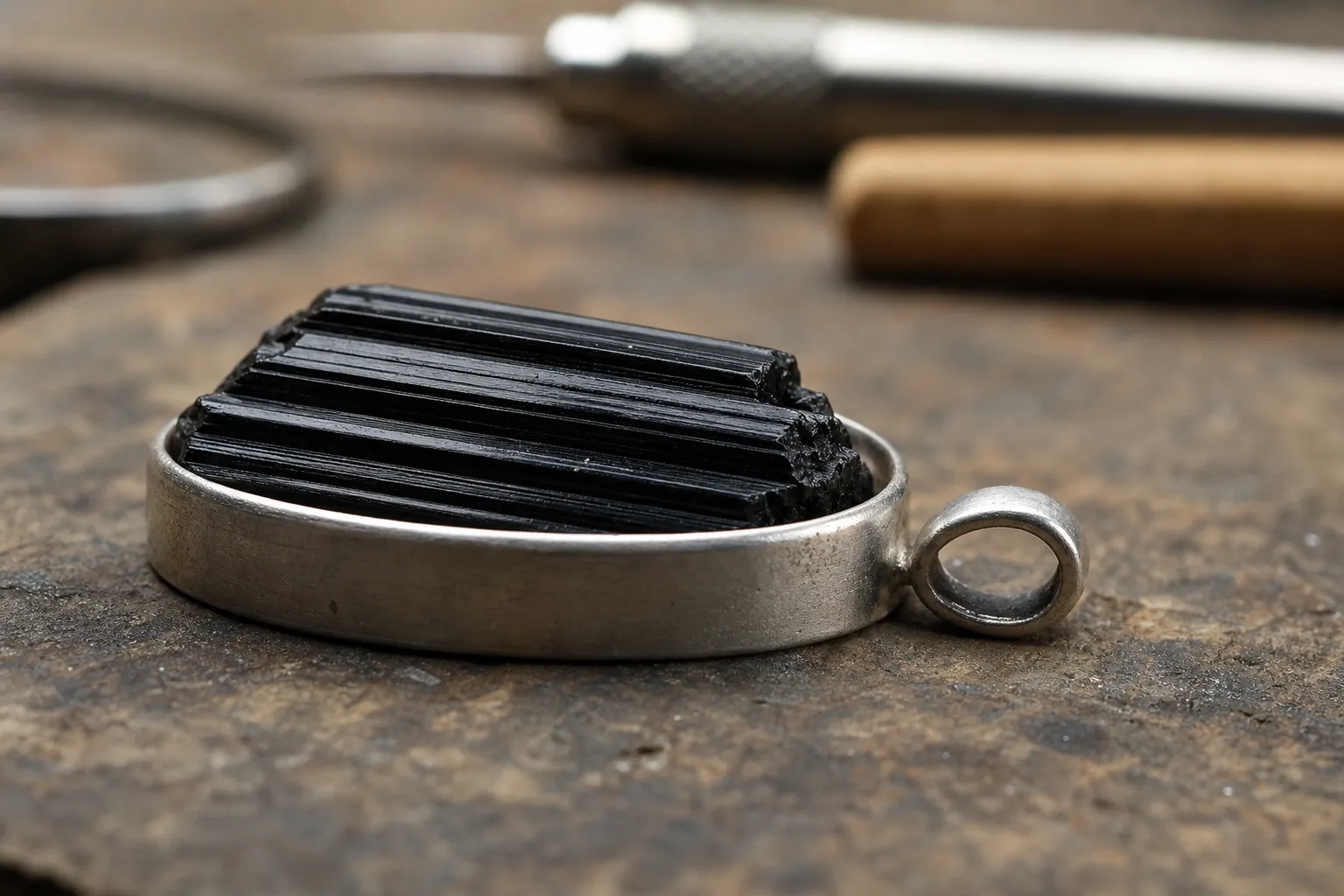
Height is the quiet variable. A low black tourmaline cabochon in a smooth full bezel generally presents fewer impact points than a tall raw crystal rising above a narrow rim. The second piece may look more sculptural, but the exposed crystal is still living in the open.
Metalwork matters too, though general product language cannot prove bench quality. In person, look for gaps, rocking, sharp metal edges, thin lips, or movement when the stone is gently touched. Online, side-view photos are more useful than a straight-on beauty image. You need to see how much stone actually rises above the rim.
When a Bezel Is the Better Choice
A bezel is usually the more sensible direction when the jewelry will be worn often, handled casually, or exposed to regular knocks. For a black tourmaline ring, that may mean desk work, errands, hand movement, sleeves, bags, and daily surfaces. For a pendant, it may mean contact with zippers, buttons, scarves, or other necklaces.
This does not mean every tourmaline jewel must be bezel set. A display pendant worn occasionally can tolerate more exposed design if the wearer accepts the handling limits. A collector-style crystal point may intentionally show its natural habit, including ridges and terminations. A symbolic piece may prioritize visibility and form over durability.
The bezel becomes the safer choice when the priority is practical protection rather than maximum exposure. If the goal is lowered gemstone exposure, reduced snag points, and more controlled edge contact, the bezel answers that need directly. If the goal is to show every side of the crystal, an open setting may serve the look better while carrying more exposure.
Black tourmaline care should stay simple: do not treat any stone-set jewelry as impact-resistant, remove rings before rough work, and inspect the setting after a drop or hard knock. A bezel reduces certain everyday vulnerabilities, but it does not remove the need for careful wear.
Common Confusion: Protective Does Not Mean Unbreakable
In jewelry, a protective setting means the design may reduce some ordinary risks: edge knocks, catching, corner pressure, and direct contact with the stone perimeter. It does not mean the stone cannot chip, crack, loosen, or break.
This distinction matters because black tourmaline also appears in symbolic and wellness-adjacent language. A protective mounting for tourmaline is a physical jewelry concept. It refers to metal placement, edge coverage, snag reduction, and wear behavior, not spiritual outcomes, body effects, emotional results, or environmental shielding. The setting is safer only in the material sense.
Another confusion is that a bezel always looks heavy or closed. Sometimes it does, especially with a wide border. But a careful bezel can also look quiet and architectural: a matte or polished frame around striated schorl, a lower outline for a ring, or a contained pendant edge that sits cleanly against clothing.
Prongs are not automatically unsafe either. Well-made prongs can hold stones securely and suit many designs. The narrower point is this: when the reader specifically wants to reduce exposed edges, snags, and direct knocks, a bezel usually fits that aim better than a more open mounting.
A Short Check Before Choosing
Before choosing a black tourmaline bezel setting, look at the piece as an object that will meet real surfaces. The useful question is not only “Is it beautiful?” but “Where will impact land first?”
Use this quick check:
- Does the metal cover the outer edge, or does the stone sit proud of the setting?
- Are there corners, ridges, or points that could hit a surface before the bezel does?
- Does the rim feel continuous and smooth, or are there gaps and sharp catches?
- Is the stone low enough for the way the piece will be worn?
- Is this a frequent-wear ring, or a pendant or occasional piece with less contact?
- Can the setting be inspected if the stone loosens, shifts, or takes a knock?
If several answers point to exposed edges and high contact points, the piece may still be appealing, but it is not using the full protective advantage of a bezel. If the metal visibly frames the vulnerable perimeter and the profile stays reasonably low, the mounting better matches the purpose of protecting fragile gemstone jewelry.
The Practical Answer
Bezel settings are the safest choice for tourmaline jewelry when “safe” means more physically protected than highly exposed designs. They give the metal more work to do: covering the edge, smoothing the outline, reducing snag points, and lowering direct gemstone exposure.
For black tourmaline, especially in rings or textured schorl pieces, that can be a sensible way to keep the stone’s visual weight while reducing ordinary wear risks. The limit is equally important: a bezel is a cautious mounting choice, not a promise that tourmaline will never chip or loosen. Choose it when you want the jewelry to feel contained, wearable, and less vulnerable at the edges; then still treat the mineral as a real material that can be damaged by force.