Dry specimen care
The No-Liquid Cleansing Ritual for Fragile Black Tourmaline
For fragile black tourmaline, the safest ritual answer is also the simplest: keep it dry, set it down gently, and use sound, breath, smoke at a distance, moonlight, selenite nearby, or quiet intention instead of rinsing, soaking, spraying, salting, or making an elixir.
On this page, cleansing black tourmaline without water means energetic or symbolic clearing, not washing away dirt. That distinction matters. Black tourmaline is often called schorl in mineralogical language, and while tourmaline can be durable in some gem settings, a raw, fractured, splintery, matrix-attached, crumbly, treated, or sentimental piece deserves a more cautious approach than a polished jewelry stone.
A good no-liquid ritual should feel complete without asking the mineral to tolerate moisture, heat, salt, smoke residue, or rough handling it may not need.
broader context
Black tourmaline context note
This narrower page works best after the broader black tourmaline context page.
A dry ritual for raw or fragile black tourmaline
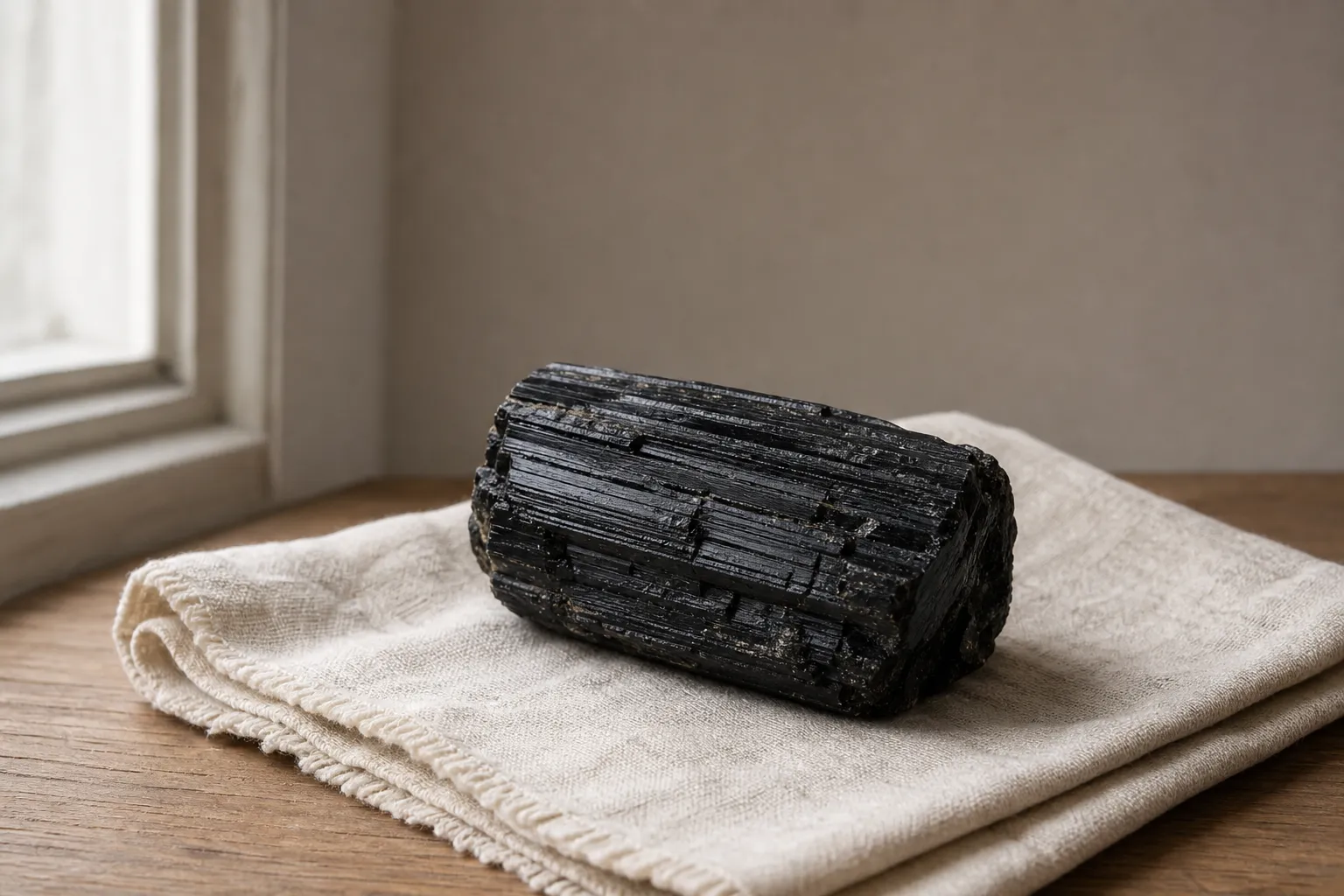
Start on a stable, dry surface: a folded cotton cloth, a lined tray, or a clean piece of fabric that keeps the stone from rolling or shedding small grains. Do not begin by wetting the stone “just a little.” For fragile black tourmaline care, the point is to avoid liquid entirely.
Place the stone down before you begin. If it has sharp striations, loose blades, crumbly edges, or attached matrix, do not rub it between your palms. Let the cloth support it.
Then choose one or two dry methods.
Breath and intention
Sit near the stone rather than gripping it. Take a few slow breaths and name what the ritual is marking: clearing, grounding, protection, closure, or returning to center.
This is symbolic practice, not a measurable mineral process. Its value is in focus, meaning, and the way it gives the stone a clear role in your space.
Sound
Use a bell, chime, singing bowl, or tuning fork near the black tourmaline. Keep the instrument from touching the specimen.
A sound bath for crystals works well when you want a no-smoke option. It leaves no ash, scent, moisture, or residue, and it does not require moving the stone once it is placed.
Smoke at a distance
If smoke belongs in your practice, waft it near the stone rather than holding black tourmaline over flame, charcoal, or a hot bundle. The smoke is the ritual element; the stone does not need direct heat.
Use a heatproof dish or holder. Keep embers away from cloth, paper, shelves, hair, curtains, dried plants, and clutter. Do not leave anything burning or smoldering unattended.
Selenite nearby
Place black tourmaline on a cloth beside a selenite plate, wand, or bowl. If the piece is too fragile to move repeatedly, simply rest it near selenite.
Within crystal practice, this is often described as a gentle reset. Treat that as ritual language rather than physical cleaning.
Moonlight through a window
Place the stone on a dry indoor windowsill or covered surface where it can sit in moonlight without dew, rain, pets, children, or temperature swings. For a fragile specimen, indoor moonlight is usually the safer version.
Avoid outdoor placement if the stone could get damp overnight.
Close the ritual by returning the piece to a soft pouch, lined box, shelf, or altar space where it will not be bumped. If visible dust is the issue, use only a soft dry cloth or a very soft dry brush, and stop if grains begin to loosen.
Why “no liquid” is a cautious default
A no-liquid ritual does not mean every piece of black tourmaline is ruined by a drop of water. It means fragile raw specimens carry variables you may not be able to see: tiny fractures, included zones, attached host rock, crumbly terminations, previous treatment, surface residue, or sentimental value that makes the risk unnecessary.
This is where mineral care and ritual language need separate lanes.
Mineral sources can help identify schorl and describe properties such as hardness, structure, and fracture behavior. But hardness is not the same as overall toughness. A mineral can resist scratching better than it resists impact, wedging, stress along old cracks, or weakness in attached matrix.
A polished stone set in jewelry and a splintery schorl cluster are not the same handling problem. General tourmaline care guidance is useful as a conservative reminder, but methods that may be acceptable for some finished jewelry should not be automatically applied to rough mineral specimens.
That is why black tourmaline dry cleansing is a practical compromise. You can still mark a meaningful energetic reset with sound, breath, moonlight, selenite, visualization, or carefully controlled smoke without making water, salt, oil, sprays, or soaking part of the process.
Keep cleansing and cleaning separate
Most confusion comes from the word “cleansing.”
In crystal practice, cleansing often means clearing stagnant energy, refreshing intention, restoring protective symbolism, or returning the stone to a grounded role. Those are belief-based meanings.
Physical cleaning is different. It means removing dust, grit, skin oil, ash, wax, perfume, dirt, or residue. A bell will not remove grit. Moonlight will not lift oil. Selenite will not clean mud out of cracks. Smoke may add scent or residue rather than remove debris.
For this ritual, the focus is dry energetic clearing. If the stone is physically dirty, keep the response modest:
Modest dry response
- Place it on a stable surface.
- Use a soft dry cloth only on smoother areas.
- Use a very soft dry brush only if the specimen is stable.
- Stop if grains, flakes, or matrix begin to loosen.
Avoid these for fragile raw black tourmaline
- Soaking in water.
- Salt water.
- Sprays or misting.
- Vinegar, alcohol, soap, or household cleaners.
- Oiling the surface.
- Direct crystal elixirs or infused water.
- Scrubbing with stiff brushes.
- Holding the stone over flame, charcoal, or strong heat.
Some crystal sources casually suggest rinsing, saltwater, or infused-water practices. For a fragile raw piece, restraint is the better default. A method that seems harmless for one polished stone does not establish safety for every schorl specimen.
If you use smoke, keep it optional
Smoke cleansing schorl can fit some rituals, but it is the dry method with the clearest real-world safety concerns. Treat it as optional, not required.
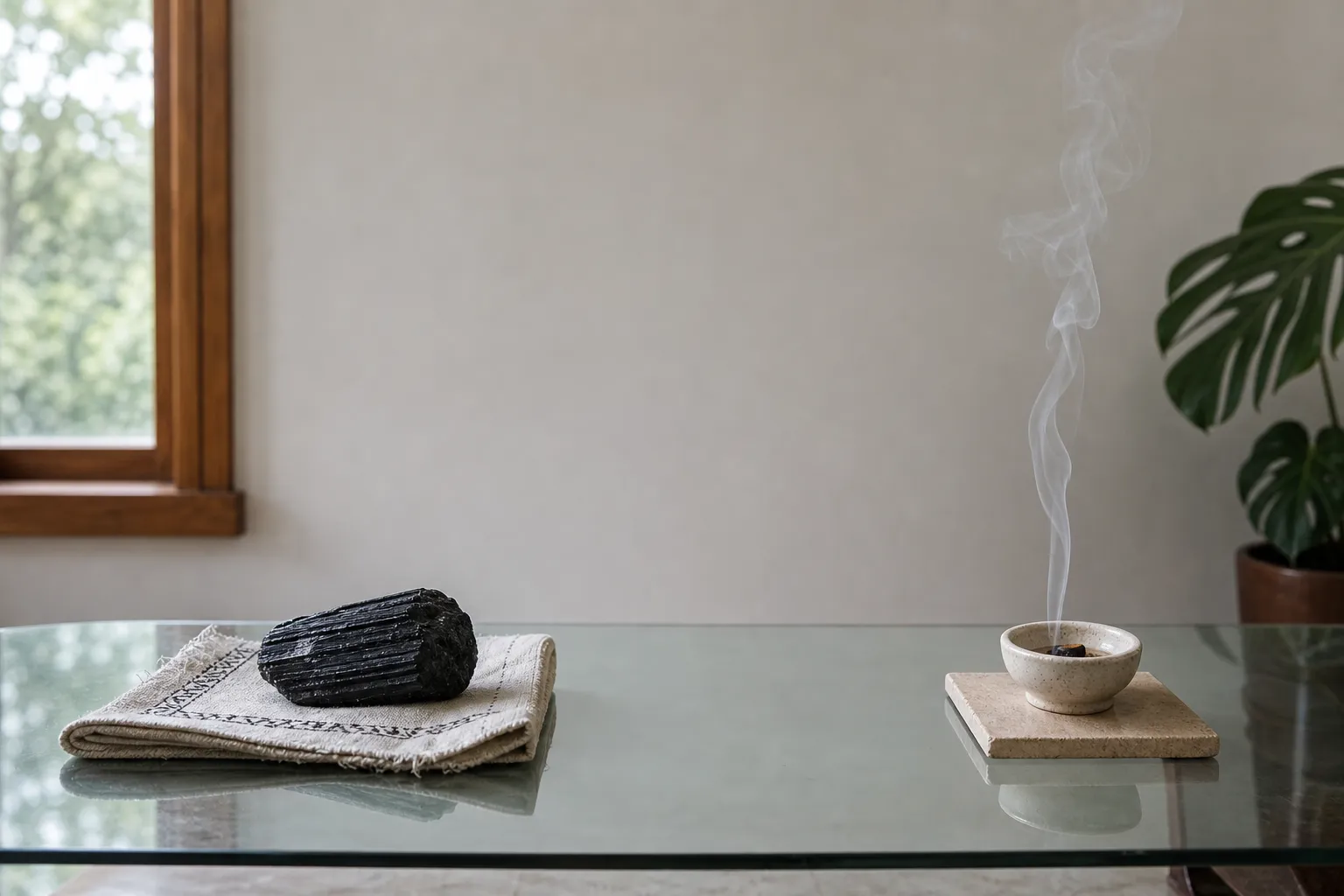
A controlled setup keeps burning material separate from the mineral. Light incense, an herb bundle, or another ritual material according to its own safe-use instructions, then place it in a heatproof holder. Let the smoke move near the stone. Do not balance burning material on black tourmaline. Do not place the specimen near hot charcoal. Do not heat the stone to “activate” it.
Use ventilation. Keep pets and children away from the setup. Avoid smoke around people or animals who may be sensitive to it. Never leave flame or embers unattended, even for a short ritual.
If smoke does not fit your home, skip it. A no-smoke crystal cleansing ritual can be complete: cloth, breath, bell, intention, selenite nearby, and quiet storage.
The ritual does not become more legitimate because it involves smoke. It becomes better when it fits the stone, the room, and the people present.
What changes the best method
The best no-liquid cleansing ritual depends on the condition of the specimen.
Sound or visualization
Choose sound or visualization if the stone is splintery, crumbly, shedding grains, or hard to move. These methods require almost no contact.
Moonlight through a window
Choose moonlight through a window if you want an overnight reset without dew, rain, outdoor temperature changes, or animals disturbing the piece.
Selenite nearby
Choose selenite nearby if the black tourmaline is too delicate to place directly on another mineral surface. “Near” is enough for symbolic practice; stacking fragile stones is unnecessary.
Smoke at a distance
Choose smoke at a distance only if the room, people, pets, and fire setup make sense.
Better storage
Choose better storage if the real issue is overhandling. Sometimes the most respectful ritual is simply giving the specimen a dry, stable place where it will not be washed, bumped, or repeatedly moved.
Common misunderstandings
“Tourmaline is hard, so water must be fine.”
Hardness mainly describes scratch resistance. Fragile raw mineral care also has to consider fractures, matrix, grainy areas, old damage, and breakage risk.
“Dry cleansing physically cleans the stone.”
Not really. Dry energetic clearing may help you mark a reset within your practice, but it does not remove dirt, oil, ash, or grit.
“Black tourmaline protection language is scientific fact.”
Many crystal users work with black tourmaline symbolically for grounding, protection, clearing, and energetic reset. Those words can be meaningful inside a personal or spiritual practice. They should not be treated as guaranteed effects, health-outcome claims, detoxification claims, air-purification claims, or electromagnetic-shielding claims.
For this page, the narrower answer is enough: a dry ritual can support the meaning you give black tourmaline without making physical or health promises about the stone.
A short no-liquid sequence you can repeat
Use this when you want the ritual to stay simple:
- Lay a clean, dry cloth on a stable surface.
- Place the fragile black tourmaline on the cloth.
- Avoid unnecessary handling.
- Take three steady breaths and name the purpose of the reset.
- Use one dry method: bell, chime, tuning fork, smoke at a distance, selenite nearby, visualization, or moonlight through a window.
- Let the stone rest undisturbed for a few minutes or overnight, depending on the method.
- Return it to a pouch, box, shelf, or altar space where it will stay dry and protected from bumps.
That is enough. For fragile black tourmaline, a careful no-liquid cleansing ritual should be quiet, dry, and low-force. The goal is not to prove that the stone has changed in a measurable way. The goal is to honor the symbolic clearing while respecting the specimen as a real mineral object with edges, fractures, and limits.