Raw schorl surface reading
Decoding Vertical Striations: What Your Raw Tourmaline is Telling You
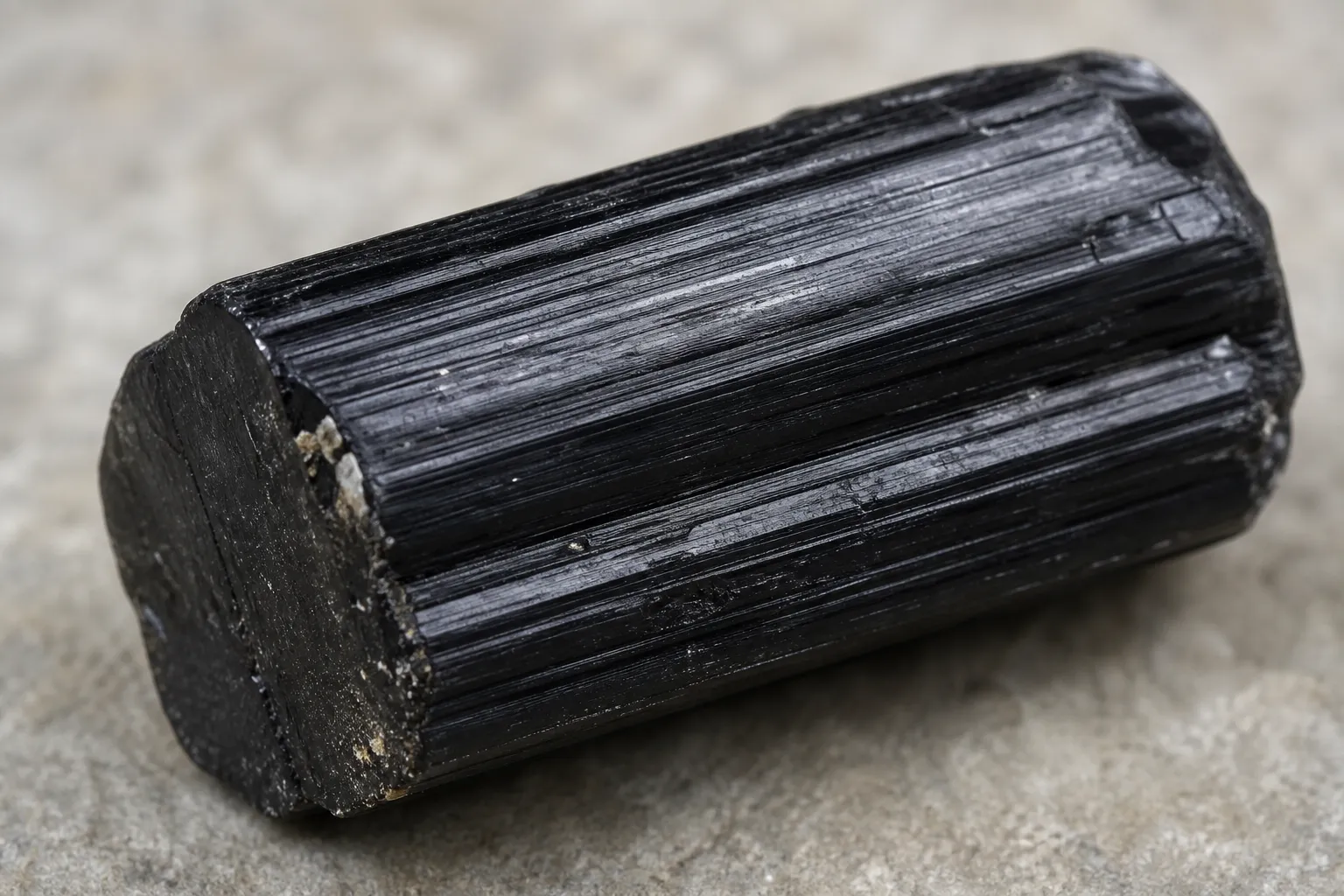
Vertical striations on raw black tourmaline are worth noticing, but they are not a verdict. In mineral terms, black tourmaline vertical striations can be consistent with the prismatic growth habit of tourmaline, especially schorl, when the lines run lengthwise along the crystal.
That means the grooves may reflect a natural surface texture related to how the crystal grew. It does not mean the lines, by themselves, prove the piece is genuine, untreated, high quality, from a specific locality, or stronger in any spiritual sense.
The better question is: are these lines behaving like natural tourmaline surface texture, or could they be cracks, scratches, saw marks, polish marks, coating, or another black material?
broader context
Black tourmaline context note
This narrower page works best after the broader black tourmaline context page.
What vertical striations can mean on raw schorl
Schorl is the black, iron-rich tourmaline most people mean when they say “black tourmaline.” Tourmaline commonly forms elongated prismatic crystals, and mineral descriptions often discuss tourmaline in relation to its crystal habit and crystallographic direction. In the scientific literature, tourmaline specimens are sometimes described as elongated, prismatic crystals with striations running parallel to the c axis.
That does not turn every lined black crystal into schorl. It simply supports the basic mineralogical point: lengthwise grooves can be part of tourmaline’s natural crystal morphology.
On a hand specimen, natural tourmaline striations may look like:
- narrow grooves running up and down the long body of the crystal;
- ridges and channels that follow the crystal’s length rather than crossing it randomly;
- uneven, natural-looking ribbing rather than perfectly repeated machine marks;
- darker shadowing inside grooves where rough surfaces catch light differently.
This is why many raw schorl pieces look “ribbed” or “lined.” If the lines run in the same direction as the long prismatic form, the texture may be compatible with natural tourmaline striations.
Compatible is the key word. Visual texture can support an identification; it cannot complete one.
Growth lines, cracks, scratches, and saw marks are not the same thing
A lot of confusion comes from using “lines” for several different features. On raw tourmaline, a line may be a natural striation, a fracture, a scratch, a chip edge, a saw mark, a polish trail, or a coating irregularity. In a product photo, those can be easy to mix up.
Natural striation
A natural striation is an external surface feature that follows the crystal habit. It tends to run lengthwise and may appear as repeated, irregular ribbing on prism faces.
Crack or fracture
A crack or fracture behaves differently. It may cut across the crystal at an angle, interrupt existing surface texture, or continue inward rather than staying on the surface. Some fractures only become obvious when the stone is turned under light.
Scratch
A scratch is usually more isolated and superficial. It may cross over natural grooves instead of following them. On a dark surface, a recent scratch can look brighter or fresher than the surrounding material.
Saw or grinding marks
Saw marks and grinding marks are often more regular. If a face is flat, unusually even, and covered with parallel lines of similar spacing, those lines may come from cutting or shaping rather than crystal growth.
Polished black tourmaline changes the question again. Once a piece has been tumbled, polished, cut, or coated, the original raw tourmaline surface texture may be reduced or hidden. A polished piece can still show pits, fractures, faint lines, or internal features, but the absence of bold vertical grooves means less after surface alteration.
A practical way to inspect the lines
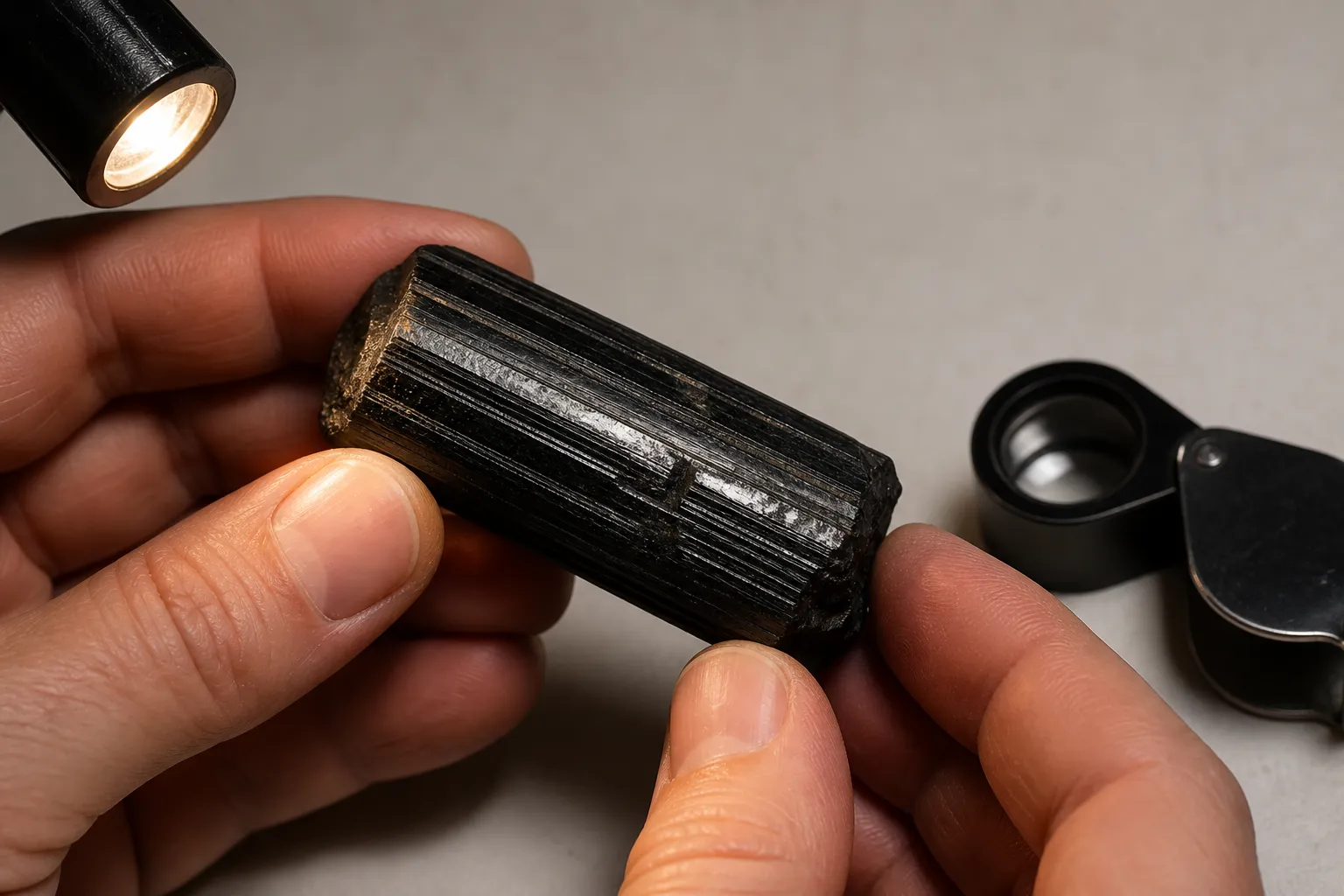
You do not need destructive testing to read the surface more carefully. For an everyday owner or shopper, non-destructive observation is the right level.
Hold the piece under steady light and slowly rotate it. Natural striations often become more visible when light rakes across the surface from the side. Straight-on lighting can flatten them.
Then ask four questions.
Do the lines run lengthwise?
Lengthwise striations on tourmaline are more consistent with the expected prismatic habit than random cross-cutting marks. If the grooves travel along the long axis of the crystal, they may be part of the raw schorl texture.
Do they follow crystal faces?
Natural tourmaline striations tend to relate to the outer faces of the crystal. If the lines shift with the faces, stop at edges, or appear strongest on prism-like surfaces, that supports a growth-texture reading.
Are they irregular rather than mechanically identical?
Mineral growth lines usually vary in depth, spacing, and sharpness. Extremely uniform parallel marks on a flat plane can suggest sawing, grinding, or later shaping.
Do the “lines” continue inward?
A surface groove and an internal fracture are different things. If a line appears to travel into the body of the stone, catches light from inside, or looks like a break plane, it may be a crack rather than an external striation.
A careful description might be: “This piece has lengthwise surface striations consistent with raw tourmaline habit.” That is more accurate than saying the lines prove it is real.
What vertical striations cannot prove
The most common mistake is turning a useful texture clue into a complete authenticity test. Vertical striations alone do not prove that a black crystal is schorl. Other dark minerals, altered surfaces, carved pieces, and manufactured textures can produce line-like appearances.
They also do not prove locality. Tourmaline is chemically and geologically complex. Research on tourmaline may use chemistry, zoning, spectroscopy, or isotope work to discuss formation conditions. Surface grooves cannot visually identify a mine, country, pegmatite, or geological setting.
They do not prove quality. Some collectors like crisp, well-defined prismatic form; others prefer broken masses, clusters, sprays, or associations with quartz or mica. Strong grooves may be visually appealing, but they are not a universal grade. A heavily fractured but strongly striated piece may be less durable than a smoother, more intact specimen.
They do not prove treatment history. A stone can be natural and later broken, cleaned, oiled, coated, polished, or mounted. Surface texture alone cannot reconstruct everything that happened to it.
And they do not establish metaphysical significance. Many shoppers use symbolic or personal-use language when describing black tourmaline. That language belongs to belief, ritual, or personal meaning, not mineral identification. The visible lines may affect how someone relates to the object, but the evidence supports describing them as physical texture.
If there are no visible striations, is it fake?
No. The absence of visible striations does not automatically mean a black crystal is fake tourmaline.
There are ordinary reasons lines may be hard to see. The specimen may be broken across the crystal rather than showing clean prism faces. It may be weathered, abraded, dusty, coated, or partly polished. It may be a chunk of schorl rather than a well-formed prismatic crystal. The visible face may simply not show the texture strongly from that angle.
This matters when shopping online. Product photos can exaggerate or hide texture depending on lighting, contrast, wetting, editing, and scale. A glossy black surface may look smoother in a photo than it does in hand, while side lighting can make grooves look more dramatic than they are.
If a listing claims every genuine black tourmaline must show bold vertical lines, that is too strong. If it claims any lined black stone is automatically authentic, that is also too strong. Real identification sits between those extremes.
When striations help with identifying uncut tourmaline
Striations are most helpful when they appear with other tourmaline-compatible features. For a raw black specimen, those may include an elongated prismatic shape, natural ridges running parallel to the long axis, uneven broken ends, a dark glassy-to-submetallic surface in places, and possible association with minerals such as quartz or mica.
Those are still visual clues, not a laboratory conclusion.
For low-stakes personal use, that may be enough to decide whether a piece seems plausible and visually satisfying. For higher-stakes buying, resale, insurance, or claims about rarity, visual inspection should not be treated as final. Gemological or mineralogical identification can involve properties and tests that go beyond surface appearance.
Useful seller questions include:
- “Is this sold as schorl or simply as black tourmaline?”
- “Is the surface raw, polished, coated, or cut?”
- “Are the lines natural crystal texture or marks from shaping?”
- “Can you provide photos from several angles in natural light?”
- “Is there any testing or provenance if the price depends on identity or origin?”
Those questions keep the discussion grounded in observable material rather than sales language.
A short note on alteration
Looking at, photographing, and gently handling a raw specimen is different from sanding, drilling, grinding, cutting, or polishing it. If you are considering any dust-generating alteration, do not treat that as a casual home experiment. Lapidary work has its own safety practices around dust control, eye protection, and suitable equipment.
For this question, there is no need to damage the stone to interpret the surface lines.
The plain reading of the lines
Vertical striations on raw black tourmaline are best read as a possible natural growth or habit feature, especially when they run lengthwise along a prismatic schorl crystal. They can support the impression that a piece has a tourmaline-like raw surface.
But they are only one clue. They do not confirm identity, origin, value, treatment history, or metaphysical meaning. They can be confused with cracks, scratches, saw marks, polish marks, coatings, or abrasion. And if they are absent, that absence does not automatically disqualify the specimen.
The most accurate reading is modest: the lines may be telling you something about surface texture and crystal form. They are not telling the whole story.