Workspace field note
The Deskscaping Secret: Using Tourmaline Pyramids to Anchor Your Workspace
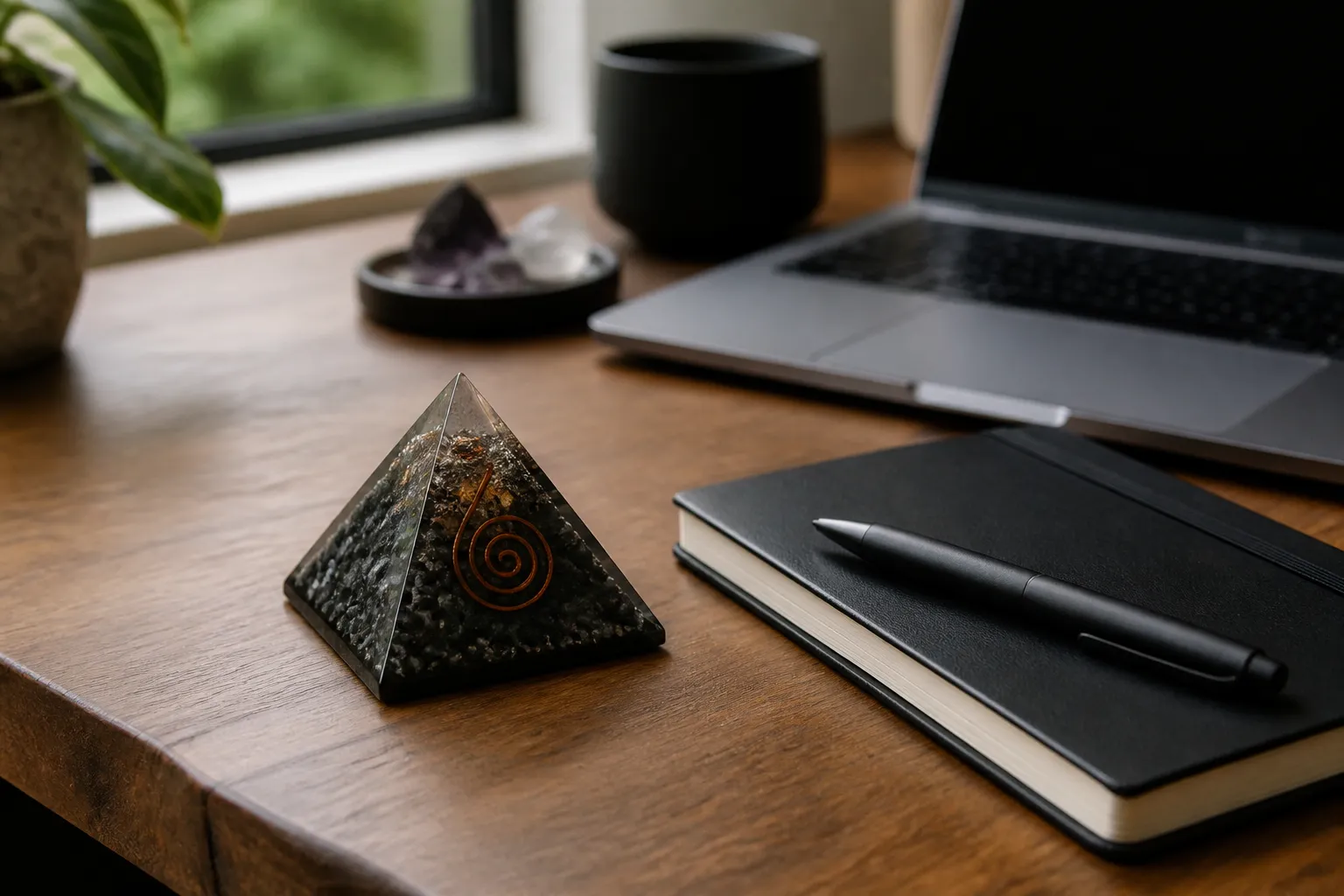
Orgonite Tourmaline Desk Pyramids work best as visual and symbolic desk anchors: small, deliberate objects that make a work-from-home space feel more defined, personal, and intentional. Their strongest use is not as an EMF shield, detox tool, productivity device, or health object. It is much simpler: they give your eye a focal point, help mark the desk as a work zone, and can become a quiet cue for starting, pausing, or ending the day.
If the word “grounding” fits your style, keep it in the realm of personal meaning. In a WFH setup, that distinction matters. The pyramid can support a desk ritual without needing to promise effects it cannot substantiate.
broader context
Black tourmaline context note
This narrower page works best after the broader black tourmaline context page.
What a tourmaline pyramid can realistically do on a desk
A desk pyramid works when you treat it as an intentional decor piece, not as a device. Its shape, weight, color contrast, and placement can make it feel more “set” than a random object. That is the real deskscaping value: it helps create a visible point of orientation in a space that may otherwise be shared with laundry, dinner, hobbies, or family life.
Workspace research supports a modest idea: people respond to visual surroundings, personal meaning, and environmental cues. Materials, layout, light, greenery, color, and personal objects can shape how a workspace is perceived. Remote-work studies also note that boundaries between work and home often blur, and many people use routines, cues, and small rituals to mark transitions.
That does not mean a tourmaline pyramid causes better focus or changes your body. It means a distinct object can be assigned a role. You decide: “When this pyramid is at the front corner of the desk, this is my work zone.” Or: “When I move it beside the notebook, I am closing the laptop for the day.” The usefulness comes from the behavior and meaning you attach to it.
For readers drawn to black tourmaline, orgonite, or bioenergetic deskscaping language, the most grounded framing is symbolism. The object can stand for steadiness, containment, or a boundary around your attention. That meaning can be real to your routine without being a technical or medical claim.
Placement ideas for a WFH desk visual anchor
The best place for a tourmaline pyramid is where it can be seen without interrupting work. It should feel like part of the desk composition, not another object competing for space.
Good placements include:
Front corner of the desk
Best if you want a visual boundary marker between your body and the screen without placing anything in the typing zone.
Beside a notebook or planner
Useful if the pyramid is part of a start-of-day or end-of-day ritual.
Near a phone tray or charging spot
Works as a gentle digital detox cue, as long as “detox” means a voluntary screen boundary. The pyramid is not changing the phone; it is reminding you not to pick it up automatically.
At the monitor base
Simple and visible. Keep it low and slightly off-center if direct placement feels visually busy.
On a shelf above the desk
Better for small desks where active surface area is limited.
Avoid placing it where your hand, mouse, keyboard, cup, or camera setup needs to function. A desk anchor should reduce friction, not create it. If it makes the surface harder to use, it has become clutter.
Contrast also matters. A dark pyramid can look strong against pale wood, linen, matte white, or warm neutral surfaces. On a black desk, it may disappear unless you pair it with a small tray, light notebook, or stone coaster. The goal is not a universal “best” setup. The goal is a desk that tells your eye: this area has a purpose.
Turning it into a mindful desk setup cue
The simplest way to use Orgonite Tourmaline Desk Pyramids in a mindful desk setup is to connect the object to one repeatable action. Keep the action small enough that you will actually do it.
Try one of these quiet rituals:
Start-of-work cue
Place the pyramid in its work position, open your notebook, and write the one task that needs your cleanest attention. The pyramid is not producing focus; it is marking the moment when you choose where to begin.
Screen-pause cue
When you reach for your phone between tasks, look at the pyramid first and take one ordinary pause before deciding whether you need the device.
Meeting reset cue
After a call, glance at the pyramid and write the next concrete step before opening another tab. The object becomes a visual stop sign between one context and the next.
End-of-day cue
Move the pyramid to a side position, close the laptop, or cover the keyboard. The shift creates a small physical marker that work mode is ending.
These rituals are intentionally ordinary. They do not require belief in a special mechanism. They work, if they work for you, because they pair a visible object with a repeatable behavior.
For many WFH workers, the home desk is not a full office. It may be a dining table, a bedroom corner, or a shared surface. In that setting, a small symbolic workspace decor piece can help create a temporary boundary: this surface is in work mode now; later, it can return to home mode.
Where “bioenergetic deskscaping” needs careful language
“Bioenergetic deskscaping” is a phrase some readers use for a desk that feels grounded, alive, or personally charged with meaning. As an aesthetic phrase, it can be expressive. As a scientific category, it needs more evidence than this topic can provide.
A tourmaline pyramid may feel grounding because of its color, density, symmetry, ritual role, or the meanings you associate with black tourmaline. It may make your desk feel calmer or more deliberate in a personal, subjective sense. Those are felt interpretations, not evidence that the object changes energy fields, protects electronics, detoxes the body, or guarantees work results.
The same applies to “digital detox.” In a desk context, use the term to mean behavior: fewer unconscious device checks, a cleaner transition between work and non-work, or a chosen screen-free pause. Do not use it to imply that the pyramid changes device emissions or produces a body-based detox effect.
A useful rule: if the claim describes how you use the object, it is usually safe and useful. If the claim describes what the object supposedly does to your body, your devices, or your environment, it needs stronger support.
Grounded ways to describe the pyramid
- “It is my visual cue to pause before opening another app.”
- “It marks the edge of my work zone.”
- “It makes my desk feel more intentional.”
- “It carries personal symbolism around steadiness and boundaries.”
- “It is part of my WFH closing ritual.”
Claims to avoid for this page
- It protects the desk from EMF.
- It neutralizes radiation from devices.
- It detoxes the body.
- It guarantees focus, calm, sleep, or productivity.
- It has measurable bioenergetic effects.
You can still enjoy crystal language as culture, symbolism, or personal ritual. The line to hold is evidence: meaningful does not have to mean physically or technically proven.
Styling the pyramid without staging the desk
A tourmaline pyramid looks best when it has a job in the composition. If it is surrounded by too many other “meaningful” objects, the desk can start to feel like a display shelf instead of a work surface.
One pyramid is usually enough for a compact WFH setup. Let it relate to three nearby elements: a writing surface, a light source, and one natural or tactile material. A pyramid beside a kraft notebook, ceramic cup, and plant reads as intentional. The same pyramid crowded by chargers, receipts, cables, and several decorative stones reads as noise.
Think in small zones:
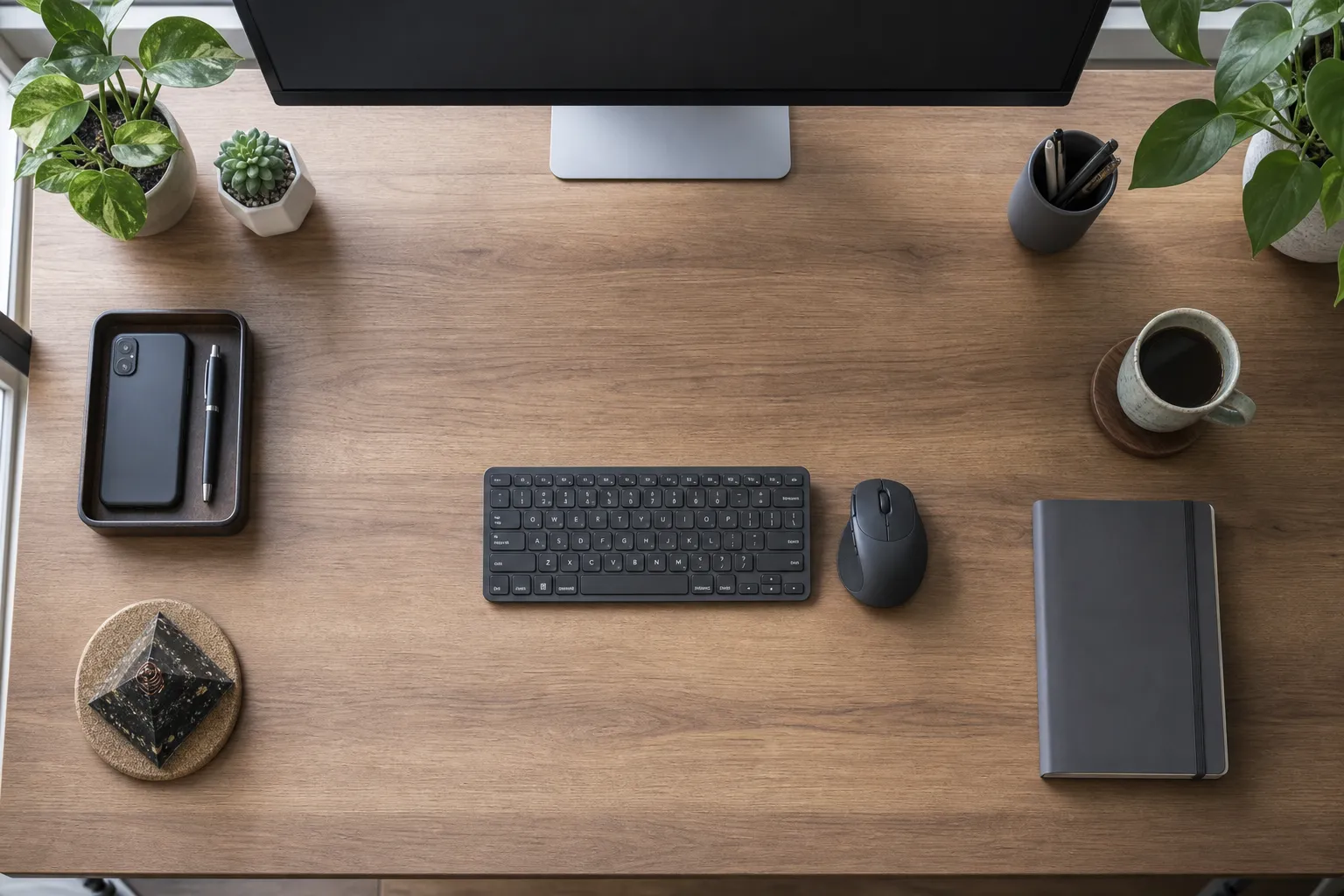
The work zone
Holds the keyboard, mouse, monitor, notebook, and anything your hands need daily.
The anchor zone
Is where the pyramid belongs. It should be visible but outside the path of work.
The release zone
Is where you place the phone, closed planner, or end-of-day items. If the pyramid supports a digital boundary habit, it can sit near this zone.
This zoning helps when your desk is part of another room. You may not be able to build a full office, but you can create a small visual grammar: laptop open means work; pyramid beside notebook means intentional work; pyramid moved to the shelf means the day is closed.
If your space is visually dense, use a tray or simplify the objects around the pyramid. If your desk is minimal, the pyramid can provide the single dark point that keeps the surface from feeling sterile. The styling should serve the workday, not compete with it.
The main limitation of crystal desk decor
The limitation is not that symbolic objects are useless. It is that their usefulness is personal, contextual, and easy to overstate.
An Orgonite Tourmaline Desk Pyramid can help you design a more intentional desk if you use it as a cue, marker, or focal point. It cannot replace ergonomic furniture, reasonable screen habits, workload boundaries, good lighting, or a real end-of-day routine. If your WFH setup is uncomfortable, overloaded, or constantly interrupted, the pyramid may make the space feel more cared for, but it will not solve the underlying structure.
The strongest use is modest: choose one role.
- Use it as a visual boundary marker if your desk blends into home life.
- Use it as a pause cue if you want a non-phone moment between tasks.
- Use it as a desk ritual focal point if opening and closing the day feels vague.
- Use it as personal symbolism if black tourmaline language resonates with your sense of steadiness.
- Use it as tourmaline pyramid desk decor if, simply, you like how it looks.
The object does not need exaggerated claims to be worthwhile. A beautiful, grounding-feeling piece can earn its place by helping you make one small behavior more visible.
A simple way to set it up today
Clear one small area of your desk, no larger than the space beside a notebook. Place the pyramid where you can see it without reaching around it. Choose one sentence for its role: “This marks my work zone,” “This reminds me to pause before picking up my phone,” or “This is where I close the day.”
Then pair it with one action for a week. Not five rituals. Not a complete lifestyle reset. One action.
If the pyramid starts to feel like clutter, move it higher, place it on a tray, or remove nearby objects. If it becomes invisible, give it more contrast. If the symbolism stops feeling useful, let it return to being decor.
That is the quiet secret of deskscaping with tourmaline pyramids: the object anchors the workspace only when your use of it is clear. Its practical value is not in a claim. It is in the boundary you choose to make visible.