Material decor note
Why Raw Black Tourmaline is 2026’s Ultimate Quiet Luxury Statement
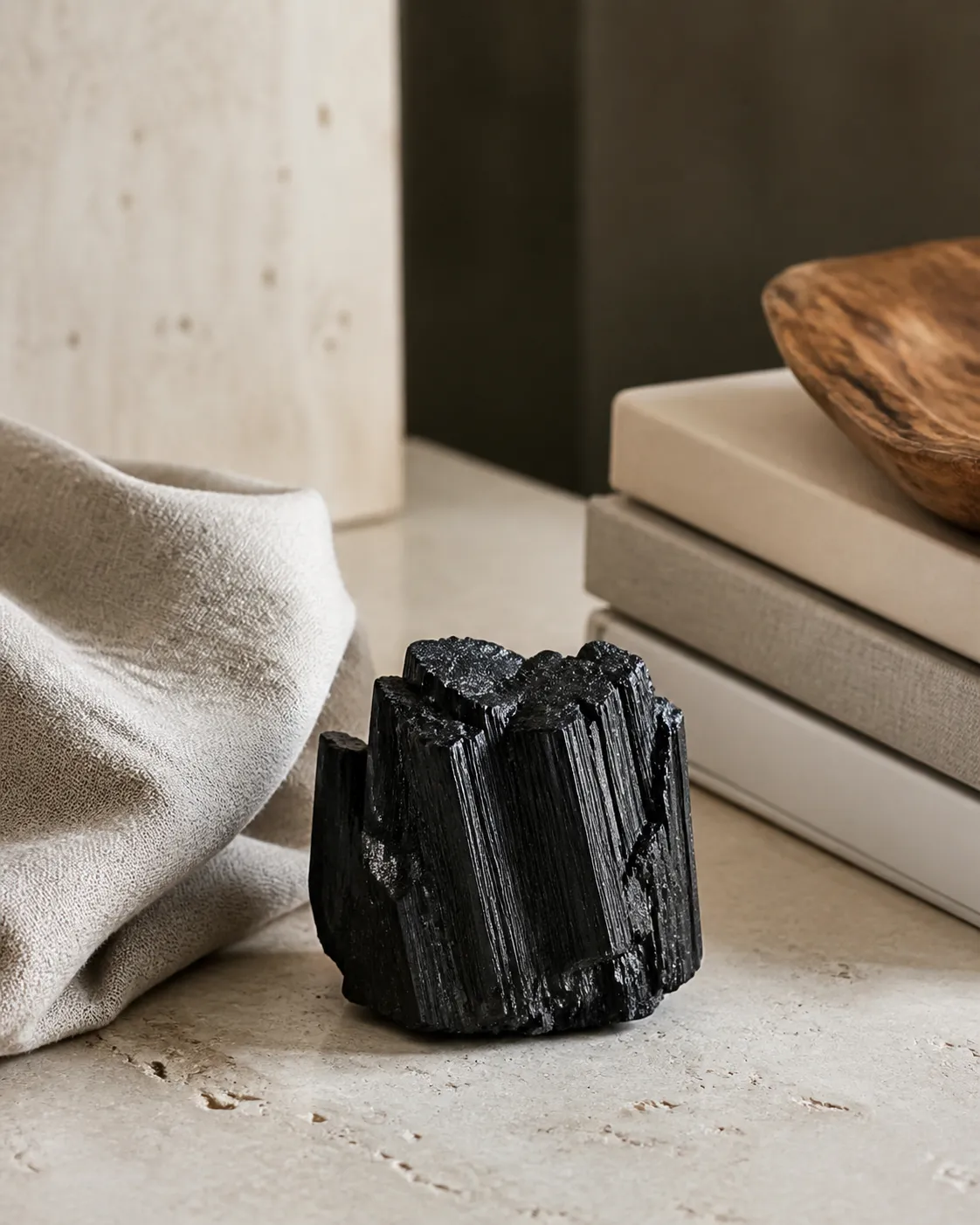
Raw Black Tourmaline Clusters fit 2026 quiet luxury decor because they bring weight, texture, and mineral restraint without looking polished or performative. A good cluster is dark, tactile, irregular, and visually grounded. It can anchor a shelf, desk, console, or quiet corner the way a small bronze, carved stone, or weathered wood object might—but with a sharper geological presence.
The strongest case is not a wellness claim. It is visual: matte black contrast, rough crystalline texture, organic asymmetry, and a low-sheen material presence that works with linen, pale wood, plaster, stone, metal, books, and quiet surfaces.
broader context
Black tourmaline context note
This narrower page works best after the broader black tourmaline context page.
Why it fits quiet luxury decor
Quiet luxury decor is less about recognizable status objects and more about material discipline. It favors surfaces that do not shout: honed stone instead of mirror-polished stone, heavy linen instead of synthetic shine, warm wood instead of glossy veneer, plastered walls instead of busy pattern, and fewer objects chosen for form rather than logo value.
A raw black tourmaline cluster belongs naturally in that language for three reasons:
-
Matte darkness
Black tourmaline is commonly described as black to very dark brown. In a room, that darkness creates a pause point against pale neutrals, wood grain, paper, ceramic, and textile.
-
Crystalline texture
Schorl, the common black tourmaline species, often appears in prismatic or columnar forms. Raw clusters may show ridges, fractures, terminations, and uneven growth patterns.
-
Small-scale sculptural weight
Even a hand-sized piece can give a surface a sense of gravity. It settles a vignette without turning into a loud centerpiece.
That is why black tourmaline quiet luxury decor feels different from trend-led crystal display. The object is not being asked to sparkle, perform, or announce a lifestyle. It is doing quieter work: adding contrast, density, and material age.
Why raw clusters feel more current than polished stones
Polished black stones can look elegant, but they often read as accessories. A raw black tourmaline cluster reads more like a found mineral object. That distinction matters.
Interiors have been leaning toward touch-aware surfaces: nubby wool, limewash, plaster, raw ceramics, brushed metal, honed stone, open-grain wood. Whether described as hyper-tactile design or simply a preference for hand-feel, the mood is moving away from screen-smooth finish and toward sensory materiality.
Raw black tourmaline decor fits because its surface is not visually flat. The ridges, striations, broken edges, and clustered forms make it feel tactile before anyone touches it. It gives a room a kind of texture that cannot be printed onto fabric or faked by a glossy accessory.
A polished black stone may still work on a tray or nightstand, but it loses part of the mineral argument. Raw clusters keep the evidence of formation visible. They feel closer to stone, mountain, pegmatite, and time. For biophilic interiors, that matters: the nature reference is not a leaf motif or a green accent, but an actual natural material with irregular form.
The mineral facts that matter for styling
Black tourmaline is commonly associated with schorl, a member of the tourmaline supergroup. Tourmaline is a complex borosilicate mineral group, and mineral references describe schorl as a dark, iron-bearing tourmaline species.
For an interiors reader, the useful mineral facts are simple:
- Black tourmaline is a real mineral material, not just a decor color category.
- Schorl belongs to the tourmaline supergroup, which has recognized mineralogical complexity.
- Raw pieces may show columnar, prismatic, clustered, or fractured forms depending on how the specimen formed and was extracted.
- The dark color and rough surface are material characteristics, not applied ornament.
- Tourmaline is often listed around Mohs 7 to 7.5, but raw clusters can still have delicate points, attached matrix, internal fractures, or brittle edges.
That last point matters. A raw black tourmaline crystal can look visually tough, but it should still be treated as a mineral specimen. Dust it gently, handle it carefully, and avoid harsh chemicals, scraping, soaking, or aggressive cleaning.
Where Raw Black Tourmaline Clusters work best
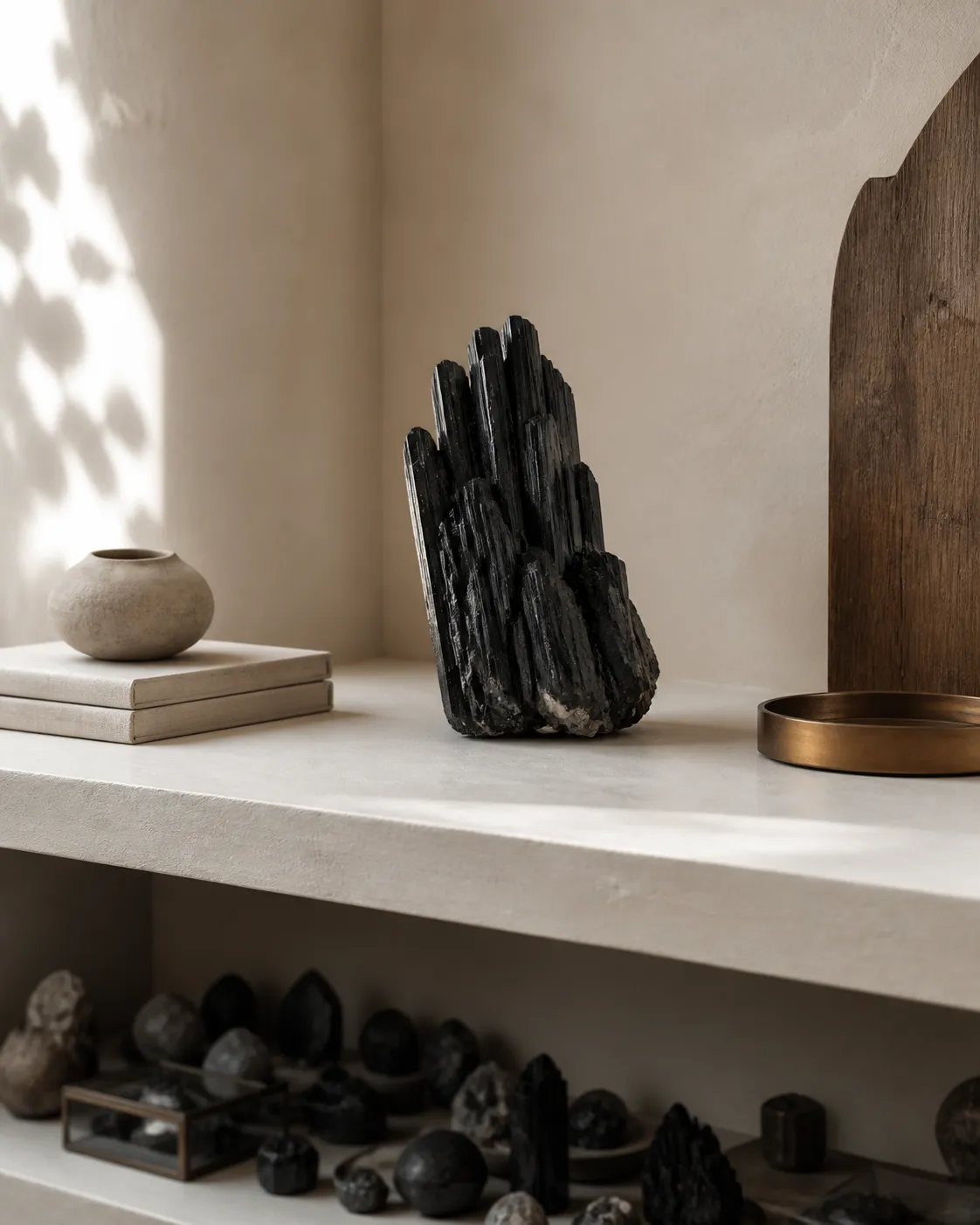
Raw black tourmaline is strongest when it has breathing space. If it is crowded among too many crystals, candles, trinkets, and small objects, it can lose the restraint that makes it feel refined.
The best placements let the cluster act as a visual anchor.
| Placement | Why it works | What to avoid |
|---|---|---|
| Entry console | Adds a dark, grounded note near keys, bowls, books, or a lamp | Too many small decorative items around it |
| Bookshelf | Breaks up rows of pale pages, ceramics, and wood | Placing it where it disappears into shadow |
| Desk | Gives a work surface a tactile mineral object without looking flashy | Treating it as a productivity or electronics tool |
| Coffee table | Works beside stoneware, art books, linen, or a low bowl | High-gloss trays that make it feel overly staged |
| Bedroom shelf | Adds quiet contrast to soft textiles and muted tones | Turning it into a promise of personal outcomes |
A raw black tourmaline cluster pairs especially well with pale wood, travertine, limestone, plaster, unglazed ceramic, aged brass, blackened steel, parchment, and woven textiles. These combinations keep the object in the world of material contrast rather than crystal-shop display.
Scale also matters. A tiny shard may look accidental on a large console. A very large specimen may dominate a small shelf. The most versatile pieces are usually substantial enough to cast a visual shadow, but not so large that they become theatrical.
What can change the answer
Raw black tourmaline is not automatically quiet luxury. The styling context decides whether it feels refined, mystical, rustic, or cluttered.
Several factors change the result:
Finish and surface treatment.
Raw clusters usually fit the quiet luxury brief better than overly polished, dyed-looking, or glitter-coated pieces. A low-sheen surface keeps the mineral feeling serious.
Specimen shape.
A strong silhouette matters. A cluster with visible vertical structure, natural ridging, or an architectural profile will usually style better than a small broken fragment with no readable form.
Room palette.
Black tourmaline works well in warm neutrals, mineral whites, tobacco browns, muted greens, charcoal, greige, plaster pink, and pale oak rooms. In a very dark room, it may need contrast from a light tray, book stack, or stone surface.
Object count.
Quiet luxury depends on editing. One raw black tourmaline cluster can feel sculptural. Ten small crystals scattered across a shelf usually shift the look into a different design language.
The story attached to it.
If the object is presented as a mineral specimen, natural sculpture, or tactile material note, it feels elevated. If the styling language leans too heavily on guaranteed energetic outcomes, the design reading weakens.
The common confusion: grounding as design language
Black tourmaline is widely discussed in crystal-commerce language through words such as grounding, protection, cleansing, calm, and negative energy. Those phrases are part of the cultural vocabulary around the stone, and many readers encounter black tourmaline through that language first.
For decor, the useful move is to translate “grounding” into visual terms.
A black tourmaline cluster can visually ground a surface. It can make a shelf feel less floaty, give a pale room a point of depth, or add a quiet center of gravity to a desk. That is an aesthetic effect, not a measured claim about health, safety, electronics, emotions, or the atmosphere of a room.
This distinction keeps the object interesting without overstating it. The stone can carry symbolic meaning for people who value that tradition, but its strongest decor role does not depend on invisible effects. It depends on what the eye can verify: darkness, texture, mass, irregularity, and natural form.
The evidence limit behind the 2026 claim
The mineral side is relatively well supported: black tourmaline can be discussed through schorl, tourmaline-supergroup mineralogy, dark coloration, prismatic habit, and natural formation contexts.
The design side is more interpretive. Mineral references do not prove that raw black tourmaline is, in a formal market sense, the defining quiet luxury object of 2026.
So the phrase “2026’s ultimate quiet luxury statement” should be read as an editorial design argument, not a data-backed forecast. The argument is that Raw Black Tourmaline Clusters match several visible directions in high-restraint interiors: low shine, fewer objects, natural materials, tactile surfaces, sculptural silhouettes, and biophilic presence without botanical cliché.
That is enough to make the case, as long as the claim stays in the realm of styling and material interpretation.
A simple way to style it
Use raw black tourmaline the way you would use a small piece of sculpture: give it space, contrast, and a reason to be there.
A strong arrangement might include:
- one raw black tourmaline cluster;
- a stack of neutral books or a stone tray;
- one softer material nearby, such as linen, paper, or unglazed ceramic;
- one warm element, such as wood or aged metal;
- enough empty space around the group for the mineral shape to read clearly.
Avoid surrounding it with too many symbolic objects if the goal is quiet luxury decor. The cluster should feel like a deliberate material choice, not a crowded display theme.
The best version of raw black tourmaline interior styling is almost austere: a dark mineral object on pale stone, a jagged cluster beside linen-bound books, a vertical black form against plaster, or a rough specimen on a desk with little visual noise.
That is where black tourmaline feels most current. It is not shiny. It is not cute. It is not trying to soften itself. It brings the room a small, dense piece of the earth—and in a design mood drawn to restraint, texture, and natural gravity, that is exactly why it works.