Display care note
Strategic Airflow: Preventing Dust Buildup on Piezoelectric Stones
To prevent dust on piezoelectric stones, treat airflow as a quiet support system, not a cleaning force. The most useful home-display strategy is to reduce dust sources near the shelf, filter airborne particles, keep direct drafts off the stones, and use covers or cases for pieces that trap dust easily.
Air should help move room particles toward filtration or away from the display zone. It should not blow floor dust, textile lint, shelf grit, or pet hair across crystal faces and into crevices.
Piezoelectric stones such as quartz or tourmaline are still physical mineral specimens. Their electrical properties do not make them self-cleaning on a display shelf. Dust control is mostly about placement, enclosure, filtration, and calm housekeeping.

broader context
Broader schorl guide
This narrower page works best after the broader black tourmaline context page.
Use indirect airflow, not a fan aimed at the shelf
For a crystal or mineral display, strategic airflow means gentle room circulation. A fan pointed at an open shelf may feel like “ventilation for crystal displays,” but it can make dust buildup worse by lifting particles from nearby surfaces and letting them settle on the stones later.
A better setup looks like this:
- Keep the display out of direct fan paths, HVAC vent streams, open-window drafts, and door gusts.
- Place an air purifier so it draws room air from the general area, rather than blowing its outlet directly over the shelf.
- Watch for movement around the display: fabric, paper tags, or fine dust should not flutter.
- Clean the floor, textiles, and nearby furniture first, because airflow will disturb whatever dust reservoir is already there.
The goal is not to create a wind path over the stones. It is to lower the amount of airborne dust available to land on them.
This is where museum-inspired thinking helps in a practical way. Preventive conservation focuses on reducing exposure before repeated object cleaning becomes necessary. For a home mineral display, that translates into fewer dust sources, less direct air impact, and less need to brush or wipe the stones themselves.
What air purifiers can do for mineral displays
Air purifiers and minerals are sometimes discussed as if a purifier can make an open shelf dust-free. That is too much to expect.
A purifier with effective particle filtration, including properly used HEPA filtration, can reduce airborne particles in a room. Over time, that can help reduce the dust load reaching a display. But filtration has limits:
- It does not remove dust already settled on a stone.
- It does not stop lint, fibers, ash, or grit created right beside the display.
- It cannot compensate for a shelf placed directly in a vent stream or beside a dusty open window.
- It depends on filter maintenance, placement, and enough room air passing through the unit.
For air purifiers for mineral displays, placement often matters more than product language. Put the unit where it can pull air from the room, not where the outlet stream cuts across an open shelf. This is especially important for rough clusters, fragile points, labels, stands, and specimens with natural cavities.
One boundary is worth keeping clear: particle filtration is not the same as ozone generation. For display dust control, use filtration and housekeeping. Do not treat ozone-producing air cleaners as ordinary mineral-display tools.
Reduce dust sources before changing airflow
If the display area keeps producing dust, stronger airflow will only move that dust around. Before adjusting fan angles or purifier placement, look at the shelf as a small environment with four parts: dust sources, airflow path, display surface, and filtration intake.
Common dust sources near crystal displays include:
- Curtains, blankets, woven runners, and fabric wall hangings.
- Open shelving above the display.
- Rough wood, unfinished décor, or textured surfaces that hold particles.
- Floor dust lifted by foot traffic.
- Pet hair and textile lint.
- HVAC vents that push dust across surfaces.
- Open windows near roads, gardens, construction, or dry soil.
- Incense ash, candle soot, and powdery decorative materials.
Often, the easiest improvement is simply moving the display away from dusty textiles and turbulent air. A black tourmaline cluster inside a clean cabinet will usually face a different dust burden than the same cluster on an open shelf beneath a fabric hanging and beside a fan.
Shelf shape also matters. Horizontal open surfaces collect settling dust easily. Vertical or angled surfaces may show less visible buildup, though fine particles can still cling to rough crystal growth, cracks, and matrix. Flat trays, shallow bowls, and broad plinths can look tidy at first but become dust catchers when placed in a busy air path.
A display does not need to look sterile. It just needs fewer dust reservoirs feeding it.
Enclosures help, but they are not magic
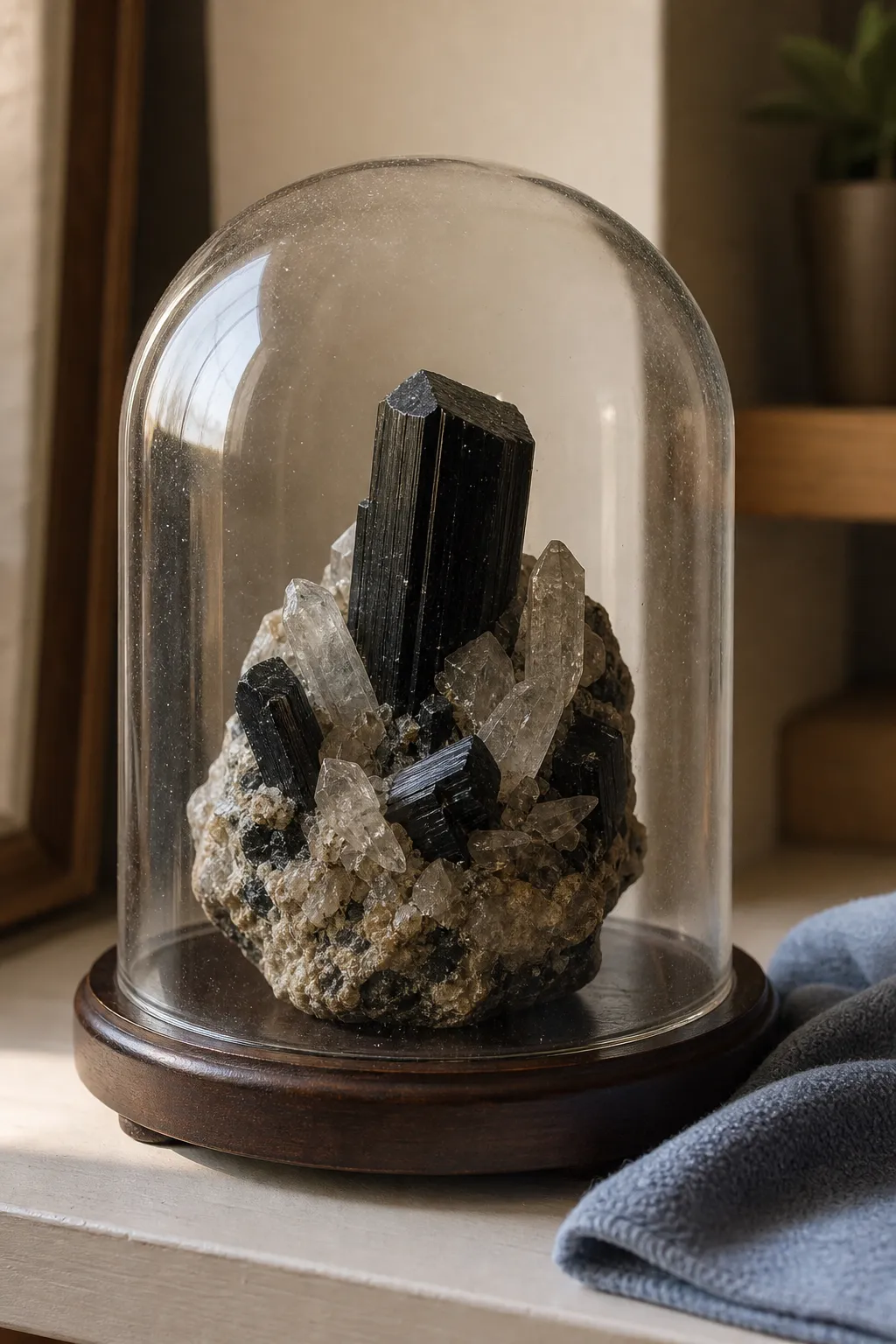
Enclosed mineral display dust control is one of the more reliable ideas borrowed from museum grade display techniques, as long as it is scaled honestly for home use. A glass-front cabinet, acrylic cover, cloche, lidded case, or partially enclosed shelf can reduce direct dust deposition compared with a fully open shelf. It can also reduce how often the stones need to be handled.
Still, enclosure is not permanent preservation. Cases vary in tightness, materials, and ventilation. Enclosed spaces can also trap emissions or odors from case materials. In home terms, use clean, stable display materials and avoid sealing specimens into a newly finished, strongly scented, or shedding container without checking it over time.
A practical middle ground:
- Use covers or cases for pieces that are hard to dust, deeply textured, fragile, or visually important.
- Keep the inside base simple and easy to clean.
- Avoid loose fibers, dusty cloth, dried botanicals, and powdery fillers inside the case.
- Open and inspect periodically instead of assuming a closed case needs no attention.
- Clean the outside of the enclosure before dust migrates inward during handling.
This is especially useful for rough tourmaline, quartz clusters, and mixed displays where dust can lodge between terminations or along matrix surfaces. The point is not to turn a home shelf into a conservation lab. It is to make the display less exposed.
Why compressed air and direct blasts often backfire
Compressed air feels like a touch-free solution, but it is not a good default for preventing dust on piezoelectric stones. It may dislodge particles from one place only to suspend them in the room and let them resettle elsewhere. It can also push grit deeper into crevices or drag abrasive particles across polished, coated, friable, porous, mounted, or otherwise delicate surfaces.
Research on dust removal from exposed surfaces supports a general caution: particle size, adhesion, surface angle, and airflow behavior all affect whether dust moves cleanly or simply relocates. But that research is not mineral-care testing, and it should not be turned into a recommendation for high-pressure air, electrostatic cleaners, vibration devices, or solar-panel-style maintenance for crystals.
For household display care, the safer pattern is slower and more preventive:
- Reduce the airborne dust load.
- Keep dirty air paths away from the display.
- Use filtration to capture particles over time.
- Enclose vulnerable pieces where appropriate.
- Clean around the display before dust builds heavily on the stones.
If dust is already visible on a specimen, that becomes a separate care question. Minerals vary in hardness, porosity, coatings, dyes, treatments, mounts, and water sensitivity. A universal “just brush it” or “just rinse it” instruction is too broad for collector-grade stones.
A simple low-dust setup for crystal shelves
A good low-dust arrangement can be simple. For an open shelf with piezoelectric stones in a normally used room, aim for this:
- The shelf is not directly under an HVAC vent.
- A purifier sits several feet away and pulls room air rather than blowing across the stones.
- The display surface is smooth and easy to clean around the specimens.
- Nearby textiles are minimized or kept clean.
- The floor below the display is vacuumed or dusted regularly.
- Fragile or deeply textured specimens sit under individual covers or inside a cabinet.
- The stones are inspected before dust becomes a thick layer.
This is the practical meaning of “museum grade” for a home display: prevention before intervention. It is not about dramatic airflow or expensive equipment. It is about controlling the small conditions that make dust settle quickly.
For black tourmaline, rough striations and clustered forms can hold dust visibly. Gentle indirect airflow and cleaner surroundings help reduce how often those surfaces need attention. The same logic applies to quartz clusters and other display stones often described as piezoelectric. The mineral identity may differ, but the dust-control problem is physical: airborne particles settle, cling, and collect in texture.
Common confusion about airflow for crystal displays
More airflow does not automatically mean less dust.
A strong fan can keep particles moving and deposit them on the shelf later. If the room is dusty, airflow may simply redistribute the problem.
An air purifier is not a shield.
It can reduce airborne particles, but it cannot keep a dusty open shelf clean by itself. It works best with source reduction and sensible placement.
Piezoelectric does not mean self-cleaning.
Some engineered systems use electrical or vibration effects to move dust on specific surfaces. That does not mean decorative piezoelectric stones repel dust in a home display.
Blowing dust off is not always gentler than touching.
Air can move grit unpredictably. For delicate, polished, coated, or crumbly specimens, prevention is usually better than repeated aggressive removal.
The realistic boundary
Indirect airflow, particle filtration, careful display placement, enclosure, and housekeeping can reduce dust buildup on piezoelectric stones. They can also reduce the need for frequent direct cleaning.
They cannot promise a dust-free shelf, universal mineral safety, or true museum-level preservation at home. Rooms vary too much: vents, pets, textiles, windows, traffic patterns, humidity, furniture, and cleaning habits all change how dust behaves.
The best working rule is conservative: move air gently, filter particles, remove nearby dust sources, cover vulnerable pieces, and clean around the display before the stones themselves become dirty.