Included quartz field note
Tourmalinated Quartz: When Darkness Meets Light
Black Tourmaline in Quartz usually describes a quartz piece crossed by black needles, rods, threads, or branching lines. The useful question is not only what it “means,” but what the material is, why it gets confused with other included quartz, and where visual identification reaches its limit.
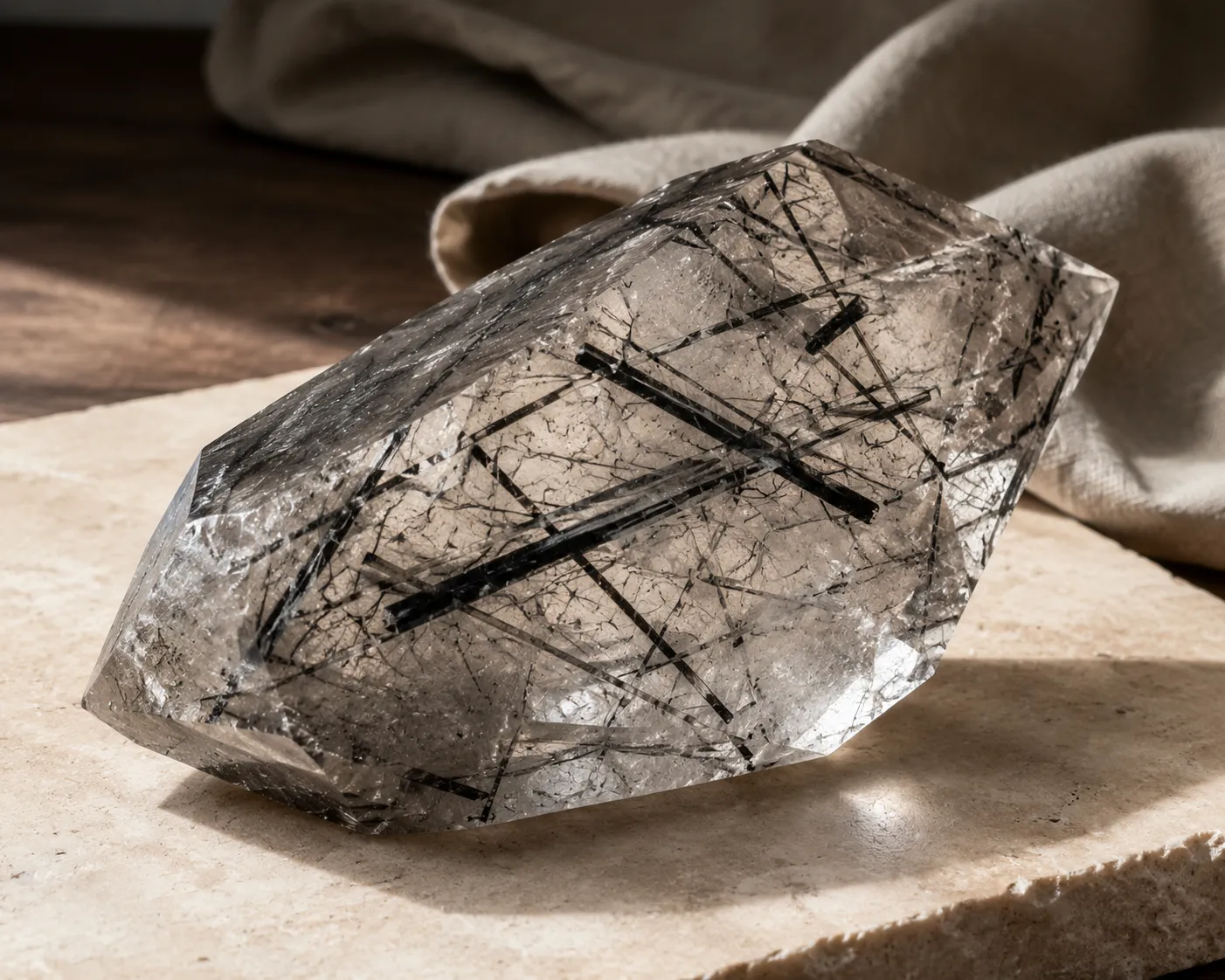
In plain terms, tourmalinated quartz is quartz containing tourmaline inclusions. In the familiar black-and-clear version, those inclusions are commonly described as black tourmaline; when mineral naming needs more precision, they may be identified as schorl.
broader context
Broader schorl guide
This narrower page works best after the broader black tourmaline context page.
What Black Tourmaline in Quartz Actually Is
Tourmalinated quartz is a host-and-inclusion material. Quartz is the host mineral. Tourmaline is the included mineral. The combined name describes an included quartz material as it appears and is traded, not a separate mineral species with one fixed composition.
That distinction prevents a lot of confusion. Quartz can contain many kinds of inclusions. Some are solid minerals. Others may be fluid, gas, fine fibers, or dark particles that change the look of the stone. When the inclusion is tourmaline, the material may be called tourmalinated quartz. When that tourmaline is black, the more careful mineral word is often schorl.
Schorl belongs to the tourmaline supergroup, which is known for chemical variety. Tourmaline names are not assigned by color alone. Formal identification considers chemistry and structure, which most buyers cannot verify by looking at a pendant, bead, sphere, tower, or raw crystal. Still, the naming principle is useful: “black tourmaline” is the practical common phrase, while “schorl” is the more specific mineral term when the black inclusion identity matters.
The quartz host may be clear, cloudy, smoky-looking, milky, or fractured. The inclusions may appear as:
- thin black needles suspended inside the quartz;
- thicker rods or elongated crystals;
- sprays, fans, or feathery groups;
- broken-looking dark strands that change with the cut;
- dense clusters that make the quartz look gray or nearly opaque.
Visible inclusions are not automatically flaws in this material. In included quartz, the inclusions are often the point. A clean quartz host with a few sharp black strands can look spare and graphic. A cloudier host with dense black inclusions can look heavier, more geological, or more dramatic. Neither look proves higher quality by itself. It changes the aesthetic, the way the piece is cut, and sometimes the price context.
Tourmalinated Quartz, Rutilated Quartz, and Other Dark Inclusions
The most common mix-up is between tourmalinated quartz and rutilated quartz. Both can show needle-like inclusions. Both are cut into beads, cabochons, rings, pendants, towers, and spheres. Both may be sold under simplified labels that lean more on appearance than confirmed mineral identity.
The better distinction is not “black means tourmaline” and “gold means rutile.” The better distinction is: identify the included mineral first, then describe the look.
Rutilated vs. Tourmalinated Quartz
Rutilated quartz refers to quartz containing rutile inclusions. Tourmalinated quartz refers to quartz containing tourmaline inclusions. The name follows the included mineral.
In common retail language, rutilated quartz is often pictured as clear quartz with golden, coppery, reddish, or silvery needles. Tourmalinated quartz is often pictured as clear or milky quartz with black needles. That shorthand can help a beginner orient the eye, but it is not a secure identification rule.
Color Is a Clue, Not the Definition
Needle inclusions in quartz can come from more than one mineral context. Dark inclusions are not automatically schorl. Bright inclusions are not automatically rutile. Color, thickness, luster, distribution, and crystal habit can all offer clues, but they do not replace closer observation when a firm identification is needed.
Why “Black Inclusions in Quartz” Is Too Broad
A listing may use phrases such as “black rutilated quartz,” “tourmaline quartz,” “black quartz,” “included quartz,” or “quartz with black needles.” These labels may point to a real visual feature, but they do not all mean the same thing.
“Black quartz” can describe quartz that appears dark for reasons other than visible tourmaline inclusions. Some dark quartz materials owe their color to fine particles or dispersed inclusions rather than distinct black tourmaline crystals. Smoky quartz is another separate appearance category, generally recognized by body color rather than visible black needles. A piece can also be smoky-looking and included, which makes the visual reading less straightforward.
For Black Tourmaline in Quartz, the defining idea is tourmaline inclusions inside quartz. The label is strongest when the inclusions show a tourmaline-like habit and there is a reasonable basis for the identification. It is weaker when it rests only on “dark lines in quartz.”
Appearance Variables That Change the Judgment
Two pieces can both be called tourmalinated quartz and still look very different. The quartz host, the tourmaline inclusions, and the cutting style all affect what the eye sees.
The Quartz Host: Clear, Milky, Smoky, or Fractured
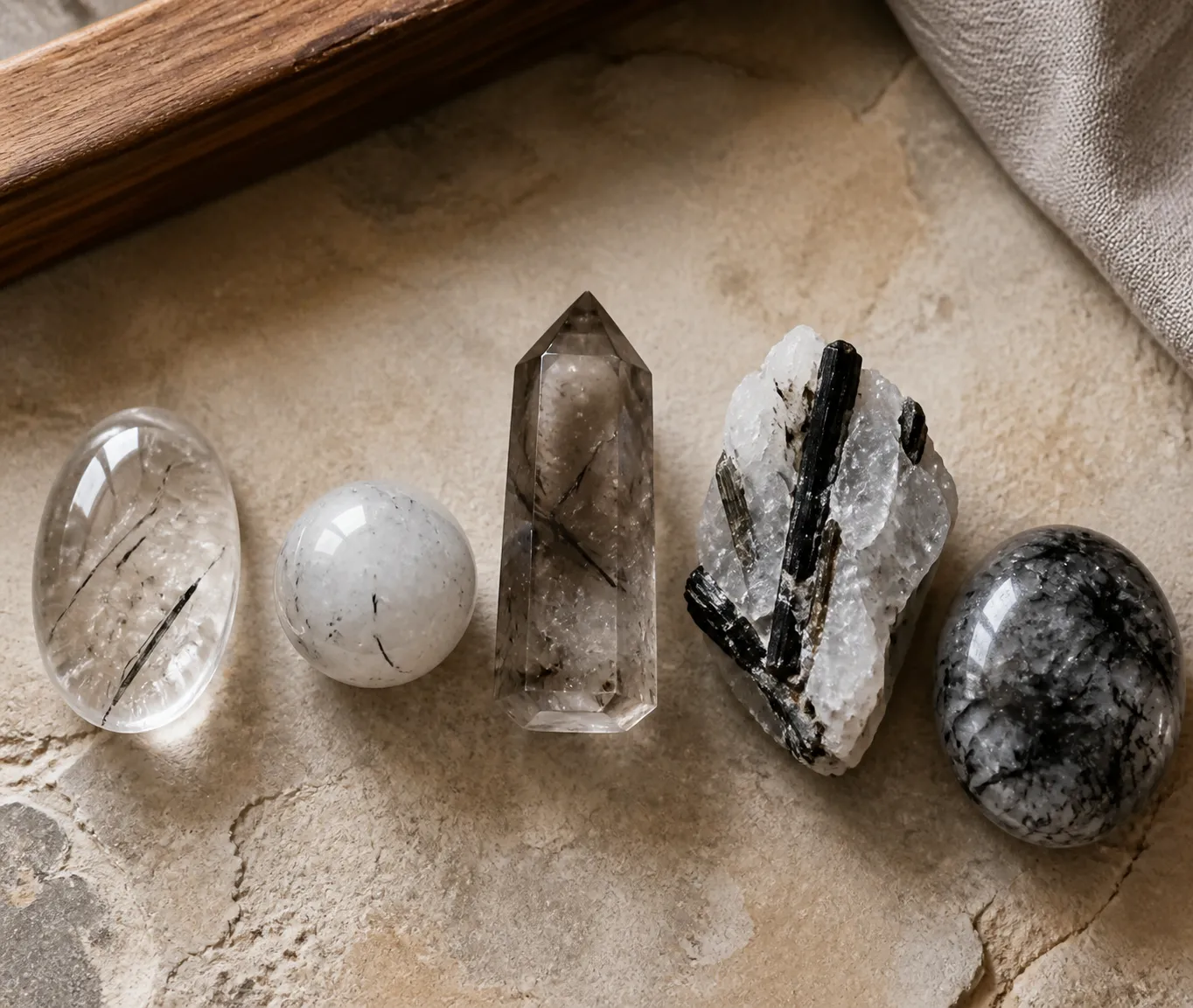
A transparent quartz host makes the black inclusions easier to inspect. Needles may look suspended in open space, especially in polished cabochons, spheres, or faceted pieces. In a milky host, the same inclusions may look softer and less sharply defined. Fractures can create reflections that look like extra lines, which makes photo identification harder.
A smoky or grayish host can deepen contrast, but it can also hide detail. If the piece is very dark overall, it may be difficult to tell whether the darkness comes from tourmaline inclusions, body color in the quartz, other inclusions, or several factors together.
Inclusion Shape: Needles, Rods, Sprays, and Clusters
Needle inclusions are the most familiar visual cue. In tourmalinated quartz, black tourmaline may appear as straight, slightly irregular, or broken-looking lines. Some pieces show radiating clusters or feathery arrangements. Others contain thicker embedded crystals that look more like rods than hair.
Cutting changes perception. A long tourmaline crystal cut across its length may appear as a short dash or dot. A dense cluster viewed through a curved sphere may look magnified or distorted. In a bracelet bead, the drill hole and surface polish can interrupt the inclusions, making continuous growth appear segmented.
Raw, Polished, and Matrix Material
Raw Black Tourmaline in Quartz may show the host-and-inclusion relationship more directly. In some specimens, quartz and tourmaline are visibly intergrown, with black crystals partly embedded and partly exposed. These pieces can appeal to collectors because they preserve more geological texture.
Polished material emphasizes contrast and pattern. Towers, spheres, palm stones, beads, pendants, and rings are shaped to show inclusions through the quartz. This can make the material easier to appreciate visually, but it may also remove external clues that would help with identification.
“Matrix” usually refers to the surrounding rock or mineral material in which crystals occur. A black tourmaline in quartz matrix specimen may include quartz, tourmaline, and associated minerals in a less refined form. Matrix pieces can be more complex than a polished bead because more than one mineral may be visible at the surface.
Meaning, Symbolism, and the Limits of Properties Language
Tourmalinated quartz meaning is often presented through contrast: dark lines in light quartz, shadow inside clarity, grounding paired with brightness. As symbolism, that reading fits the material well. The visual structure is direct. A person may experience a piece as calming, weighty, stark, or balancing when it is worn, handled, or placed in a room.
Those meanings are best kept in the symbolic and subjective lane. Mineralogical and gemological sources support descriptions of quartz, schorl, inclusions, appearance, durability considerations, and identification limits. They do not establish guaranteed emotional, environmental, or body-related outcomes.
A restrained reading is enough: the quartz host gives the piece light, translucency, and structure; the black tourmaline inclusions give contrast, direction, and visual weight. The phrase “darkness meets light” works as an aesthetic and reflective frame. It should not be stretched into certainty.
This boundary matters because Black Tourmaline in Quartz is often marketed with broad claims about benefits, spiritual meaning, metaphysical properties, and protection. In a personal or cultural practice context, someone may use the stone as a reminder to pause, settle attention, or create a visual anchor in a space. That is an interpretive use. It is not the same as evidence that the object changes conditions around the body or room.
Practical Identification and Buying Context
Tourmalinated quartz is often recognizable at a glance, but certainty is easy to overstate from a photograph. A reasonable first-pass judgment looks at the whole piece, not one cue.
Useful visual clues may include:
- black or very dark elongated inclusions inside quartz;
- needle, rod, or spray-like forms rather than cloudy patches alone;
- inclusions that appear embedded within the quartz, not painted on or stuck to the surface;
- visible depth changes when the piece is rotated;
- a label that distinguishes the quartz host from the tourmaline inclusion.
These clues suggest a possibility. They do not prove the mineral identity by themselves.
Photo identification has limits. Reflections can imitate internal lines. Surface scratches can look like needles. A curved sphere or polished bead can distort inclusions. Lighting can make brown, green, gray, or metallic inclusions appear black. Online images may also be sharpened, filtered, or taken at angles that increase contrast.
If the question is casual—“Does this look like tourmalinated quartz?”—a visual assessment may be enough for personal interest. If the answer affects resale, insurance, collection labeling, or a higher-priced purchase, a firmer identification may require magnification, gemological examination, or laboratory-style testing. That does not make every piece suspect. It simply reflects how visually complex included quartz can be.
Price and Quality Without Hype
Black Tourmaline in Quartz price varies with size, transparency, pattern, polish, workmanship, setting, and seller description. A small bracelet bead is judged differently from a clean pendant, a sharp cabochon, a carved tower, or a collector specimen with exposed intergrowth.
Inclusion visibility matters, but not in a simple “more is better” way. Sparse inclusions can look elegant if they are sharp and well placed. Dense inclusions can be desirable if they create a strong graphic pattern. Too many fractures, weak polish, poor drilling, or unstable settings may reduce appeal even when the material itself is interesting.
For jewelry, construction matters as much as the name. A ring faces more contact than a pendant. A bracelet is exposed to knocks, water, lotions, and repeated movement. Quartz has good hardness, but hardness is not the same as overall durability. Inclusions, fractures, and cut shape can influence how a piece handles regular wear.
For interiors, towers and spheres are mostly aesthetic objects. A sphere may highlight inclusions in a floating, magnified way. A tower may emphasize vertical lines and contrast. Raw pieces may feel more geological and less refined. Placement choices are more grounded when discussed through light, surface, scale, and visual mood rather than promised effects.
Common Misreadings to Keep Separate
Several misunderstandings repeat because trade language, symbolic language, and mineral language overlap.
One misreading is that tourmalinated quartz is a new mineral. It is more accurate to describe it as quartz with tourmaline inclusions.
Another is that every black strand in quartz is black tourmaline. Dark strands can suggest tourmaline, but quartz can host different inclusions, and appearance alone may not confirm the species.
A third is that rutilated and tourmalinated quartz are separated only by color. The names should be separated by inclusion mineral. Color is a clue, not the definition.
A fourth is that visible inclusions automatically lower quality. In ordinary transparent gems, inclusions are often treated as flaws. In included quartz, the inclusions may be the feature people want. The question becomes pattern, clarity, condition, and accuracy of description.
Finally, meaning language can be mistaken for material evidence. A person may value Black Tourmaline in Quartz for its contrast, symbolism, or place in a grounding ritual. That can be part of how the object is used. It does not change the mineral facts or confirm broader claims attached to the stone.
FAQ
Is tourmalinated quartz the same as black tourmaline?
No. Black tourmaline usually refers to schorl, a tourmaline mineral. Tourmalinated quartz refers to quartz that contains tourmaline inclusions. In the common black version, schorl may be the included mineral inside the quartz host.
Can tourmalinated quartz be used in bracelets and rings?
Yes. It is commonly cut for jewelry, including bracelets, rings, pendants, and beads. The practical question is condition and construction: fractures, exposed inclusions, sharp edges, drilling quality, and setting protection can affect wearability.
Are black needles in quartz always tourmaline?
No. Black needles or dark strands can suggest tourmaline, but they are not proof by themselves. Other inclusions, lighting effects, fractures, or surface marks can create similar impressions, especially in photos.
What is the simplest way to describe its meaning?
A grounded description is visual and symbolic: dark tourmaline inclusions suspended in a light quartz host. Many people read that contrast as balance, grounding, or clarity, but those are subjective interpretations rather than established material effects.
Closing Perspective
Tourmalinated quartz is most clearly understood as included quartz: a quartz host containing tourmaline, often black schorl in the material most readers are trying to identify. That host-and-inclusion frame prevents most of the confusion. It separates tourmalinated from rutilated quartz, keeps black inclusions from becoming automatic proof, and leaves room for symbolism without turning it into certainty. The material’s appeal comes from the visible meeting of contrast and transparency. Its limit comes from the same place: what the eye sees is meaningful, but it is not always enough to confirm exactly what is inside.