Material care note
Is Black Tourmaline Toxic? Water Safety & Durability
Black Tourmaline water safety is not one question. Most confusion comes from mixing several situations together: rinsing a dusty stone, soaking a rough specimen, wearing a pendant in the shower, placing it in saltwater, or using it near water someone plans to drink. Those uses do not carry the same material questions.
Black tourmaline is commonly discussed as schorl, an iron-rich member of the tourmaline group. It is a relatively hard borosilicate mineral, often listed around Mohs 7 to 7.5. That tells us something about scratch resistance. It does not, by itself, settle solubility, fracture behavior, soap exposure, salt residue, or drinkable gem water use.
Working distinction
Scratch resistance, water contact, jewelry durability, and drinking-water use are separate questions. The exposure pathway matters.
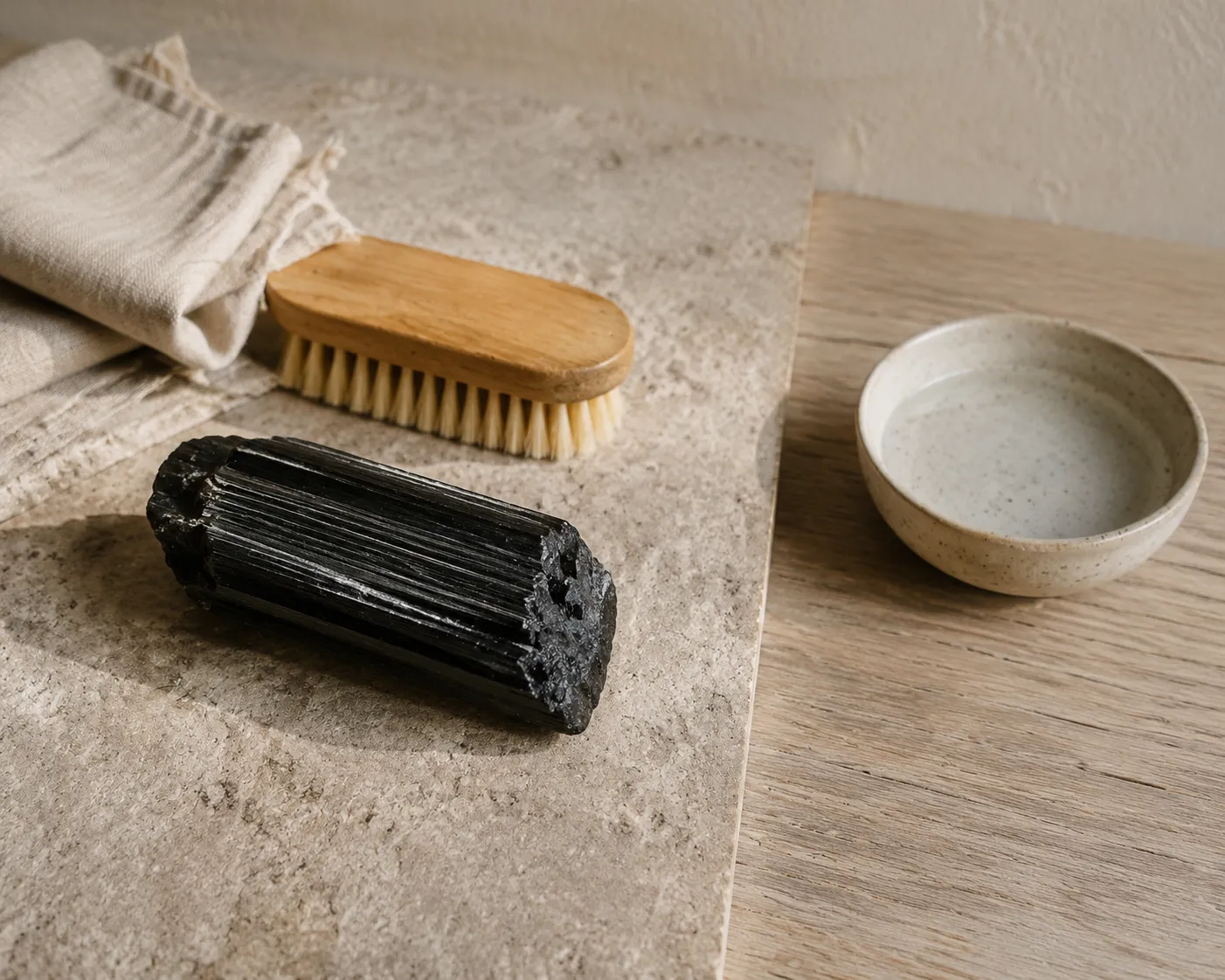
broader context
Broader schorl guide
This narrower page works best after the broader black tourmaline context page.
Toxicity, water contact, and durability are separate questions
“Is black tourmaline toxic?” often gets folded into “can black tourmaline go in water?” because crystal-care language uses the word “safe” loosely.
One source may use “water safe” to mean the stone does not visibly dissolve. Another may mean it will not fade, crack, shed particles, dull, loosen from a setting, or become unsuitable for a symbolic practice. Those are different claims.
A more useful breakdown
- Toxicity: whether contact, dust, ingestion, or dissolved material creates a meaningful exposure concern.
- Solubility: whether the mineral meaningfully dissolves in ordinary water.
- Durability: whether water, salt, soap, temperature shifts, or handling can worsen fractures, dull the surface, or loosen weaker parts.
- Use context: whether the stone is being wiped, rinsed, soaked, worn, stored, or placed in water meant for consumption.
Tourmaline is not one uniform substance. It is a mineral group with complex borosilicate chemistry, and schorl is one member of that group. Pieces sold as black tourmaline can also differ in surface condition, fracture pattern, matrix attachment, finish, and treatment history.
The restrained answer is this: black tourmaline is not like a soft, water-soluble salt mineral, but hardness does not turn it into a material that should be soaked without thought or used in direct-contact drinking water. The exposure pathway matters.
What Mohs hardness can and cannot tell you
The Mohs scale measures scratch resistance. It tells you whether one mineral can scratch another. It does not measure waterproofing, chemical resistance, toughness, or the way a fractured stone behaves when water enters its cracks.
That is why online answers often conflict. A seller may say black tourmaline is fine around water because tourmaline is harder than glass. A care guide may warn against soaking because rough black tourmaline can be brittle, ridged, fractured, or attached to other minerals. Both may be responding to different versions of the material.
Hardness is not toughness
A hard material can still break. Glass is the familiar example: it resists many scratches but can fracture.
Black tourmaline often shows lengthwise striations, uneven surfaces, and internal cracks. Those features are part of its typical columnar, architectural look. They also matter for water exposure. Moisture can sit in grooves. Soap or salt can dry in recesses. A rough piece with host rock attached may behave differently from a polished bead or cabochon.
So “Mohs 7” is not the same as “waterproof.” Mohs hardness helps with scratch expectations. It does not settle black tourmaline durability in water.
The individual piece matters
Two pieces sold under the same name may not respond the same way.
A polished bead may have fewer open surface crevices than a rough crystal cluster. A heavily fractured specimen may shed small grains more easily than a compact, well-finished piece. A stone attached to matrix may include other minerals with different water behavior. Dyed, filled, coated, glued, or low-grade material adds more uncertainty.
For care decisions, the better question is not “Is black tourmaline waterproof?” It is: what kind of exposure, for how long, and on what kind of piece?
Rinsing, soaking, showering, saltwater, and soap
Available mineral references help with identity, structure, and hardness. They do not provide a direct household study covering every intact schorl specimen in every kind of water. Consumer care advice often separates quick cleaning from prolonged exposure, and that distinction is useful as practical material care rather than a sweeping safety conclusion.
Brief rinsing
For ordinary dust, dry cleaning is usually the lower-risk first step. A soft brush can remove debris from striations without leaving moisture in grooves.
A brief rinse may be reasonable for a compact, stable, untreated piece when dry cleaning is not enough. The key is to keep contact short and dry the stone promptly, especially along ridges, cracks, drilled holes, and settings.
This is a care judgment, not a claim about every black tourmaline specimen. Rough, crumbly, fractured, glued, coated, matrix-bearing, dyed, or filled pieces deserve more caution. If a piece sheds grains when handled dry, water is unlikely to improve that behavior.
Prolonged soaking
Long soaking adds variables that a quick wipe or rinse does not. Water has more time to enter cracks, sit against mixed minerals, affect surface treatments, or leave residues as it dries.
There is no precise general threshold where black tourmaline changes from acceptable to unacceptable water contact. The issue is not that every soaked piece will show visible damage. It is that soaking is often unnecessary for cleaning, and it can expose weak points that are not obvious from the outside.
For display pieces, rough crystals, and sentimental jewelry, the main concern is usually durability: fractures, surface changes, loosened material, or residue. A dry brush, a barely damp cloth, and prompt drying usually accomplish the same cleaning goal with fewer variables.
Saltwater exposure
Saltwater is commonly treated as riskier than plain water in crystal-care discussions. The stronger public references do not give a black-tourmaline-specific saltwater test, so the mechanism should not be overstated.
From a practical care perspective, salt adds residue and abrasion concerns. Salt crystals can remain in grooves after water evaporates. On a ridged black tourmaline surface, that can make the stone look dull or gritty, and removing the residue may require more rubbing than the piece needed in the first place.
If saltwater is used symbolically in some practices, that tradition should be kept separate from material evidence. For rough or fractured black tourmaline, avoiding saltwater soaking is the cleaner care choice.
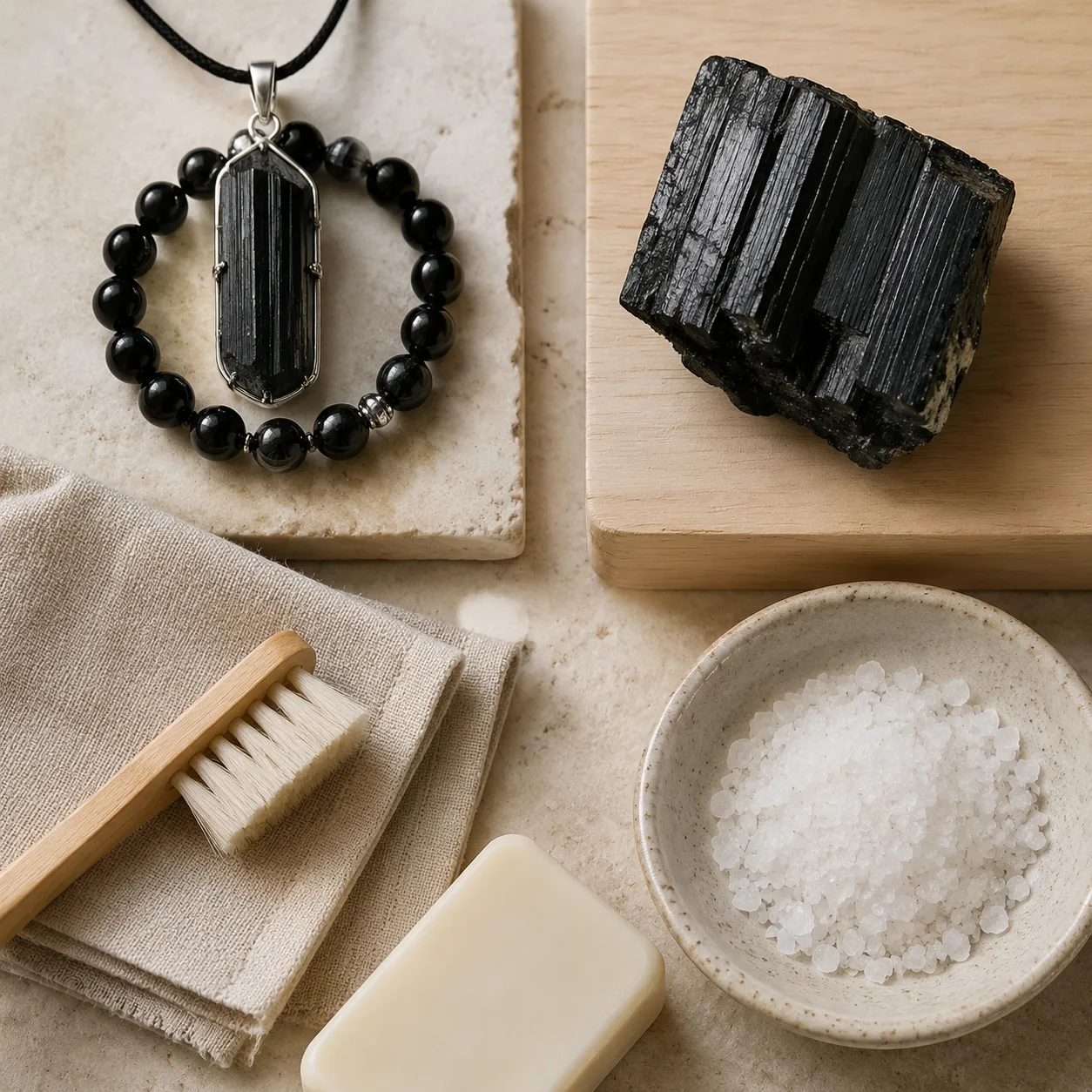
Showering with black tourmaline jewelry
“Can you shower with black tourmaline?” is not only a mineral question. It is also a jewelry-construction question.
A black tourmaline bead or pendant may tolerate occasional water contact, but showers add warm water, soap, shampoo, conditioner, skin oils, and repeated wet-dry cycles. The stone is only one part of the object. Metal settings, elastic cord, adhesives, coatings, surface polish, and drilled holes may be more vulnerable than the mineral itself.
Soap and cosmetic exposure can leave film in grooves or around settings. Over time, that may change the look of the piece even if the tourmaline remains intact. For jewelry, removing it before showering is usually a better durability habit than trying to prove the stone is fully waterproof.
Sun and heat after water
Black tourmaline’s dark appearance is tied to its composition and light behavior, not usually to a delicate surface dye in ordinary mineral form. The available references do not support a broad claim that schorl readily fades in sunlight the way some color-sensitive minerals may.
Heat is a separate issue. Leaving a wet, dark, fractured stone in intense sun, a hot car, or near a heat source can create uneven drying and temperature stress. The practical care point is simple: dry it gently. Do not use high heat as a shortcut.
Aluminum in black tourmaline does not equal an exposure claim
Some readers worry because tourmaline formulas can include aluminum. That concern needs a careful frame. The presence of aluminum in a mineral structure is not the same as a meaningful aluminum exposure.
Aluminum exposure discussions depend on chemical form, solubility, route, dose, and bioavailability. Public health materials discuss exposure through food, drinking water, air, certain products, and soluble compounds. They do not imply that every aluminum-bearing mineral on a shelf releases a relevant amount of aluminum into ordinary water.
The boundary cuts both ways. It would be too fearful to say, “black tourmaline contains aluminum, therefore it creates a water problem.” It would also be too broad to say, “black tourmaline contains aluminum but belongs in drinking water.” The available material supports neither extreme.
A better reading
- A mineral formula is not an exposure assessment.
- Insoluble or tightly bound mineral structures differ from soluble aluminum compounds.
- Drinking-water use requires a higher evidence bar than display, handling, or surface cleaning.
- Unknown treatments, powders, dust, coatings, and mixed-mineral pieces introduce variables not answered by the word “tourmaline.”
Dust is also a separate pathway. Cutting, grinding, or polishing minerals can create fine particles. That is not the same scenario as holding a finished stone, dusting a display piece, or briefly wiping jewelry.
Why tourmaline water studies do not prove gem-water use
Technical discussions about tourmaline powders, nanoparticles, water-treatment materials, adsorption, wastewater treatment, or functional composites can be interesting in materials science. They should not be stretched into household claims about black tourmaline water.
The conditions are different.
Powdered or nanoscale tourmaline has far more surface area than an intact crystal or polished bead. Water-treatment studies may involve controlled particle size, dosage, contact time, temperature, pH, and target contaminants. Functional composites may use modified materials rather than a natural crystal placed in a bowl.
A material can be studied for water-treatment applications without that meaning an intact stone changes a glass of water in a predictable or appropriate way at home. A paper about tourmaline-water interaction does not automatically establish that black tourmaline makes drinkable water better or chemically suitable.
For direct-contact drinking water, the cautious answer is narrow: the available material does not establish black tourmaline as appropriate for that use. If someone keeps a symbolic or decorative practice, separating the stone from the water reduces material-contact variables. That still should not be presented as a water-quality or health-outcome claim.
A practical framework for black tourmaline water safety
Lower-uncertainty handling
These uses usually keep variables limited:
- Displaying black tourmaline dry.
- Dusting it with a soft brush.
- Wiping it with a dry cloth.
- Using a barely damp cloth on a stable polished piece, then drying it promptly.
- Briefly rinsing a compact, untreated piece when necessary, then drying grooves and edges.
This does not establish a universal rule for every specimen. It simply keeps water contact short, avoids residues, and reduces stress on fractures or surface treatments.
Higher-uncertainty handling
These uses introduce more variables:
- Overnight soaking.
- Saltwater soaking.
- Repeated shower wear.
- Contact with soap, shampoo, lotions, perfumes, or cosmetics.
- Leaving rough black tourmaline in water-filled bowls.
- Using black tourmaline in direct-contact drinking water.
- Wetting matrix-bearing, crumbly, coated, glued, dyed, or filled pieces.
The issue is not that every one of these will visibly damage every stone. The issue is that the exposure goes beyond simple cleaning, and the available evidence does not support a broad promise.
Simple care order
For ordinary care, use the least aggressive method that works:
- Dry brush first. It removes dust from striations without moisture.
- Use a barely damp cloth if needed. Keep water contact brief.
- Dry promptly. Pay attention to grooves, drilled holes, and settings.
- Avoid saltwater and long soaking. They add more risk than benefit for most care needs.
- Do not use direct-contact drinking water as a default. That question requires stronger support than ordinary cleaning.
This keeps the decision grounded in material conditions rather than fear about toxicity or overconfident claims about purification.
Common misunderstandings about black tourmaline and water
“If it is Mohs 7, it must be waterproof.”
Mohs hardness means scratch resistance. It does not measure solubility, fracture behavior, chemical resistance, or the effect of soap and salt residue. A hard mineral can still be brittle or fractured.
“If it contains aluminum, it must release aluminum into water.”
Composition alone does not establish exposure. Aluminum risk depends on chemical form, route, dose, solubility, and bioavailability. Aluminum held in a complex mineral structure is not the same as soluble aluminum in drinking water.
“If tourmaline is studied for water treatment, a crystal can purify my water.”
Powders, engineered materials, wastewater experiments, and intact decorative stones are different contexts. Technical research should not be converted into a household water claim for a crystal.
“Water-safe means every water use is the same.”
A quick rinse, a long soak, shower wear, saltwater cleansing, and drinkable gem water are separate questions. A cautious answer may allow brief cleaning while still avoiding soaking or ingestion-adjacent use.
FAQ
Is black tourmaline soluble in water?
Black tourmaline is not generally described as water-soluble in the way soluble salts are. Low solubility, however, does not answer every care question. Water can still affect fractures, residues, surface treatments, matrix minerals, or jewelry components.
Can black tourmaline be in water overnight?
Overnight soaking is not a good default. The available material does not establish a universal damage threshold, but prolonged exposure adds avoidable uncertainty, especially for rough, fractured, matrix-bearing, or treated pieces.
Is black tourmaline okay to rinse?
A brief rinse may be reasonable for a stable, compact, untreated piece when dry cleaning is not enough. Dry it promptly afterward. For fragile, crumbly, coated, glued, or matrix-bearing material, use a dry brush or cloth instead.
Can you make black tourmaline water to drink?
The available material does not establish black tourmaline as suitable for direct-contact drinking water. Claims about tourmaline powders or water-treatment materials should not be treated as proof that an intact crystal belongs in water meant for consumption.
Bottom line
Black tourmaline is not usefully judged by one broad “toxic or not toxic” label. For ordinary handling, the main question is usually durability: fractures, ridges, residues, surface treatments, and jewelry construction. For drinking water, the evidence bar is higher, and the current material does not support direct-contact gem-water use.
A cautious care pattern is simple: keep black tourmaline mostly dry, clean it with a brush or cloth, use brief water contact only when needed, dry it well, avoid saltwater soaking, and do not confuse Mohs hardness with full water safety.
Sources
Sources and further reading
Reference links are limited to sources considered suitable for public citation in this page.