Symbolic pairing guide
The Ultimate Shield: Why Black Tourmaline and Shungite Belong Together
Black tourmaline and shungite belong together when the pairing is treated as a Synergistic Crystal Pairing in symbolic crystal practice—not as a proven protective device.
In that language, black tourmaline is often used as the grounding stone: the boundary, the anchor, the line around a space. Shungite adds a more modern association: carbon-rich, dark, filtering, and often linked in crystal culture with technology-heavy environments. Together, they create a clear ritual image: black tourmaline marks the edge; shungite refines the atmosphere inside it.
That is the useful answer. The limit matters just as much: this pairing does not prove physical protection from electromagnetic fields, radiation, toxins, illness claims, stress outcomes, or environmental risks. “The ultimate shield” works best as metaphor, design intention, and ritual language.
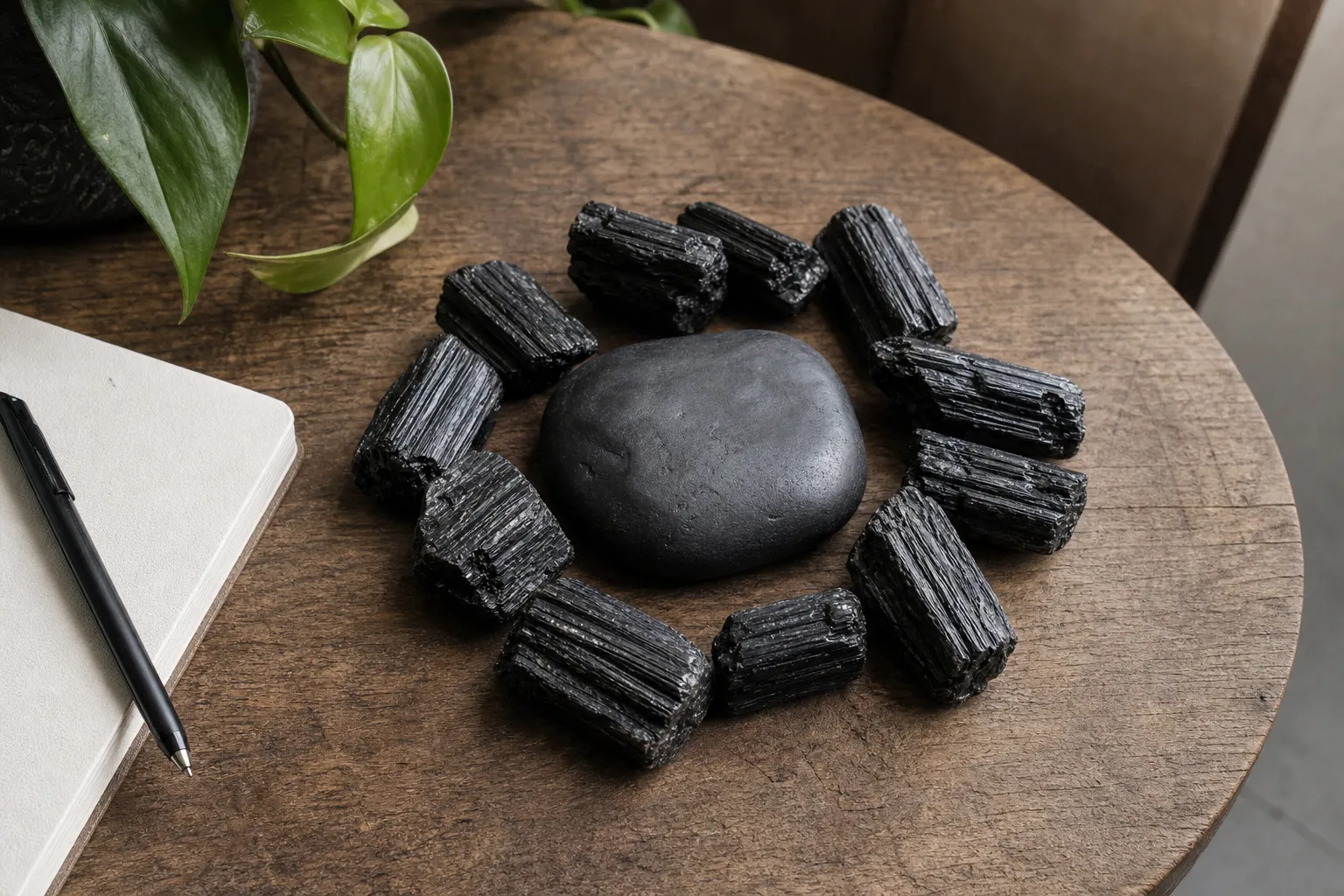
Why Pair Black Tourmaline With Shungite?
The appeal of a black tourmaline and shungite pairing is easy to understand. Both stones are dark, visually weighty, and often chosen by people who want a sense of grounding, steadiness, and energetic boundary-setting in a room.
In metaphysical crystal pairing language, black tourmaline usually plays the anchor role. It is the stone people reach for when they want a symbolic edge: a threshold, a root, a steady object on a desk, a boundary around personal space.
Shungite brings a different kind of story. Scientific literature does discuss shungite as a carbonaceous or mineralized carbon material, with sample-to-sample variation and technical interest around its structure. That background has helped shape shungite’s modern reputation as a stone associated with filtering, technology, and environmental clutter.
In ritual terms, the two ideas fit:
- Black tourmaline: boundary, grounding, anchoring.
- Shungite: filtering, buffering, technology-facing symbolism.
- Together: a simple “anchor and screen” pairing for a space that needs less noise and clearer edges.
That is the energetic synergy meaning here. It is not two stones doubling a verified force. It is two symbolic roles reinforcing one intention from different angles.
The Pairing Works Best as Symbolic Crystal Practice
A useful metaphysical crystal pairing usually needs both overlap and contrast. If two stones mean exactly the same thing, the pair can feel redundant. If they are too different, the intention can feel scattered.
Black tourmaline and shungite sit in the middle.
Where they overlap
- Visual tone: both are dark and quiet in a room.
- Ritual language: both are commonly placed in conversations about grounding, boundaries, shielding, and clearing.
- Use setting: both fit naturally on desks, entry tables, bedside areas, meditation trays, and workspaces.
Where they differ
Symbolic role
Black tourmaline: the boundary stone.
Shungite: the filter or buffer stone.
Design feeling
Black tourmaline: mineral, rooted, firm.
Shungite: dark, compact, carbon-associated.
Best ritual use
Black tourmaline: marking a line or threshold.
Shungite: naming the wish for less clutter or distraction.
This is why “ultimate shield” can be a helpful phrase if it stays poetic. It gives the pairing a strong intention. It becomes misleading only when the phrase is treated as a physical protection claim.
A grounded intention sentence works better than an inflated claim:
“This space supports steadiness, clear boundaries, and less unnecessary noise.”
That wording keeps the practice honest. It gives the stones a job without turning them into safety equipment.
What Shungite Science Does—and Does Not—Support
Shungite needs careful wording because scientific terms around it are easy to stretch too far.
Research describes shungite as a carbonaceous or mineralized carbon material, but not as one uniform substance. Different shungite samples can vary in carbon content, mineral impurities, structure, and technical behavior. So “carbon-rich” may be a useful general association, but it should not be treated as a guarantee for every object sold as shungite.
The word fullerene also needs restraint. Some technical literature discusses fullerenes, fullerene-like structures, and unusual carbon arrangements in shungite. Other structural work shows that interpretation can be complicated. A careful summary is: shungite is part of fullerene-related discussions in carbon-material research, but that does not mean every shungite stone contains meaningful fullerenes in a way that proves personal crystal effects.
The same caution applies to electromagnetic language. Some studies examine shungite-based powders, fillers, plates, or composites for radar, microwave, or electromagnetic shielding and absorption. Those are engineered materials in controlled settings, with specific forms, thicknesses, concentrations, and frequency ranges.
A loose palm stone, bead bracelet, tower, pyramid, or decorative piece is not the same thing as a tested composite material.
So yes: shungite has a real carbon-rich reputation with a technical background. No: that background does not prove that a black tourmaline and shungite pairing physically shields a person, room, desk, or device.
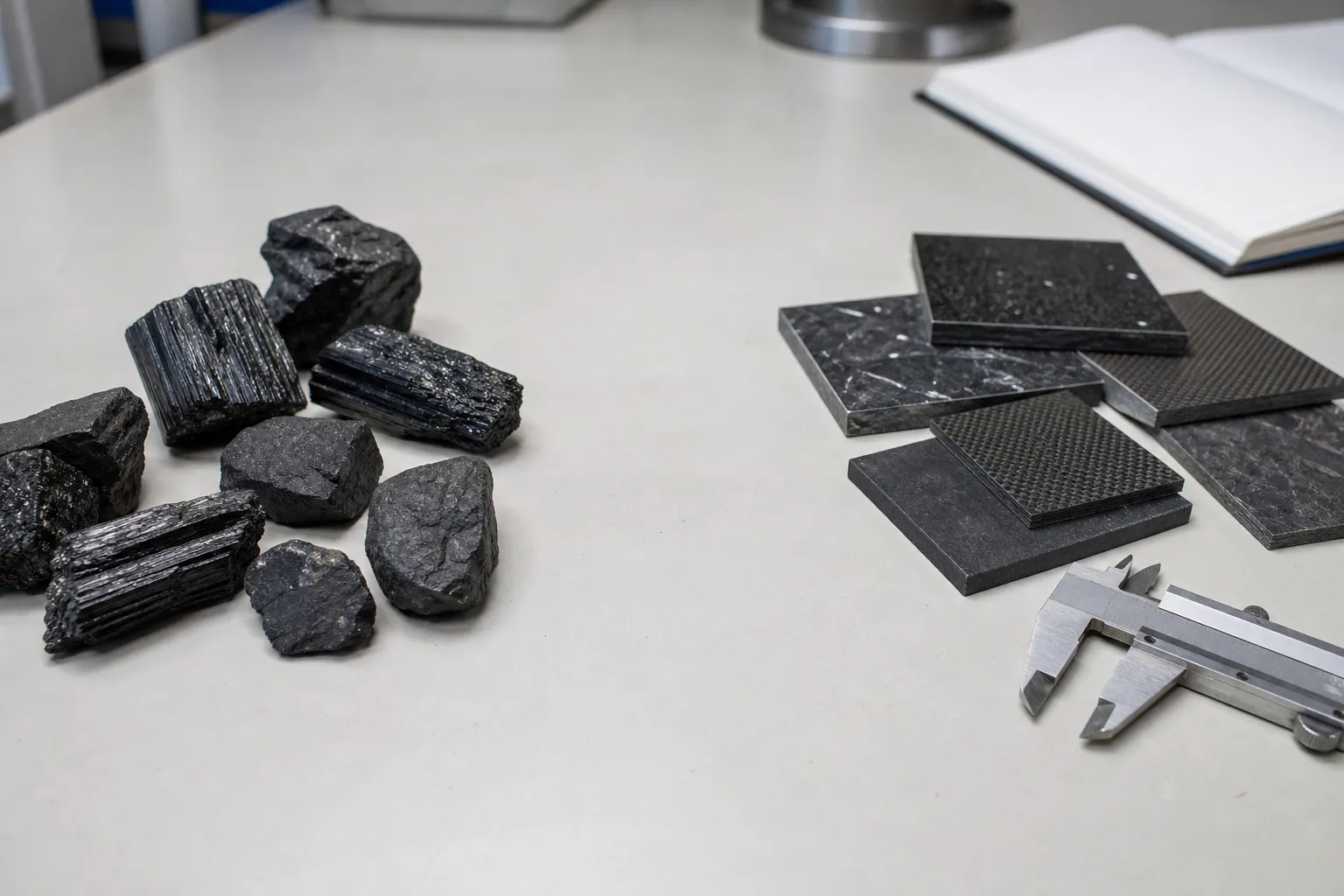
A Simple Black Tourmaline Shungite Comparison
The cleanest way to understand the pairing is to keep three layers separate: material identity, symbolic role, and unsupported claim.
Visual presence
Black tourmaline: dark, mineral-looking, often striated. Shungite: dark, matte to shiny, carbonaceous-looking. What the pairing means: a visually coherent grounding pair.
Symbolic role
Black tourmaline: boundary, anchoring, protection language. Shungite: filtering, buffering, technology-facing symbolism. What the pairing means: a ritual of “anchor and screen.”
Evidence boundary
Black tourmaline: not shown here to produce measurable energetic effects. Shungite: technical sources support limited carbon-material discussion. What the pairing means: symbolic pairing, not a verified safety tool.
Best use
Black tourmaline: thresholds, desks, personal altars, grounding rituals. Shungite: desks, tech-adjacent spaces, intention layouts. What the pairing means: a reminder object for steadiness and boundaries.
Claim to avoid
Black tourmaline: guaranteed energetic protection. Shungite: guaranteed EMF or radiation blocking by a loose stone. What the pairing means: no proven physical protection from the pair.
This kind of crystal pairing chart is useful because it prevents the two stones from being blended into one exaggerated promise. The pairing can be meaningful without being overstated.
Where the Pairing Makes Sense
This combination works best when symbolism, visual design, and personal intention are the point.
On a desk
Black tourmaline can represent the boundary around attention. Shungite can represent the wish for less digital noise. That does not mean the stones neutralize a laptop, router, or phone. It means the arrangement reminds you how you want to relate to the space: less scattered, more contained.
Near an entryway
Black tourmaline can carry the threshold role, while shungite adds the idea of leaving static or clutter at the edge of the home. The action is ritual and visual, not a substitute for practical home safety, electrical standards, air quality measures, or medical guidance.
On a bedside table
The pair can support a quieter visual mood. Dark stones, especially when placed in a small dish with wood, linen, or ceramic, can make the nightstand feel less busy. Keep the claim modest: the pair can be part of a wind-down ritual, not a guaranteed sleep or mood outcome.
In all three settings, simple is better. One piece of black tourmaline and one piece of shungite are enough. More stones do not automatically make the intention stronger; they can just make the layout visually noisy.
Common Confusion: Energetic Shielding vs. Physical Shielding
Most confusion around this pairing comes from the word “shield.”
In crystal belief language, energetic shielding usually means a symbolic boundary: a way of naming what you want to let in, what you want to keep out, and how you want your space to feel. It belongs to ritual, meditation, personal meaning, and spiritual vocabulary.
In materials science, shielding has a more specific meaning. It refers to measurable interactions with radiation or electromagnetic waves under defined conditions. Studies involving shungite-based materials may use engineered forms, laboratory measurements, and controlled frequency ranges.
Those meanings should not be blended.
It is fair to say, “I use black tourmaline and shungite as an energetic shield in my crystal practice,” if that is understood as belief-based language. It is not fair to present the pair as a verified way to block EMF, protect against radiation, remove toxins from the body, or guarantee emotional results.
The distinction protects the practice. Symbolic language does not need to pretend to be laboratory evidence in order to be personally meaningful.
When This Is Not the Right Pairing
Black tourmaline and shungite are not the right answer if you are looking for a scientifically verified protective tool. If your concern involves electrical safety, occupational exposure, environmental contamination, device emissions, or health symptoms, the next step is appropriate testing, standards-based controls, or qualified guidance—not stones.
The pairing may also feel too heavy for some spaces. Both stones are dark and visually dense. If a room already feels shadowed, cluttered, or closed in, a black-on-black pairing may not create the atmosphere you want. A lighter grounding object, clearer layout, or natural texture may work better.
It may also be unnecessary if your practice works best with one focal object. Some people prefer black tourmaline alone because it gives the ritual a cleaner center. Others prefer shungite alone because its carbon-rich reputation and modern symbolism match a technology-heavy setting.
A synergistic crystal pairing is useful only when the second stone clarifies the intention.
A Grounded Way to Use the Pair
If you want to work with black tourmaline and shungite together, keep the practice plain.
Place the black tourmaline where you want to mark a boundary: the edge of a desk, near an entry point, beside a meditation cushion, or on a small tray. Place the shungite nearby as the companion symbol for filtering distraction or softening the feel of digital clutter. Then name the intention in ordinary words:
“This space supports steadiness, clear boundaries, and less unnecessary noise.”
That says enough. It does not borrow scientific language it cannot support. It does not turn the stones into safety equipment. It lets the pairing do what symbolic objects do well: focus attention, shape atmosphere, and give form to an inner decision.
The best reason to pair black tourmaline with shungite is not that they prove an invisible shield. It is that their shared darkness, grounding symbolism, and contrasting stories create a clear ritual grammar.
Black tourmaline gives the line. Shungite gives the filter. Together, they make a strong symbolic pairing—useful, visually coherent, and best kept within honest limits.
FAQ
Is black tourmaline and shungite a true Synergistic Crystal Pairing?
Yes, in symbolic crystal practice. The synergy comes from their complementary meanings: black tourmaline as boundary and anchor, shungite as filter and buffer. It should not be read as a verified physical effect.
Does shungite’s carbon content prove the pairing works?
No. Shungite’s carbon-rich reputation has a real technical background, but carbon content varies by sample, and material science does not prove personal crystal outcomes.
Can I place the pair near electronics?
You can place them near electronics as a ritual or decor choice. Do not treat a loose stone arrangement as proven EMF mitigation.
Which stone should be larger?
There is no rule. If the intention is boundary-setting, make black tourmaline the visual anchor. If the focus is technology-related symbolism, let shungite be more prominent. The arrangement should make the intention clearer, not more complicated.