Reflective crystal practice
Crystal Graduation: 5 Signs Your Energetic Work With a Stone Is Complete
Sometimes a crystal does not feel “wrong.” It just stops feeling central.
The clearest crystal graduation signs are usually quiet: you no longer reach for the stone, the intention you paired with it feels complete, the emotional charge has softened, or the piece starts to feel more like a marker of a past chapter than an active crystal tool.
That does not mean the stone has literally lost power, become “dead,” or failed you. In a reflective crystal practice, “energetic completion” is best understood as a change in meaning: your relationship with the stone has shifted, and you may be ready to pause, store it, cleanse it, pass it on, or keep it nearby in a different role.
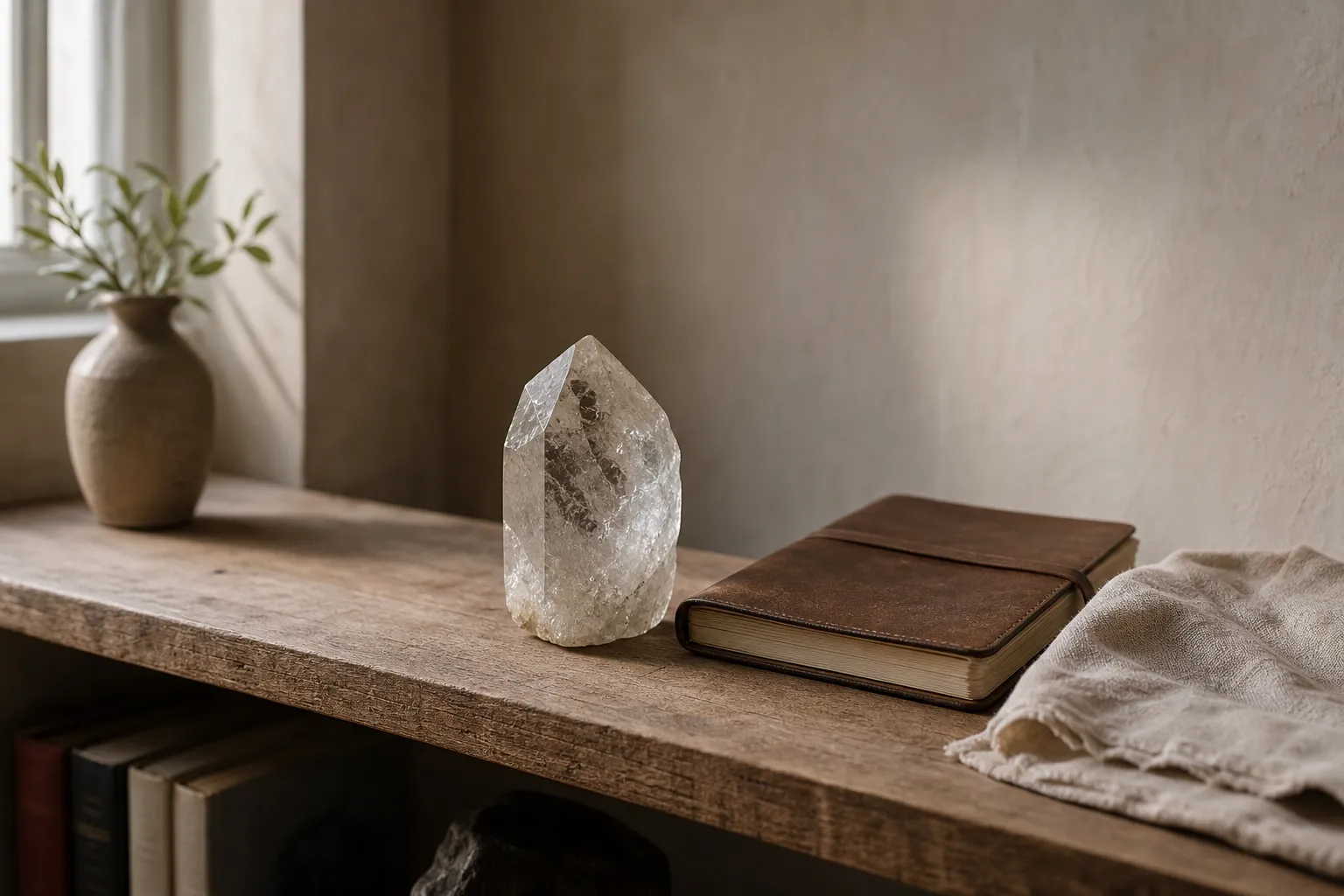
broader context
Start with the main black tourmaline page
This narrower page works best after the broader black tourmaline context page.
The 5 Signs Your Work With a Stone May Be Complete
1. You no longer reach for it automatically
One of the simplest signs crystal work is complete is a change in habit.
A stone that once lived in your pocket, on your desk, beside your bed, or in your hand during meditation may gradually become less necessary. You leave it on the shelf without thinking. You choose a different piece. You move through the day without the old impulse to touch it.
That lack of pull does not need to be dramatic. In many cases, no longer reaching for a crystal is the sign.
“What was I asking this stone to hold with me, and do I still feel actively connected to that intention?”
If the answer is no, the relationship may have shifted from active support to completed association. The stone can remain meaningful without staying in daily use.
2. The original intention feels settled
Many people work with a crystal around a particular intention: steadiness, focus, closure, courage, protection, grief, boundaries, a new home, or a personal transition. In that kind of spiritual vocabulary, completion usually has less to do with the object and more to do with the intention.
You may notice that the original reason for carrying the stone no longer feels current. The question has been answered enough. The chapter has settled. The practice has served its symbolic purpose for you.
This is not a claim that the stone caused a specific outcome. It is a way to read your relationship with the object. If the crystal once helped you remember an intention, and now that intention feels part of your ordinary life, the stone may no longer need to act as a daily reminder.
“If I picked up this stone today, would I know what I am working on with it?”
If the answer feels blank, finished, or gently complete, that may be your clearest sign.
3. The stone feels quiet instead of charged
Some readers describe this as “the crystal feels dead.” That phrase appears often in spiritual search language, but it needs care. A crystal is a physical mineral or material object; “dead” is not a measurable condition here. Usually, the phrase points to a changed relationship with a stone.
A piece that once felt vivid, comforting, intense, or strongly tied to a phase of life may begin to feel quiet. You pick it up and notice very little. No aversion, no spark, no particular message. Just the object itself.
That neutrality can mean several things. You may be tired, distracted, too used to the same ritual, or simply in a different season. But if the quiet feeling is calm rather than uneasy, it may suggest the stone’s role has changed.
The useful distinction is fear versus clarity. “This crystal feels dead, so something is wrong” creates pressure. “This crystal feels quiet now, and I can choose what comes next” leaves room for discernment.
4. You feel ready to cleanse, store, rotate, or pass it on
Completion often comes with a practical impulse.
You may want to clean the stone physically if the material allows it, place it somewhere restful, move it from a daily pocket to a shelf, wrap it, set it on an altar, or give it to someone else.
In spiritual language, people may describe this as wanting to cleanse, store, or pass on a crystal. The important point is that these are personal choices, not rules. You do not have to perform a closing ritual to avoid bad luck. You do not have to give the stone away to prove you are done. You do not have to keep using it out of loyalty.
If you want a simple closure practice, keep it plain:
- Hold the stone and name the original intention.
- Say what feels complete or changed.
- Thank the object as a symbolic companion.
- Decide whether to store, display, rotate, or release it.
This kind of closure is not about proving that an invisible process has ended. It is about giving your attention a clean ending.
5. The stone feels like a chapter marker, not an active tool
A completed crystal relationship often does not disappear. It changes category.
The stone may become a memory object, a threshold marker, or a quiet part of your space. You may still like it. You may still respect what it represented. But it no longer feels like something you are “working with” in a daily or intentional way.
This can happen with stones connected to a move, breakup, recovery period, creative project, grief season, or identity shift. The piece may still belong in your life, but as a marker of where you have been rather than a tool for what you are currently practicing.
“When I see this stone, do I feel called into an active practice, or do I simply remember a completed passage?”
If it feels like a chapter marker, crystal graduation may be the right language for your experience.
When to Stop Wearing a Crystal
Knowing when to stop wearing a crystal does not require a dramatic sign. If a stone feels heavy, distracting, irrelevant, or simply unnecessary, you can stop wearing it for a while and observe the difference.
A pause is often better than a final decision. Put the stone somewhere visible but not on your body. Leave it there for a few days or weeks. Notice whether you miss it, feel relieved, forget about it, or return to it with a clearer intention.
Stopping may make sense when:
- The original intention feels complete.
- You are wearing it out of obligation rather than choice.
- The stone is physically uncomfortable, fragile, or impractical.
- You feel more settled without the daily reminder.
- Another object or practice fits your current focus better.
Pausing may make more sense when the feeling is unclear. If you are in a charged moment, tired, grieving, or trying to force an answer, give yourself time. Losing connection with a stone for a few days does not automatically mean the work is over. Sometimes attention returns after rest.
The grounded approach is to treat crystal use as optional and adjustable. You can rotate pieces, take breaks, return later, or let a practice end without treating that ending as a failure.
What Can Change the Answer
The same sign can mean different things depending on context. A crystal feeling quiet may point to completion, but it may also reflect your mood, your environment, or how you have been using the object.
Before deciding that a stone is “done,” consider these variables.
Your original intention may have been too vague.
If you never named what the stone was for, it can be hard to know whether the work is complete. The next step may be clarification rather than closure.
You may be overusing the same object.
A stone carried every day can become visually and emotionally familiar. Familiarity can feel like disconnection, even when the object still matters to you.
The practice may need a different form.
You may no longer want to wear the crystal but still want it on a desk, windowsill, bedside table, or small ritual space. Completion of one use does not require ending every relationship with the piece.
The feeling may be about the life chapter, not the stone.
If the crystal is tied to a difficult period, losing connection may mean you are ready to stop revisiting that version of yourself. The object becomes a boundary around the past.
You may simply not need a crystal for this intention anymore.
That is allowed. A reflective crystal practice does not have to become permanent to be meaningful.
These variables matter because “crystal graduation” is not a technical status. It is a personal interpretation. The answer depends on what the stone represented, how you used it, and whether the relationship still feels alive in your present life.

Common Confusion: Completion Is Not Rejection
The most common misunderstanding is treating completion as a problem.
If a crystal feels dead, less magnetic, or emotionally distant, it can be tempting to assume that something has gone wrong. Some people worry that they failed the practice, chose the wrong stone, ignored a message, or need to fix the object with a more elaborate ritual.
You do not need to turn the feeling into a crisis. A changed relationship with a stone can be ordinary. Objects gather meaning because we give them attention, context, and repetition. When that attention changes, the meaning can change too.
Completion does not have to mean:
- The crystal has lost an objective property.
- You are spiritually disconnected.
- You must replace the stone immediately.
- You are obligated to gift it away.
- The stone is unsafe to keep.
- The practice was fake because it ended.
It can simply mean: this object belonged to a season, and the season has moved.
That interpretation keeps the practice symbolic without making it fearful. You can honor the stone without treating it as a source of pressure.
A Short Discernment Check Before You Decide
If you are unsure whether your energetic work with a stone is complete, use a short reflection rather than looking for a perfect sign.
Ask yourself:
- 1. What intention did I connect with this stone?
- 2. Does that intention still feel active?
- 3. Do I reach for the stone from desire, habit, fear, or obligation?
- 4. When I hold it, do I feel engaged, neutral, complete, or resistant?
- 5. Would storing it for a while feel peaceful?
- 6. If I returned to it later, would that feel available rather than forbidden?
The answer does not need to be mystical or absolute. If you feel peaceful about pausing, that is enough information to experiment. If you feel strongly attached, continue. If you feel complete, mark the ending.
You can also choose a middle path: cleanse it in whatever way fits your practice, place it somewhere respectful, and let it rest. If you feel drawn back later, the relationship can reopen. If not, it can remain part of your space as a quiet record of where you have been.
The Boundary of This Answer
This article uses crystal graduation, energetic completion, and related phrases as reflective language. It does not claim that a stone’s energy can be measured, that a crystal can literally become dead, or that a mineral object can determine your health, future, safety, or emotional outcome.
The guidance here stays close to personal discernment: what you notice, what the object represents, what your intention was, and whether the practice still feels meaningful.
That boundary does not make the question unimportant. It simply places the answer in the right category. Crystal work, for many readers, is a symbolic and spiritual practice. Within that frame, completion can be real as an experience without needing to be presented as a proven external mechanism.
So, Is Your Crystal Work Complete?
Your work with a stone may be complete if the original intention feels settled, you no longer reach for the piece, the emotional charge has softened, and the crystal now feels more like a chapter marker than an active tool.
You do not have to force a final answer. Try a pause. Move the stone. Stop wearing it for a while. Notice whether the change feels peaceful, empty, relieving, or unfinished.
If the relationship still feels alive, continue gently. If it feels complete, let it complete. The stone does not need to be rejected, replaced, or explained away. It can simply move from active companion to remembered threshold — and that may be the graduation you were sensing.