2026 sourcing certification check
Sweatshop-Free Minerals: Navigating 2026 Sourcing Certifications
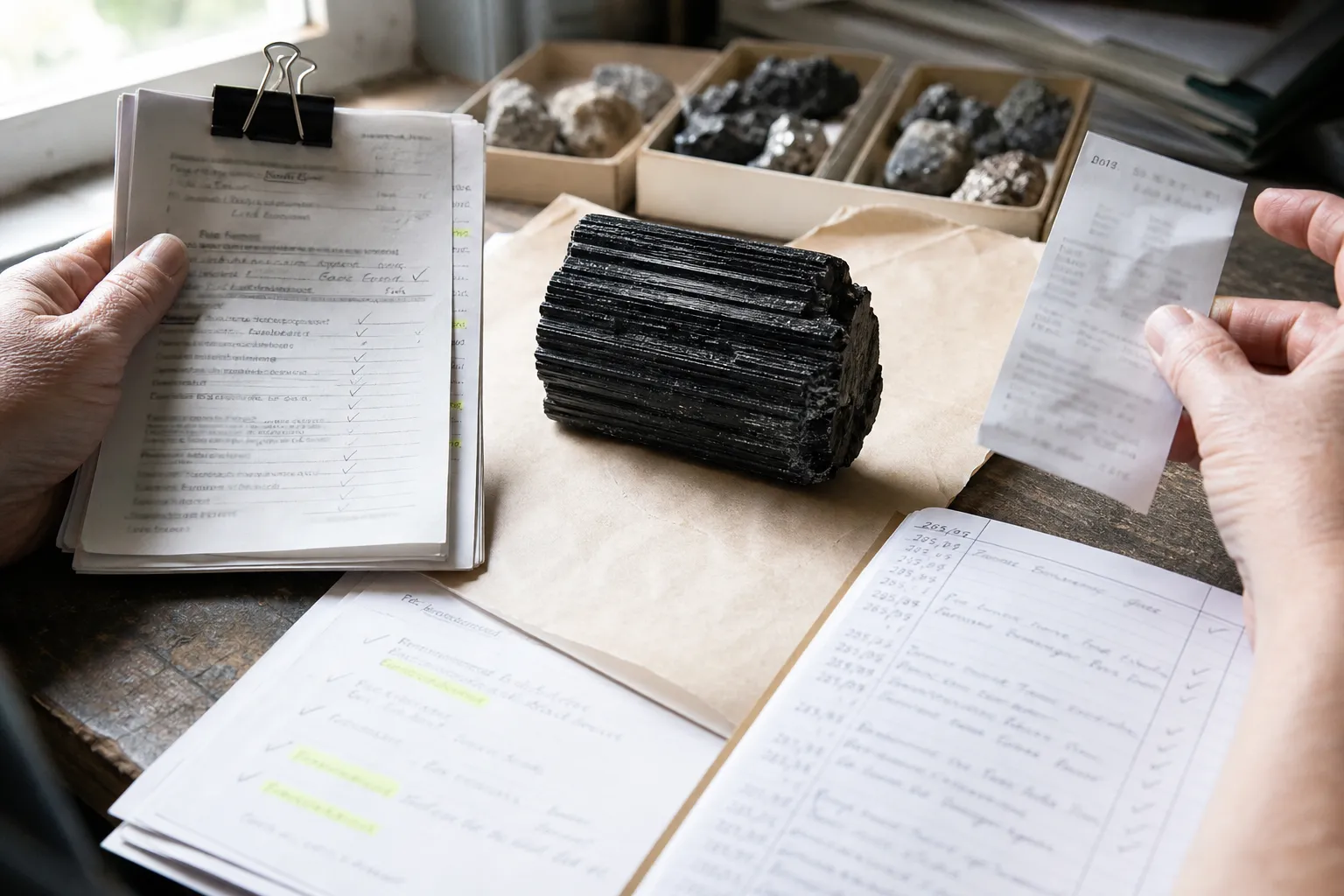
A black tourmaline specimen can feel definite in the hand: ribbed surface, dark mass, enough weight to settle a shelf or desk. Its sourcing story is harder to see. In 2026, a “sweatshop-free” or ethically sourced mineral label should be treated as one piece of ethical mining compliance evidence, not as proof that labor conditions, legal status, environmental protection, habitat reclamation, or traceability are complete.
The direct answer: use sourcing certifications as screening tools, then verify the current standard, audit scope, supplier documentation, and regulatory context before relying on the claim. If a seller cannot explain what the certification covers, who it applies to, and which records support the mineral’s path from mine to market, the label is not enough.
broader context
Broader schorl guide
This narrower page works best after the broader black tourmaline context page.
What a Sourcing Certification Can Tell You
A sourcing certification may show that a mine, supplier, processor, trading program, company, or chain-of-custody step has been assessed against a stated framework. That can be useful because it gives the reader something more concrete than soft retail language such as “conscious,” “responsible,” or “ethically mined.”
The limit is scope. A label may apply to a company policy, a facility, a product line, a shipment, a mine site, or a broader due diligence process. Without that scope, you cannot know whether the black tourmaline specimen in front of you is covered, or whether the seller is borrowing language from a wider sustainability statement.
“Sweatshop-free” is not a universal mineral standard that can be assumed from a pleasant product description. The phrase points toward labor concerns, but it does not automatically answer questions about wages, worker protections, subcontracting, informal mining, child labor risk, legal extraction, transport records, or intermediary handling. Those questions require documents that match the actual material being sold.
A certification can open the file. It should not close the question.
Documents to Request Before Trusting the Claim
The useful question is not “Is this ethical?” It is: “What documentation supports the sourcing claim for this material?” That wording keeps the conversation practical and asks the seller to connect the language on the page to records that can be reviewed.
For a black tourmaline purchase marketed as ethically sourced, sweatshop-free, or covered by a responsible sourcing program, ask for the claim in writing. The seller should be able to say whether the language refers to the specimen, the batch, the supplier, the mine, or only the company’s general policy. If the claim cannot be narrowed, treat it as marketing language rather than sourcing evidence.
Useful compliance documents may include certification records, audit scope summaries, supplier declarations, chain-of-custody descriptions, mine or region information, and the current standard or program document the seller relies on. The point is not paperwork for its own sake. The point is whether the claim has a traceable basis.
Read the date and version. A past document may not describe the current standard, supplier, or inventory. In 2026, the safer question is not “Was this ever reviewed?” but “Which current framework, scope, and record support this current mineral claim?”
Also separate seller language from independent evidence. A supplier’s own sustainability page may explain how the business talks about sourcing, but self-description should not carry the same weight as a current standard, regulator guidance, audit document, or non-commercial due diligence framework.
How to Read “Ethical Mining Compliance”
Ethical mining compliance sounds precise, but in retail mineral spaces it can be used loosely. Sometimes it refers to labor expectations. Sometimes it points toward legal extraction and trade. Sometimes it is used to suggest environmental care, safer working conditions, or community benefit. Those are different claims, and they need different support.
A careful reader can divide the phrase into four plain questions:
- What labor issue is being addressed?
- What legal or regulatory requirement is being referenced?
- What environmental protection or habitat reclamation claim is being made?
- What document connects the claim to this mineral, supplier, or shipment?
This matters because a sourcing certification may cover one area and leave another outside its audit scope. A labor-focused claim may say little about reclamation. A chain-of-custody claim may not show working conditions at the extraction site. A broad sustainability statement may not identify the mine, processor, or trader involved.
For black tourmaline, material literacy and sourcing literacy sit side by side. Surface, striations, crystal habit, and weight help you read the specimen as a mineral object; documents help you read its commercial path. Neither one substitutes for the other. A convincing schorl habit does not prove ethical sourcing, and a polished sourcing phrase does not prove mineral identity.
Environmental Claims Need Their Own Check
Environmental language deserves a separate look. A seller may use phrases such as low-impact, responsible, reclaimed, or environmentally conscious, but those words do not explain what was measured, who reviewed it, or whether a site was restored after extraction.
If habitat reclamation is part of the claim, ask what the statement refers to. Does it describe a mine closure plan, a site restoration practice, a legal requirement, a company policy, or a certification criterion? Without that distinction, the claim remains too general to rely on.
Environmental protection references should ideally come from current standards, regulators, environmental authorities, or credible non-commercial frameworks. If the only support is a product description, a mood-setting brand page, or a short retailer note, treat the claim as unverified language. It may express an intention, but it does not demonstrate performance.
Scale matters too. A polished palm stone, a raw cluster, and a large decor specimen may pass through different hands before sale. A claim attached to the retailer may not describe every upstream step. When environmental sourcing is important to your decision, ask whether the coverage applies to the mine site, supplier, shipment, product line, or general company policy.
Common Confusion Around “Sweatshop-Free Minerals”
A labor phrase is not a complete sourcing verdict
The first confusion is treating “sweatshop-free” as a complete sourcing verdict. It is usually a labor-oriented claim, but it does not automatically resolve legal extraction, worker safety, subcontractor practices, environmental disturbance, transport records, or document continuity.
A company label may not cover the exact object
The second confusion is assuming a certification label covers the exact object being bought. A black tourmaline piece may be sold by a company that participates in a responsible sourcing effort, but the individual specimen still needs a clear connection to the covered scope.
Wellness meaning is not sourcing evidence
The third confusion is using spiritual or wellness language as sourcing evidence. A mineral can be part of a somatic grounding ritual, a nervous-system-aware desk arrangement, or a biophilic interior without making its origin ethically verified. Felt meaning belongs in one lane; compliance documents belong in another.
Evidence requests are not legal conclusions
The fourth confusion is expecting a seller to provide a legal conclusion. Most buyers are not asking the seller to interpret law. They are asking for the evidence behind a claim. If binding compliance matters for business, import, resale, or institutional procurement, consult qualified compliance or legal professionals who can read the current rules in the relevant jurisdiction.
A Practical 2026 Verification Path
For a personal mineral purchase, the verification path can stay modest. You are not running a mine audit; you are deciding whether a claim is specific enough to trust.
- Start with the wording. “Ethically sourced” is broad. “Sweatshop-free” is narrower but still incomplete. “Certified” may sound stronger, but the important question is certified under what standard, for which scope, and during which period.
- Ask for the document trail. A useful response names the applicable standard or framework, explains the audit scope or assessment boundary, and connects the claim to the supplier or material being sold. A weak response repeats the same phrase without adding dates, scope, or records.
- Check whether the claim reaches beyond its support. A seller may have labor documentation but no environmental protection references. Another may discuss habitat reclamation but provide no chain-of-custody explanation. A third may have supplier documentation but no current regulatory context. None of those gaps proves wrongdoing, but each gap limits what a buyer can responsibly conclude.
- Decide how much certainty the purchase requires. A small decor specimen for a shelf may call for a different level of review than a bulk purchase, resale inventory, or public-facing procurement policy. The higher the consequence, the more important it is to verify sourcing claims against current standards, regulatory sources, and qualified advice.
The Safest Way to Use Certification Language
The safest wording is measured. A mineral may be “supported by supplier documentation,” “covered by a stated sourcing program,” or “presented with a certification record,” if those statements match the documents. It is stronger than the evidence allows to say that a certification proves sweatshop-free sourcing, complete traceability, legal compliance, environmental protection, or successful habitat reclamation.
For readers who care about black tourmaline as both a material and a presence in the room, this restraint is not cold. It keeps the specimen honest. Schorl can still carry visual weight: dark columns, broken terminations, ribbed surfaces, a quiet mass beside wood, stone, or linen. The sourcing story, however, should remain attached to documents rather than atmosphere.
In 2026, navigate sweatshop-free mineral sourcing certifications as evidence tools. Ask what is covered, request the supporting records, check the date and scope, and keep labor, legal, environmental, and reclamation claims separate. A label can help you ask better questions; it should not be treated as the final answer.