Comfort-first placement
Left Wrist or Right? How to Wear Heavy Tourmaline Without Over-Grounding
If a heavy black tourmaline bracelet feels too intense, do not treat the left wrist or right wrist as a fixed rule. Start with the side that feels easiest in daily use, wear it briefly, and move it—or take it off—if the weight, pressure, or emotional tone feels unpleasant.
Wearing black tourmaline is often discussed through belief-based language around grounding and protection. That can be meaningful as a personal practice, but it does not make one wrist universally “correct.” With a heavy piece, comfort comes first.
If the bracelet feels compressive, distracting, or emotionally heavy, the next step is not to force the opposite wrist as a fix. Try a shorter wear time, a looser fit, a pocket carry, a bag carry, or a break from wearing it.
broader context
Broader schorl guide
This narrower page works best after the broader black tourmaline context page.
The Short Answer: Choose the Wrist That Feels Least Intrusive
For black tourmaline wrist placement, the practical answer is simple: use the wrist that creates the least strain.
Some crystal traditions describe the left side as more “receiving” and the right side as more “projecting.” You can use that language if it fits your ritual, but it should not override the physical experience of wearing the bracelet.
A heavy black tourmaline bracelet has ordinary factors that matter before symbolism: weight, fit, texture, and contact. It may pull against the wrist bone, bump a desk, tighten when your hand bends, or make you unusually aware of one side of your body. Those sensations can easily be read through a grounding lens, especially if you already associate black tourmaline with grounding.
A useful starting point:
- If you write, type, cook, or use tools mostly with your right hand, try the left wrist first.
- If your left wrist is smaller, sensitive, strained, or easily irritated, try the right wrist instead.
- If both wrists feel too noticeable, carry the stone in a pocket, pouch, or bag.
- If wearing it brings up worry, chest tightness, or a sense of pressure, remove it and reassess without trying to “balance” the feeling through another placement.
The goal is not to find the spiritually perfect side. The goal is to find the least intrusive way to keep the piece in your routine.
What Can Change the Answer
The best side can change with the bracelet, the day, and your attention level. The same piece may feel fine during a quiet walk and irritating during a long work session. That does not prove a hidden mechanism; it means context changes how an object feels on your body.
Bracelet weight and fit
A heavy bracelet should not be something you endure. If it slides hard against the wrist bone, leaves pressure marks, pinches, or makes your hand position feel guarded, the placement is not working well.
A loose bracelet can be distracting because it moves too much. A tight bracelet can feel restrictive. Either issue can make “over-grounding” language feel more convincing because your attention keeps returning to the object.
If the bracelet is large, try wearing it for 10 to 30 minutes instead of all day. That may be enough for a belief-based ritual or grounding pause. If the purpose is mostly aesthetic, comfort still decides whether it belongs on the wrist, layered lightly, or off the body.
Dominant hand use
The dominant wrist usually gets more motion, bumps, and awkward angles. A heavy bracelet on that side can become a nuisance fast.
If you are choosing between left wrist or right wrist, the non-dominant side is often the calmer first test. That is a usability choice, not an energetic law.
Try the bracelet while sitting, walking, and doing one normal task. A placement that feels fine when still may feel irritating once you type, drive, carry a bag, or use your phone.
Your belief framework
If you use belief-based crystal placement, you may prefer one wrist because it fits your ritual language. That is fine as long as the claim stays in the right category.
You might say, “I use the left wrist when I want the piece to feel inward and quiet,” or “I prefer the right wrist when I want a reminder while I work.” That is different from saying the wrist itself produces a guaranteed result.
That distinction leaves room for adjustment. A ritual can be meaningful and still change when the physical experience is unpleasant.
Current stress and body awareness
When someone searches for black tourmaline over-grounding or chest tightness with crystals, they are usually trying to make sense of a felt experience. The careful approach is to observe the experience without turning the stone into a diagnosis.
Ask what else is happening: caffeine, poor sleep, a crowded room, tight clothing, posture, emotional stress, or the simple pressure of a heavy bracelet. If chest tightness is severe, persistent, unexplained, new, or alarming, seek appropriate medical care or emergency help depending on the situation.
A Comfort-Based Placement Test
A short test is more useful than forcing a full-day decision. You are not proving what black tourmaline does. You are checking which placement feels workable for you.
Try this on a low-pressure day:
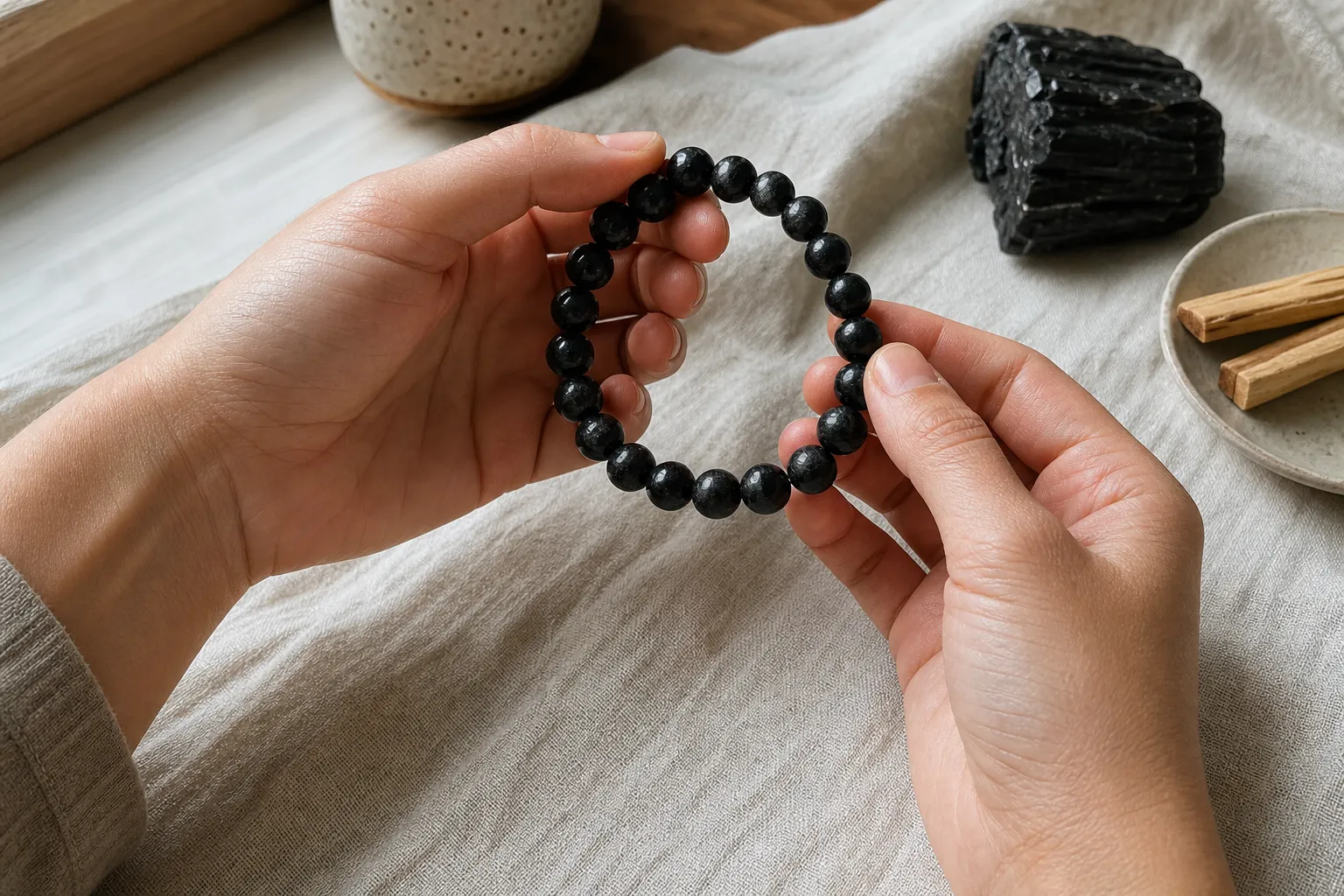
- Hold the bracelet first and notice its weight, texture, temperature, and your immediate reaction.
- Wear it on the left wrist for 10 to 20 minutes during a quiet, normal task.
- Remove it for a few minutes and notice your wrist, attention, mood, and breathing.
- Repeat on the right wrist for the same length of time.
- If both wrists feel too intense, try a pocket, pouch, bag, or table placement.
- If you feel uneasy, pressured, or physically uncomfortable, stop the test.
Keep the observations plain. Instead of “the left wrist over-grounded me,” try “on the left wrist, the bracelet felt heavy and made me keep checking my chest.” Instead of “the right wrist fixed it,” try “on the right wrist, I noticed it less while working.”
That second kind of wording is more useful because it separates experience from certainty.
Helpful prompts:
- Does the bracelet pull, pinch, slide, or press?
- Do I notice it more when I am still, moving, typing, or lying down?
- Does the feeling change after I remove it?
- Am I reading discomfort through a meaning I already expect?
- Would a smaller piece, shorter wear time, or non-wrist placement serve the intention better?
This is especially useful for people who describe themselves as energetically sensitive. “Sensitivity” can mean tactile awareness, emotional association, expectation, stress, or plain discomfort with a heavy object. You do not have to flatten the experience into one explanation. You only need enough clarity to choose a better placement.
When Pocket, Bag, or Nearby Placement Makes More Sense
A heavy black tourmaline bracelet does not have to stay on your wrist to be part of your routine. If it feels too dense, too noticeable, or too symbolically loaded on the body, an alternate placement may be the better answer.
Pocket carry works when you want the stone close without wrist pressure. Use a small pouch if the stone has rough edges or might scratch keys, phone glass, or fabric.
Bag carry works when you want the object with you but not constantly against your skin. A desk, nightstand, or entry-table placement works when the piece is more of a visual anchor than a wearable object.
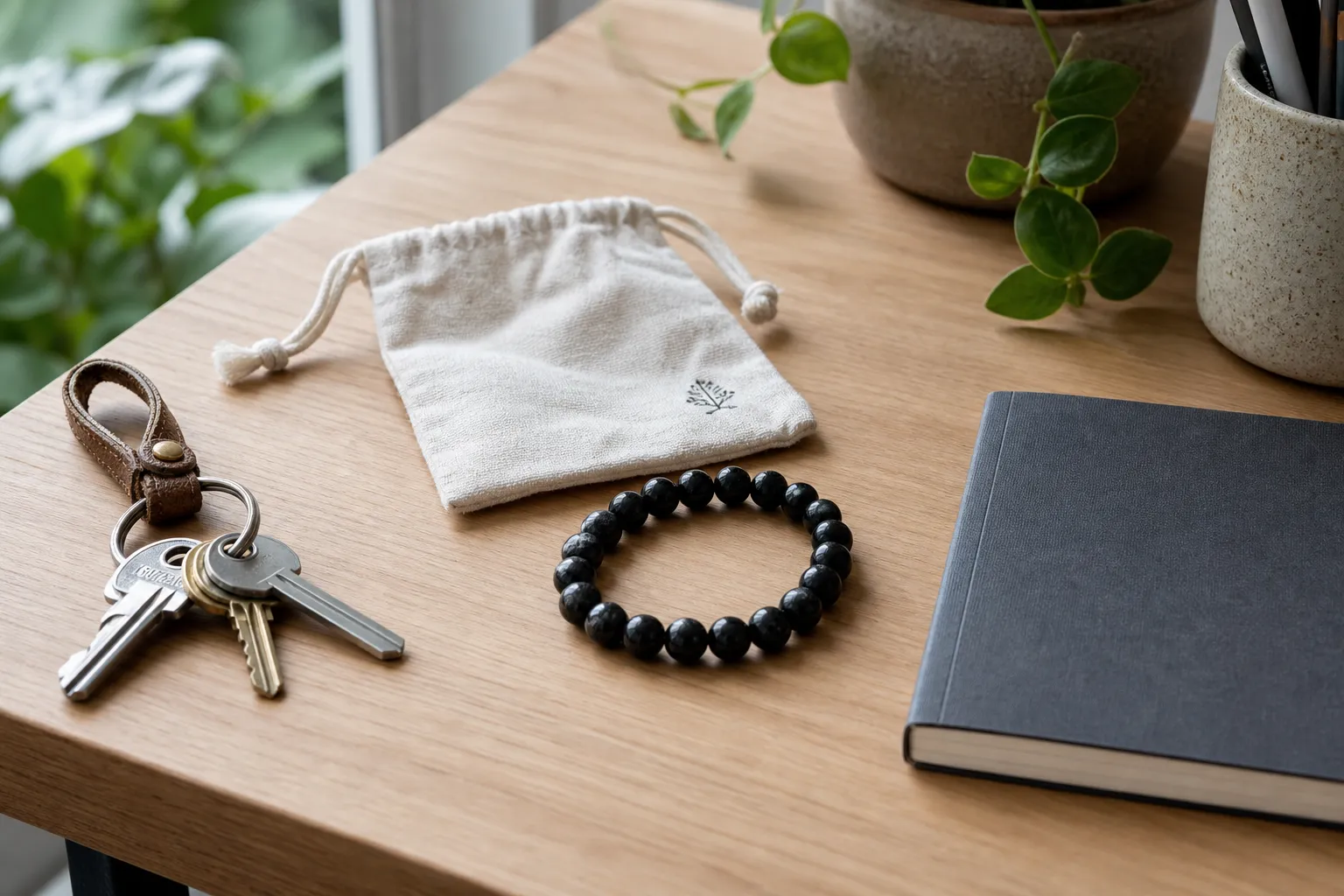
This is where crystal placement becomes practical rather than mystical. Ask where the stone supports the intended reminder without creating a problem. If the bracelet marks a transition into work, placing it beside your keyboard may be enough. If it helps you pause before leaving home, keeping it near the door may serve the ritual better than wearing it all day.
For some readers, the best placement is no placement for a while. A break is not a failure of the practice. If “over-grounding” has become your shorthand for feeling dull, heavy, tense, or compressed, taking the bracelet off may give you more information than switching wrists repeatedly.
Common Confusion Around Over-Grounding and Chest Tightness
“Over-grounding” is common language in crystal communities, but in this article it means reader-reported experience, not a medical category. People may use it to describe heaviness, low energy, emotional dullness, pressure, unease, or the sense that a stone feels like “too much.” Those feelings are real as experiences, but the label does not prove the cause.
The same caution applies to chest tightness. Do not use left wrist or right wrist placement as the main response to chest symptoms. Remove the bracelet if it feels uncomfortable, but take severe, persistent, unexplained, new, or frightening chest tightness seriously and seek appropriate help.
Another common mix-up is confusing a “strong stone” with a strong physical setup. A large bead bracelet, rough pendant, tight elastic, heavy clasp, or constant skin contact can create a strong experience without needing an energetic explanation. The object has weight, texture, temperature, and visual presence. Those qualities are enough to shape how it feels.
Discomfort is also not proof that the placement is powerful. It may simply be discomfort. A belief-based practice does not need to become a test of endurance.
Clear Limits for This Page
This page answers one narrow question: how to approach a heavy black tourmaline piece when you are deciding between the left wrist, right wrist, or another placement.
It does not establish a verified left/right wrist rule. It also does not claim that black tourmaline causes or resolves physical symptoms. No high-quality public references were available for this specific research pass, so the useful answer stays practical and modest.
For most readers, the workable sequence is:
- Choose the wrist that interferes least with movement.
- Wear the heavy piece briefly before making it an all-day habit.
- Treat left/right meanings as personal ritual language, not universal fact.
- Move to pocket, bag, or room placement if wrist wear feels too intense.
- Remove the piece and seek appropriate help if chest symptoms feel serious or worrying.
The best placement is the one that lets the object remain meaningful and comfortable without asking you to ignore your body.