Tactile grounding guide
Somatic Checkpoints: 5 Ways to Interact with Your Matte Stone Necklace
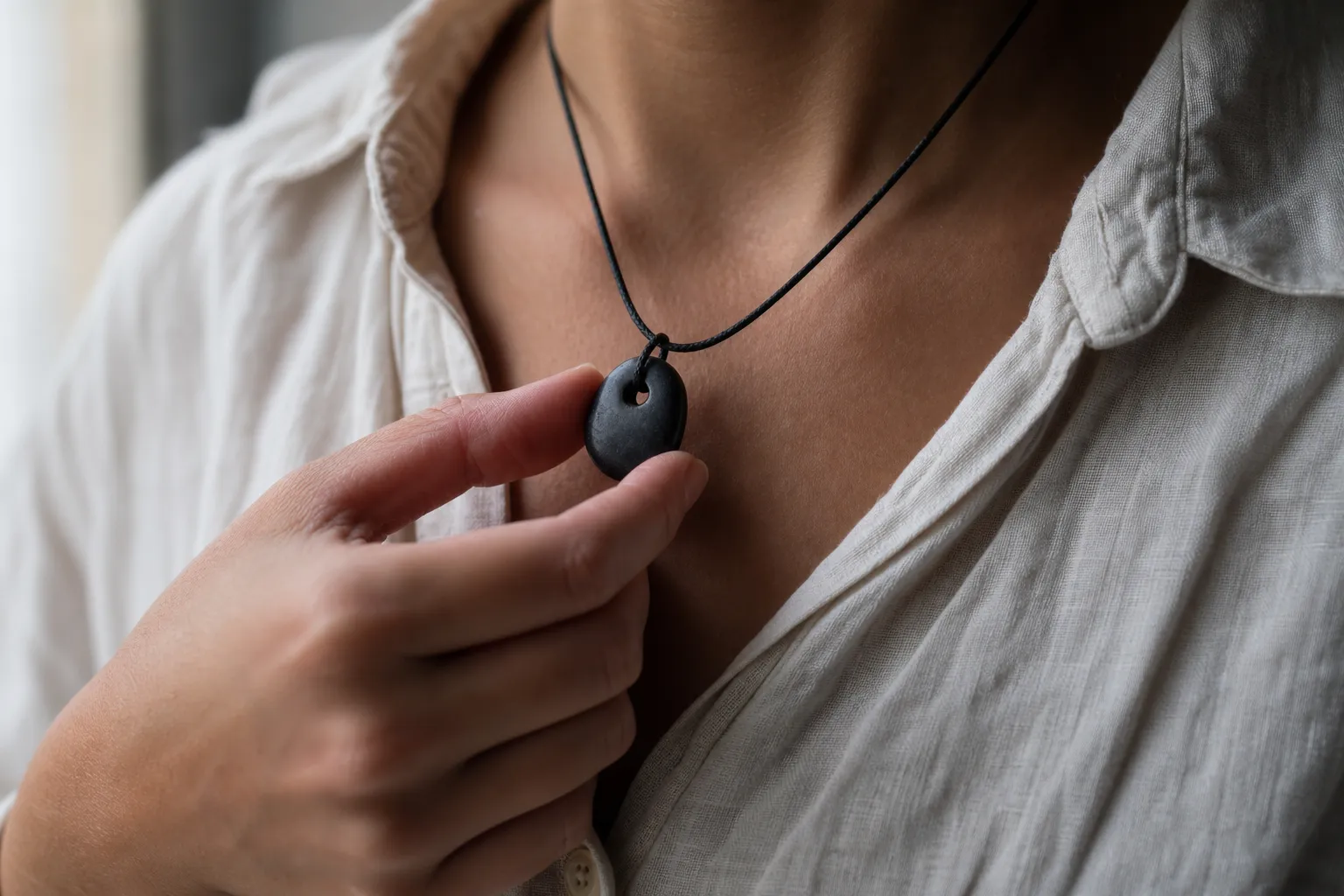
A matte stone necklace can work as a small tactile reminder: pause, feel the object, notice one body signal, and return to what comes next with a little more attention. These five Somatic grounding checkpoints do not depend on the stone having a special effect. The necklace is simply a cue you can find by touch.
A useful version stays modest: texture, weight, breath, posture, and transitions. If the necklace helps you slow down for a few seconds, it is doing the practical job of a habit prompt. If it feels uncomfortable, distracting, or emotionally loaded, skip it or choose another cue.
broader context
Start with the main black tourmaline page
This narrower page works best after the broader black tourmaline context page.
The Five Checkpoints
Use these as optional prompts, not a fixed ritual. Each one can take a few seconds. You do not need to complete all five every time.
1. Find the Texture Before You Name the Feeling
Touch the pendant or beads with your thumb and first finger. Before deciding whether you feel tense, calm, scattered, or fine, notice the surface.
A matte stone necklace may feel smooth, dry, cool, slightly grippy, rounded, or uneven depending on the finish and shape. Stay with those plain details first. The point is not to assign meaning to the stone. The point is to give your attention one simple place to land.
Try this
- Touch one part of the necklace.
- Notice whether it feels cool, warm, smooth, powdery, dense, or irregular.
- Keep the words physical: “cool edge,” “soft surface,” “small weight,” “flat side.”
- Release it and continue what you were doing.
Ordinary language helps. “I’m noticing the texture” is more useful here than trying to force a deeper interpretation. You are using physical touch as a reminder to return to sensation, not asking the object to change your mood for you.
2. Notice the Weight on Your Body
A necklace is easy to forget until it shifts. That makes weight a useful checkpoint.
Let the pendant rest where it naturally falls. Notice whether you feel it at the collarbone, sternum, upper chest, or through the chain at the back of the neck. If the necklace is very light, the signal may be subtle. If it is heavier, you may also notice whether the weight feels pleasant, neutral, or annoying.
Ask one simple question: “Where do I feel this right now?”
That keeps the practice concrete. You are checking contact, pressure, and placement, not trying to create a special state. The necklace becomes a small mindfulness habit cue because it gives you something consistent to locate.
This checkpoint can fit before opening your laptop, stepping into a conversation, waiting for a message, or moving from one room to another. Touch the pendant once, notice its weight, and let that be enough.
If the necklace pulls on your neck, catches on clothing, or makes you more tense, that is useful information. A grounding prompt should not require you to push past discomfort.
3. Pair Touch With One Breath
Pairing touch with breath is where this practice can easily become too complicated. Keep it small.
Touch the necklace. Take one natural breath. Notice the beginning, middle, and end of that breath without trying to perform it. Then let go of the necklace.
That is the whole checkpoint.
You do not need a counted breathing pattern unless counting feels genuinely helpful. You also do not need to make the breath deeper. For some readers, controlling the breath can become distracting. A lighter approach is enough: hand touches stone, attention notices breath, hand releases.
A simple version
- Touch the pendant.
- Inhale normally.
- Exhale normally.
- Feel the necklace leave your fingers.
- Return to the next action.
This may interrupt automatic rushing for a moment. It should not be treated as a clinical technique or as a predictable way to change the nervous system. It is a self-directed grounding practice built around attention, sensation, and a repeatable cue.
4. Use the Pendant as a Transition Cue
Some moments are not emotionally dramatic; they are just messy. You leave one task and enter another. You close a tab, answer a text, walk into a meeting, sit down to eat, or move from public space to private space.
A pendant can work as a transition cue because it is already on the body. You do not have to open an app, find a notebook, or set up a separate practice. You touch it briefly and mark the shift.
Try using it at thresholds
- Before replying to a message.
- After closing a work call.
- Before entering your home.
- Before getting out of the car.
- After scrolling longer than you meant to.
The checkpoint is not “make yourself calm.” It is “notice that one moment is ending and another is beginning.”
That difference matters. When jewelry is surrounded by wellness language, it can be easy to expect the object itself to produce a result. A more careful approach is to let the object remind you to participate in the pause. The matte surface, chain, bead, or pendant does not need to carry a health-outcome claim. It only needs to be findable by touch.
5. Check Jaw, Shoulders, and Posture
The final checkpoint uses the necklace as a doorway into the rest of the body.
Touch the necklace, then ask: “What else is holding?”
Start with the jaw. Is it clenched, resting, pushed forward, or pressed shut? Then notice the shoulders. Are they raised, pulled inward, uneven, or settled? Finally, notice posture without correcting it aggressively. Are you leaning toward the screen, bracing through the chest, or collapsing into the chair?
This is not a posture audit. It is a tension check.
One small adjustment
- Let the jaw soften slightly.
- Drop the shoulders a fraction.
- Move the tongue away from the roof of the mouth.
- Let the back of the neck lengthen.
- Shift the pendant so it sits comfortably.
The necklace is just the starting point. It reminds you to check areas that often tighten during concentration, waiting, or social pressure. If nothing changes, the checkpoint can still be complete. Noticing is the practice; adjusting is optional.
What Makes This Practice More or Less Useful
The same necklace interaction can feel helpful one day and irrelevant the next. That does not mean you are doing it wrong. A tactile prompt depends on context.
It may be more useful when the necklace is easy to reach, comfortable to wear, and distinct enough in texture that your fingers can recognize it without effort. Matte surfaces can be useful for this because they often offer less shine and more tactile presence, but the material itself should not be credited with an effect. What matters here is that you can feel it clearly.
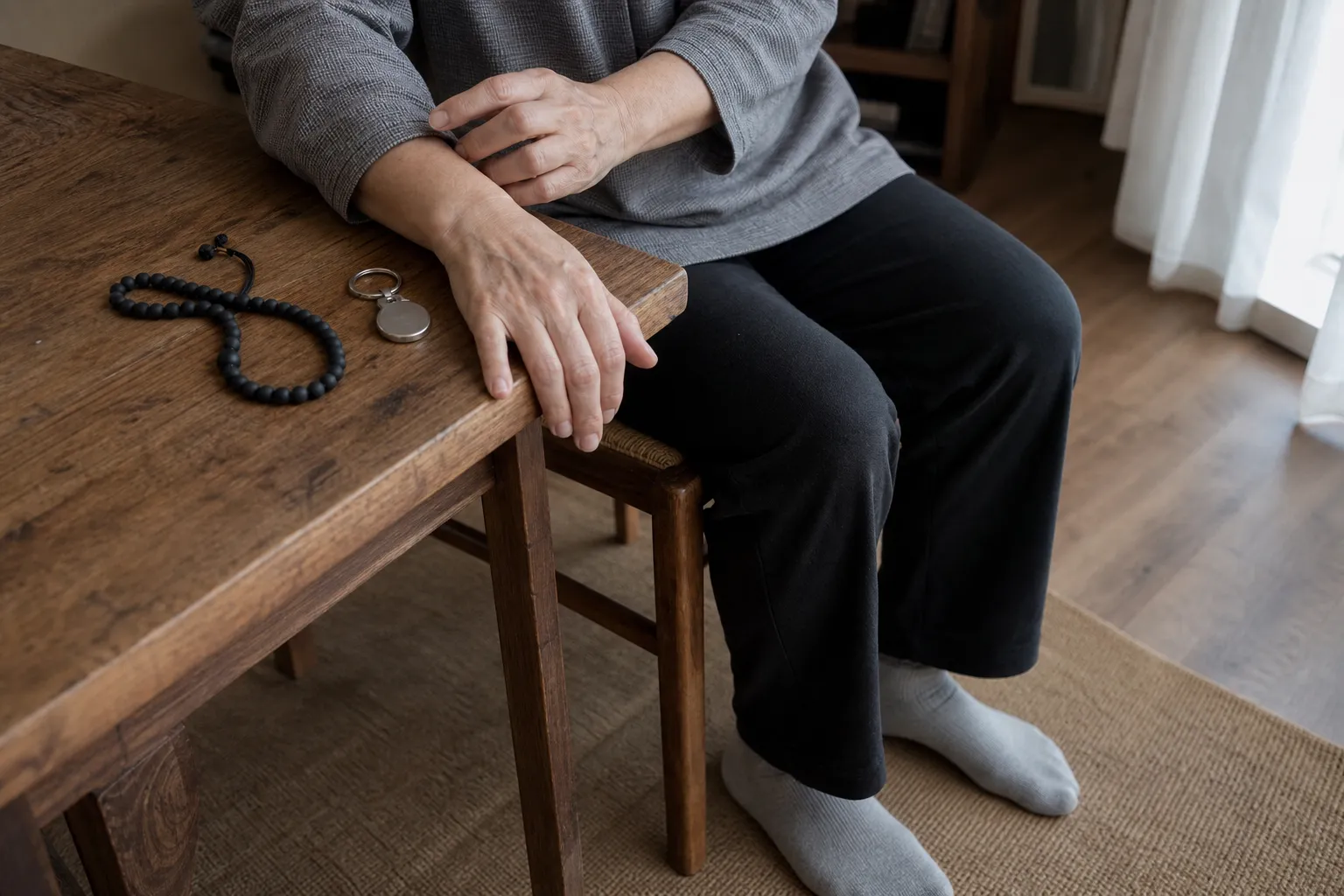
It may be less useful when the necklace is too delicate to touch often, too heavy, strongly associated with a person or event, or tied to a promise you feel pressured to believe. If touching it makes you monitor yourself more harshly, choose a different cue: a ring, a sleeve cuff, a smooth keychain, the edge of a desk, or simply your feet on the floor.
The moment matters too. A short pause before sending an email is different from distress that feels intense, persistent, or unsafe. A necklace-based checkpoint may support ordinary self-awareness, but it is not a substitute for professional mental health care, crisis support, or medical advice.
Common Confusion: Cue, Not Outcome
The most important boundary is simple: the necklace does not need to be treated as a regulating device.
Words like grounding, somatic, and nervous system regulation can sound clinical even when people use them casually. In this article, they refer to everyday acts of noticing: texture under the fingers, breath moving once, shoulders lifting, weight resting on the chest, attention returning to the body for a moment.
That is different from saying the necklace changes health outcomes or creates a reliable biological effect. The source boundary for this page does not support claims about stone energy, predictable emotional results, or consistent user outcomes. It also does not include verified firsthand reports that would justify broad statements about what people experience.
This does not make the practice useless. It keeps the claim the right size.
A necklace can be a reminder. A reminder can help you pause. A pause can give you a chance to notice what is happening. That is enough for a low-stakes, self-directed routine.
A Simple Way to Try It for One Week
If you want structure without turning the necklace into a project, choose one checkpoint for a week.
For example, use the pendant as a transition cue. Each time you move from one task to another, touch it once and ask, “What am I entering now?” Do not track outcomes. Do not rate your mood. Do not try to prove whether it works. Just see whether the cue is easy to remember and neutral enough to repeat.
Another option is the jaw and shoulder check. Touch the necklace once before starting focused work. Notice whether your mouth, neck, or shoulders are already bracing. Make one small adjustment if you want to. Then continue.
The goal is not to build a perfect mindfulness habit. The goal is to test whether this particular object gives your attention a simple place to return. If it does, keep the practice light. If it does not, release it without making that mean anything about you.
When to Skip the Necklace Checkpoint
Skip this practice if the necklace feels physically uncomfortable, if touching it becomes compulsive, or if it increases self-monitoring. Also skip it during any situation where attention should stay fully on safety, such as driving, using tools, cooking near heat, or moving through a crowded place where the necklace could catch.
If you are dealing with distress that feels overwhelming, persistent, or connected to safety concerns, a necklace prompt is not the right level of support by itself. Reach out to a qualified professional, local crisis resource, or trusted support system appropriate to your situation.
For ordinary moments, though, the practice can stay very small: touch the matte surface, notice one sensation, take one breath, check one area of tension, or mark one transition. The value is in the repeatable pause, not in a claim about the stone.