Crystal Safety 101
Crystal Safety 101: Identifying Heavy Metals in Raw Tourmaline
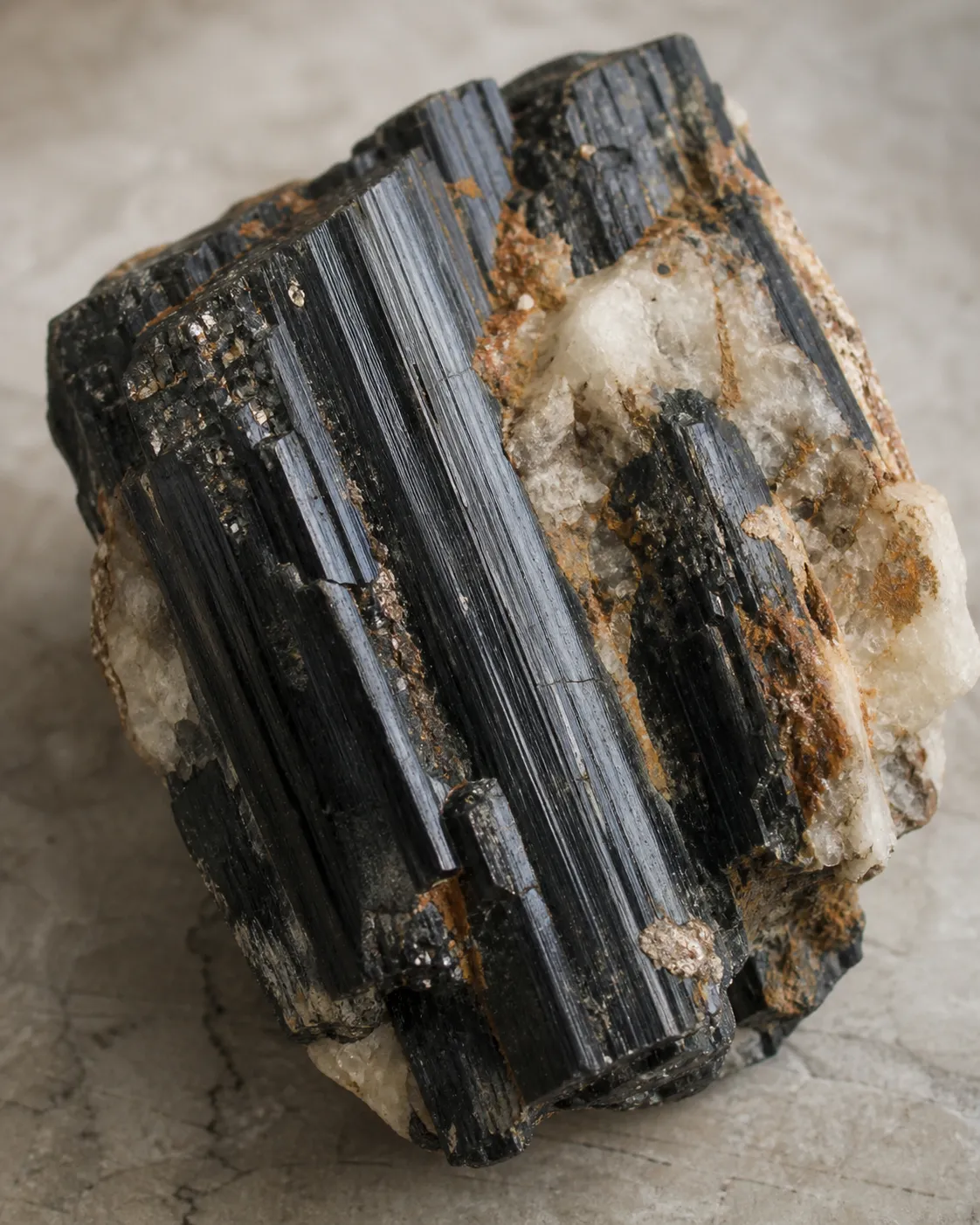
A raw black tourmaline specimen can show striations, broken faces, mica-like flashes, rusty coating, pale matrix, or metallic-looking specks. Those cues are worth noticing, but they do not let a non-expert identify heavy metals with confidence.
The direct answer is conservative: toxic mineral identification in raw tourmaline cannot be done reliably by eye. A visual check can raise a question; it cannot confirm composition, exposure risk, or water-contact safety.
If a piece has unknown inclusions, crumbly coating, loose dust, or attached matrix, treat it as an unknown raw mineral rather than a “safe crystal” by default. Keep it out of drinking water, avoid powders or chips, wash hands after handling, and choose testing or avoidance when the use involves children, pets, food areas, frequent skin contact, or water infusion.
broader context
Black tourmaline context note
This narrower page works best after the broader black tourmaline context page.
What You Can See, and What It Cannot Prove
Black tourmaline, often discussed as schorl, is commonly recognized by dark color, lengthwise striations, prismatic habit, weight, and a fractured raw surface. Those features can support a basic authenticity conversation, especially when a piece looks like a typical rough specimen rather than glass or dyed material. They do not identify trace metals, coatings, attached minerals, or contaminants.
A raw crystal is rarely a single clean idea. It may include the tourmaline crystal, host rock, surface staining, weathered areas, and small inclusions. A dark column may be the part a seller calls black tourmaline, while pale, rusty, shiny, greenish, or powdery areas may belong to other material. Without qualified analysis, the surface remains a clue, not a conclusion.
Metallic shine is one common source of worry. A bright fleck can look metallic under a desk lamp, but shine alone does not show that a specimen contains a heavy metal. Dullness does not show that it is free of one. Color has the same limit: orange, gray, silver, black, yellowish, or greenish marks may invite caution, but they are not chemical tests.
Seller labels have limits too. “Raw tourmaline,” “black tourmaline with matrix,” or “natural schorl” may describe the market category, but the label does not document every exposed surface. For ordinary display, that uncertainty may be acceptable. For drinking water, powders, elixirs, or prolonged contact with damaged material, it should carry more weight.
The practical point is simple: visual identification can help you decide whether a specimen deserves more caution. It should not be used to clear a raw mineral for ingestion, infusion, or safety-sensitive use.
When Uncertainty Should Change Your Handling
The useful question is not only, “Does this raw tourmaline contain heavy metals?” It is, “What am I planning to do with a specimen whose composition I cannot verify?” A piece on a shelf, a piece handled daily, and a piece placed in water do not carry the same practical risk.
Use more conservative handling when the specimen has loose grit, powdery residue, crumbly matrix, sharp broken edges, unknown metallic-looking inclusions, or staining that transfers to fingers or cloth. These features do not prove raw mineral contamination, but they increase uncertainty. The less stable the surface, the less sense it makes to rub it, soak it, sleep with it loose in bedding, place it near food preparation, or hand it to children.
A stable display piece asks for a lower level of interaction. It can sit where its mass, dark texture, and vertical crystal habit contribute to an interior arrangement without becoming a contact object. In a biophilic room, raw black tourmaline often reads through shadow, surface, and contrast; it does not need washing, scraping, oiling, or submerging to have a visual role.
Somatic grounding language should stay separate from safety claims. Holding a stone, placing it on a desk, or using it as a tactile pause object is a personal practice context, not evidence that the material suits every kind of contact. If the piece sheds particles or has uncertain inclusions, a smoother, sealed, or better-documented material is the cleaner choice for frequent handling.
Testing becomes relevant when the planned use depends on composition. Laboratory methods such as XRF or ICP-MS are often mentioned in mineral analysis, but this page does not have enough sourced detail to recommend a testing protocol or interpret results. The narrower takeaway is stronger: if composition matters to the use, a visual check is not enough.
Avoidance is not alarm. It is a practical choice when the benefit is low and the uncertainty is high.
The Water Infusion Boundary
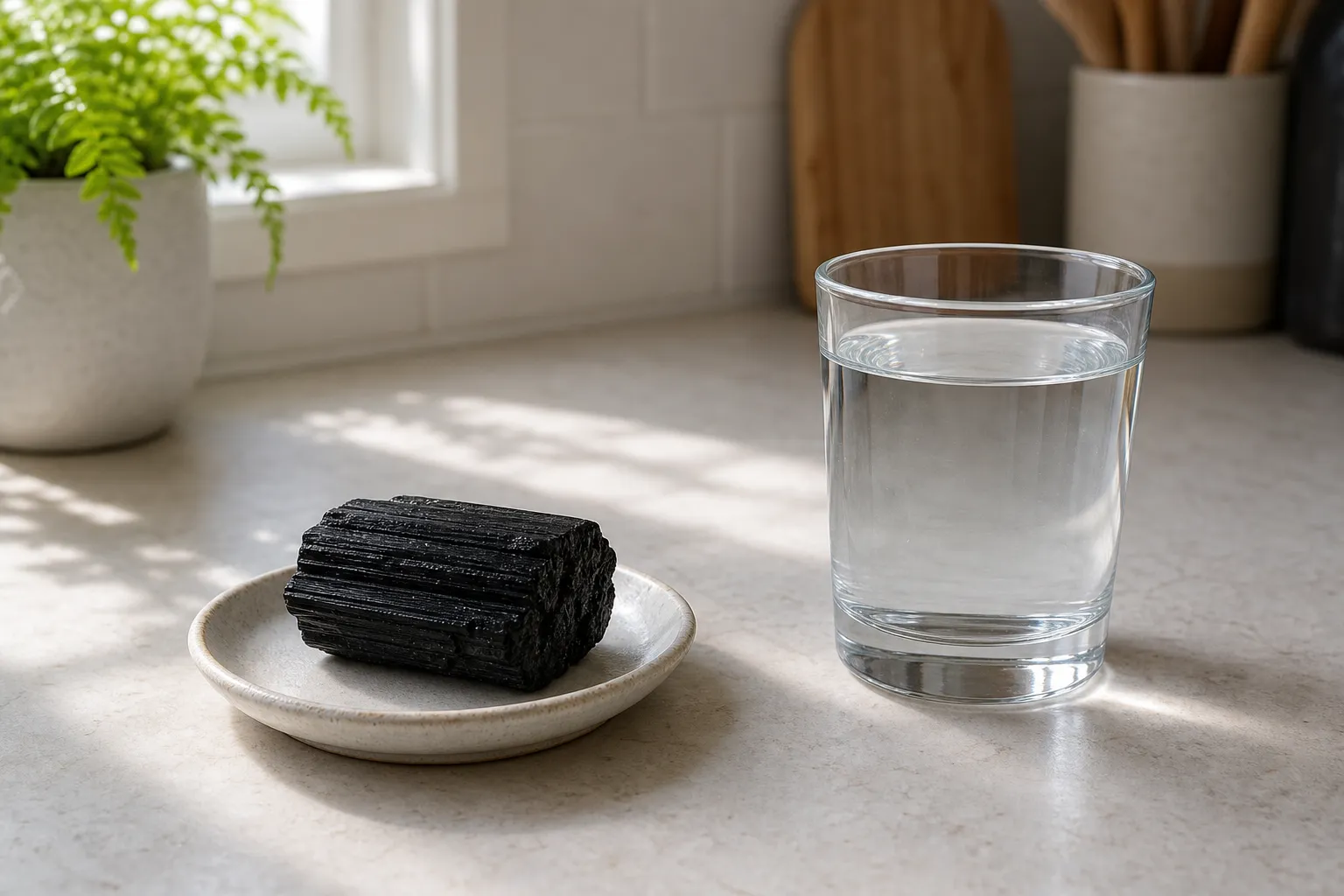
Water infusion is where raw tourmaline safety needs the firmest boundary. Do not place unknown raw tourmaline, mixed-matrix crystals, or unidentified mineral specimens directly into drinking water unless their composition and water-contact suitability have been verified by qualified sources. The available material for this page does not support saying that raw tourmaline is water-safe, heavy-metal-free, or appropriate for direct infusion.
This is not a claim that every raw specimen is hazardous. It is a limit on what can be responsibly inferred. Water changes the question from “Can I look at or handle this mineral?” to “Can I drink water that has touched every exposed surface, inclusion, coating, fracture, and residue on this specimen?” For a non-expert, that is a much harder question.
Crystal-water advice online often treats a mineral name as if it were enough. With raw material, the name on the label may not cover matrix minerals, small inclusions, surface treatments, polishing residue, dust, or weathered areas. Even if the main crystal is accurately identified, the attached material may remain unknown. The whole object touches the water, not just the part you recognize.
If you want the symbolic or design language of black tourmaline near water, keep the mineral outside the drinking vessel. A dry placement beside a glass, on a tray, or within a room arrangement keeps the visual boundary intact without turning an unknown raw mineral into an ingredient. For a nervous-system-aware routine, that separation can be part of the practice: the stone is observed or touched dry, while the water remains plain.
The short rule is firm: do not ingest unknown minerals, and do not drink water infused with unknown raw mineral specimens.
Common Confusion Around Crystal Inclusions
Crystal inclusions sit in a difficult middle ground. They are visible enough to attract attention, yet often too small or mixed to identify by casual inspection. One collector may see bright specks and wonder about metal; another may see orange staining and wonder about contamination; another may see pale matrix and assume it is harmless because it came attached to a familiar crystal.
All three reactions are understandable. None is a reliable identification method. A mark, flash, vein, or coating can be described as something to notice; it should not be named as a specific heavy-metal-bearing mineral without support. A clean-looking surface should not be treated as proof that no relevant material is present.
“Natural” can also mislead. Natural does not mean tested, food-contact appropriate, skin-contact appropriate, or suitable for water. It only suggests that the specimen is presented as a naturally occurring mineral rather than a manufactured object. Natural raw minerals can still be dusty, fractured, mixed with matrix, mislabeled, treated, or simply undocumented.
“Tourmaline” is not a complete safety certificate either. It is a mineral name used across a broad family and market category, while the object in your hand may include more than the tourmaline crystal itself. In a shop photo, that complexity can look beautiful. In a safety decision, it is a reason to slow down.
The useful question is not “What does this inclusion look like?” but “Can I verify what it is well enough for the way I want to use it?” If the answer is no, keep the use dry, external, and low-contact, or choose a different material.
A Conservative Check Before Use
Use this quick check to decide whether visual uncertainty should change your next step:
- If the specimen sheds dust, grit, or flakes, do not use it in water or near food.
- If it has unknown metallic-looking specks, staining, or mixed matrix, treat the inclusions as unidentified.
- If children, pets, or frequent hand-to-mouth contact are part of the setting, choose controlled placement or avoid the piece.
- If you want a drinking-water practice, do not place raw tourmaline directly in the water.
- If the intended use requires material certainty, seek qualified mineral testing or choose a better-documented specimen.
- If the use is decorative, keep the piece dry, stable, and away from surfaces where loose residue could matter.
This checklist does not prove safety. It helps a non-expert avoid turning uncertain mineralogy into unnecessary exposure.
What This Page Can and Cannot Say
What it can say
This page can say that visual toxic mineral identification has clear limits. It can say that unknown inclusions, coatings, and matrix material deserve caution when the use involves ingestion, water contact, loose particles, children, pets, or food areas. It can also say that avoidance is reasonable when testing is unavailable and the planned use depends on knowing composition.
What it cannot say
This page cannot responsibly say that a raw tourmaline specimen is toxic, non-toxic, heavy-metal-bearing, heavy-metal-free, water-safe, or unsafe based only on appearance. Those claims require stronger mineralogical, geochemical, toxicological, laboratory, or public-health support than the available material provides. The boundary is part of the answer.
For ordinary room placement, raw black tourmaline can stay in the realm of observable material: dark mass, striated habit, broken surface, and contrast against wood, stone, linen, or ceramic. For somatic grounding language, it can remain a dry object used for attention and texture, without turning felt experience into a safety conclusion.
Look closely, but do not over-read the surface. If the specimen is unknown, keep it dry and external; if the use requires certainty, test it or choose avoidance.