Material, design, and evidence boundaries
Quiet Luxury Meets EMF Shielding: The New Standard for High-End Accessories
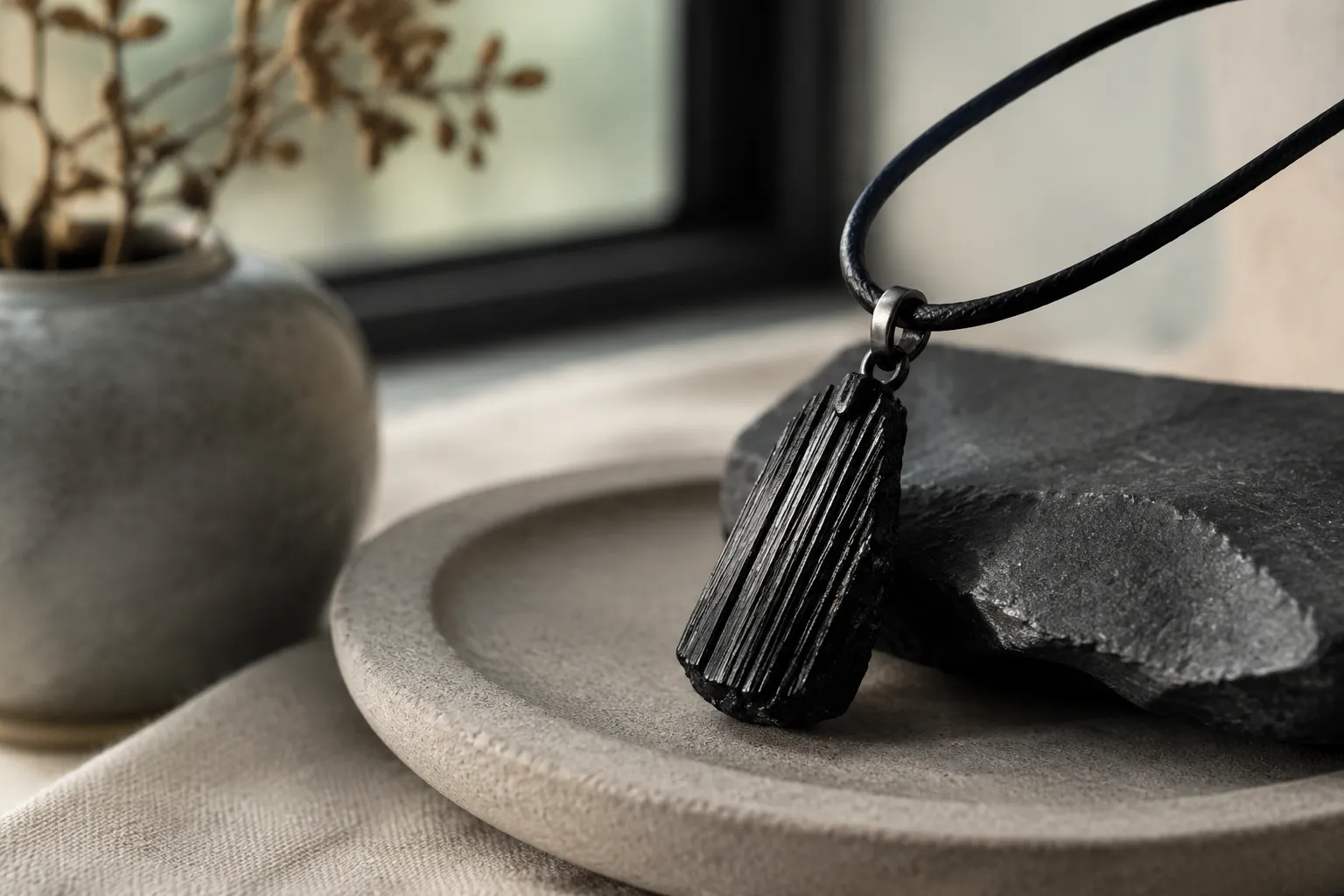
A black tourmaline pendant can look convincing before any technical claim is tested: dark surface, quiet weight, clean setting, minimal hardware. That is the appeal behind EMF shielding jewelry in the quiet luxury market. It turns a wellness-adjacent concern into something wearable, discreet, and visually restrained.
The direct answer is this: the new standard for high-end accessories is not simply jewelry that says it can block EMF. It is jewelry that keeps three things separate: design value, material identity, and measurable shielding evidence. Quiet luxury can make a pendant feel considered; it does not prove radiation deflection. A mineral name can describe what a piece may be made from; it does not establish body-level performance.
broader context
Black tourmaline context note
This narrower page works best after the broader black tourmaline context page.
What EMF Shielding Jewelry Means Now
EMF shielding jewelry sits between two consumer languages. One is style language: quiet luxury accessories, matte black surfaces, slim chains, low-contrast metal, and pieces that look more like a minimalist amulet than a technical device. The other is tech wellness language: 5G jewelry claims, EMF pendant claims, and phrases such as radiation deflection or everyday device shielding.
Style language
Style language can describe proportion, finish, weight, setting, and how a piece sits on the body. A black tourmaline necklace may appeal because schorl has a dense visual presence; its dark tone and natural striations pair naturally with restrained metals and simple clothing. That is a design reading.
Shielding language
Shielding language asks for a different standard. It suggests a measurable interaction with electromagnetic fields. That type of claim cannot be carried by atmosphere, price point, spiritual vocabulary, or the fact that a stone appears in jewelry. It needs evidence tied to the actual product, construction, frequency range, and test setup.
This distinction matters because quiet luxury has a credibility effect. Muted photography, fine chain work, and careful packaging may make a product feel more trustworthy than a loud gadget. But the visual grammar of good taste does not turn a pendant into a tested shielding system.
Where Black Tourmaline Fits
Black tourmaline jewelry often appears in this category because tourmaline has a long life in mineral collecting and symbolic wellness language. Mineral terminology helps here: tourmaline is a mineral group, and schorl is the common black, iron-rich tourmaline species often associated with black tourmaline specimens and jewelry descriptions.
That keeps the material vocabulary cleaner. It does not settle the shielding question.
A piece may be genuine black tourmaline, or it may use tourmaline language in a way that deserves closer material checking. Either way, material identity is not the same as electromagnetic shielding evidence. A real schorl bead is still a bead. A polished black tourmaline pendant is still a pendant. The mineral name can support a discussion of surface, crystal habit, weight, fracture, and jewelry terminology; it cannot carry a broad EMF performance claim on its own.
This is where many product pages blur categories. They move from “tourmaline is a known mineral” to “tourmaline jewelry changes personal exposure,” as if the second statement follows from the first. It does not. A mineral database can help identify what a material is called. It does not show that a necklace changes exposure from 5G, Wi-Fi, or cell phone RF signals.
For a style-conscious buyer, the practical reading is simple: choose black tourmaline jewelry for appearance, texture, craftsmanship, and personal meaning if those matter to you. Treat EMF language as a separate claim that needs separate support.
What Counts as Useful Shielding Evidence
Electromagnetic shielding is not a mood or an ingredient label. In technical use, shielding performance depends on conditions: material, thickness, geometry, frequency range, attenuation, placement, and test setup. A sheet, enclosure, coating, mesh, fabric, or case can be tested under defined conditions. Jewelry is harder to evaluate because it is small, open, irregular, and worn in changing positions on the body.
That does not mean a material can never affect electromagnetic behavior. It means the claim has to be measured in the form being sold. A broad statement about shielding materials does not automatically apply to a pendant, ring, bracelet, charm, or strand of beads. The object’s size and shape matter. The distance from the source matters. The frequency being discussed matters. So does whether the product is claiming to affect a device, a body part, or the wearer in a general way.
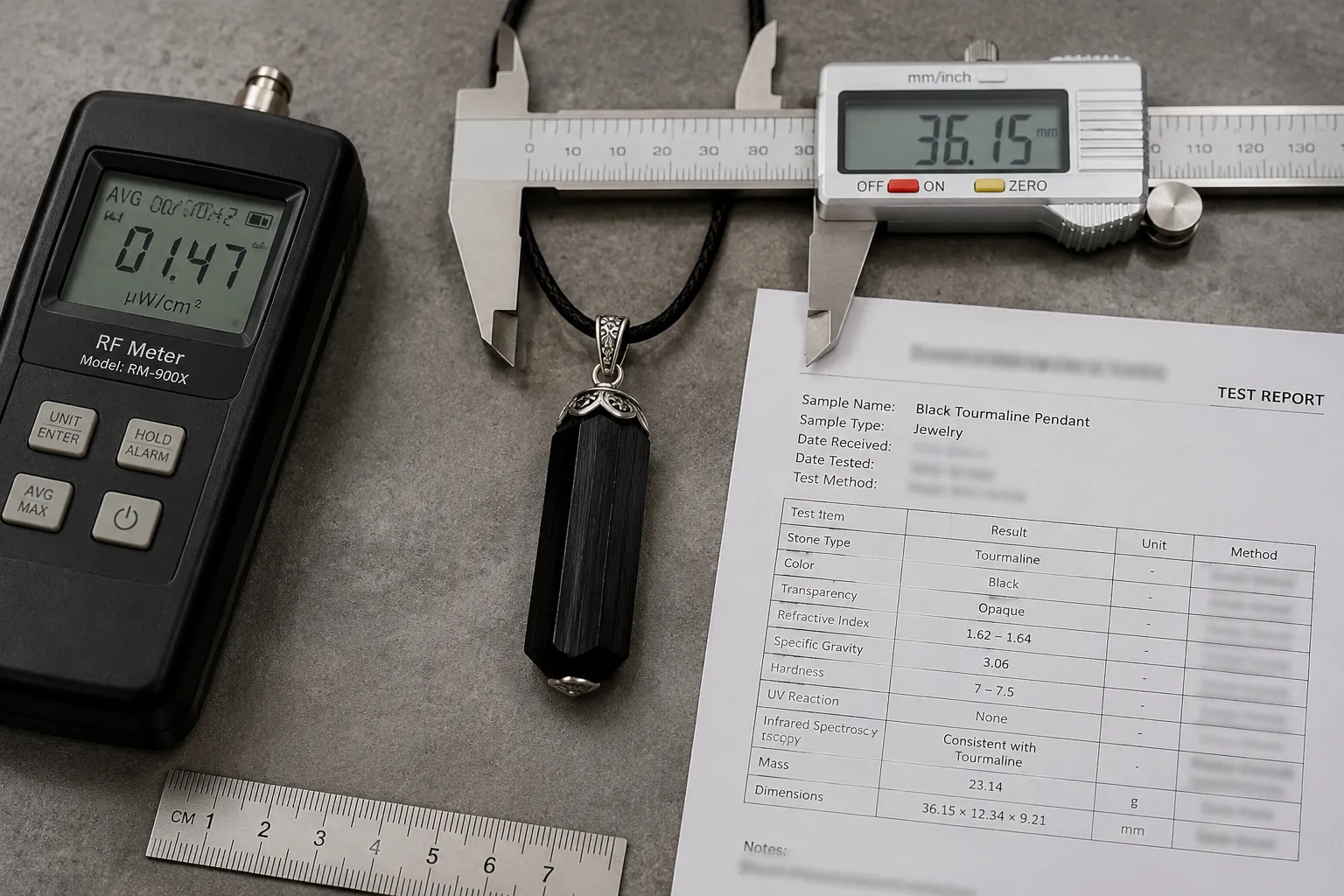
A useful product-specific report should identify
- the exact item tested
- the frequencies used
- the measurement method
- the jewelry position
- the measured attenuation
- the limits of the result
If the report only says “EMF tested” or uses technical-looking language without conditions, it gives the reader little to evaluate.
This is especially important with 5G jewelry claims. “5G” is often used as a broad anxiety word in consumer copy, but it is not one simple exposure situation. A more serious claim would name the relevant frequency range and test context. Without that, 5G protection language is better read as market positioning than demonstrated performance.
RF Safety Sources Are Not Jewelry Endorsements
The FDA and FCC are useful for setting a calm boundary around this topic. Public discussion of cell phone RF exposure is generally handled through evidence reviews, exposure limits, device rules, and measurement frameworks. That is a different world from luxury accessory copy.
Some EMF pendant claims borrow the feel of regulatory language. They may mention radiation, exposure, standards, or compliance-adjacent terms in a way that makes the product sound more grounded than it is. But a reference to RF exposure limits does not show that jewelry is necessary, recognized, or effective as a personal shielding object. It only shows that RF safety is normally evaluated through defined limits and testing contexts.
For everyday readers, the better posture is neither panic nor dismissal. The available public sources do not support fear-based claims that a person needs jewelry to move through modern wireless environments. They also do not validate a pendant or bracelet simply because it uses tech wellness language. The useful question is narrower: what does this exact product claim, and what evidence is provided for that exact claim?
If a piece is sold mainly as quiet luxury jewelry with black tourmaline, the evidence burden is modest. A buyer can evaluate style, material description, workmanship, fit, and price. If the same piece is sold as EMF shielding jewelry that changes exposure from phones, Wi-Fi, or 5G, the burden rises. The claim has moved from aesthetics into measurable performance.
Common Misunderstandings
“Radiation deflection” can sound precise while staying unclear.
It may suggest that a pendant redirects energy away from the body, but the phrase often appears without a defined source, distance, frequency, measurement, or result. Without those details, it is not enough to evaluate performance.
“Shielding” shifts meaning by context.
In ordinary speech, it can sound like general reassurance. In technical contexts, it is narrower: something is tested under certain conditions and found to reduce a measured field or signal by a stated amount. The difference is not just semantic. It changes what kind of evidence is needed.
Minimal design can make weak claims harder to notice.
A minimalist amulet can feel more sophisticated than a visible gadget, and that subtlety is part of the attraction. Quiet luxury accessories often communicate confidence by removing excess: no bright logo, no heavy explanation, no dramatic color story. But a clean object still deserves clean evidence.
Mineral terminology can be accurate and still overextended.
Tourmaline jewelry terminology can be accurate at the material level and still overextended at the performance level. A seller may use a real mineral term while making a separate claim that has not been shown by the information provided. Keep the two lines apart: what the object is made of, and what the object is claimed to do.
How to Read a High-End EMF Jewelry Claim
1. Read the design claim first.
Does the piece work as jewelry without needing the EMF promise? Look at scale, setting, chain quality, stone finish, and whether the object suits how you actually dress. Quiet luxury should be able to stand on proportion and material presence.
2. Read the material claim.
If the product says black tourmaline or schorl, look for clear material language rather than vague gemstone stacking. Mineral names should be used consistently, and any authenticity statement should stay within what the seller can actually support. Visual cues can be useful, but they do not create certainty on their own.
3. Read the shielding claim.
This is where the language should become more specific, not more dramatic. A meaningful claim would point to product-specific lab reports with frequency range, test setup, measured attenuation, and the exact item tested. If a pendant claims broad EMF shielding but offers only lifestyle language, gemstone lore, or references to general RF standards, the claim remains unsupported.
Notice what is being implied, too. If an accessory page suggests the jewelry is needed for health outcomes, sleep, fertility, mood, immunity, or general safety around modern devices, the claim has moved far beyond design and mineral language. A wellness mood is not evidence.
The more expensive the accessory, the more important this separation becomes. A high price may reflect design, materials, metals, labor, scarcity, or brand positioning. It does not automatically buy technical performance.
The Practical Standard
The cleanest way to understand EMF shielding jewelry is to treat it as a layered accessory category, not a single proven function. At the top layer, it may be quiet luxury: an understated pendant, bracelet, or ring built around dark mineral presence and discreet styling. In the middle layer, it may be tech wellness jewelry: a product using the language of modern device anxiety, personal space, and subtle daily ritual. At the evidence layer, however, shielding remains a measurable claim that needs product-specific support.
That is the standard worth keeping. Elegance can be real, material identity can be real, and personal meaning can be real without turning them into unsupported protection language.
For black tourmaline, the strongest grounded reading stays close to the object. Schorl can be appreciated for its mineralogy, deep black surface, weight, and fit within restrained personal styling or biophilic interiors. A pendant can serve as a tactile cue, a design choice, or a quiet symbolic object. But if it is marketed as changing exposure to 5G or deflecting radiation, the question shifts from taste to evidence.
The responsible conclusion is narrow but useful. EMF shielding jewelry may be a polished expression of quiet luxury and tech wellness culture, especially when black tourmaline is used with care. It should not be assumed to shield the wearer unless the specific product has clear, relevant testing that shows what was measured and under what conditions. Keep the mineral in view, keep the claim separate, and let the accessory stand only where the evidence reaches.