Material comparison
Black Tourmaline vs. Obsidian: Choosing the Right Dark Stone for Your Space
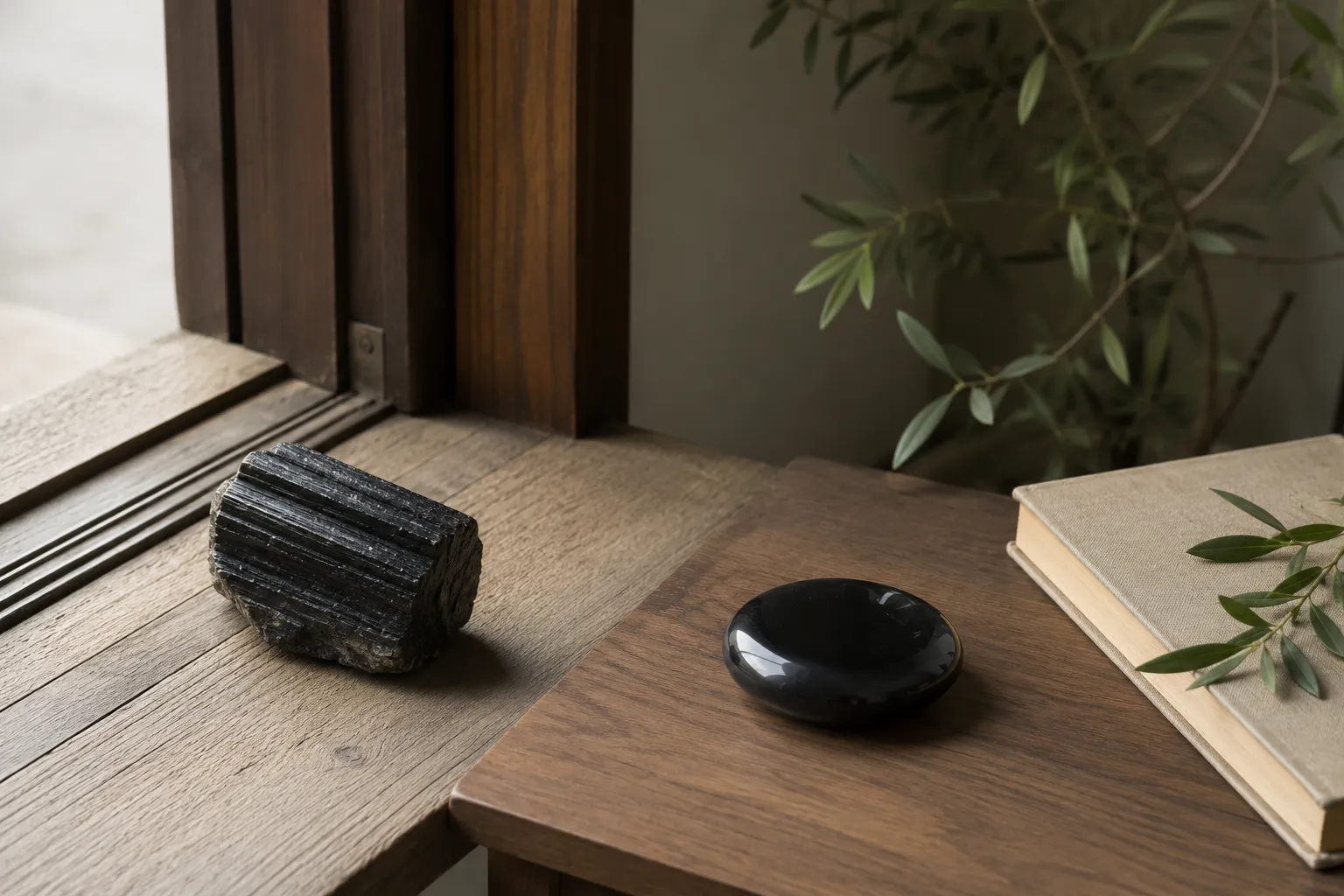
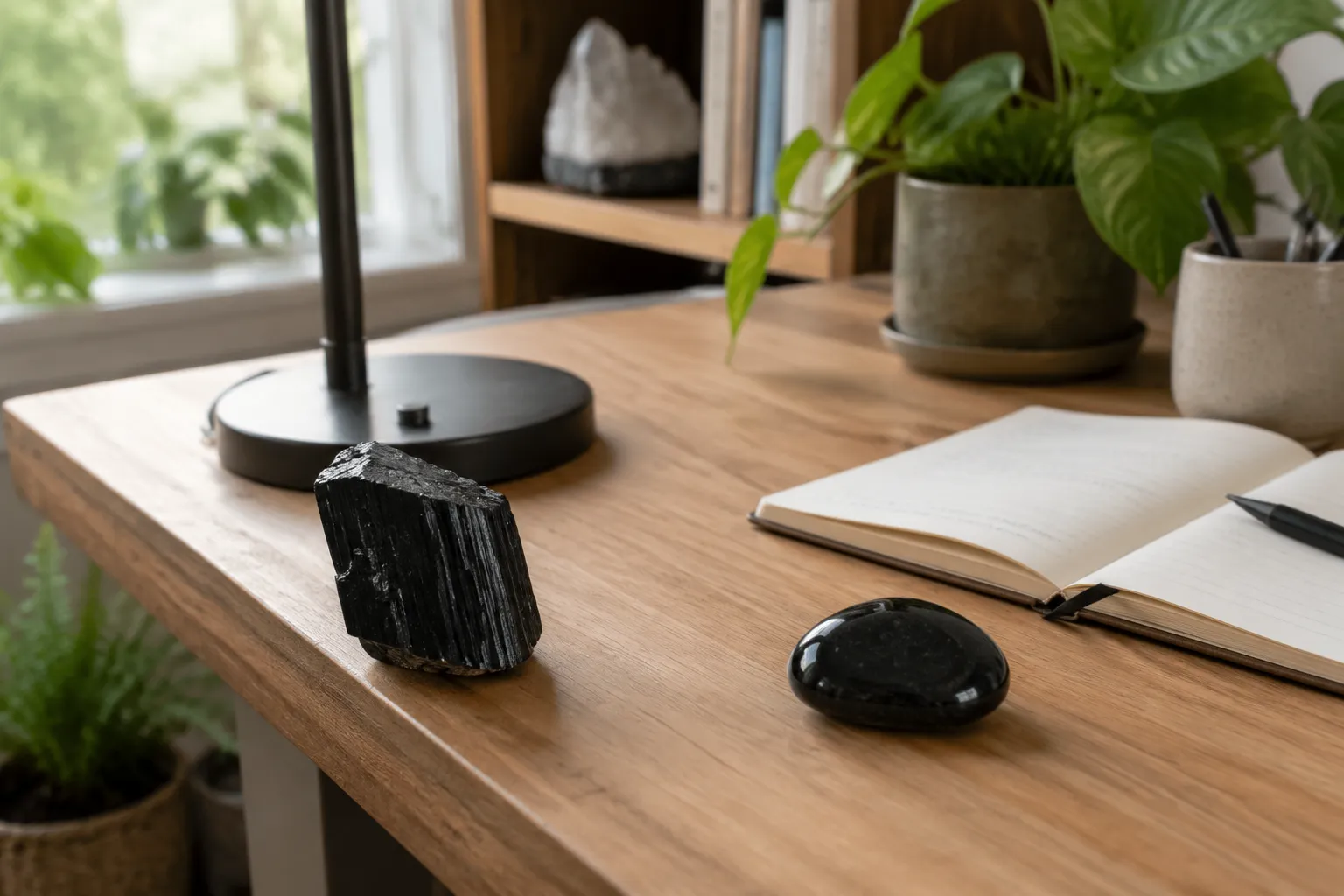
A rough black tourmaline piece at the edge of a desk does not read the same way as a smooth obsidian palm stone beside a journal. Both are dark stones, and both are often sold with symbolic protection language, but they usually serve different roles in a room.
For Black Tourmaline vs Obsidian, the practical answer is simple: choose black tourmaline if you want a quieter, steadier symbolic boundary stone for an entryway, desk, corner, or shared room. Choose obsidian if you want a more reflective personal stone for journaling, altar work, or intentional clearing practice.
That answer is about fit, not proven force. The available source set does not support claims that either stone changes a room's energy, shields electromagnetic exposure, or changes emotional health outcomes. What it does show is a consistent pattern in crystal-market and practitioner language: black tourmaline is usually framed as room-oriented and settling; obsidian is framed as sharper, inward, and more personally reflective.
broader context
Black tourmaline context note
This narrower page works best after the broader black tourmaline context page.
The Short Choice: Room Boundary or Personal Mirror
Choose black tourmaline when
The stone will stay in a home or workspace without much handling. In contemporary crystal practice, black tourmaline for home use is often treated as steady and background-friendly. People place it near an entryway, beside a computer, on a desk, or in a corner because its rough surface and dark mass create a clear visual edge.
Choose obsidian when
Smooth glassy obsidian has a mirror-like quality in both appearance and symbolism, so it often belongs better in a private corner, journal area, meditation shelf, or altar. It asks for more attention. On a shared console table, it may feel formal or intense; beside a notebook, that same quality can feel focused.
For sensitive users, black tourmaline is usually the lower-drama option in the way the market describes it. That does not mean it is objectively gentler in a medical sense. It means the language around it tends to be less charged. Obsidian is more often tied to shadow work, emotional processing, and deeper self-inquiry, all of which should stay in the category of personal or spiritual-practice language.
How They Look and Feel in a Space
The easiest practical distinction is visual. Black tourmaline is commonly sold as rough, matte, grooved, or striated. Those surface cues are useful for shopping and placement, though they should not be treated as laboratory identification. A rough specimen can look architectural: ridged, dark, irregular, and mineral-heavy. In interiors, that gives it presence without needing a large footprint.
Obsidian is commonly described in the crystal market as smooth and glassy. Polished pieces can look like black glass, sometimes with a reflective sheen or a soft curved form. That finish changes the mood of a room. It reads as more deliberate and object-like than a rough mineral piece. On a desk, obsidian may feel like a personal tool; on a shelf, it can become a dark reflective accent.
Do not rely on weight alone
Weight is not a reliable shortcut. Quick comparison posts sometimes imply that one stone will always feel heavier, but size, shape, polish, inclusions, and seller accuracy all affect how a piece feels in the hand. If authenticity matters, surface and structure can raise useful questions, but they cannot guarantee identity on their own.
For a design-conscious room, the choice may come down to texture. Choose black tourmaline when you want a dark natural interruption against wood, linen, stone, paper, or warm lighting. Choose obsidian when you want a sleek reflective point near a candle, notebook, tray, or personal arrangement. One behaves like a dark anchor; the other behaves like a dark mirror.
Placement: Entryway, Desk, Altar, or Private Corner
Entryway
For an entryway, black tourmaline is the cleaner fit. The recurring practice language around black tourmaline symbolic boundary work matches thresholds: front doors, mudrooms, hallway consoles, studio entrances, and workroom corners. It gives the space a pause without asking visitors to participate in a personal ritual.
Desk
For a desk, black tourmaline also tends to work better when the goal is steady presence. A small rough piece near a monitor, notebook, or lamp can serve as a tactile reminder to return to the task. Some sellers attach stronger electromagnetic language to black tourmaline for desk use, but the available material does not support treating it as a measured shield. Keep the desk role symbolic and sensory: texture, placement, and reminder.
Altar or private corner
Obsidian belongs where the interaction is more deliberate. If you journal, sort through a difficult decision, or use a personal reflection ritual, obsidian's market meaning fits that setting. The phrase "obsidian for shadow work" belongs to spiritual-practice language, not factual psychology. Used carefully, it can describe a private practice of looking inward, naming what feels unresolved, and putting thoughts on paper.
Shared living room or office
For a shared living room or office, be cautious with obsidian if its symbolism feels too intense for the space. A smooth black piece can be beautiful, but the meaning attached to it may be more personal than room-level. If the room needs spatial silencing in the ordinary design sense of fewer visual hooks and a quieter field, a matte black tourmaline piece may be easier to live with.
Meaning in Crystal Practice, Without Overstating It
In current crystal-practice language, black tourmaline is often called a grounding stone. Here, that is best read as a non-medical embodied phrase: the object may help someone mark a pause, notice the weight of the room, or create a small ritual of arrival. The meaning lives in attention, habit, and symbolism, not in a verified mechanism.
Obsidian is often called a clearing stone. It is also linked with reflection, emotional processing, and inward work. Those phrases can be useful if they stay in their proper category. They describe how practitioners and sellers talk about the stone, not an established effect that the material produces for every person.
The useful question is not which stone is stronger, darker, more powerful, or more protective. The useful question is: what job do I want this object to perform in the room?
This is where the comparison often gets distorted. Retail language can turn black tourmaline and obsidian into a ranking: stronger, darker, more powerful, more protective. That is not the useful question for a home or workspace. If the job is ongoing boundary symbolism, black tourmaline fits. If the job is focused personal reflection, obsidian fits.
The same boundary applies to emotional stabilization language. A stone can be part of a calming routine as a visual cue, hand object, or intention marker. It should not be presented as changing mental health outcomes or replacing care, support, or practical environmental changes. The grounded use is modest: place the object where it helps you remember the behavior you already want to practice.
Can You Use Black Tourmaline and Obsidian Together?
Yes, some people use black tourmaline and obsidian together, but the pairing works best when each has a separate role. Put black tourmaline near the threshold, desk edge, or room corner as the boundary piece. Keep obsidian in the more private place where you write, reflect, or do intentional clearing practice.
Avoid crowding them into a display that tries to do everything at once. If every dark stone is labeled as protection, clearing, grounding, and emotional processing, the arrangement becomes muddy. The room reads better when the objects have distinct jobs. Black tourmaline can hold the outer edge; obsidian can stay closer to the personal work.
This pairing also prevents a common misunderstanding. Black tourmaline and obsidian are not interchangeable just because both are black and both appear in symbolic protection language. Their surfaces, market meanings, and placement logic are different enough that choosing one at random can make a space feel slightly off.
Common Confusion Before You Buy or Place One
Material identity
Black stones are often grouped together visually, and shoppers may see obsidian, black tourmaline, onyx, agate, jet, and other dark materials discussed side by side. This page is not a full identification guide, and the supplied sources are not strong enough to support hard testing rules. Treat quick online shortcuts as prompts for closer inspection, not as certainty.
Protection language
In crystal shops, black tourmaline is often marketed for room protection, and obsidian is often marketed for clearing or deep reflection. Those are belief-system and practice labels. They can be meaningful to the person using the stone, but they should not be written as environmental, electrical, psychological, or supernatural proof.
Cleansing
Some sources say obsidian needs frequent cleansing while black tourmaline does not, or that one stone absorbs and the other transforms unwanted energy. The available material does not support those as material facts. If cleansing is part of your tradition, treat it as a ritual habit, not a physical requirement established here.
Intensity
Many people describe obsidian as more intense and black tourmaline as steadier. That is a useful cultural pattern for choosing a room object, but it is still a pattern of language. Your response to a stone can depend on association, setting, memory, design preference, and the ritual you attach to it.
A Simple Decision Check
- Choose black tourmaline if the stone will sit near an entryway, desk, corner, or shared space; if you want a low-key symbolic boundary; if you prefer rough texture and mineral presence; or if you are sensitive to dramatic spiritual language and want something quieter.
- Choose obsidian if the stone will be used privately; if you want a smooth, reflective object for journaling or intentional clearing; if you are drawn to mirror-like surfaces; or if your practice already includes personal reflection work and you want a physical focus for it.
- Choose both only if you can give them separate roles. Black tourmaline can belong to the room. Obsidian can belong to the moment of reflection.
The grounded answer is this: black tourmaline is usually the better dark stone for ongoing home or workspace placement, while obsidian is usually better for private reflective practice. Keep the material visible, the symbolism clear, and the claims modest.