How to Build a Four-Corner Black Tourmaline Grid for Unshakable Room Boundaries
To build a four-corner black tourmaline grid, place one piece of black tourmaline near each main corner of the room, then set one clear intention for what that boundary means: rest, privacy, focus, quiet, steadiness, or a stronger sense of “this space is mine.”
In crystal-practice language, this is the Four-Corner Gridding Method. The room itself becomes the grid: four stones, four corners, one symbolic perimeter. Use it as an intention-based boundary ritual, not as a physical safety system, EMF barrier, health intervention, or guaranteed sleep aid. The stones work best here as visible anchors for attention and reminders of the boundary you want to maintain.

broader context
Start with the main black tourmaline page
This narrower page works best after the broader black tourmaline context page.
The Four-Corner Gridding Method, step by step
This method is meant for one room or defined zone at a time: a bedroom, studio, meditation room, office, or quiet corner. You do not need a complex crystal diagram. You are simply marking the outer edge of the space.
1. Choose four pieces of black tourmaline
Use four separate pieces if possible. They do not need to match perfectly, but the layout feels more balanced when the stones are similar enough in size or visual weight that no corner feels neglected.
Good options include:
- Four rough black tourmaline chunks
- Four small terminated pieces
- Four tumbled stones, especially where floor placement is impractical
- A mixed set, as long as each corner has one dedicated stone
For a bedroom protection grid ritual, smaller stones are often easier to live with. They can sit behind furniture, near baseboards, on shelves, or on windowsills without making the room feel cluttered. In a larger room, slightly heavier pieces may be useful simply because they are easier to notice and less likely to be moved by accident.
Do not make the stones carry more certainty than they can. The grid does not become more reliable because the pieces are bigger, darker, more expensive, or sold with dramatic protection language. Choose stones you can place consistently and keep in place.
2. Find the room’s four working corners
Stand inside the room and identify the four main outer corners: the points that most clearly define the room’s boundary. In a rectangular room, this is simple. One stone goes near each corner.
Place each stone:
- Close to the wall, baseboard, or corner line
- Low to the ground if you want the grid to feel grounded
- On a shelf, windowsill, or stable surface if the floor is not practical
- Somewhere it will not be kicked, lost, handled by children, or reached by pets
The point is not mathematical precision. The point is conscious placement. In this practice, the four stones act like pins holding the room’s symbolic perimeter in your awareness.
3. Prepare the room before placing the stones
Before setting the grid, do one ordinary pass through the space. Put laundry away, clear trash, make the bed, wipe the surface where a stone will sit, or open a window if that fits the room.
This matters because a black tourmaline room grid should not become a way to avoid practical maintenance. If the room feels unsettled because the door does not latch, the window is drafty, the air is stale, or the bedside area is overloaded, handle the real-world issue first. Then use the ritual to mark the atmosphere you want to reinforce.
4. Set one clear intention
Hold the four stones together, or place your hand over them before setting them down. Use plain language. A strong intention does not need to sound mystical; it needs to be specific.
Examples:
- “This room is for rest, privacy, and calm.”
- “Only what supports my focus belongs in this workspace.”
- “I mark these four corners as a boundary for steadiness.”
- “This bedroom is where I put the day down.”
- “This room holds quiet and clear edges.”
If you use the phrase “spatial lockdown,” keep it as ritual language. Here, it can mean: “I am choosing a firm energetic boundary for how this room is used.” It should not mean the room is sealed from harm, intrusion, electromagnetic fields, illness, conflict, or unwanted outcomes.
5. Place the stones in a consistent order
Start at the door or at the corner that feels most natural. Move clockwise or counterclockwise around the room, placing one stone in each corner. The direction matters less than your consistency and attention.
As you place each stone, repeat the same intention or use a short version:
- “This corner marks rest.”
- “This corner marks privacy.”
- “This corner marks steadiness.”
- “This corner completes the boundary.”
Once all four stones are placed, stand near the center of the room. Look at each corner in turn. In practical terms, the grid is complete: four stones, four corners, one room boundary.
What “unshakable room boundaries” means in this practice
“Unshakable” is best understood as a personal commitment, not a claim that the stone produces an external force. The grid gives your boundary a visible structure. Each time you notice a corner stone, it can remind you of the rule or feeling you chose for the room.
For example:
- In a bedroom, the boundary might mean no work laptop on the bed.
- In a studio, it might mean protecting quiet creative time.
- In a shared home, it might mean a clearer shift when you close the door.
- In a meditation corner, it might mean returning to one simple practice without adding more tools.
Room energy language can be useful when it stays grounded. Many crystal users describe a room as heavy, open, scattered, protected, or settled. Those words describe felt experience and ritual meaning. They are not measurements of air quality, physical safety, radiation, health, or sleep outcomes.
A four-corner black tourmaline placement is strongest as symbolic room boundary setting: it helps you name the edge of the room, decide what belongs inside it, and make that decision visible.
How to adapt the grid for irregular rooms
Most rooms are not perfect boxes. Closets, bay windows, alcoves, open doorways, partial walls, and L-shaped layouts can make “four corners” less obvious. Keep the method simple: mark the four points that best describe the space you actually use.
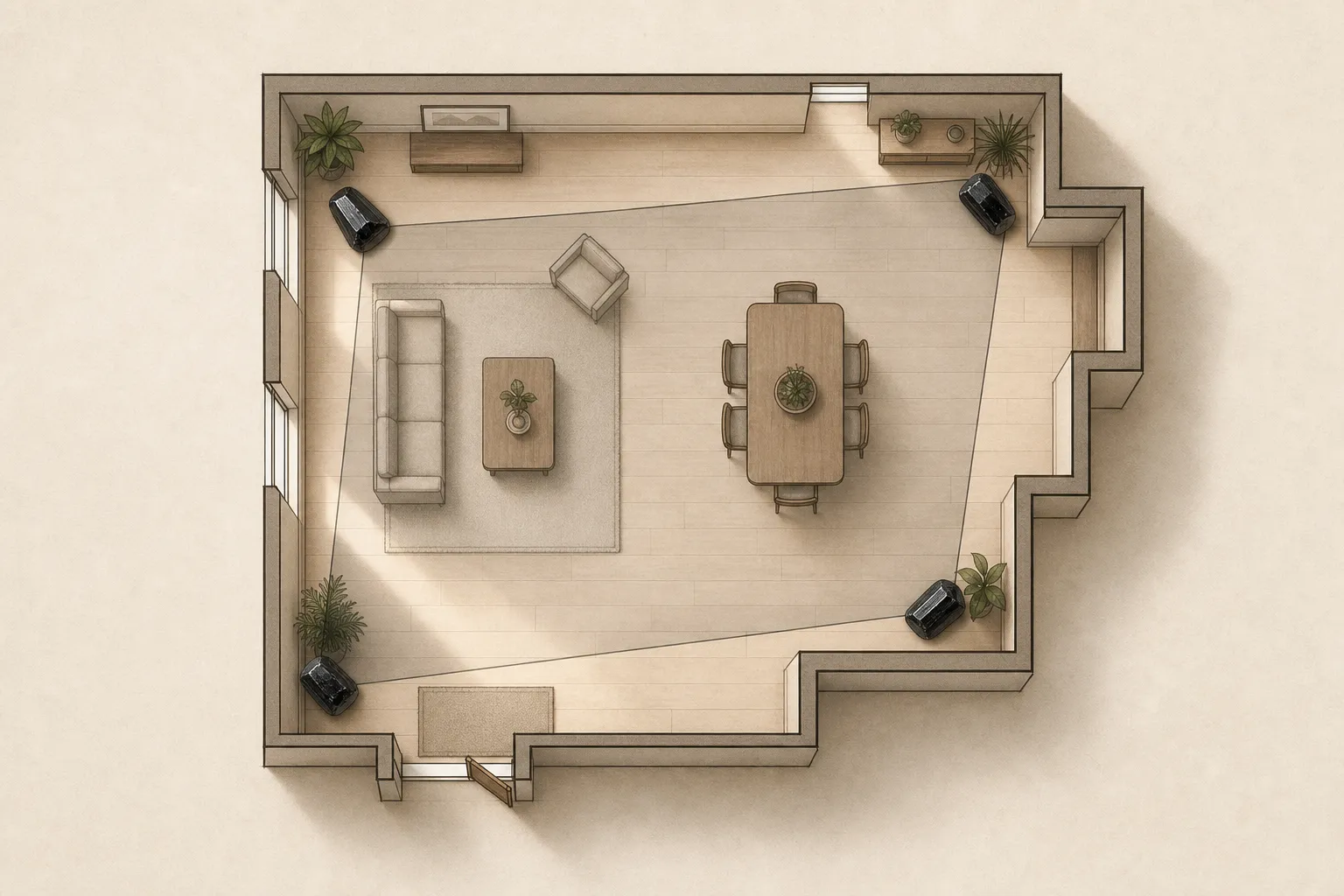
If the room is L-shaped
Use the four outermost corners of the usable room zone, not every angle in the wall. If one part of the L is clearly the main area, grid that section first. If both sections matter equally, place the stones at the four widest boundary points that create the clearest perimeter.
You are not trying to solve the architecture. You are choosing a symbolic frame.
If one corner is blocked by furniture
Place the stone as close as practical to that corner: on a nearby shelf, behind a dresser if it is safe and accessible, or on the floor just outside the obstruction. A visible placement is often better than a technically exact placement that disappears and never gets maintained.
If the room opens into another space
For an open-plan room, grid the zone rather than pretending there is a full wall. Use four points that define the area: the corner of a rug, the edge of a bookshelf, a column, a sofa line, or the nearest architectural corner.
In this case, the grid marks a use-zone, not a sealed room.
If the room has more than four corners
Choose the four corners that form the clearest boundary around the room’s main function. If the extra angles feel important, you can add more stones later, but that becomes a different layout. For the Four-Corner Gridding Method, stay with four. The simplicity is part of the practice.
Maintaining a black tourmaline room grid
A room grid should not become something you forget until it gathers dust. Maintenance is less about “recharging power” and more about keeping the intention current.
A simple rhythm:
- Check the stones when you clean the room.
- Dust or wipe the surface around each piece.
- Make sure all four stones are still in place.
- Repeat the intention if the room has started to feel undefined.
- Reset the grid after major changes in how the room is used.
Good times to reset a crystal grid include:
- After moving furniture
- After a guest stay
- After an argument or emotionally intense period in the room
- When changing a bedroom into an office, or an office into a rest space
- At the start of a new season, project, or routine
- When the grid starts to feel like clutter instead of support
To reset it, pick up all four stones, clean the area, restate the room’s purpose, and place them again. If you no longer want the grid, remove the stones and put them somewhere neutral. You do not need to keep a ritual object in a room after its meaning has expired.
Common confusion about protection, EMF, and “spatial lockdown”
The language around black tourmaline can get inflated quickly. A bedroom protection grid, room energy grid, or spatial lockdown ritual can be meaningful within personal practice, but those phrases should stay in the realm of symbolism, intention, and lived experience.
Use the grid to:
- Mark the four corners of a room with intention
- Create a visual reminder of the boundary you want
- Support a transition into rest, focus, privacy, or quiet
- Give your room ritual structure without adding complexity
Do not treat the grid as a replacement for:
- Door locks, alarms, or ordinary home security
- Medical or mental-health care
- Electrical safety practices
- Ventilation, filtration, or air-quality controls
- Conflict resolution or direct boundary conversations
- Professional help when a real-world issue needs it
This distinction does not make the ritual empty. It makes it cleaner. The stones can carry symbolic weight without being asked to do jobs that belong to practical systems, care, maintenance, or communication.
Academic writing on ritual space often describes how people use lines, perimeters, thresholds, and repeated actions to separate an “inside” from an “outside” for the duration of a practice. That broad idea helps explain why a four-corner ritual feels legible: it gives the room an edge. It does not establish that black tourmaline creates a measurable protective field.
Compact placement checklist
Use this if you want the setup without overthinking it:
- Choose four black tourmaline pieces.
- Tidy the room enough that the corners are reachable.
- Decide what boundary the room needs: rest, focus, privacy, steadiness, or quiet.
- Place one stone near each main corner.
- Move in one consistent direction around the room.
- Repeat one short intention as each stone is placed.
- Stand in the center and notice the four marked points.
- Recheck the stones when you clean or when the room’s purpose changes.
That is the whole method: four stones, four corners, one clear boundary. Let the black tourmaline mark the room, let the room remind you of your intention, and let the boundary be something you continue to honor in ordinary ways.