Bounded ritual note
Guilt-Free Cord Cutting: Reclaiming Your Energy Sovereignty
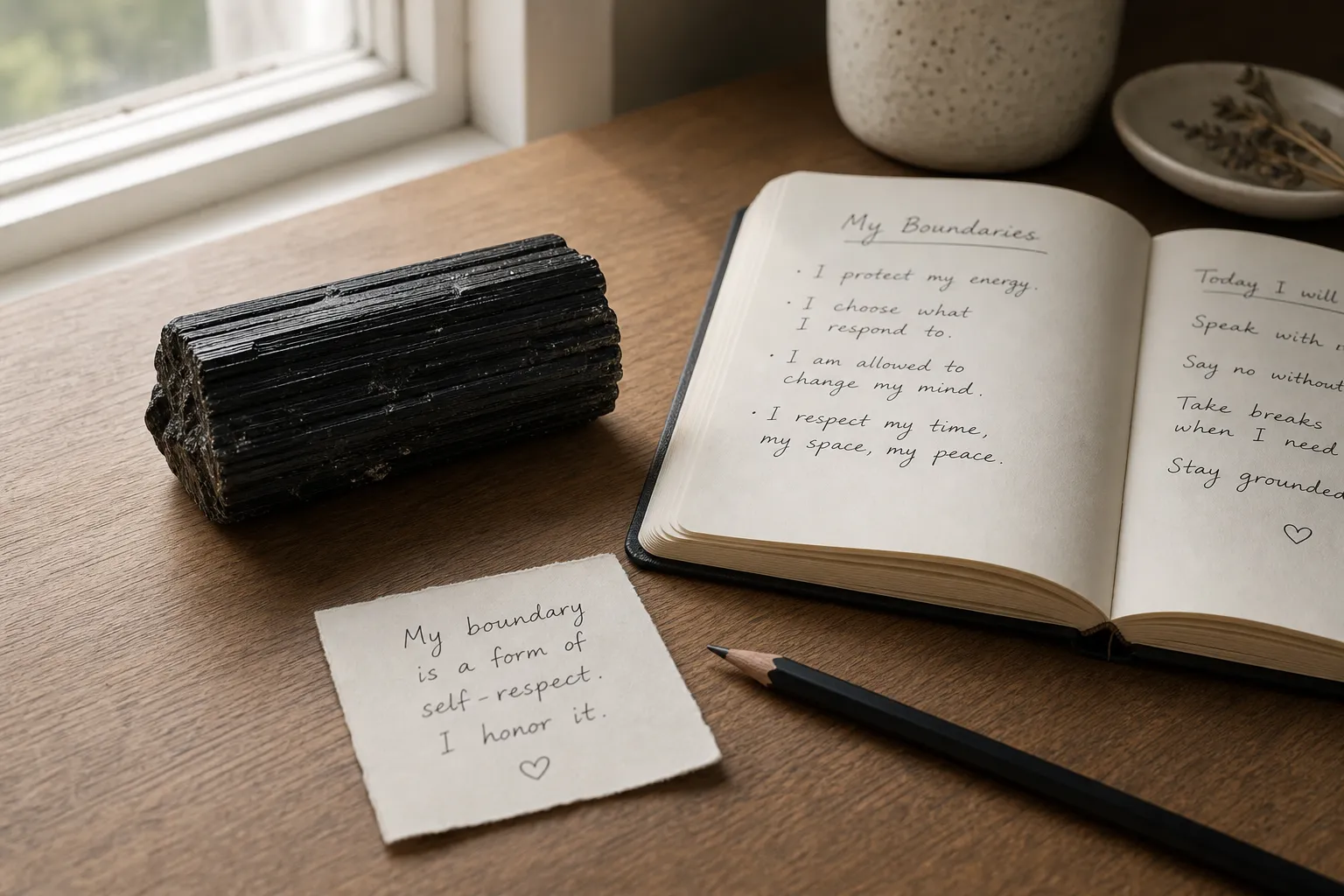
A piece of black tourmaline can sit on a desk as a dark, ridged mineral; its surface is observable, while its meaning belongs to practice and interpretation. Invisible Cord Cutting sits in that same careful space. It can be a guilt-free, belief-based ritual for reclaiming attention, symbolic boundaries, and personal agency, but it should not be treated as proof of invisible harm, a clinical method, or a guaranteed energetic result.
The direct answer: guilt-free cord cutting is not about punishing someone, erasing a relationship, or declaring another person an “energy vampire.” It is a self boundary ritual. You are choosing where your attention, emotional availability, and daily energy go next.
broader context
Start with the main black tourmaline page
This narrower page works best after the broader black tourmaline context page.
What Invisible Cord Cutting Can Mean
Invisible Cord Cutting works best here as symbolic language. The “cord” is a metaphor for a perceived attachment: a thought loop, an old obligation, an unfinished conversation, a repeated pull toward someone else’s needs, or a relationship pattern that keeps taking up room in your day.
That does not mean energy cords have been established as literal structures. The available material for this page does not support factual claims about invisible energetic anatomy, spiritual attack, chakra mechanics, or guaranteed outcomes. The useful part is more modest: the cord image can help you name what feels entangled, then decide what kind of boundary is possible.
Energy ownership works the same way. It is not a claim that energy can be measured, transferred, or taken in a verified spiritual system. It is a plain metaphor for agency: your right to decide what receives your focus, what access people have to you, and what you no longer want to rehearse internally.
That is why cord cutting without blame matters. You can release a perceived attachment without making the other person wrong. “I am no longer available for this pattern” is cleaner than “this person is bad.” The first sentence keeps the ritual anchored in self-responsibility.
Release Without Demonizing
“Energy vampire” language is common in spiritual and wellness spaces, but it can become too sharp too quickly. It may describe how a connection feels from the inside: draining, demanding, intrusive, or hard to put down. It should not be used as an objective label for another person’s character, intention, mental health, or spiritual effect.
A steadier phrase is: “This connection is taking more attention than I want to give it.” That keeps the focus on your experience and your next choice. It also leaves room for complexity. A person can be struggling, lonely, intense, needy, or mismatched with your capacity without being turned into a villain.
Before a ritual, ask three grounded questions
- What am I still carrying from an old interaction, promise, fantasy, resentment, or fear?
- What access do I want to change: emotional, conversational, digital, physical, or symbolic?
- What real action matches the ritual: fewer checks, clearer replies, a pause before responding, or a private decision to stop replaying the story?
This is where symbolic energy boundaries become practical. A ritual may give the decision a shape, but the boundary is lived afterward. If the ritual says, “I return my attention to myself,” the next action might be closing a message thread, moving a reminder out of sight, writing one unsent page, or deciding not to explain yourself again.
Black tourmaline can be present as a tactile object if it already belongs in your practice or interior space. Its striations, weight, and dark crystal habit can make the moment feel physically located. That does not turn the mineral into a guaranteed shield. It gives your hands and eyes something observable while the meaning stays symbolic.
A Simple Energy Ownership Ritual
Keep this small. The point is not dramatic severing; it is a clear, consent-based release statement to yourself. If the ritual makes you feel more agitated, afraid, or fixated on the other person, pause and return to ordinary support.
1. Set the room plainly
Choose a quiet place where you will not be interrupted for a few minutes. You may place black tourmaline, a candle, a bowl of water, or a blank page nearby if those objects help mark the moment. They are supports for attention, not evidence of an outcome.
2. Name the cord as a metaphor
Write one sentence: “The cord I am naming is my repeated attention to…” Finish with a pattern, not an accusation. For example: “checking whether they approve,” “replaying the argument,” or “feeling responsible for their mood.”
3. Locate the felt symbol
Some readers use solar plexus symbolism because the upper abdomen is often associated in spiritual language with will, confidence, and personal power. Here, that is symbolic language only. You might place a hand there and notice posture, breath, or tension without turning the sensation into a diagnosis.
4. Use breath and boundary setting
Take a few slow breaths and say the boundary in ordinary language: “I release my role in carrying this pattern.” Or: “I keep compassion, but I return responsibility to its proper place.” If that feels too formal, use plainer words: “This is not mine to hold today.”
5. Visualize the release gently
Visualization for cord cutting can be simple. Imagine the cord loosening, fading, dissolving, or being set down. You do not have to cut violently. You do not have to imagine the other person losing anything. A guilt-free image is enough: your attention returns to your body, your room, your next hour.
6. Close with one grounded action
End by doing something small and real. Drink water. Put the journal away. Step outside. Move the black tourmaline back to a shelf or desk. If a practical boundary is needed, choose one manageable step, such as waiting before replying or muting a thread.
The ritual is complete when you stop feeding the loop for now. It does not have to feel dramatic to be meaningful.

When the Answer Changes
Invisible Cord Cutting is most appropriate when the issue is symbolic, reflective, or emotional in a non-urgent way. It may fit a breakup, a one-sided friendship, an old work identity, or a version of yourself that kept overextending.
The answer changes when the situation involves safety, coercion, stalking, abuse, threats, risk of self-injury, severe distress, or a relationship where you cannot freely set boundaries. In those cases, ritual language should not be the main support. Seek appropriate emergency, legal, medical, mental health, workplace, school, or local assistance depending on the situation. A symbolic release cannot replace a safety plan or qualified help.
The answer also changes if cord cutting becomes a way to avoid necessary communication. Sometimes a clear conversation, a practical limit, or a change in access matters more than a private ritual. If shared responsibilities remain — legal, financial, parenting, housing, workplace, or caregiving — the boundary may need ordinary structure.
A useful check is this: after the ritual, are you more able to act with steadiness and respect for consent, or are you more certain that the other person is spiritually dangerous? The first direction supports agency. The second can deepen fear and fixation.
Common Misunderstandings
Caring can remain
Releasing perceived attachment does not mean you must stop caring. You can care and still withdraw from over-involvement. You can wish someone well and still stop making their state the center of your day.
Symbolism is not proof
Solar plexus symbolism may represent will, self-trust, or personal power in symbolic practice, but it should not be presented as a clinical or universal fact. Physical discomfort, distress, or persistent symptoms should be treated as real-world concerns rather than something a ritual is expected to resolve.
Agency is not control
Energy ownership is about your attention, choices, availability, and boundaries. It is not a way to make someone else feel differently, apologize, stop contacting you by mystical force, or change their behavior because you performed a ritual.
Closure may be layered
One ritual may not create permanent closure. Personal meaning making often works in layers. You may need to repeat a boundary in daily life, revisit the journal page, reduce exposure to reminders, or ask for support. Releasing perceived attachment is usually less like cutting a rope once and more like choosing, repeatedly, not to pick it up.
Limits of Cord Cutting
The limitation is not a failure of the ritual; it is the boundary of the claim. Invisible Cord Cutting can give form to an inner decision. It can help you mark a transition, name a boundary, or return attention to the present. The available evidence for this page does not support saying it changes another person, proves energetic harm, resolves distress, or creates guaranteed protection.
That makes the practice smaller, but cleaner. It does not need to be sold as a force. It can remain a private symbolic act: a way to say, “I am allowed to stop organizing myself around this attachment.”
If you use black tourmaline, keep the same distinction. The mineral’s surface, heft, and dark crystal habit are observable. Its meaning in your room is interpretive. Let schorl be schorl before symbolism, then let the symbolism serve a grounded choice rather than a fearful story.
A guilt-free release returns you to scale: one body, one room, one decision, one next action. Invisible Cord Cutting is most responsible when it helps you reclaim attention without blame, hold symbolic boundaries without certainty claims, and practice energy ownership as personal agency rather than proof of unseen conflict.