Practical mineral care
Neutralizing Static: The Secret to Keeping Black Tourmaline Dust-Free
Black tourmaline stays cleaner when you treat “static” as a placement, friction, and dust-control problem, not as something you can permanently remove from the stone. To prevent static dust on crystals, keep the specimen away from forced air and lint-heavy surfaces, handle it less, dust it with a soft dry brush, and avoid sprays, oils, coatings, soaking, heat, or hard rubbing.
The evidence boundary matters here. No usable public references were supplied to confirm black-tourmaline-specific electrostatic behavior, humidity effects, or a home method for reducing piezoelectric charge. So the reliable answer is practical mineral care: reduce exposure, reduce residue, and clean the surface without changing the specimen.
broader context
Start with the main black tourmaline page
This narrower page works best after the broader black tourmaline context page.
The Practical Answer: Reduce Exposure, Friction, and Residue
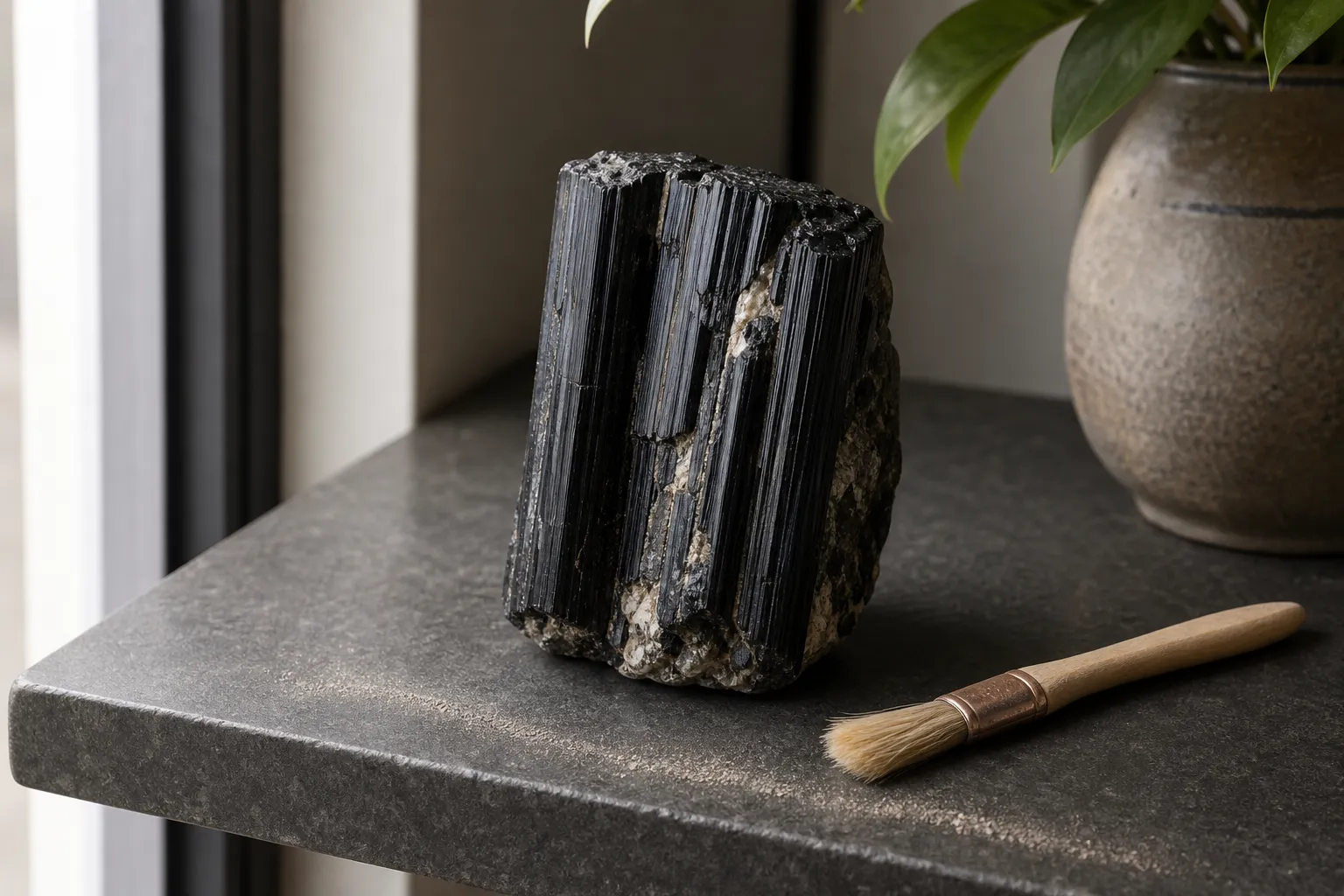
Dust shows quickly on black tourmaline because schorl is dark, textured, and often ridged. Pale particles stand out against black crystal faces, while striations, broken points, crevices, and uneven crystal habit can hold fine dust even when the specimen is not unusually charged.
Start with the conditions around the mineral:
- Place it away from HVAC vents, open windows, fabric lint, incense ash, powdery decor, pet traffic, and high-touch desk edges.
- Handle it by the base or attached matrix when possible, rather than rubbing the crystal faces.
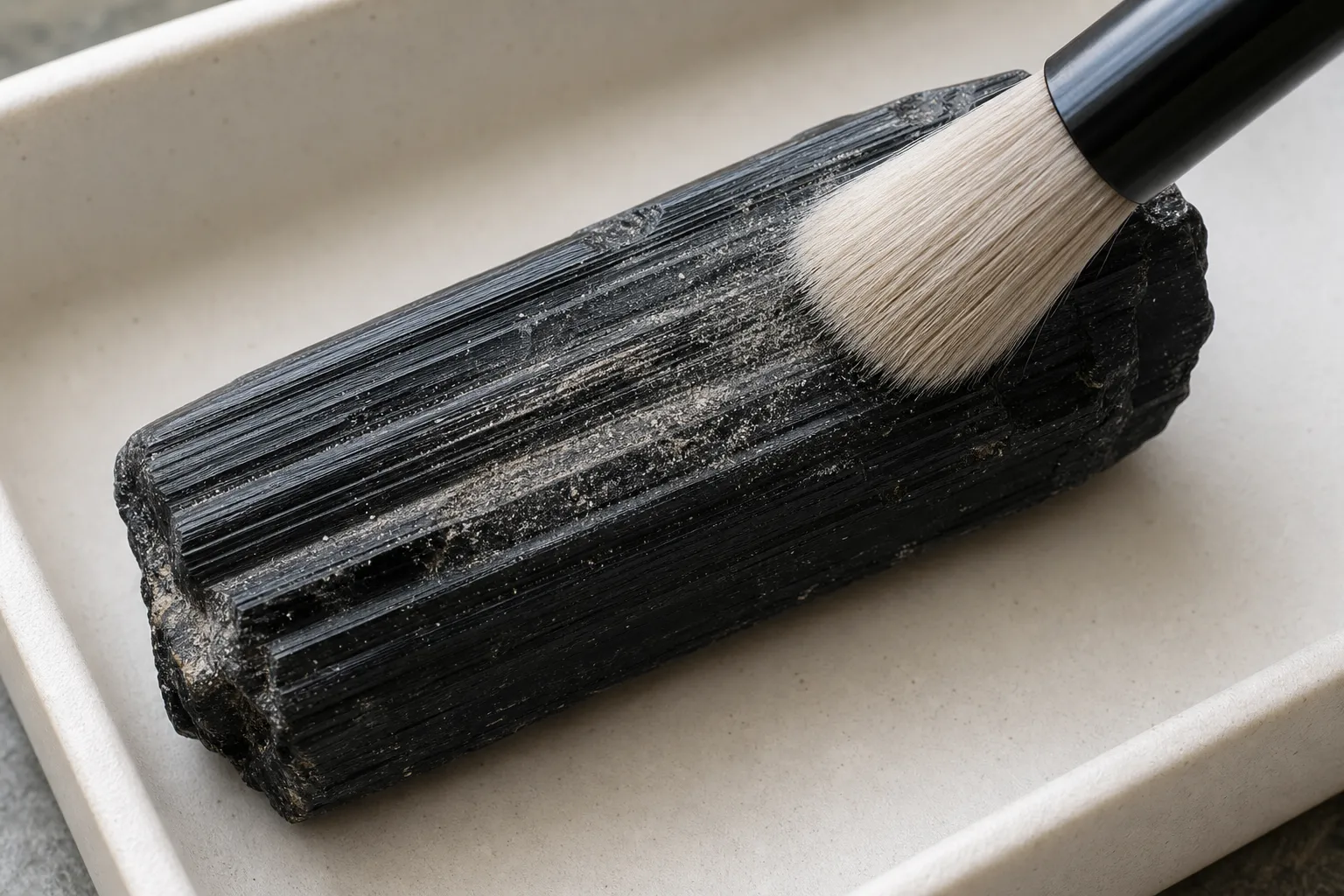
- Use a soft, dry artist’s brush or a clean hand blower to lift loose dust before wiping.
- If you wipe, use very light pressure; extra friction can leave fibers behind or dull the surface.
- Clean the shelf, tray, or display riser first, because nearby dust returns to the crystal fast.
That is anti-static mineral care in the practical sense. It does not claim to discharge black tourmaline; it lowers the conditions that make dust cling, show, or return.
Why Black Tourmaline Looks Dusty So Fast
A dark mineral surface makes dust visible. Under window light, shelf lighting, or camera flash, a thin gray film can look more dramatic on black tourmaline than it would on a pale stone. That does not prove the specimen has a special static problem.
Schorl is also valued for its natural surface: longitudinal striations, matte-to-glassy variation, chips, growth features, and weight in the hand. Those details give the mineral its character, but they make cleaning less like wiping a smooth tabletop. A polished palm stone may clean in one pass; a ribbed crystal often needs a brush that can follow the channels.
This is where the static explanation can outrun the evidence. Dust may cling because of room conditions, surface texture, fabric fibers, ordinary airborne particles, or handling. Without stronger source support, this page should not claim that a specific black tourmaline piece is collecting dust because of piezoelectric charge, dry-room static, or a mineral-specific electrical effect. First change the environment and the cleaning method.
A Gentle Routine for Keeping Schorl Clean
Begin around the specimen, not on it. Wipe the shelf or display tray first, then let the area settle before brushing the stone. If you clean the crystal and then disturb a dusty surface, particles can land back on the mineral.
Next, lift loose dust with a soft brush. Work along the striations rather than scrubbing across them. For a cluster, angle the bristles into grooves and between attached crystals, but do not force them into fragile points. A hand air blower can help with loose particles, though using it too close may push dust deeper into crevices.
Use a barely damp cloth only when the surface appears stable, non-fragile, and suited to light wiping. The cloth should not leave visible moisture behind. Because this article does not have reliable support for black tourmaline cleaning chemistry, it should not recommend detergents, alcohol, anti-static sprays, mineral oils, or household coatings. Those can leave residue, change the appearance, or create a film that catches more dust.
A good stopping point is not “perfectly black under magnification.” It is a specimen that looks clean at normal viewing distance and keeps its natural surface without repeated rubbing.
What Changes the Answer
Desk crystal
A single terminated crystal on a desk is exposed to skin contact, paper lint, keyboard dust, and daily airflow. For that piece, relocation may help more than another cleaning method. A tray, shelf, or covered display area can reduce how much loose material reaches the crystal.
Cluster
A cluster has more hiding places. Dust may sit between crystals, along matrix, or beneath broken points. Brushing matters more than wiping here, because a cloth can snag fibers and miss the grooves.
Polished object
A polished black tourmaline object has a different issue: smudges and lint show because the surface reflects light. Gentle wiping may be appropriate, but repeated polishing can become part of the problem if it adds fingerprints, fabric fibers, or surface friction.
Room context
Room conditions matter, but they should stay in proportion. If a shelf sits near textiles, vents, open windows, or pet areas, dust will return regardless of the mineral. In very dry rooms, people often notice more static around ordinary objects, but this article cannot give a measured humidity threshold for static charge on crystals. Treat humidity as part of the room context, not as a proven black tourmaline fix.
What Not to Do in the Name of “Neutralizing Static”
“Neutralizing static” sounds precise, but it can lead to unnecessary treatments. The goal is not to force a charge out of the crystal, chemically alter the surface, or make the specimen permanently dust-proof.
Avoid anti-static sprays unless a reliable mineral-care source for your exact material and finish supports that use. Sprays can leave films, and films can attract dust in a different way. Avoid oils for the same reason; they may make the surface look deeper for a while while giving particles something to hold onto.
Do not use heat, strong sunlight, electrical devices, saltwater, soaking practices, or abrasive cleaning as static-dust solutions. Without stronger support, those are not responsible recommendations for schorl care. They also distract from the simpler problem: visible dust on a textured black surface.
Use “reducing piezoelectric charge” carefully, too. Tourmaline is often discussed in relation to electrical properties, but this page does not have reliable source material tying a home-care routine to measurable dust prevention on black tourmaline. For this reader task, the cleaner wording is: reduce handling, reduce friction, and remove loose dust gently.
A Quick Check Before You Clean Again
Before repeating the same routine, look at where the dust returns. If the gray film comes back within a day, the source may be a nearby shelf, textile, vent, or traffic pattern. If dust gathers mainly in grooves, the tool may not be reaching the surface. If fibers appear after wiping, the cloth is part of the problem.
A simple check is enough:
- Look at the specimen in side light before touching it.
- Clean the surrounding display surface first.
- Brush along the striations, not against them.
- Wait a day and note where dust returns.
- Change placement if the same side collects particles repeatedly.
This keeps the answer grounded in observation. You are not trying to prove a static theory; you are watching how dust behaves around a real mineral in a real room.
FAQ
Can black tourmaline be made permanently dust-free?
No practical home method should be framed that way. Dust prevention depends on placement, airflow, handling, surface texture, and cleaning habits. A covered display may reduce dust, but it does not change the mineral into a permanently dust-free object.
Is static the main reason dust sticks to black tourmaline?
It may be one possible factor in some room conditions, but this page does not have enough source support to name it as the main cause. Dark color, ridged crystal habit, nearby lint, and ordinary airborne dust are simpler explanations to check first.
Should I use an anti-static spray on black tourmaline?
Not as a default care method. Unless a reliable mineral-care source supports the spray for your exact specimen and finish, avoid it. Residue can change the look of the surface and may attract more dust later.
What is the safest first step for dust on black tourmaline?
Clean the display area, then use a soft dry brush along the crystal’s striations. If dust keeps returning, change placement before adding products or stronger cleaning methods.
The Bottom Line
To keep black tourmaline dust-free, use low-residue, low-friction care: place it away from dust sources, handle it less, brush it gently, and avoid chemical or electrical “anti-static” fixes that are not supported for the specimen in front of you.
The secret is modest: schorl before symbolism, surface before theory. A clean black tourmaline piece is usually the result of good placement and gentle maintenance, not a permanent static-neutralizing treatment.