Material evidence before meaning
Reading the Matrix: What Mica and Quartz Inclusions Reveal About Your Stone
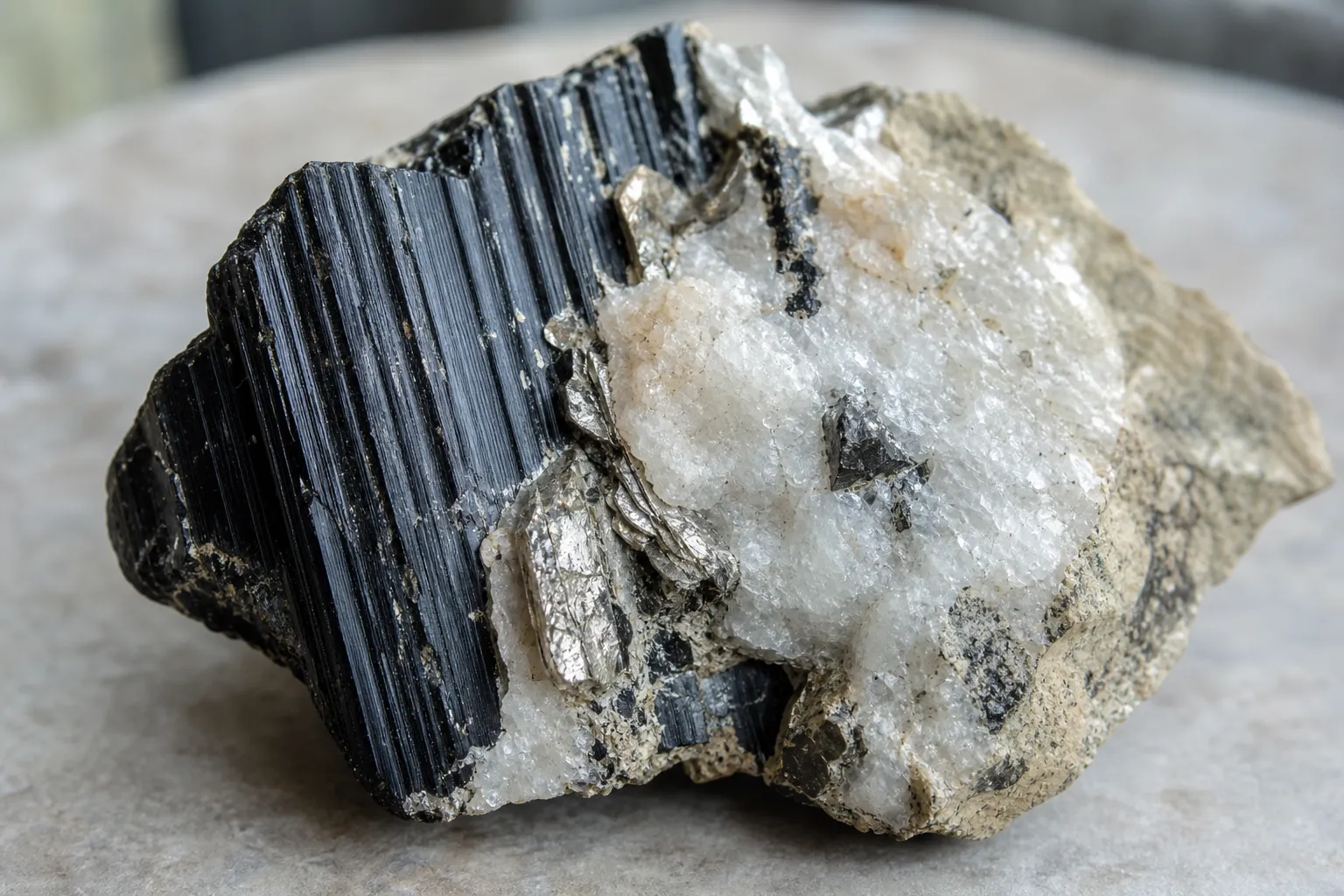
A black tourmaline specimen with pale quartz, silvery mica, or bits of host rock can tell you how the surface is put together. It can show contact points, broken matrix, reflective flakes, milky patches, striations, and the way dark schorl sits against lighter material.
That is useful, but it is not a verdict. Visible black tourmaline inclusions may help you describe a specimen more accurately; they do not prove origin, treatment history, value, or authenticity by sight alone. Read the matrix as a clue, then match any bigger claim to documentation or expert identification.
broader context
Start with the main black tourmaline page
This narrower page works best after the broader black tourmaline context page.
What Matrix Can Responsibly Suggest
Matrix is the surrounding rock or associated mineral material that remains attached to a specimen. On raw black tourmaline, it may appear as pale, gray, tan, white, glassy, or glittering material beside the darker schorl.
For a collector or buyer, that attached material preserves some visible context. A polished bead tells you little about the surface it came from; a raw black tourmaline matrix specimen may show how the dark crystal meets other minerals.
The most responsible use is descriptive. Quartz and tourmaline matrix may be consistent with a mixed mineral specimen. Visible mica inclusions may show that more than one mineral is present. Those details can support phrases such as “black tourmaline with quartz,” “schorl in matrix,” or “black tourmaline with mica-like reflective flakes.”
What matrix cannot do is make the object self-authenticating. A quartz tourmaline matrix does not prove a particular mine, country, deposit type, or price category. Mica in schorl, or beside schorl, is not a simple stamp of authenticity.
Useful observation
Attached quartz, mica-like flakes, host rock, breaks, and contact zones can help describe the visible surface and the way dark schorl sits against lighter material.
Claim boundary
Those visible cues do not prove origin, treatment history, value, locality, quality, or authenticity without stronger support.
Reading Mica Without Overreading It
Mica often gets noticed because it catches light. Thin reflective flakes can look silvery, golden, gray, or glassy, depending on lighting, surface angle, and the minerals around them. On a mixed specimen, these flashes may sit on the host rock, along cracks, in small pockets, or near the edge where dark tourmaline meets lighter matrix.
For the buyer’s eye, mica-like material can suggest that the piece is not a single uniform black mass. It may help you notice layered surfaces, sparkly planes, irregular boundaries, and tiny reflective sheets that would be easy to miss in a quick listing photo.
The mistake is treating sparkle as proof. Reflective flakes do not automatically confirm that the dark mineral is schorl, that the matrix is original to the specimen, or that the piece has not been cleaned, stabilized, repaired, coated, or assembled. Visual mineral identification has limits, especially when surfaces are dusty, polished, broken, glossy, or photographed under strong light.
A careful description might say: the specimen appears to show black tourmaline with mica-like reflective material in the surrounding matrix. That keeps the observation useful without making the photo carry more than it can.
Reading Quartz Beside Black Tourmaline
Quartz is easier for many collectors to recognize than mica because it often appears pale, translucent, milky, gray, or glassy. When quartz is attached to black tourmaline, the contrast can be strong: dark, ridged schorl beside a lighter mineral mass.
Quartz can help you read shape and contact. Look at whether the pale material wraps around the dark crystal, fills gaps, sits as a separate patch, or appears as broken matrix around the base. These visual cues can help you describe the specimen and decide whether it looks like a naturally mixed piece, a trimmed display specimen, or a stone that needs closer inspection before purchase.
Still, quartz is only a supporting visual cue. A quartz and tourmaline matrix may be consistent with a mixed mineral specimen, but it does not verify locality, age, formation sequence, quality, or collection history. Two stones can look similar and come from different contexts; two pieces from different places can share the same dark-and-light visual pattern.
A Practical Observation Order
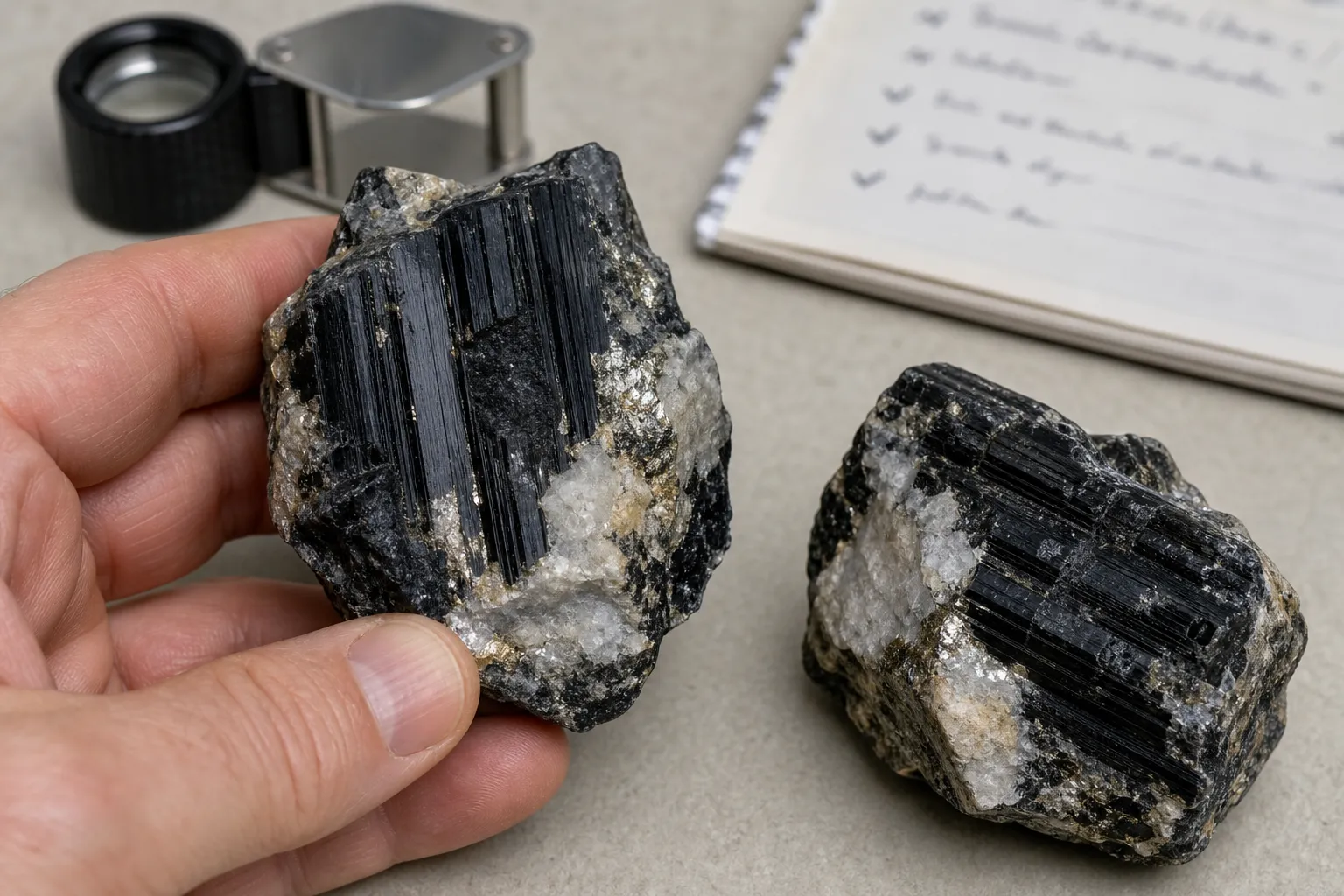
Start with slow looking rather than quick certainty. Use neutral light if possible, because bright seller lighting can exaggerate sparkle, hide coatings, or flatten surface detail. Rotate the stone and observe the transitions between dark tourmaline, pale quartz-like areas, mica-like flakes, and other host material.
First, look at the dark mineral. Black tourmaline, especially schorl, is often discussed by collectors through crystal habit, lengthwise striations, dark color, weight, and surface feel. On a raw specimen, ask whether the dark areas show coherent crystal surfaces or whether they appear as random black coating over lighter stone. This does not authenticate the piece, but it helps separate structure from surface color.
Next, study the contact zones. Is the pale material attached along a natural-looking break? Does the dark crystal appear embedded, crossing, or emerging? Are the edges sharp, crumbly, glossy, filled, or unusually uniform? These questions are more useful than judging from color alone.
Then check the claim attached to the specimen. “Black tourmaline with quartz” is a simple descriptive claim. “Rare high-value black tourmaline from a specific locality” is a stronger claim and needs stronger support. “Authentic because it has mica” is not enough.
What Matrix Does Not Prove
Matrix is persuasive because it can look less processed than a polished stone. A rough piece with quartz, mica, and host rock can feel more geologic, more tactile, and more at home in a biophilic interior. That visual richness is real as an aesthetic experience. It is not the same as verification.
Visible inclusions do not prove that a stone is untreated. They do not prove that no parts were added, cleaned, stabilized, repaired, or enhanced. They do not prove that a seller’s locality statement is accurate. They do not determine quality or value. They also do not support claims about health, energetic, protective, or psychological outcomes.
If the stone is used for grounding language or interior placement, keep the wording tied to texture, weight, color, location, and personal association. That is different from promising an effect.
The clearest boundary is simple: visible matrix can support observation; it cannot replace verification.
Questions to Ask Before You Buy
If the specimen is inexpensive and you are buying it for display, touch, texture, or a room-scale black accent, a careful visual check may be enough for your purpose. You can choose a piece because the contrast between schorl, quartz, and mica-like flashes suits your shelf, desk, or stone tray. Just avoid paying extra for claims that are not documented.
If the seller makes stronger claims, ask stronger questions:
- Is the dark mineral identified as black tourmaline or specifically as schorl?
- Is the pale material identified as quartz, feldspar, calcite, or simply matrix?
- Is the reflective material described as mica, or only as “sparkly inclusions”?
- Are there clear photos of multiple sides, including the base and contact points?
- Is there provenance documentation for minerals if locality, rarity, or high value is part of the sale?
For identifying raw mineral deposits, visual cues are only the beginning. A believable locality claim should not rest on a single photo of quartz or mica. A casual decorative specimen may not need that level of detail; a locality-priced or collection-grade specimen should be held to a higher standard.
If you already own the stone, write down what you can observe without overnaming it. “Dark striated crystal with white matrix and reflective flakes” is often more honest than forcing a full mineral label before you have better evidence.
A Short Field Checklist
Use this checklist when matrix is part of the decision:
- Describe first, conclude later: note dark crystal, pale matrix, reflective flakes, breaks, coatings, and contact zones.
- Treat mica-like sparkle as a clue, not proof of natural origin or authenticity.
- Treat quartz-like material as a useful visual association, not a locality marker by itself.
- Compare the seller’s claim with the evidence shown; stronger claims need clearer support.
- Be cautious with high-value, rare, or origin-specific language unless documentation is available.
- Keep symbolic or personal meanings separate from mineral identification.
This keeps the stone readable without asking the matrix to carry the whole claim.
When to Seek More Than Visual Identification
Most everyday buyers do not need lab-level certainty for a modest display piece. But if a specimen is expensive, claimed to be from a specific locality, sold as rare, or presented as collection-grade, visual inspection alone is a weak foundation.
That is especially true when the stone is mixed, repaired-looking, unusually glossy, heavily coated, or photographed in a way that hides the base and edges. At that point, the next step is not another round of guessing from inclusions. It is better documentation: clearer images, seller provenance, known collection history, or appropriate mineral identification by someone equipped to examine the material.
Mica, quartz, and other black tourmaline inclusions can make a specimen more legible and more beautiful. They can show contrast, texture, and the meeting of minerals in one object. Read them as part of the visible surface, then stop at the edge of what sight can responsibly say: material evidence before meaning, observation before certainty.