Bounded practice note
The Step-Down Method: How to Phase Out a Daily Crystal Habit
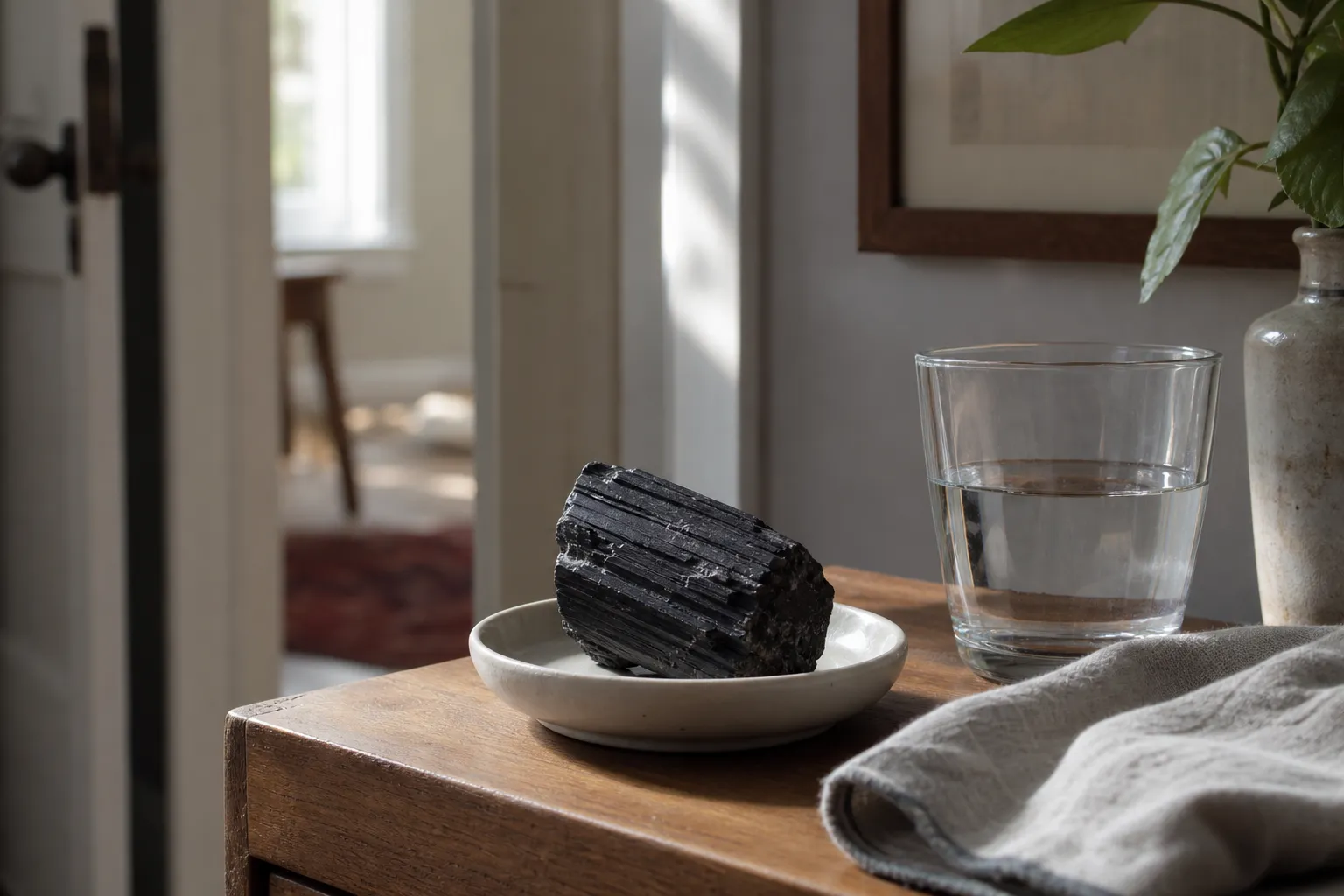
A black tourmaline piece can feel steady in the hand: dark surface, mineral weight, visible striations, a small object that marks the start of the day. If carrying it has become automatic, the step-down method is straightforward: reduce use gradually, make each change reversible, and replace the automatic reach for the stone with one ordinary grounding choice you can do without it.
For stepping down crystal use, begin with short stone-free windows instead of a dramatic break. Keep the crystal available, but not constantly on your body. Notice when you want it, what you are about to do, and what else helps you proceed. The aim is not to prove or disprove protection-stone language. The aim is to see whether the habit still feels chosen, or whether ordinary movement has started to feel conditional.
broader context
Black tourmaline context note
This narrower page works best after the broader black tourmaline context page.
A Practical Step-Down Schedule
The most useful version is modest. It treats a daily crystal habit as a routine you can adjust, not as something that needs a harsh reset. If you use black tourmaline symbolically, spiritually, aesthetically, or as part of a reflective practice, the method does not ask you to reject that meaning. It asks you to separate the object from the feeling that you cannot move through the day without it.
Use a schedule small enough to keep:
This is only a sample. A person who wears a small crystal every day may step down by reducing hours. Someone who keeps a black tourmaline specimen near a desk may begin by moving it farther away rather than removing it from the room. Someone who sleeps with a stone nearby may choose a daytime window first, because night changes can feel more loaded.
The verification point is ordinary: after each change, ask whether you can still do the planned activity. If yes, the window can stay. If no, make the step smaller. The method works best when the next step is boring enough that you do not have to argue with yourself all day.
Use Stone-Free Windows Without Making Them a Test
A stone-free window is a defined period when the crystal is not on your body or in your hand. It is not a challenge, punishment, or proof of spiritual strength. It is a small observation space.
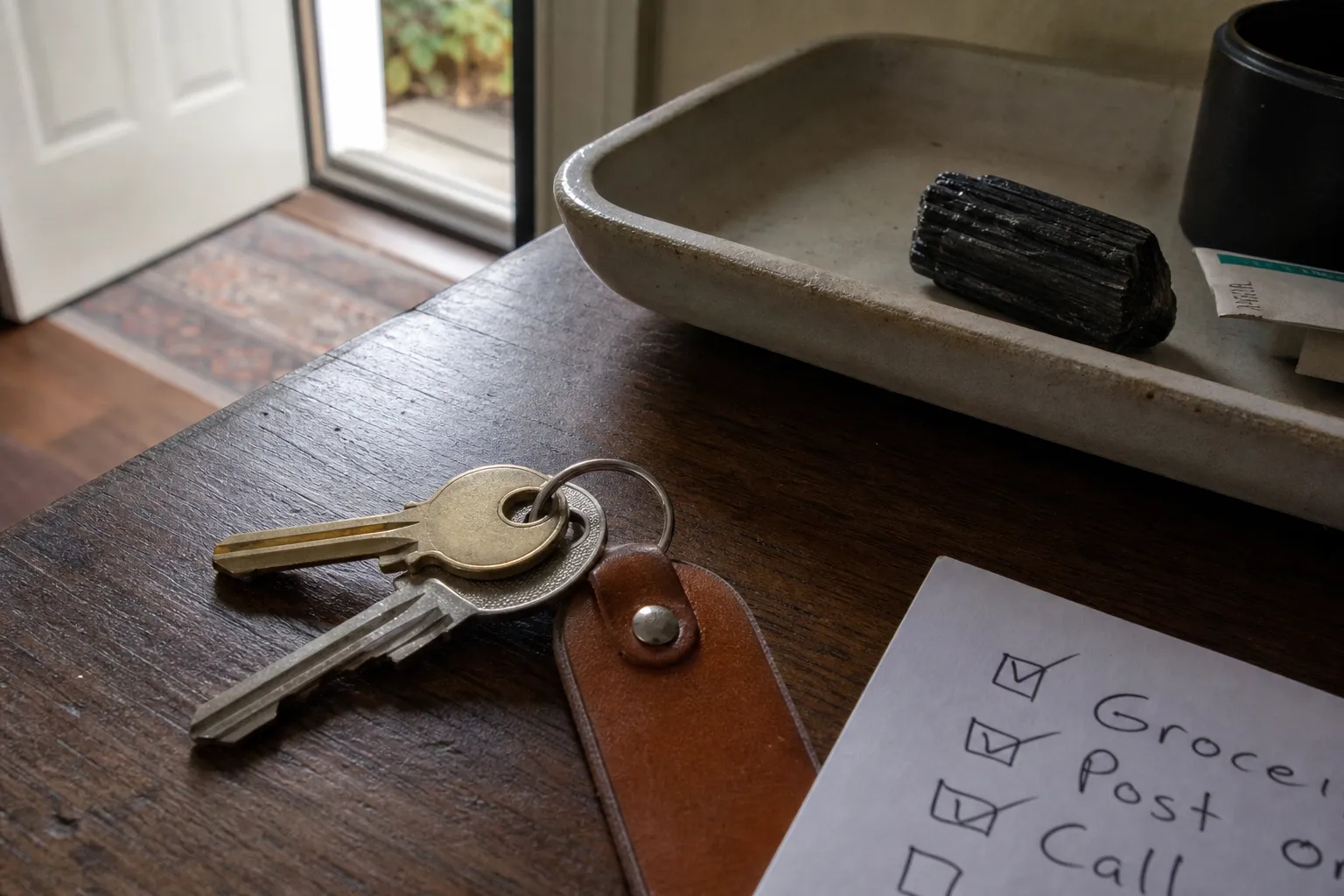
Start where the stakes are low: making breakfast, checking email, watering plants, folding laundry, walking to the mailbox, or sitting in a familiar room. Put the stone in a known place rather than hiding it. For black tourmaline, this might mean placing the specimen on a shelf, tray, windowsill, or entry table where its texture and presence remain part of the room but not part of every movement.
Before the window begins
“I am leaving the stone here for ___ minutes while I do ___.”
After the window ends
- What did I expect would happen?
- What actually happened?
- What did I do that helped me continue?
Keep the language plain. If your usual wording is “I need my protection stone before I go out,” translate it into observable terms: “I feel hesitant leaving without this object.” That sentence does not mock the belief, and it does not validate the crystal as an objective shield. It gives you something workable.
Stone-free windows are useful because they reduce the all-or-nothing pressure around weaning off protection stones. You are not deciding forever. You are making one interval visible.
Replace the Automatic Reach
Gradual crystal reduction becomes easier when the hand has something else to do and the day has another starting cue. The replacement does not need to be mystical, elaborate, or impressive. It should be repeatable without special conditions.
Try one replacement at a time:
- Place both feet on the floor and name the next physical action: “keys, door, sidewalk.”
- Touch a neutral object such as a smooth pen, fabric edge, watch strap, or house key.
- Set one practical boundary before leaving: “I can pause once, but I will still go.”
- Look at the stone in its set place, then leave it there as part of the room rather than your pocket.
- Write two lines: “What am I asking the crystal to do for me? What can I do myself in the next five minutes?”
These are replacement grounding habits in the ordinary sense: they bring attention back to the body, the room, and the next task. They are not presented as a guaranteed emotional result. Their value here is practical and reflective; they give you something specific to do when the crystal-use loop would otherwise run by itself.
For readers interested in energetic self-reliance, keep the phrase personal rather than absolute. A grounded version might be: “I am practicing one small choice before I reach for the stone.” That wording keeps the focus on agency, not on proving unseen forces.
Journaling Prompts for Trigger Observation
If phasing out black tourmaline feels difficult, the useful question is not “Was the stone really protecting me?” The better question is “When do I feel unable to proceed without it?”
Use crystal-use journaling prompts for one week before changing anything major:
- When did I reach for the stone today?
- Was I starting, leaving, deciding, resting, or avoiding something?
- Did I want the object for beauty, ritual, habit, reassurance, identity, or fear?
- What did I imagine might happen if I did not carry it?
- What was the smallest non-crystal action that helped me continue?
- Did the crystal use feel chosen, or did it feel required?
These prompts are not diagnostic tools. They do not label you, and they do not turn “dependency” into a formal category. They simply help you see the pattern.
Many daily crystal habits are mixed. A black tourmaline piece may be part of an interior arrangement, a tactile object, a personal symbol, and a leaving-the-house ritual at the same time. You do not have to flatten that into one explanation. The step-down method only asks you to identify the moments when the object stops being meaningful support and starts becoming a condition for basic action.
“Today I wanted the stone before a phone call. I paused, held my keys, and made the call without carrying it.”
That kind of note stays inside observable reality. It records the action without claiming a spiritual outcome.
Common Confusion About Reducing Crystal Dependency
The first confusion is thinking that unease without a crystal proves the crystal was objectively protecting you. Unease may simply show that the routine has become familiar. Without stronger public evidence, this page cannot treat protection-stone language as factual proof. It can only treat it as reader language that may carry personal meaning.
The second confusion is treating the step-down method as a rejection of crystals. It does not have to be. You may still keep black tourmaline in a room because you like its dark mass, fractured surfaces, or place within a biophilic interior. You may still use a stone in a reflective ritual. The difference is that the use becomes chosen and bounded, not required before ordinary tasks.
The third confusion is expecting a linear schedule. Some weeks will be uneven. A smaller step is not failure; it may be the more accurate step. If leaving the stone at home for an errand feels too large, leave it across the room for ten minutes. If removing a necklace all day feels abrupt, remove it for one planned window. The method should reduce pressure, not create a new rule system.
The fourth confusion is using the language of “dependency” too heavily. In everyday search language, reducing crystal dependency means relying less on the object before routine actions. It is not a clinical label here. If the reliance feels intense, distressing, fear-driven, or tied to feeling unable to function without the stone, seek qualified mental-health support rather than trying to solve it through a crystal routine alone.
A Self-Trust Checklist Before the Next Step
Move to the next phase only when the current one feels workable enough. “Workable” does not mean perfectly comfortable. It means you can complete the chosen action without escalating the ritual around it.
Use this checklist:
- I can name where the stone is, without needing it on my body.
- I can complete one familiar activity during a stone-free window.
- I know at least one non-crystal cue that helps me begin the next task.
- I can tell the difference between intentional use and automatic use.
- I am not using the schedule to punish myself or prove anything.
- I would pause and seek support if fear, panic, unsafe feelings, or inability to function became central.
If several answers are no, stay with the same phase. If most answers are yes, lengthen the window slightly or choose one new low-stakes setting.
This is the quiet center of the step-down method: self-trust is built through small reversible choices. The crystal does not need to be cast as false, dangerous, powerful, or powerless. It can return to being an object with meaning, weight, surface, placement, and limits.
When Not to Force the Method
Do not force a step-down schedule during a period when you already feel overwhelmed by major life changes. Also do not use this method as a substitute for care if the issue has moved beyond a daily habit into severe distress, compulsive fear, unsafe feelings, or inability to do ordinary activities. In that case, the next step is support from a qualified professional, not a stricter crystal rule.
The method is also not meant to settle debates about black tourmaline, energetic protection, or spiritual practice. The available material for this page does not provide public evidence that can verify crystal effects, mental-health outcomes, or metaphysical protection claims. That limit matters. It keeps the article practical: reduce carrying time, observe patterns, make stone-free windows, and keep the change reversible.
A black tourmaline specimen can still belong in the room. Its schorl form, dark surface, and visual weight can remain part of a shelf, desk, or entryway. Phasing out daily reliance does not have to remove the mineral from your life; it only loosens the rule that it must come with you before you can begin.