High-end kitchen material note
Beyond Marble: Why Tourmalinated Quartz Slabs Are Redefining High-End Kitchens
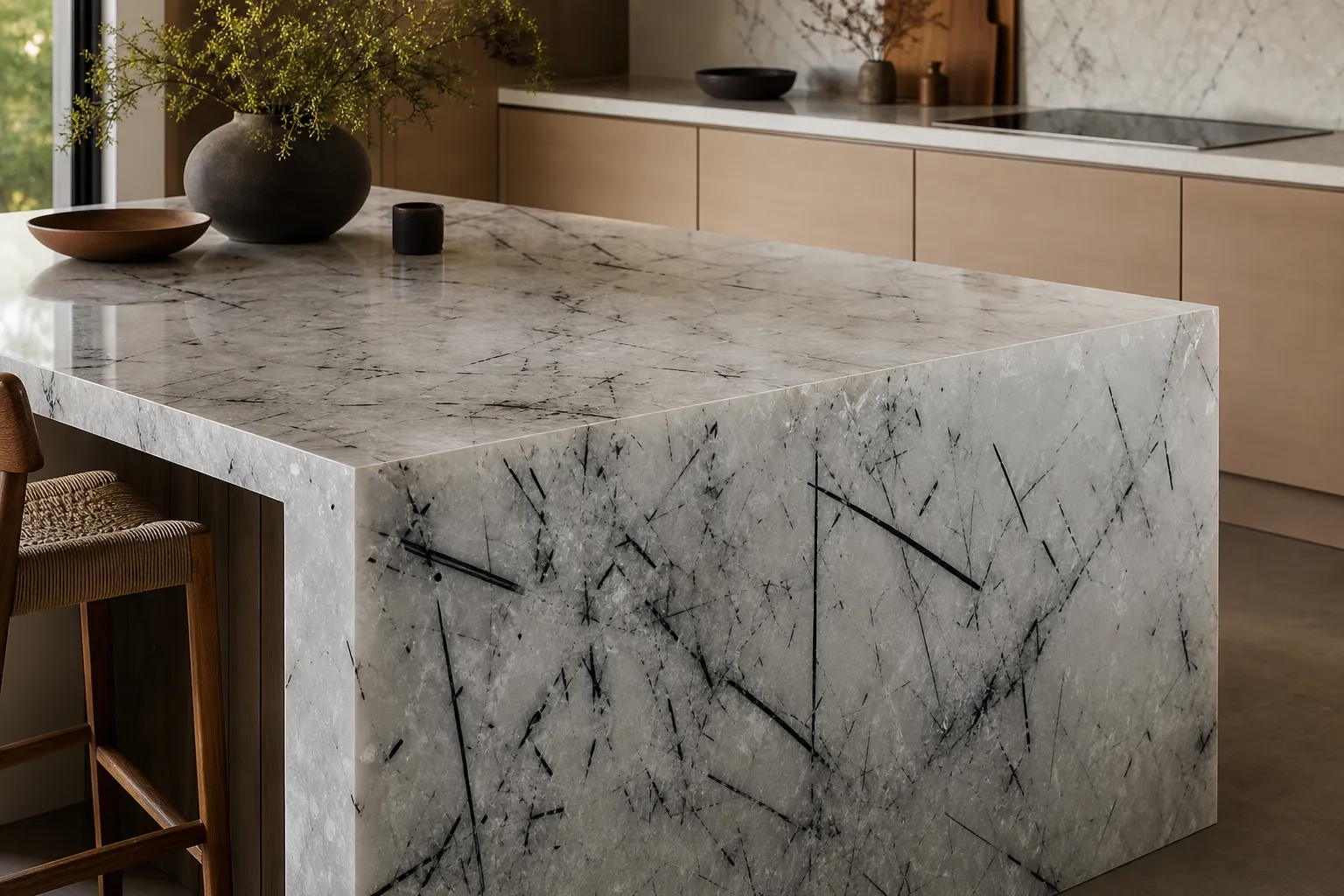
Tourmalinated Quartz Slabs are drawing attention in high-end kitchens because they offer a different version of luxury than marble. Marble is familiar: soft veining, classical movement, pale depth. Tourmalinated quartz is more geological. In a quartz body, dark tourmaline-related inclusions can appear as black needles, strokes, rods, or clustered lines, giving the slab a natural graphic character that does not look like a repeated marble pattern.
That is the short answer: Tourmalinated Quartz Slabs can move a kitchen “beyond marble” when the goal is not to imitate a classic stone, but to use a natural surface with sharper mineral contrast and slab-to-slab individuality. The case is aesthetic, not a universal performance claim. The right answer still depends on the actual slab, finish, lighting, fabrication plan, and how the kitchen will be used.
broader context
Start with the main black tourmaline page
This narrower page works best after the broader black tourmaline context page.
Why tourmalinated quartz reads differently from marble
Marble has an established design language. It often brings softness, historical association, and a sculptural quality to a room. Tourmalinated quartz works differently. Its visual strength comes from the contrast between the quartz host mineral and black tourmaline inclusions, often associated with schorl, a common black tourmaline species.
That shift changes the mood of the kitchen. Instead of cloudy veining or broad movement, the surface may show fine black lines, directional streaks, or mineral clusters suspended in the stone. From a distance, it can feel restrained. Up close, it reveals a more specimen-like complexity.
This is why the material fits many quiet luxury countertops: it has presence without relying on a loud color, heavy pattern, or high-gloss drama. A tourmalinated quartz island can feel calm in the room and still reward close viewing. A backsplash can read almost like a geological drawing. A waterfall edge can turn the black inclusions into architectural lines.
Still, “beyond marble” should be understood as a design argument, not a claim that tourmalinated quartz is automatically more durable, easier to maintain, more heat resistant, or better for every kitchen. Those questions require slab-specific information, finish details, fabrication quality, sealing expectations, and real use conditions.
The terminology matters before you specify a slab
The word “quartz” creates one of the most common misunderstandings in kitchen shopping. In this article, Tourmalinated Quartz Slabs means natural stone slabs understood as quartz with dark tourmaline-related inclusions. It does not mean resin-based engineered quartz countertops.
That distinction matters. Engineered quartz is a manufactured surface category. Natural tourmalinated quartz is selected as a stone slab, with all the variation, inspection needs, and fabrication considerations that come with natural stone.
The practical takeaway is simple: do not rely on the name alone. Ask the supplier or fabricator what the slab is, how it is identified, what finish it has, whether it has reinforcement or filled areas, and how it should be fabricated and maintained. Mineral references can support the basic quartz and schorl terminology, but they cannot verify every commercial slab sold under a showroom name.
It is also worth correcting another easy assumption: the black lines are not just “marble-style veining.” In genuine material terms, the appeal comes from black tourmaline inclusions in quartz. Because stone trade names can be broad, the safest design move is to inspect the exact slab rather than make decisions from a sample photo.
Where it works best in a high-end kitchen
Tourmalinated quartz is strongest when the design gives the inclusions enough room to be read. A small sample may look too busy, too sparse, or too abstract. At kitchen scale, the same marks can become the organizing feature of the room.
Kitchen islands
Kitchen islands are the most natural placement. A large horizontal surface lets the inclusions travel across the center of the space. In a minimal kitchen, that can make the island feel important without adding ornate cabinetry or strong color.
Waterfall edges
Waterfall edges can make the material feel more architectural. If the slab is laid out carefully, the inclusions may appear to continue from the countertop down the side panel. This effect depends on slab size, cut direction, seam planning, and fabrication skill; it should never be assumed from a single showroom image.
Backsplashes
Backsplashes are another strong use. Behind a range or along an open wall, tourmalinated quartz can add natural detail where a plain surface might feel too flat. In kitchens with flat-panel cabinetry, integrated appliances, and minimal hardware, the stone can provide the visual complexity.
For quieter interiors, the material may work better as a feature surface than on every plane. Dense, high-contrast inclusions can become visually crowded if used across countertops, backsplash, and island sides at once. Softer, milkier, or more sparsely marked slabs may tolerate broader use.
Pairing also matters. Warm white, pale oak, walnut, charcoal, plaster tones, brushed metal, and low-sheen finishes usually support the mineral character well. High-gloss cabinetry, busy tile, or competing stone patterns can fight with the black inclusions. The slab already brings a natural line; the rest of the kitchen should either soften it, echo it carefully, or stay quiet around it.
What to check before choosing Tourmalinated Quartz Slabs
The reason to choose tourmalinated quartz is visual specificity. The reason to slow down is the same: every slab is different.
Before specifying it for a kitchen, the useful question is not simply, “Is tourmalinated quartz luxurious?” It is, “Does this exact slab, in this finish, at this scale, work in this kitchen?”
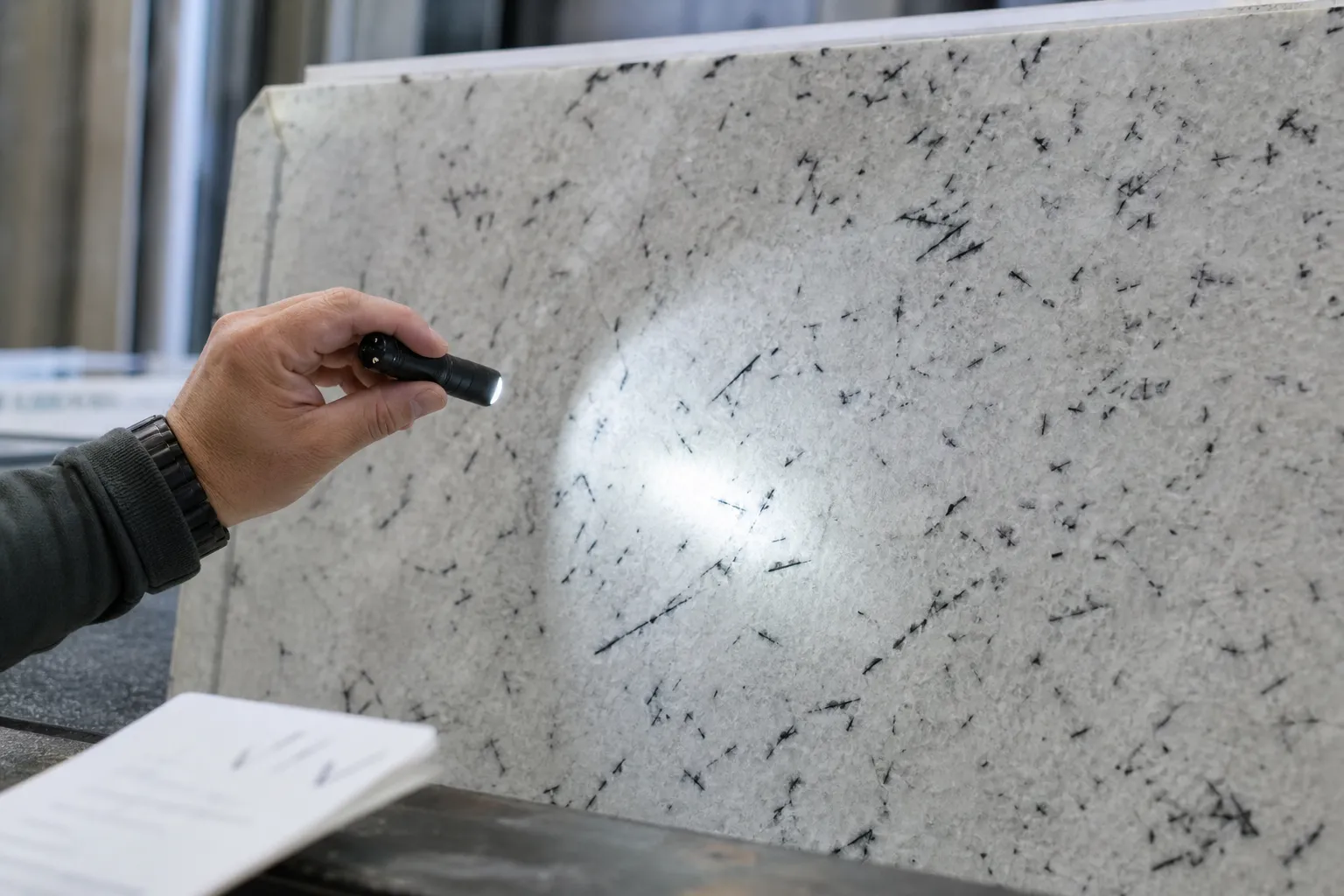
Look closely at these selection variables
- Inclusion density: Fine scattered needles can feel delicate; heavy clusters can feel dramatic or busy.
- Line direction: Long directional marks may suit an island run or waterfall edge; more chaotic inclusions may work better as a backsplash or feature panel.
- Background color: The quartz body may appear clear, smoky, white, gray, or milky, which changes the entire mood.
- Contrast level: Strong black-on-light contrast feels graphic; softer contrast is usually easier to live with visually.
- Natural fissures and filled areas: Some marks may be inclusions, while others may be cracks, fills, or structural concerns. A fabricator should evaluate this.
- Finish: Polished, honed, leathered, and other natural stone surface finishes change reflectivity, touch, and how strongly the inclusions appear.
- Lighting: Warehouse light, daylight, under-cabinet light, and grazing light can make the same slab read differently.
- Cut and edge plan: The same slab can look refined or fragmented depending on seams, edge profiles, openings, and layout.
General natural-stone guidance is useful here: appearance is only one part of selection. Finish, maintenance expectations, sealing approach, installation quality, and use habits all affect how a stone surface performs in a real kitchen.
If you are comparing tourmalinated quartz vs marble, keep the comparison grounded. Marble may be chosen for softness and tradition. Tourmalinated quartz may be chosen for sharper mineral contrast and a more geological decor language. Without project-specific technical data, it is not responsible to say one is universally easier, tougher, safer, or better.
A narrow but important safety boundary
There is one safety point worth keeping in view. Quartz-containing stone, when cut, ground, polished, or otherwise fabricated, can generate respirable crystalline silica dust. OSHA materials discuss this risk in countertop manufacturing, finishing, cutting, grinding, polishing, and installation contexts.
For a homeowner or design client, the practical boundary is clear: fabrication and installation should be handled by qualified professionals following applicable workplace safety requirements. Kitchen slabs require cutting, sink and cooktop openings, edge work, polishing, transport, and installation decisions that are not casual DIY tasks.
This safety context should not be stretched beyond what it supports. It does not mean an already installed tourmalinated quartz countertop creates the same exposure scenario during normal kitchen use. It also should not be used to claim that natural tourmalinated quartz is healthier than marble, granite, quartzite, engineered quartz, or any other surface. The issue belongs to dust-generating fabrication and installation work, not to a broad consumer health ranking.
The clearest reason to choose it
Tourmalinated quartz belongs in the high-end kitchen conversation because it makes the stone feel specific. It is not a generic white-and-gray surface. It is a quartz host with black tourmaline inclusions, irregular mineral movement, and a pattern that resists repetition.
That is the real “beyond marble” argument. Not that marble is over. Not that tourmalinated quartz is automatically superior. Rather, Tourmalinated Quartz Slabs give design-conscious kitchens another route to luxury: quieter than a showpiece color, more geological than a printed pattern, and more personal than a familiar marble look.
The strongest projects treat the slab with discipline. See it in person. Confirm what it is. Study the finish under realistic light. Decide whether the inclusions should lead the kitchen or remain an accent. Ask how maintenance, sealing, edge details, and installation will be handled.
When those conditions are met, Tourmalinated Quartz Slabs can make a kitchen feel less like a reference to luxury and more like a direct encounter with natural stone.