Why Scientific Validation Frameworks for EMF are Taking Over 2026
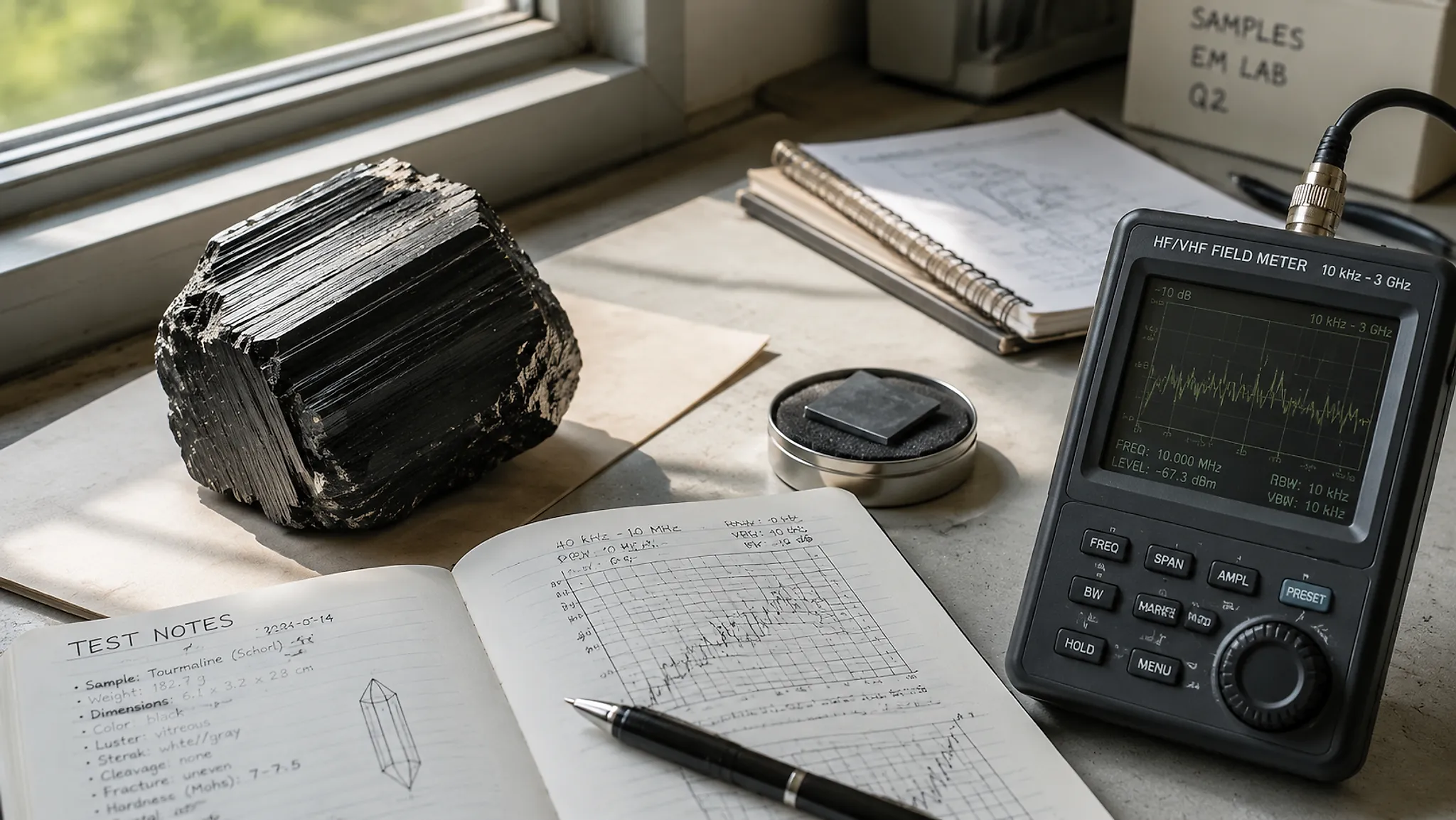
A piece of black tourmaline can sit on a desk with visible striations, weight, and mineral presence; that is a material fact. The larger claim that it changes electromagnetic exposure is a different kind of statement. That difference is why Scientific Validation Frameworks are taking over EMF conversations in 2026.
The direct answer: EMF claims are now judged through validation frameworks because broad protection language is no longer specific enough. A reader needs to know what was tested, at which electromagnetic frequencies, under what laboratory method, in which configuration, and whether the advertising claim stays inside the data. “Blocks EMF” may sound simple, but it can blend material shielding, device behavior, exposure-limit context, and health or wellness claims that require different kinds of support.
broader context
Start with the main black tourmaline page
This narrower page works best after the broader black tourmaline context page.
The shift is from protection language to testable claims
EMF is not one practical category. WHO materials describe electromagnetic fields across static fields, extremely low frequency fields, intermediate frequencies, and radiofrequency fields. A result tied to one frequency range does not automatically apply to another.
That is where validation frameworks become useful. They slow the claim down. Instead of asking whether something is broadly “protective,” they ask tighter questions: What type of field is being discussed? What metric was measured? Was the result produced through a defined laboratory method? Was the object tested as a flat material, a finished product, or a real-use arrangement?
This matters in a market where phrases such as “lab-backed,” “science-backed,” “patented,” or “blocks up to 99%” can sound stronger than the evidence behind them. Those phrases are not evidence by themselves. They are claims that need to be matched to data.
For a mineral-centered site, the boundary is familiar. Black tourmaline can be discussed as schorl, with observable crystal habit, surface texture, weight, and room placement. It can also carry symbolic or somatic grounding language in personal practice. But a measurable interference-shielding statement is not the same as a felt association or an interior design choice. Scientific validation frameworks keep those categories from collapsing into one another.
Four layers that marketing often blends
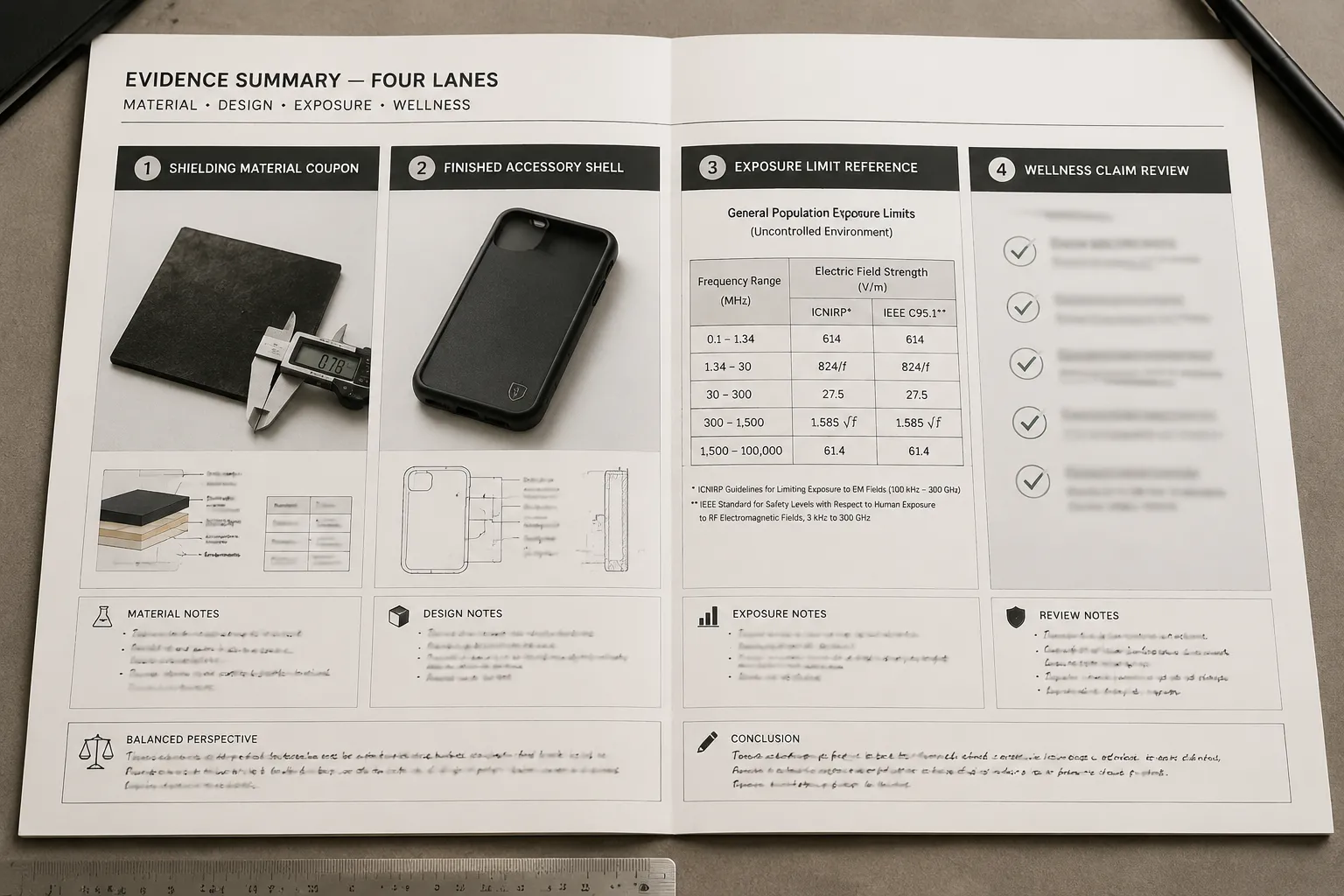
A useful 2026 framework separates EMF language into four layers. Many product descriptions move quickly between them, but the evidence standard changes at each step.
Material-level shielding performance
A material can be tested for electromagnetic shielding effectiveness under defined laboratory conditions. ASTM D4935 is a relevant example because it gives a standard method for measuring shielding effectiveness of planar materials. That kind of method can produce laboratory data, but its scope is limited to the tested material and tested setup.
Product or device-level behavior
A fabric, foil, composite, case, sticker, pendant, canopy, or room object may behave differently once it is shaped, interrupted by openings, placed near electronics, or used with a transmitting device. A flat material result does not automatically establish how a finished consumer product changes real-use exposure.
Exposure-boundary context
WHO and ICNIRP materials help explain frequency categories, evidence assessment, and exposure-limit frameworks. They do not, by themselves, validate a consumer product. A product can borrow the language of exposure limits without showing that its own configuration changes exposure in a documented way.
Health or wellness claim
This is the highest-risk layer. When advertising implies health, safety, or protective outcomes, the support has to fit that implied claim. The FTC’s health-products compliance guidance is not an EMF product manual, but it makes the substantiation principle clear: the evidence must match what ordinary readers are likely to take from the claim.
That separation is why “scientific validation” has become more than a reassuring phrase. It is a filter. Material data, device performance, exposure context, and advertised outcome each need their own evidence lane.
Laboratory data only helps when it can be read
Laboratory data is useful when the method and configuration are visible. A number without its test method is hard to interpret. A percentage without a frequency range is incomplete. A “tested” badge without the tested object, lab independence, and report detail leaves the reader with a slogan.
Practical verification points
- Which frequency range was tested?
- Was the claim about shielding effectiveness, interference shielding, exposure reduction, or a health or wellness outcome?
- Was the sample a planar material, a finished product, or a real-use arrangement?
- Was the laboratory method named clearly enough to understand its scope?
- Is a report or technical summary available, or only a marketing excerpt?
- Does the advertised claim match the tested configuration?
ASTM D4935 is useful because it shows what a defined laboratory method can look like for planar materials. It does not make every EMF claim valid. It shows that certain shielding measurements can be made under stated conditions. The stronger the advertising claim becomes, the more the evidence has to move beyond a general reference to testing.
A result that applies to a flat sample should not be casually presented as proof for a phone accessory, mineral specimen, pendant, room object, or whole-home arrangement. A result at one frequency should not become a blanket statement across all electromagnetic frequencies. A material measurement should not be turned into a wellness conclusion.
The framework does not reject laboratory methods. It keeps them attached to their actual scope.
Exposure limits are not product endorsements
A common misunderstanding is the relationship between exposure-limit frameworks and consumer EMF products. WHO and ICNIRP materials can help readers understand terminology, frequency categories, and public-health assessment. They do not validate a sticker, case, canopy, room layout, or mineral placement.
The distinction matters because exposure-limit language sounds authoritative. A product page can mention radiation, frequencies, shielding, or standards in a way that feels technical. Technical vocabulary is not the same as product-specific evidence.
Government radiation-protection cautions make the point more concrete. The German Federal Office for Radiation Protection has warned that so-called protective products against electrosmog may be unnecessary, unsuitable, unsupported, or unfavorable in some configurations. That does not mean every shielding material is meaningless. It means configuration matters, and a consumer claim should not be accepted just because it borrows the language of protection.
A phone-related example shows the issue. If an accessory blocks part of a signal in one direction, the device and network conditions may affect how the device behaves. The practical result depends on the phone, network, placement, and product design. Without configuration-specific testing, a broad statement about benefit is not well supported.
For black tourmaline, the same boundary keeps the discussion grounded. A specimen can be valued for mineral presence, interior placement, and symbolic use without claiming that it changes exposure levels. The observable object and the measurable EMF claim remain separate.
Why advertising substantiation now belongs in the discussion
Scientific validation frameworks are taking over because EMF claims are not only scientific statements. They are often advertising statements.
When a company says or implies that a product affects safety, wellness, or exposure, the evidence has to fit the claim that a reasonable reader would understand. “Lab-backed” is not enough if the test does not support the advertised takeaway. “Patented” is limited too; a patent can describe an invention without establishing the result suggested in marketing. “Science-backed” is meaningful only when the science is visible, relevant, and not stretched beyond the tested setting.
The more defensible 2026 language is narrower. A material might be described as tested for shielding effectiveness under a named method and frequency range. A finished product might be described only according to the configuration actually tested. A health or wellness claim should not be inferred from material testing alone.
This is less dramatic than protection marketing, but it is more useful. It gives the reader a way to sort language before trusting it.
What would change the answer?
The answer would change if strong product-level evidence became available: independent testing, clear laboratory methods, frequency-specific data, real-use configurations, and claims that match the results. For stronger health or wellness language, the evidence burden would be higher still, and the materials available for this page do not support those claims.
The answer also changes by category. A flat shielding fabric tested under a recognized method is not the same as a pendant, sticker, polished stone, phone case, architectural material, or room placement. A claim about electromagnetic shielding effectiveness is not the same as a claim about personal exposure reduction. A claim about exposure is not the same as a health or wellness outcome.
The practical rule is simple: trust the narrowest claim the data actually supports.
If the evidence only shows a material test, keep it at material level. If the evidence only names exposure limits, do not treat it as product endorsement. If the wording moves into wellness outcomes, look for claim-specific substantiation rather than borrowed technical language.
Common questions
Does scientific validation mean an EMF product works?
No. It means the claim should be checked against a defined framework: tested frequency range, test method, configuration, data transparency, and claim-match. A product can use scientific language and still overstate what its evidence shows.
Is a laboratory shielding test enough?
Only for the claim it actually supports. A planar-material shielding test can support a narrow statement about that material under that method and frequency range. It does not automatically support claims about a finished product, personal exposure, or wellness outcomes.
Do WHO or ICNIRP exposure materials approve EMF products?
No. Their materials help frame EMF terminology, frequency categories, evidence assessment, and exposure limits. They should not be read as endorsements of consumer accessories, minerals, room layouts, or wellness products.
The useful 2026 reading stance
Scientific validation frameworks are taking over EMF because the old language was too broad for the claims being made. Readers are being asked to evaluate laboratory data, electromagnetic frequencies, tested configurations, exposure-limit context, data interpretation, and advertising substantiation at the same time. A framework gives those pieces order.
The point is not to become alarmed or dismissive. It is to ask better questions before accepting a confident phrase. What was measured? Where was it measured? Which frequency category is involved? What does the test actually show? Does the product claim stay inside that result?
That stance also leaves room for black tourmaline to remain what can be observed: a dense schorl specimen, a dark vertical form, a textured mineral presence in a room, or a personal grounding object in non-medical language. It does not need unsupported EMF claims to have a place. Scientific validation simply keeps measurable protection language tied to measurable evidence.