Material-first screening
How to Spot Fake Schorl: Molded Glass vs Magmatic Reality
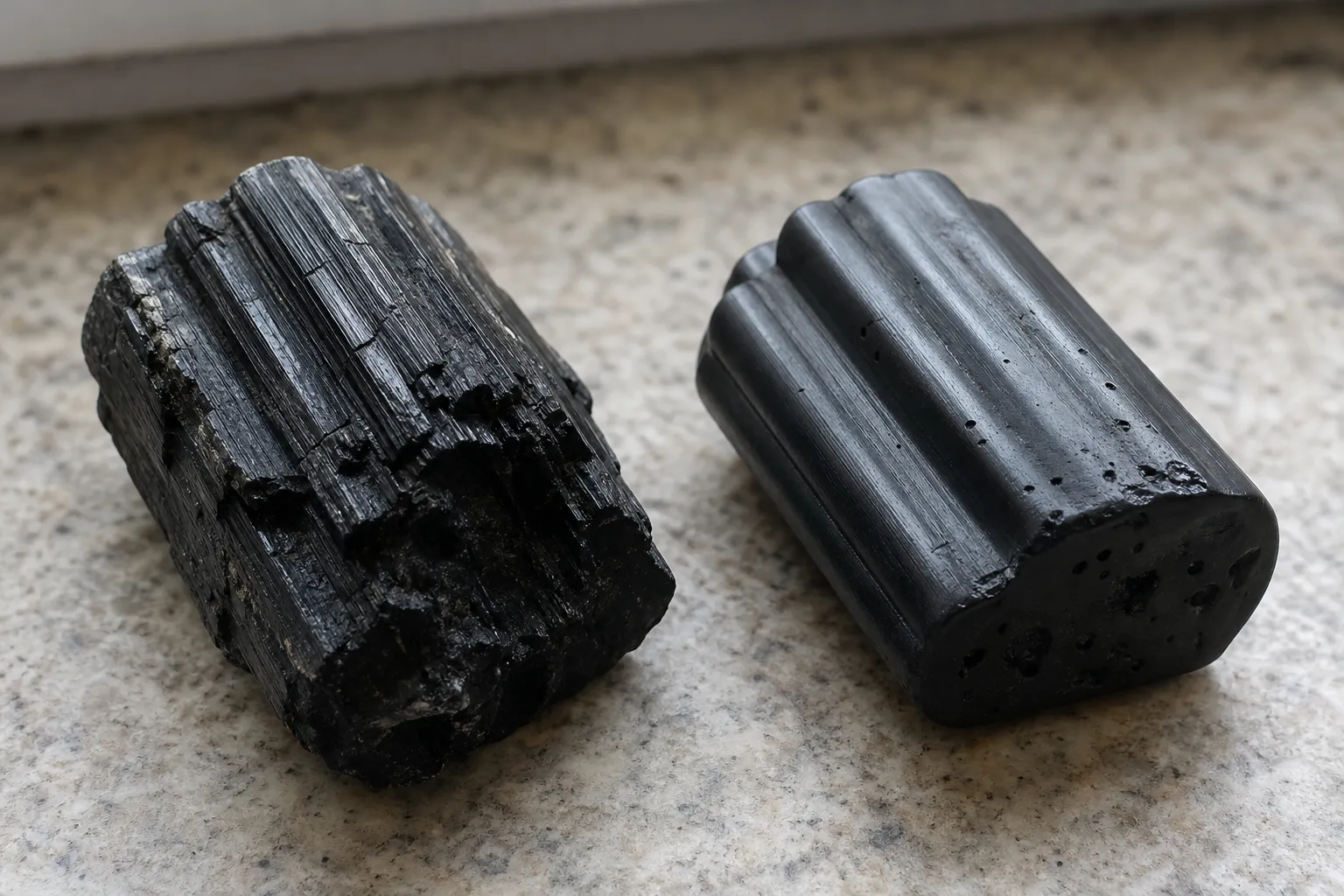
A black stone sold as Authentic Raw Black Tourmaline is more plausible as natural schorl when its shape, surface, and broken edges behave like a mineral rather than a molded object. Look for irregular prismatic form, lengthwise striations, uneven terminations, angular chips, and texture that continues through the piece instead of sitting on the outside like decoration.
A likely molded glass imitation may show repeated shapes, softened seams, rounded bases, bubble-like voids, or staged “ice cracks” that look more designed than geological. Still, home observation is only a screening pass. Color, cold touch, shine, and weight feel cannot authenticate schorl by themselves; they only help you decide whether the label deserves more trust or more caution.
broader context
Broader schorl guide
This narrower page works best after the broader black tourmaline context page.
What Natural Schorl Should Suggest
Schorl is the black tourmaline species most buyers mean when they say raw black tourmaline. Mineral references describe it as a tourmaline-group mineral with a trigonal crystal system, uneven to conchoidal fracture, vitreous to resinous luster, and hardness commonly listed around 7 to 7.5 on the Mohs scale. Those facts matter because they give the material a structure; molded glass can copy a look, but it does not grow as schorl.
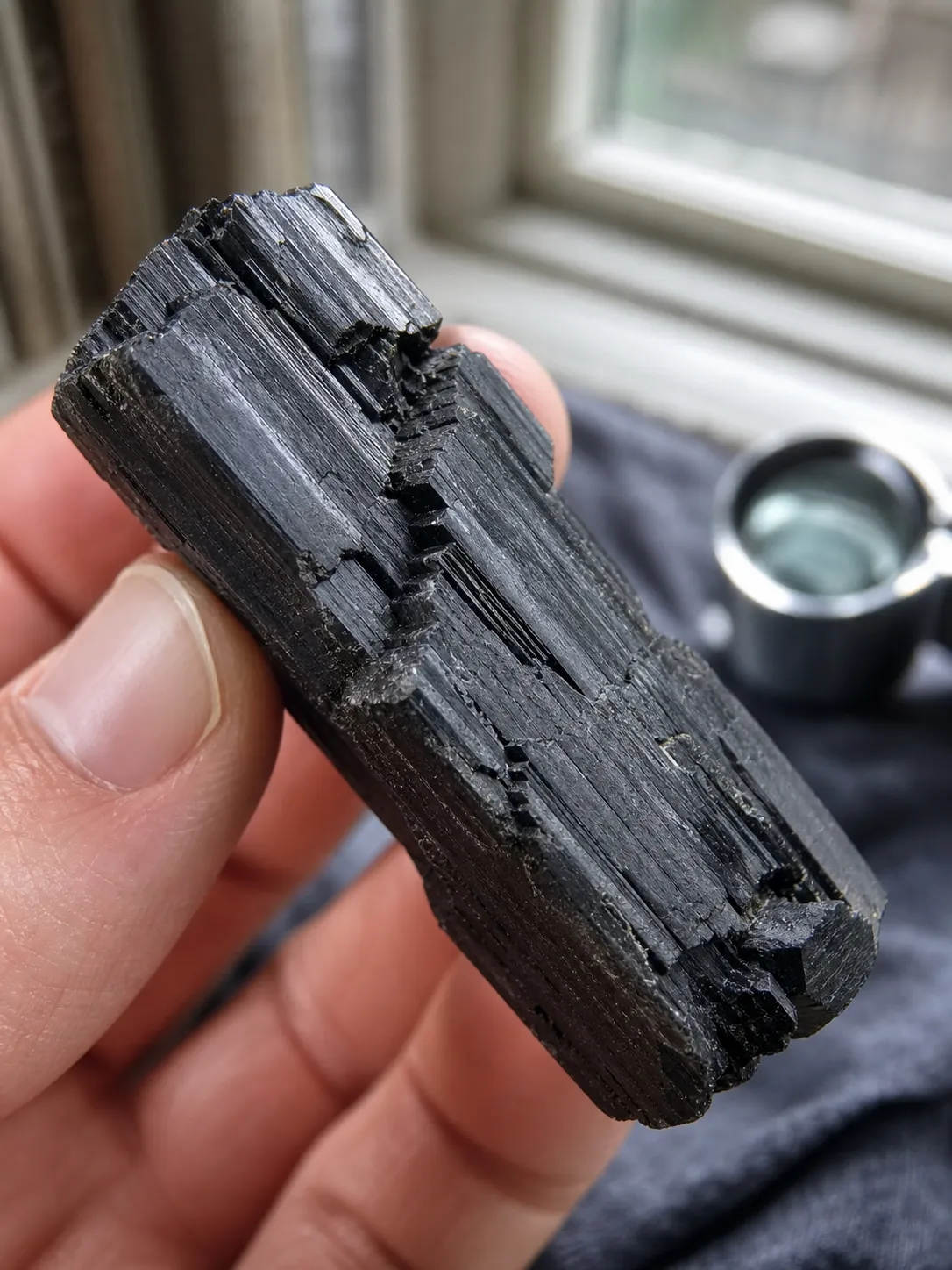
In practical inspection language, natural schorl often looks directional. It may appear as long prismatic crystals, column-like fragments, sprays, or broken pieces with ridges running along the length. Those ridges, usually called striations, are useful because they connect to crystal habit rather than to shop language. They do not prove authenticity on their own, but they make more mineral sense than a smooth black lump with applied drama.
Raw schorl also does not need to look tidy. A real specimen may be chipped, splintered, terminated at one end, broken across the grain, attached to matrix, dull in recesses, or shinier on worn high points. “Rough” alone is not enough, because glass can be etched, tumbled, chipped, or coated. The better question is whether the roughness follows believable structure.
Molded Glass Cues Worth Slowing Down For
“Molded imitation” is a buyer-friendly phrase, not a formal mineral category. It usually means a black object made to resemble raw schorl through color, shine, shape, or crack-like decoration. Because public reference sources support schorl’s mineral properties more clearly than they support any single home fake-spotting rule, treat these cues as warnings rather than verdicts.
Be cautious when several pieces in a tray or listing seem nearly identical. Natural schorl crystals can share a general habit, but they usually do not repeat the same softened peak, rounded base, side texture, or “raw” outline. Repetition can suggest a form made for appearance rather than a specimen collected as a natural crystal.
Surface texture matters most when it has no mineral logic. Schorl can be shiny, so gloss alone is not the issue. The concern is a poured or pressed-looking surface with no striations, no angular variation, no convincing fracture, and no relationship between exterior texture and broken edges.
Bubble-like features can also raise suspicion, especially when they are round, isolated, and trapped inside a glassy black body. Natural minerals can have inclusions and fractures, so this is not a simple rule. But rounded air-bubble patterns fit manufactured glass more comfortably than they fit schorl crystal habit.
Edges often tell more than the front view. A molded object may have softened ridges, seam-like lines, or a skin-like exterior wrapping the form. Broken raw schorl more often shows angular chips, uneven fracture, and structure that continues into the piece. If the “raw” effect appears only on the outside, treat it as a caution flag.
Ice Cracks, Cold Touch, Gloss, and Weight
Ice cracks
Black tourmaline “ice cracks” do not prove a stone is real. The phrase is market language for internal-looking crack patterns, not a dependable mineral identification method. Natural schorl can show fractures, breaks, and internal-looking features, but crack-like effects can also be created, exaggerated, or confused with glass texture.
Ask whether the cracks behave like part of the material. Do they connect to broken edges, crystal direction, or natural stress lines? Or do they look evenly staged for visual effect? Even then, the answer remains a clue, not confirmation.
Cold touch
The cold touch test is also weak. Many dense or smooth objects feel cool at first because they pull heat from the skin. Glass, stone, and other materials can all feel cool in the same room, while sunlight, storage, warm hands, and room temperature change the sensation. Cold touch may describe the moment; it does not confirm raw schorl identity.
Gloss
Gloss has a similar limit. Schorl can have vitreous to resinous luster, so a shiny black surface is not automatically fake. A dull surface is not automatically natural. Polishing, handling, oil, coatings, dust, and lighting can change how black stones appear, especially in high-contrast photos.
Weight feel
Weight feel belongs in the same modest category. Schorl has a measurable density range in mineral data, but hand-feel comparison is imprecise unless size, shape, and material are known. A small piece of dense glass can feel convincing; a fractured natural specimen may feel lighter than expected.
A Practical Screening Pass
Start with the seller’s label, then return to the object. If the claim is Authentic Raw Black Tourmaline, the material question is schorl. The piece does not become more credible because it is black, dramatic, or pleasant to hold. It becomes more credible when visible structure fits raw schorl better than molded glass.
Use this short pass before you trust the label:
- Shape: Does the piece look naturally irregular, or repeated, softened, and cast from a pattern?
- Structure: Are there lengthwise striations, prismatic direction, angular breaks, or crystal habit?
- Surface: Does the texture vary with ridges, chips, and fractures, or does it look like a decorative skin?
- Edges: Do broken areas show mineral-like fracture, or do they look rounded, melted, or molded?
- Batch comparison: Do nearby pieces look individually formed, or are many nearly identical?
- Claim language: Does the listing rely on cold touch, ice cracks, or vague effect-based wording instead of material description?
A specimen that passes several of these checks is more plausible, not automatically authenticated. A piece that fails several deserves caution, especially if the listing has no locality, no scale, poor photos, and no clear return path.
Photographs need extra restraint. Black minerals are hard to judge online because shadows hide structure and highlights exaggerate gloss. Ask for daylight images from more than one angle, including a side view and a close look at any broken edge or termination. Front-facing glamour images may not give enough information.
Avoid casual scratch or break tests. Schorl hardness is a real mineral property, but damaging an unknown object can create misleading results and ruin the specimen. If certainty matters, direct mineral or gemological identification is the cleaner route.
What Could Change the Answer
A rough, black, striated specimen is more consistent with raw schorl, but exceptions remain. Natural tourmaline can be broken, dusty, partly polished by handling, attached to other minerals, or photographed badly. Some authentic pieces do not show textbook crystal shape.
The reverse is also true. A fake black tourmaline object can be rough, dark, shiny, cracked, and heavy enough to seem convincing. It may borrow the mood of schorl without matching its mineral structure. Single-cue judgments fail because imitation usually targets the easiest cues: color, shine, cracks, and drama.
Black color adds another limit. Other black minerals, dyed materials, slag-like materials, and manufactured objects can sit in the same visual category for a buyer. Tourmaline is a varied mineral group, so identity should not be reduced to color or surface appearance.
The honest home conclusion is probabilistic. You can say a piece looks consistent with raw schorl, or that it shows molded imitation cues. You should not claim certainty from a countertop inspection unless the material has been identified through appropriate methods.
When Identification Is Worth It
Professional mineral identification is worth considering when the piece is expensive, rare-looking, sold with a specific locality, used in a design project where material accuracy matters, or purchased as a meaningful personal object. It also matters when the seller’s claim is strong but the visible evidence is thin.
An identification route may involve direct examination, magnification, refractive or physical-property testing, or other methods chosen by a mineral or gem professional. Not every small raw stone needs a report. The point is simpler: home checks screen plausibility; they do not replace identification.
For everyday buying, prefer clear photos, transparent material language, reasonable return terms, and sellers who can answer basic questions without leaning on cold touch or ice-crack claims. If a listing makes authenticity feel urgent, mystical, or beyond question, slow down. The stone should be able to meet ordinary material scrutiny.
Short Answers to Common Buyer Questions
Do ice cracks prove black tourmaline is real?
No. Crack-like patterns can appear in natural material, but “ice cracks” is not a dependable schorl test. Treat them as a visual feature, not proof.
Is real black tourmaline always cold to the touch?
No. Cold touch depends on the object, the room, and your hand. Glass and stone can both feel cool, so this test is too weak to authenticate a specimen.
Can I identify authentic raw black tourmaline at home?
You can screen for plausibility, not certainty. Natural-looking striations, irregular crystal habit, angular fracture, and non-repeated form support a schorl interpretation. Overly uniform shapes, rounded molded edges, bubble-like voids, and staged surface effects raise caution. For certainty, use appropriate mineral identification.
A good fake-spotting habit is quiet and material-first: study the structure before the story. Schorl is a mineral with habit, fracture, luster, and density; a molded glass imitation is trying to borrow that appearance. At home, the best answer is a careful likelihood, not a final certificate.