Sourcing Screen
How to Spot Fake or Dyed Black Tourmaline Before Sourcing
A ribbed black specimen can look convincing in a listing photo, especially when the seller leans on words like natural, raw, or genuine. The practical answer is narrower: identifying un-dyed raw schorl before sourcing is a screening task, not final authentication.
Before buying, look for weak evidence rather than one dramatic sign. Question overly even color, slick or coated-looking crevices, “raw” pieces with unclear surface preparation, limited photos, mixed product language, missing treatment disclosure, and sellers who answer precise questions with reassurance instead of details. These cues can help you reject a poorly supported listing; they do not prove that a specimen is un-dyed schorl.
If the claim affects price, resale, collection value, or a larger design order, keep the boundary simple: visual screening can guide a buying decision, but gemological confirmation is needed when the answer must carry more weight.
broader context
Black tourmaline context note
This narrower page works best after the broader black tourmaline context page.
What You Can Reasonably Check Before Buying
Your strongest pre-sourcing tools are observation, supplier questions, and restraint around certainty. Raw schorl identification is difficult from photos alone because black surfaces hide detail, lighting can flatten texture, and marketplace language often stretches the word authentic.
Start with the listing. A stronger listing shows the actual specimen or batch from more than one angle, includes close surface views, and separates material description from mood language. A single high-contrast image, a vague “black crystal” label, or a description built mostly around decorative or symbolic appeal is not proof of a problem. It means the evidence is thin.
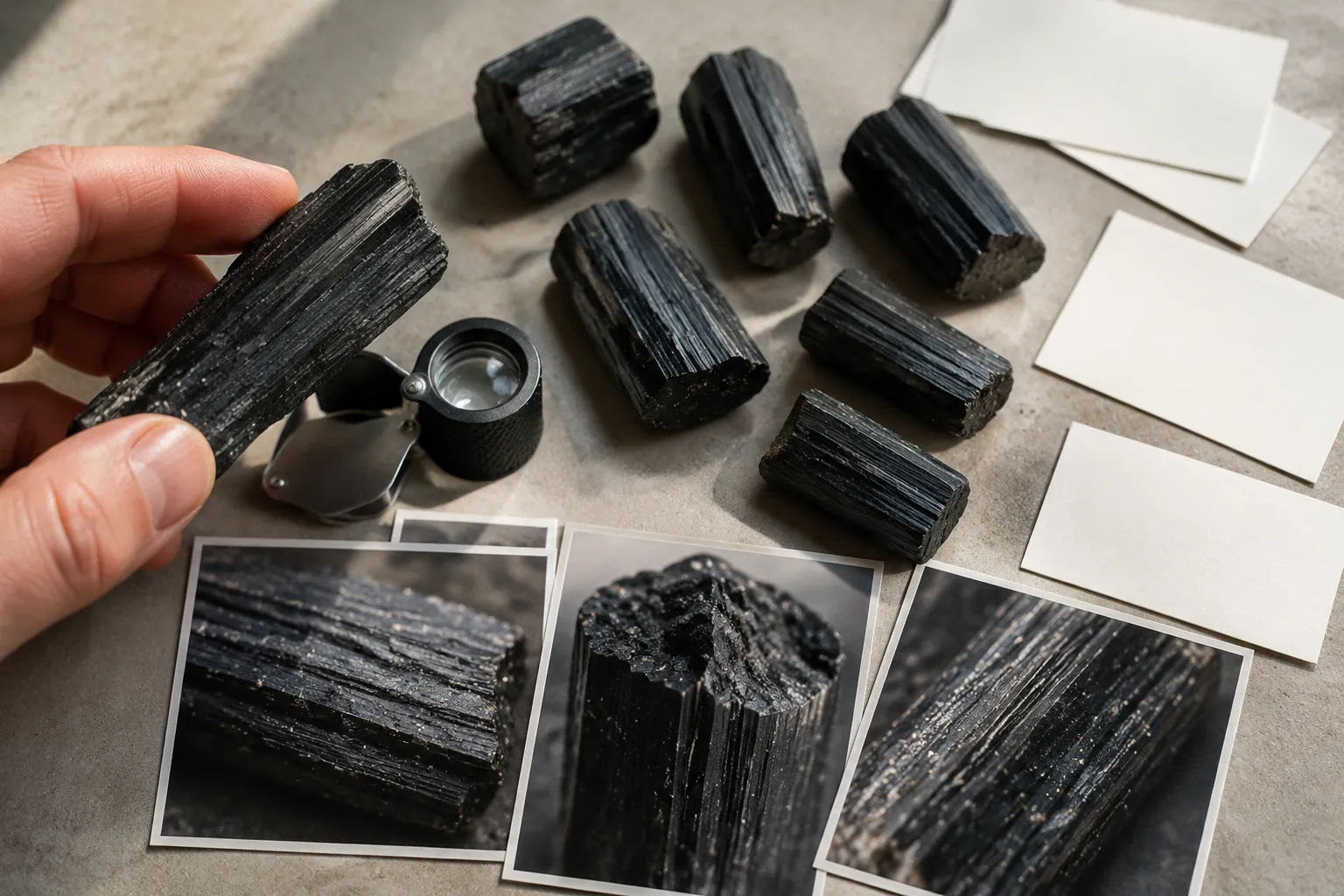
Look at color across the piece. Raw black tourmaline often reads dark overall, but useful photos may still show variation in edges, fractures, raised areas, attached matrix, dust, or shadow. A surface that looks uniformly coated across every break, groove, and crevice deserves a follow-up question. Treat that as a red flag, not a verdict.
Check how the seller uses “raw.” A raw specimen should not be presented as untouched if the visible surfaces look heavily polished, sealed, coated, or artificially darkened. Polished black tourmaline can be legitimate, but polished and raw are different buying expectations. If the preparation is unclear, ask before sourcing.
Batch sameness is another useful signal. If dozens of pieces look unusually identical in color, shine, size, and texture, the lot may still contain real mineral material, but the listing gives you less to evaluate. Ask whether the photos show the exact pieces being supplied and whether the batch has natural variation.
The most honest early conclusion is modest: “consistent enough to keep asking,” or “not enough visible evidence to buy with confidence.”
Red Flags That Deserve Supplier Questions
A red flag is not proof of dye, imitation, or mislabeling. It is a reason to slow down before money moves.
Absolute wording
Phrases like “100% real,” “guaranteed natural,” or “authentic black tourmaline test passed” sound decisive, but they do not replace treatment disclosure, lot details, or independent confirmation. If the seller cannot explain what the claim is based on, the wording is marketing, not sourcing evidence.
Avoided detail
Photos that avoid edges, fractures, terminations, contact points, and any matrix are less useful than close surface views. For dyed crystals vs natural material, this page does not support a single visual rule that proves dye. The practical move is to request clearer images before purchase.
Mixed product language
A listing may use black tourmaline, schorl, raw crystal, tumbled stone, protection stone, and decorative stone in the same description. Some of that is ordinary marketplace shorthand, but it can blur whether you are buying raw schorl, polished tourmaline, another dark mineral, or a treated decorative piece.
Claims stronger than evidence
This article cannot set fair market value or verify origin risk, but the sourcing logic is plain: the stronger the seller’s claim, the stronger the supporting detail should be. High-certainty language with low-detail photos is a reason to pause.
Questions to Ask Before Sourcing Raw Schorl
A useful supplier question asks for specific information, not a performance of expertise. Keep the tone calm and factual; the goal is to reveal what can be supported.
Ask before buying
- Is this sold specifically as schorl, black tourmaline, or a mixed black mineral lot?
- Are the photos of the exact specimen or exact batch being shipped?
- Has the material been dyed, coated, oiled, sealed, stabilized, or otherwise surface-treated?
- Is the piece raw, polished, partly polished, or cleaned after extraction?
- Can you provide close photos of broken edges, surface texture, terminations, and any matrix?
- Do you have supplier documentation, a lab report, an invoice trail, or treatment disclosure for this lot?
- For volume sourcing, can you show natural variation across the batch?
Do not ask only, “Is it real?” That question invites a yes-or-no answer without detail. For some sellers, real may simply mean “not plastic.” For identifying un-dyed raw schorl, the question is narrower: mineral identity, treatment status, surface condition, and whether the seller can connect the claim to the specific lot.
Documentation has limits. A document can be generic, incomplete, or disconnected from the specimen being shipped. Still, a supplier who can explain the chain of representation is easier to assess than one who offers only confidence language. If documentation matters to the purchase, ask before payment.
If the seller refuses ordinary questions, rushes the decision, or treats treatment disclosure as irrelevant, you do not need proof of a problem to walk away.
Why Home-Test Lore Should Not Decide the Purchase
Searches for an authentic black tourmaline test often lead buyers toward rubbing, scraping, heating, solvent checks, streak checks, or other quick trials. The available material for this page does not provide safety-aware, credible support for using those methods to confirm un-dyed raw schorl, so this article does not present them as recommended or reliable.
The problem is not only handling risk. A home check can be misread, damage the specimen, or create false confidence. A surface mark, color transfer, scratch, smell, or reaction may have more than one explanation. Without qualified testing, it should not carry the final answer.
Destructive checks are especially poor fit for pre-sourcing. If you have not bought the piece, you usually cannot perform them. If you have bought it, damage may reduce value while still failing to answer the exact treatment question. Even a seller’s video may not show the exact item or batch being shipped.
This does not mean all testing is useless. It means the decision route is different: use non-destructive screening before purchase, then move to qualified gemological or laboratory evaluation when the claim needs confirmation.
What Visual Screening Cannot Prove
Visual screening has hard limits. A black specimen can look plausible and still be mislabeled, treated, or weakly documented. A suspicious-looking piece can also be poorly photographed, wet, dusty, partly polished, or shown under lighting that exaggerates shine.
Surface structure has the same boundary. Striations, fractures, luster, crystal habit, and weight can be useful parts of a material conversation, but this page does not have the source support to turn those features into proof of identity or treatment status. They can support better questioning; they cannot certify the claim.
Color is fragile on a screen. Camera exposure, editing, wetting, dust, display settings, and background color can all change how black material appears. Daylight images, close-ups, and unedited batch photos improve screening, but they do not replace confirmation.
For interiors and somatic grounding contexts, keep two ideas separate. A piece may matter in a room because of mass, texture, placement, and personal ritual. That felt use does not verify mineral identity. Material evidence and meaning should not be asked to do the same job.
The clearest rule: visual cues can help you reject weak listings; they cannot certify strong ones.
When to Walk Away
Walking away is part of careful sourcing, not suspicion for its own sake. If the seller cannot show the actual specimen, explain treatment status, or provide meaningful support for a high-certainty claim, you have enough reason to pause or decline.
Walk away when the claim depends on trust alone. Natural, genuine, and un-dyed are material claims; they should be supported by more than urgency, mood, or decorative appeal. A calm supplier should be able to answer basic questions without pressure.
Walk away when the listing sounds more certain than the evidence allows. If the title promises authenticity but the description is generic, the photos are limited, and the supplier avoids specifics, the issue is not only that the specimen may be fake or dyed. The issue is that you cannot evaluate the claim responsibly.
Also match the evidence threshold to the purchase. For a small personal object, you may decide that appearance is enough as long as you do not repeat unsupported authenticity claims. For resale, collection, volume sourcing, or higher-value design work, require stronger support before you rely on the label.
A Short Buyer Checklist
Use this as a pre-purchase filter, not a lab substitute.
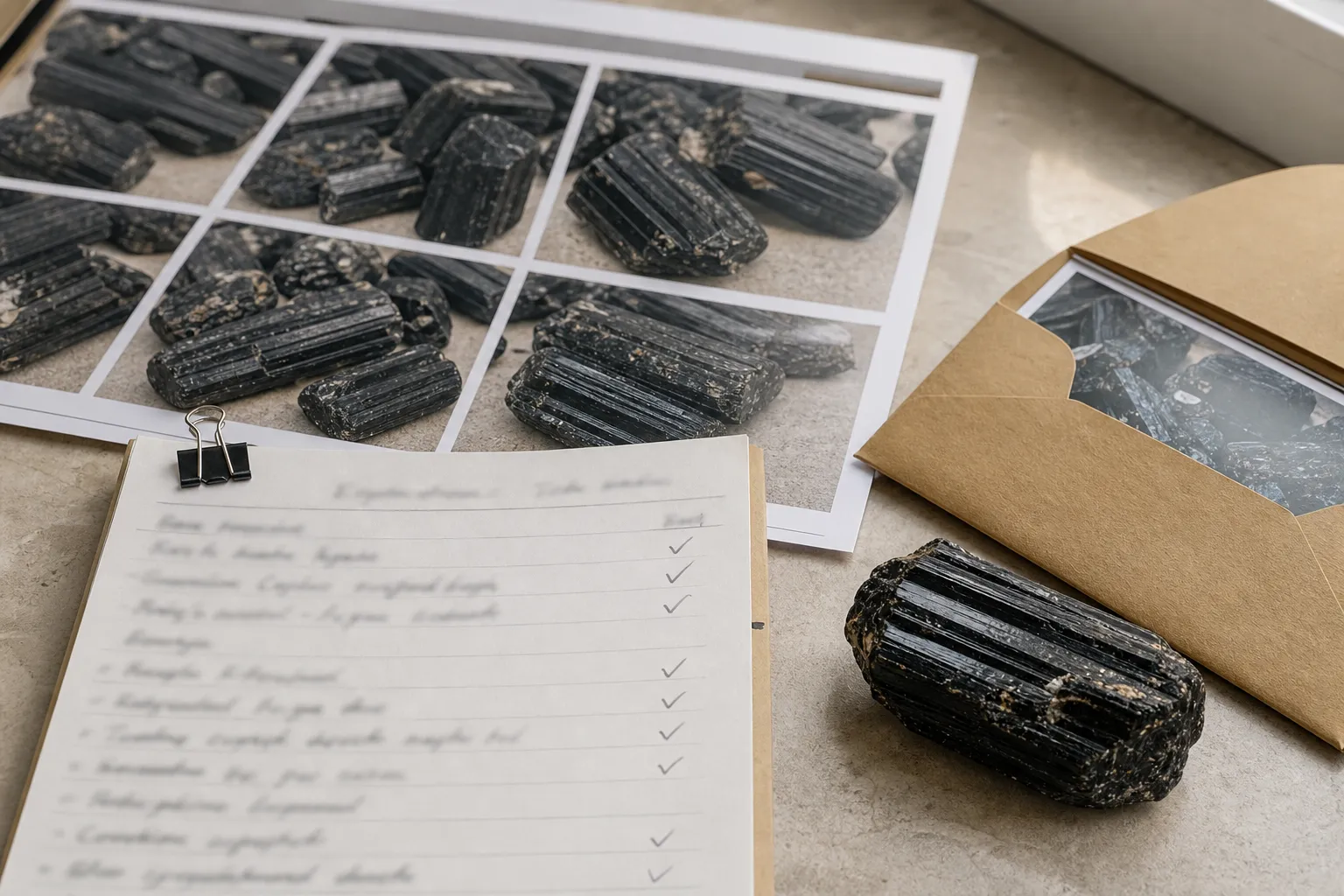
- The seller shows the exact specimen or exact batch, not only generic stock images.
- Photos include close views of surfaces, edges, fractures, and any matrix.
- The listing separates raw, polished, treated, and decorative language clearly.
- Treatment questions receive direct answers, not only reassurance.
- Any documentation is tied to the lot or specimen, not just the seller’s reputation.
- The seller avoids claims that outrun the evidence shown.
- You know whether you are buying for appearance, personal placement, resale, or confirmed mineral identity.
If several boxes fail, the most useful conclusion is not “fake.” It is “insufficient evidence.” From there, you can ask for more information, reduce the purchase risk, choose another supplier, or reserve final identity claims for qualified confirmation.
The Bottom Line Before Sourcing
To spot fake or dyed black tourmaline before sourcing, look for evidence gaps: uniform or coated-looking surfaces, unclear preparation, limited photos, mixed terminology, absolute promises, and missing treatment disclosure. These are practical screening cues for likely un-dyed raw schorl, not definitive authentication.
Ask better questions before purchase, especially when the claim affects value. If the answer needs to be more than a buying hunch, seek gemological confirmation. Black tourmaline can still hold a place in a room by texture, weight, and presence; the sourcing claim should stay tied to what can actually be shown.