Material answer
The Truth About Brittle Schorl: Why Raw Tourmaline Easily Breaks
A raw black tourmaline point can look dense, dark, and sturdy, then snap at a thin edge or split along a weakness that was already there. The direct answer is narrow but useful: raw schorl can behave like a Brittle Mineral, so breakage does not automatically mean the specimen is fake, poorly handled, or low quality.
The better explanation is usually a combination of mineral behavior and form. Raw tourmaline breaks when brittleness, crystal shape, small flaws, and pressure meet in the wrong place. Because the available source pack for this page does not include public, verifiable mineralogy or lapidary references, this article keeps the conclusion conservative rather than treating every broken specimen as proof of one cause.
broader context
Broader schorl guide
This narrower page works best after the broader black tourmaline context page.
Why Raw Tourmaline Breaks Even When It Is Real
The confusion starts with a visual mismatch. Black tourmaline often feels weighty in the hand, and its dark surface can read as strong. But “hard” and “brittle” are not the same thing.
Hardness usually describes resistance to scratching. Brittleness describes how a material behaves when force moves through it. A brittle mineral may not bend or compress much before it breaks. If stress concentrates at a thin point, chipped ridge, narrow column, or existing crack, the specimen may fracture instead of absorbing the impact.
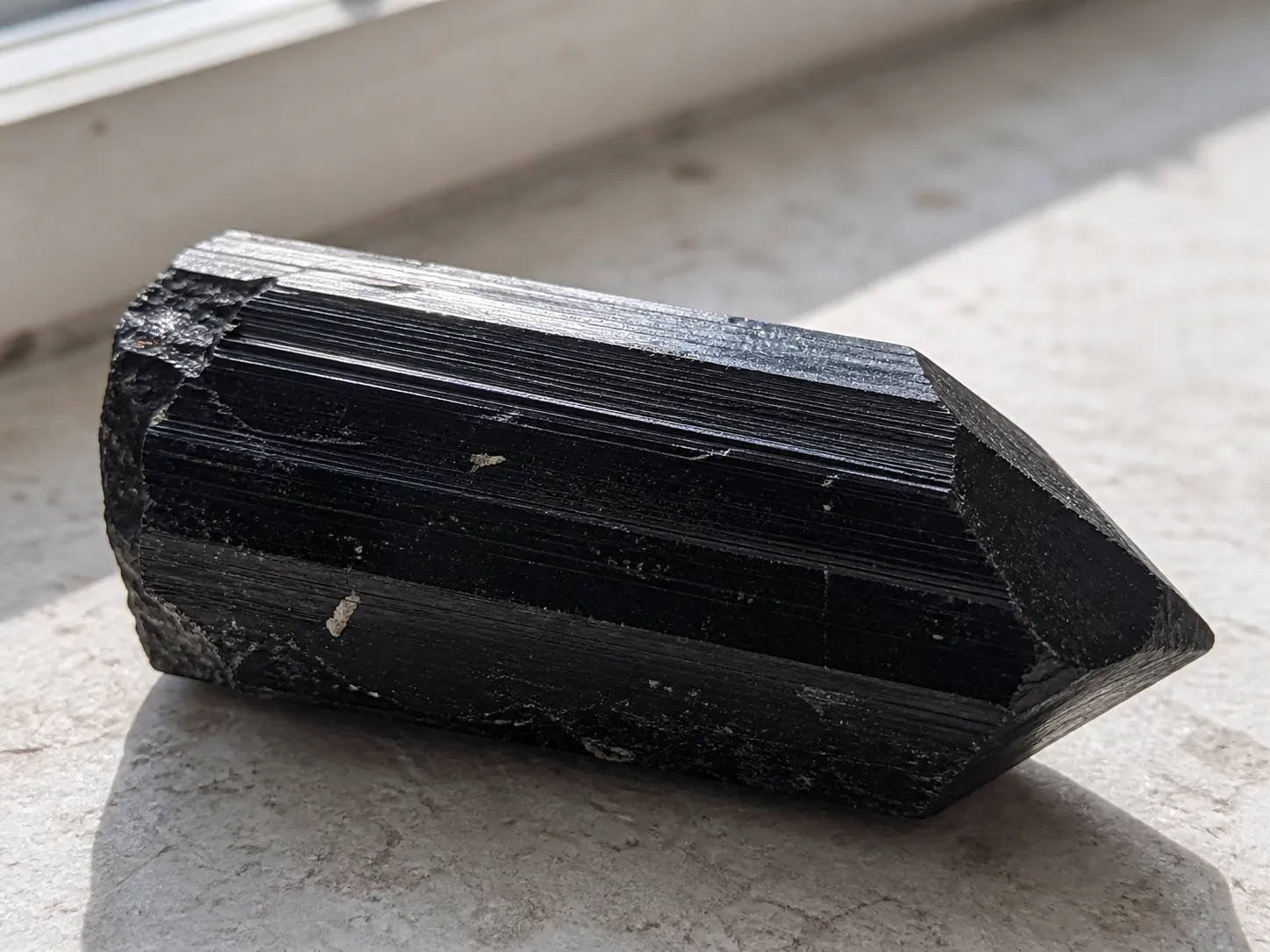
Shape matters here. Many raw schorl pieces are elongated, striated crystals or fragments of those crystals. A thick base may sit quietly on a shelf, while a thinner termination or side ridge remains vulnerable. That is why tourmaline breakage should be read first as a material clue, not a verdict.
A broken edge can happen in genuine raw material. It can also happen during extraction, sorting, packing, shipping, display, or home handling. Without a reliable source history or direct identification work, the break alone cannot prove authenticity, fraud, grade, or carelessness.
Brittle Is Not the Same as Low Quality
“Brittle schorl tourmaline” often gets mistaken for a value judgment. In mineral language, brittle is a behavior under stress; it does not simply mean cheap, fake, weak, or ruined.
A specimen may be visually strong, naturally formed, and still fragile in certain zones. Another piece may be less dramatic but more stable because it is compact, less fractured, or supported by a broader base. Mineral identity, surface beauty, structural condition, and display durability are related, but they are not one score.
Reader concern
What it may mean
What it does not prove by itself
A point snapped
Force found a weak area
The specimen is fake
A side chipped
An edge or ridge was vulnerable
The whole piece is worthless
A crystal split
A flaw or stress path may have opened
The seller necessarily mishandled it
Small fragments shed
The surface may be fractured or crumbly
The material is automatically synthetic
Use this as a sorting tool, not a lab conclusion. A broken raw specimen needs context: where it broke, whether the break follows an old seam, how thin that section was, how it was packed, and whether the rest of the surface, weight, habit, and striations remain consistent.
Cleavage, Fracture, and the Break Surface
Two useful words often appear around mineral breakage: cleavage and fracture. Cleavage describes a tendency to split along certain structural directions. Fracture describes breakage that does not follow a clean cleavage plane. Some mineral descriptions also use terms such as subconchoidal fractures for curved or shell-like break surfaces.
For this page, the vocabulary helps with observation, not certainty. The supplied material does not include a verifiable source confirming the exact cleavage and fracture behavior of schorl. So it would be too strong to diagnose every black tourmaline break from a photo or a single chipped edge.
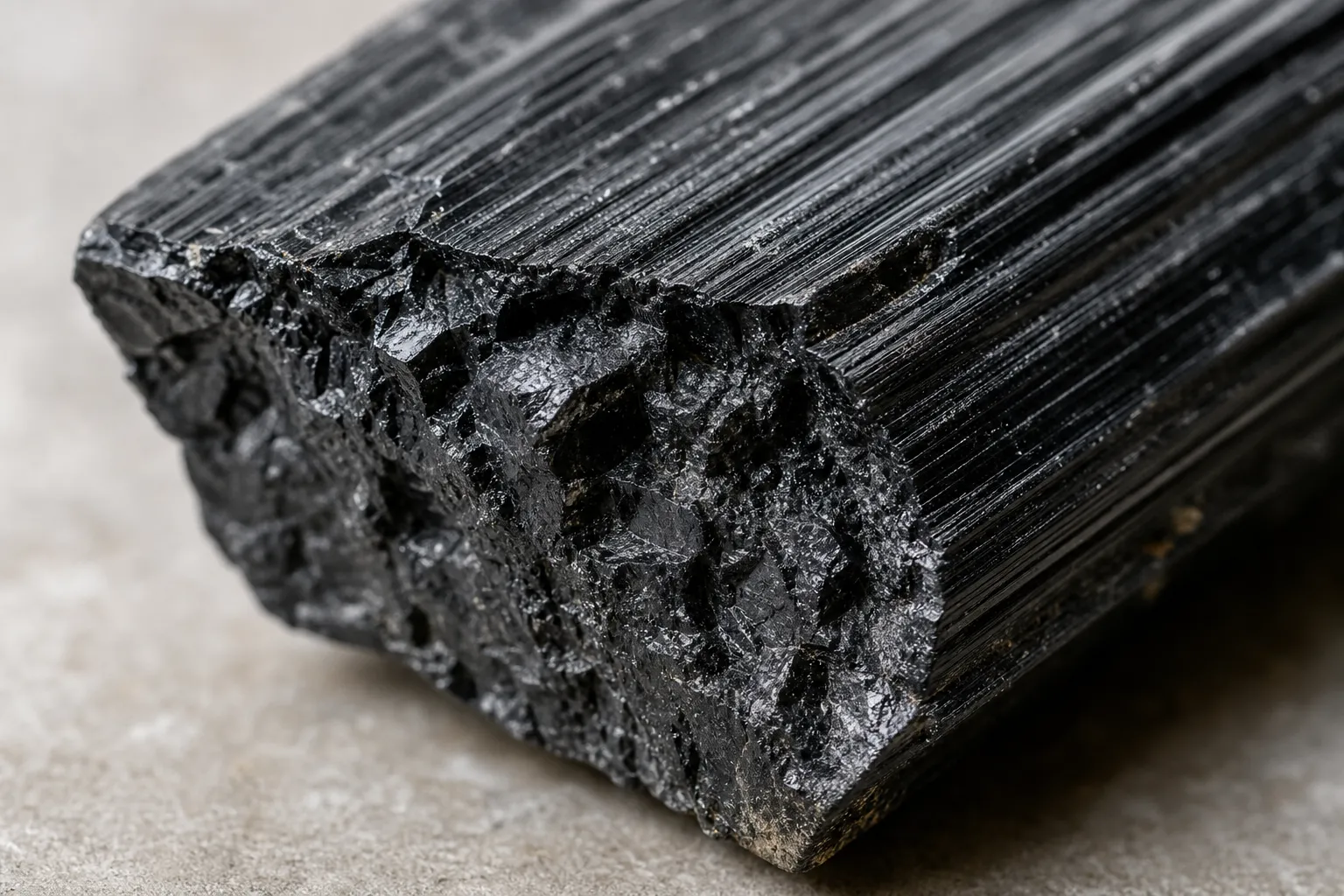
What you can do is look more carefully. A fresh break may show a texture different from the older outer surface. A split may travel through a thin point, across a column, or around a pre-existing flaw. A chipped area may look granular, uneven, glassy, curved, or stepped.
Those details can help you describe the piece if you later ask a mineral dealer, lapidary worker, or geology-informed source to look at it. They do not turn a break face into a full identity test. The safest conclusion from breakage alone is limited: stress reached a vulnerable place.
Micro-Fractures and Pre-Existing Flaws
Raw schorl durability may be partly decided before the specimen reaches your desk, shelf, altar, or windowsill. A crystal can contain tiny cracks, internal strain, old stress zones, matrix scars, or narrow weak areas. In general mineral language, these are often discussed as micro-fractures in minerals or pre-existing mineral flaws.
The current research set does not provide a citable technical source for how micro-fractures form in schorl specifically. Still, the idea is useful for buyer thinking: not every break begins at the moment you notice it. A specimen may carry stress from growth, host rock movement, extraction, trimming, cleaning, transport, or previous impacts. Later pressure may simply finish a weakness that was already present.
Raw pieces are not shaped for durability the way finished objects often are. They preserve irregularity: striations, ridges, uneven ends, attached material, small cavities, and natural-looking breaks. Those qualities can make black tourmaline compelling in a biophilic interior, where texture and mass matter more than polish. They can also create weak points.
So ask the narrow question first: did the break occur at a thin, cracked, protruding, or unsupported part? If yes, the event may fit ordinary brittle mineral behavior better than a dramatic authenticity story.
What Changes the Answer
Handling matters, but it is only one part of the explanation. A careful owner can receive a fragile piece. A careless drop can break a strong-looking one. The answer changes with condition, shape, and force.
The most relevant variables are:
- Crystal shape: Long, narrow, or blade-like sections are easier to stress than compact chunks.
- Existing cracks: Visible lines, open seams, or old chips may become future break points.
- Impact direction: A small hit at a tip or edge can matter more than gentle pressure across a broad base.
- Packing and transit: Movement inside a box can stress protruding points, especially when the piece is not well supported.
- Display location: Shelf edges, sliding trays, heavy books, and busy surfaces can increase everyday knocks.
- Handling style: Pinching a thin termination or lifting by a narrow projection adds stress where the form is least supported.
None of these variables prove a fake. They also do not excuse every broken shipment. They simply explain why raw tourmaline breaks in more than one way. Treat the piece as an irregular mineral specimen, not as an unbreakable decorative object.
For home placement, choose a stable base, keep fragile points away from traffic, and avoid pressing heavier objects against the crystal. That is ordinary care for a raw mineral object, not a guarantee.
Fake, Fragile, or Mishandled?
The most common misunderstanding is that real black tourmaline should be nearly indestructible. That idea usually comes from symbolic language around the stone, not from careful material description. A specimen may carry personal meaning or a quiet grounding role in a room, but that meaning does not change how a brittle mineral responds to force.
A broken piece also does not automatically lose its usefulness as a specimen. If the fragments still show the same general color, weight, striated habit, and surface character, the piece may still work as a display object or tactile mineral. That is an aesthetic and personal decision, not proof of identity.
At the same time, breakage matters when a purchase was represented as intact. If a piece arrives broken, photograph the packaging, the broken faces, and the full specimen before rearranging it. Those photos can support a return conversation without making a scientific claim.
The measured buyer position is this: raw schorl can break, but condition still matters. Normal brittleness explains possibility. It does not erase expectations around accurate listing photos, careful packing, and honest description.
A Quick Check Before You Decide
Use this short check when raw tourmaline breaks and you want to avoid overreading it.
- Locate the break. Did it happen at a tip, narrow column, old crack, or protruding ridge?
- Look for prior weakness. Are there visible seams, color changes, chips, or crumbly areas near the break?
- Separate identity from condition. A broken edge is not enough to prove fake material.
- Compare the whole specimen. Surface, weight, crystal habit, and striations matter more than one fracture alone.
- Document arrival issues. If it broke in shipping, record packaging and condition before cleaning up.
- Avoid certainty from photos. A picture can show damage; it usually cannot confirm the full mineral story.
This keeps the question small. It does not replace professional identification, but it helps avoid the two easiest mistakes: assuming every break is fraud, or assuming every break is irrelevant.
The Evidence Limit
Because the supplied research set contains no public, verifiable source records, this page cannot responsibly cite specific claims about schorl cleavage, exact fracture type, internal stress patterns, or tested durability. It can explain the reader problem, define useful terms in general language, and keep the interpretation conservative.
That matters because authenticity and quality language can become too confident quickly. “Brittle” is a helpful concept, but it should not become a blanket excuse for every broken shipment. “Breakage” is a real condition issue, but it should not be treated as instant proof of fake black tourmaline.
The most reliable takeaway is deliberately narrow: raw schorl tourmaline may break because brittle mineral behavior, shape, small flaws, and handling stress can combine. The break shows that stress reached a vulnerable point; by itself, it is not a complete judgment about authenticity, value, or care.
FAQ
Is raw black tourmaline supposed to break easily?
Not exactly, but it can break more easily than its dark, heavy look suggests. A raw specimen may have thin points, cracks, or unsupported edges that make breakage more likely under pressure.
Do subconchoidal fractures prove my tourmaline is real?
No. A fracture description can help you talk about the break surface, but it does not prove authenticity on its own. Identification needs more than one visual clue.
Should I stop handling a broken schorl specimen?
You do not have to treat it as ruined, but handle it more carefully. Support the broader part of the piece, avoid pressure on fresh edges, and place it where it is less likely to be knocked or pinched.