Environmental heavy metal immobilization
Heavy Metal Immobilization: The Green Chemistry of Black Tourmaline
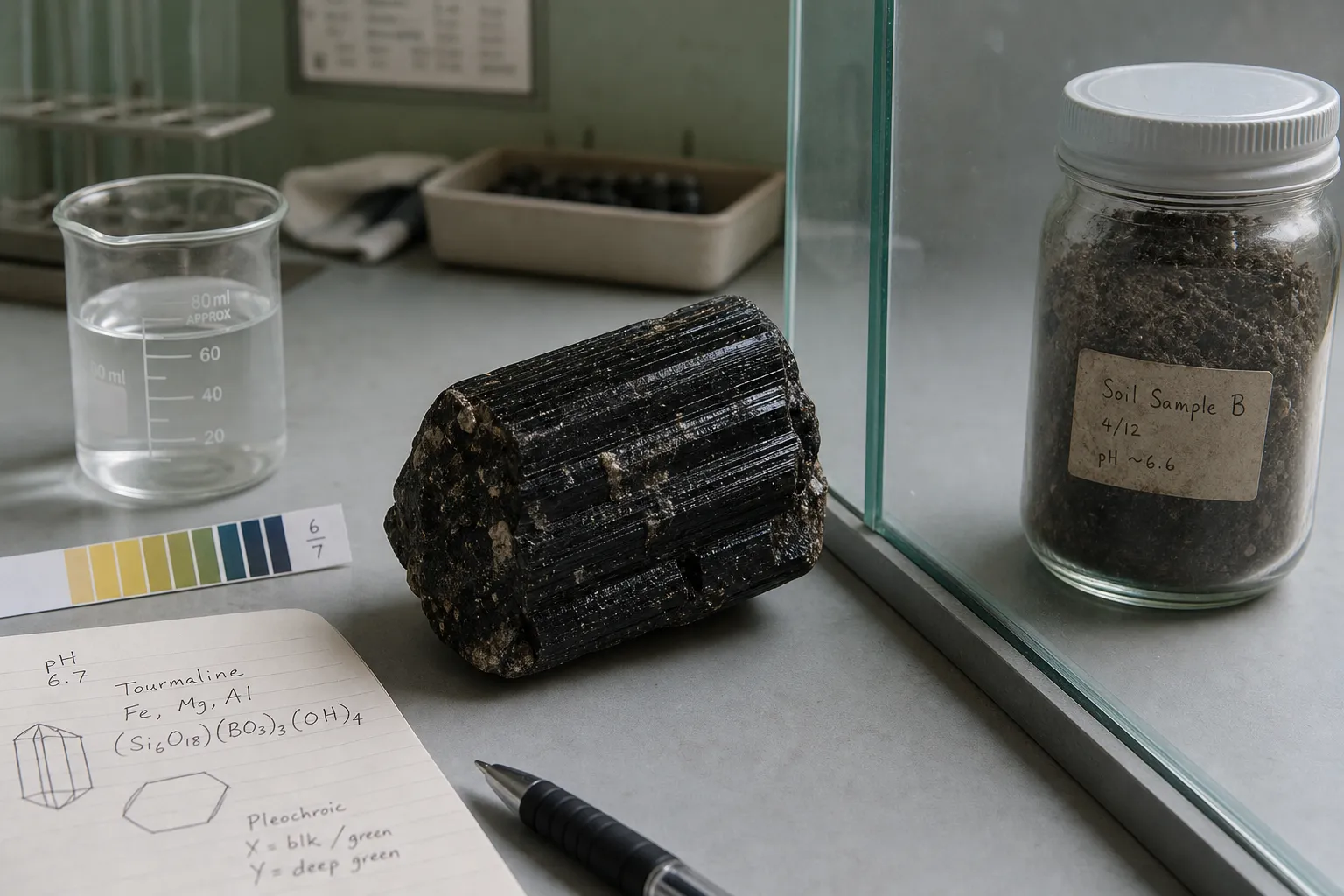
Black tourmaline can be discussed in relation to Environmental heavy metal immobilization, but only within a narrow evidence boundary. The clearest tourmaline-specific research is in wastewater or other aqueous systems, including lab-made composites such as tourmaline–biochar. That is not the same as showing that raw black tourmaline can make contaminated soil safe in a yard, garden, farm, or mine-impacted site.
The careful answer is this: black tourmaline is interesting as a mineral surface in green-chemistry discussions, especially where adsorption, ion exchange, precipitation, pH effects, and redox behavior are being studied under controlled conditions. For real soil contamination, the evidence is not strong enough to treat it as a stand-alone remediation material.
broader context
Start with the main black tourmaline page
This narrower page works best after the broader black tourmaline context page.
What heavy metal immobilization actually means
Heavy metal immobilization does not mean the contaminant disappears. It means a metal or metalloid is shifted into a less mobile, less soluble, or less bioavailable form under specific conditions.
That distinction matters for contaminants such as lead, cadmium, chromium, arsenic, copper, zinc, nickel, and mercury. These elements can persist in soil for long periods. A material may reduce leaching in one test, or reduce plant uptake in one soil, without removing the total contaminant mass from the site.
In green chemistry, immobilization is attractive because it may reduce exposure without excavation or intensive chemical processing. But it is highly conditional. Soil pH, organic matter, clay content, iron and manganese oxides, water movement, oxygen conditions, competing ions, and the contaminant’s chemical form all affect whether immobilization holds.
That is why black tourmaline should not be framed as a soil-cleaning crystal. It is better understood as a mineral that appears in environmental chemistry because tourmaline materials have been studied for metal removal in water and as components in engineered adsorbents.
Why the idea is chemically plausible in controlled systems
The mechanisms linked to tourmaline are familiar in environmental remediation: adsorption, ion exchange, precipitation, pH-mediated behavior, and redox or speciation effects. These are surface and solution chemistry, not mystical properties.
In wastewater-focused tourmaline research, metal removal is commonly discussed through mechanisms such as electrostatic adsorption, ion exchange, water polarization associated with tourmaline, and the formation of less soluble metal hydroxides. In plain terms, metal ions in water may attach to charged mineral surfaces, trade places with other ions, or become less soluble when the water chemistry changes.
A tourmaline–biochar study on hexavalent chromium adds a useful clue, but also a clear limit. The tested material was not a decorative black tourmaline stone or loose mineral mixed into soil. It was a synthesized composite tested in aqueous solution. Under those lab conditions, the composite performed better than pristine tourmaline. That supports tourmaline’s possible role in engineered adsorbent design. It does not show that raw black tourmaline will stabilize chromium in real soil.
Wider soil-remediation literature also helps explain the chemistry. Biochar, iron minerals, and modified mineral materials can immobilize potentially toxic elements through adsorption, complexation, precipitation, ion exchange, and redox changes. Those examples are useful as analogies. They should not be used as a shortcut to claim the same field performance for black tourmaline.
Where pH, redox, and “electron shuttle” language need caution
Three phrases often make this topic sound more settled than it is: pH regulation, redox control, and electron shuttle.
pH regulation
pH matters because many metals become more or less soluble depending on acidity or alkalinity. Some amendments can raise pH, change surface charge, or encourage precipitation. Biochar research, for example, often discusses pH, cation exchange capacity, mineral ash, and functional groups. But that does not mean black tourmaline reliably regulates pH in contaminated soil. The tourmaline-specific evidence is much closer to water-treatment and composite-material behavior.
Redox and speciation
Redox and speciation matter because the same element can behave differently in different chemical forms. Chromium is the common example: hexavalent chromium is generally more mobile in many water-soil settings than trivalent chromium. Iron mineral research helps explain why electron transfer and surface chemistry are important in remediation science. It does not establish black tourmaline as a field-ready redox amendment.
Electron shuttle
“Electron shuttle” should be used even more carefully. Some minerals and organic materials can participate in electron-transfer processes, and tourmaline is discussed in relation to spontaneous polarization, piezoelectricity, and thermoelectricity in water-treatment literature. The available evidence does not support saying that black tourmaline functions as a reliable electron shuttle in contaminated soils. At most, it belongs as a research hypothesis or mechanism question.
The soil-contamination gap
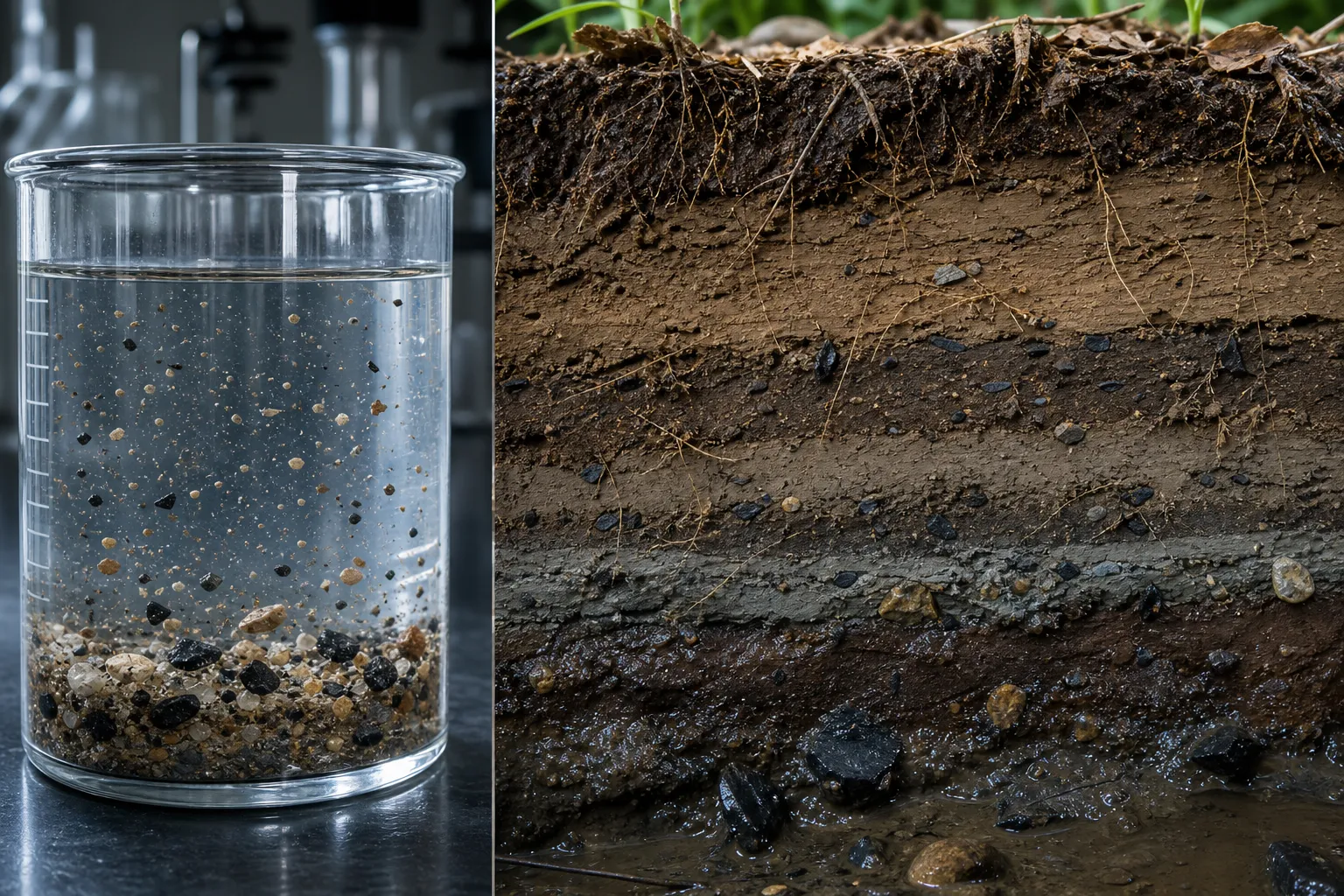
The key gap is simple: contaminated soil is not wastewater.
In water, researchers can control pH, contact time, dosage, temperature, particle size, starting contaminant concentration, and competing ions. Soil is a much more crowded system. Clay particles, organic matter, roots, microbes, wet-dry cycles, oxygen gradients, carbonates, sulfides, iron oxides, and dissolved organic matter can all change metal behavior.
A contaminant may look immobilized after a short test and later become more mobile if pH drops, redox conditions shift, or organic ligands carry it back into solution. That is why soil studies usually ask more than whether a material adsorbed a metal. They ask whether the contaminant changed fractions, whether it leaches under realistic conditions, whether plants take up less of it, whether the result persists, and whether the amendment introduces new concerns.
For black tourmaline specifically, the missing pieces are still large: soil-column data, greenhouse or field trials, long-term leaching tests, contaminant-speciation tracking, comparisons with established amendments, aging studies, and regulatory evaluation. Without that chain, black tourmaline field outcomes should not be stated as established.
A practical way to read black tourmaline claims
Use the system label first. Ask what the claim was actually tested in: water, a lab composite, a soil incubation, a greenhouse trial, or a real contaminated site.
Tourmaline removes metals from water
What it can reasonably mean: Some studies discuss tourmaline as an adsorbent or modifier in aqueous systems.
What it should not be stretched to mean: Raw black tourmaline cleans contaminated soil.
Tourmaline–biochar improves adsorption
What it can reasonably mean: A lab-made composite may perform better than tourmaline alone in controlled solution.
What it should not be stretched to mean: Any tourmaline mixed into garden soil will reduce risk.
pH affects immobilization
What it can reasonably mean: Soil and water pH can change metal solubility and surface charge.
What it should not be stretched to mean: Black tourmaline reliably controls contaminated-soil pH.
Redox/speciation affects mobility
What it can reasonably mean: Certain metals, such as chromium, behave differently by oxidation state.
What it should not be stretched to mean: Tourmaline has demonstrated field-scale electron-shuttle performance.
Amendments may reduce bioavailability
What it can reasonably mean: Some tested soil amendments can reduce mobility or plant availability under defined conditions.
What it should not be stretched to mean: A crystal product can guarantee safer crops, dust, or exposure.
This filter keeps black tourmaline heavy metal immobilization in the right frame. The mineral may be interesting to environmental chemists. It is not, based on the available evidence, a stand-alone answer for black tourmaline soil contamination.
What stronger claims would need
A stronger claim would need direct soil evidence, not just appealing mechanism language.
Material characterization
First, the material would need to be characterized: mineral composition, particle size, surface area, surface charge, and impurities. “Black tourmaline” in the marketplace can mean natural schorl specimens, crushed mineral, mixed rock, or polished decorative pieces. Those are not automatically equivalent to research-grade materials.
Defined soil system
Second, the soil system would need to be defined. Which contaminant is present: lead, cadmium, chromium, arsenic, copper, zinc, nickel, or mercury? Is the soil acidic, calcareous, sandy, clay-rich, organic, flooded, or oxidized? Is the goal to reduce leaching, plant uptake, dust exposure, or movement from a mine-impacted site? Each goal needs different measurements.
Time and evaluation
Third, the result would need time. Short-term adsorption can look promising while long-term stability remains uncertain. Environmental remediation decisions usually require leaching tests, bioavailability assessment, contaminant speciation, exposure evaluation where relevant, and qualified interpretation. In regulated contexts, cleanup decisions depend on site assessment and local environmental requirements, not on mineral enthusiasm.
Bottom line
Black tourmaline belongs in this conversation as a research-adjacent mineral, not as a confirmed soil remedy. Its green-chemistry relevance comes from plausible surface and water-chemistry mechanisms: adsorption, ion exchange, precipitation under certain conditions, and possible interactions with redox-sensitive contaminants in controlled systems.
The best-supported tourmaline evidence is in wastewater and aqueous composite studies. General soil-remediation research explains why immobilization can work for some amendments, while also showing why field performance is conditional.
So the responsible conclusion is narrow: black tourmaline may be discussed as a possible contributor to heavy-metal immobilization mechanisms in controlled water-treatment or engineered-material contexts. There is not enough evidence to claim that raw black tourmaline immobilizes heavy metals in contaminated soil under real field conditions. If soil contamination is suspected, the practical next step is certified soil testing, contaminant identification, site-specific risk assessment, and guidance aligned with local environmental authorities.