Biophilic luxury design
Sculptural Fluidity: Integrating Heavy Minerals into Organic Spaces
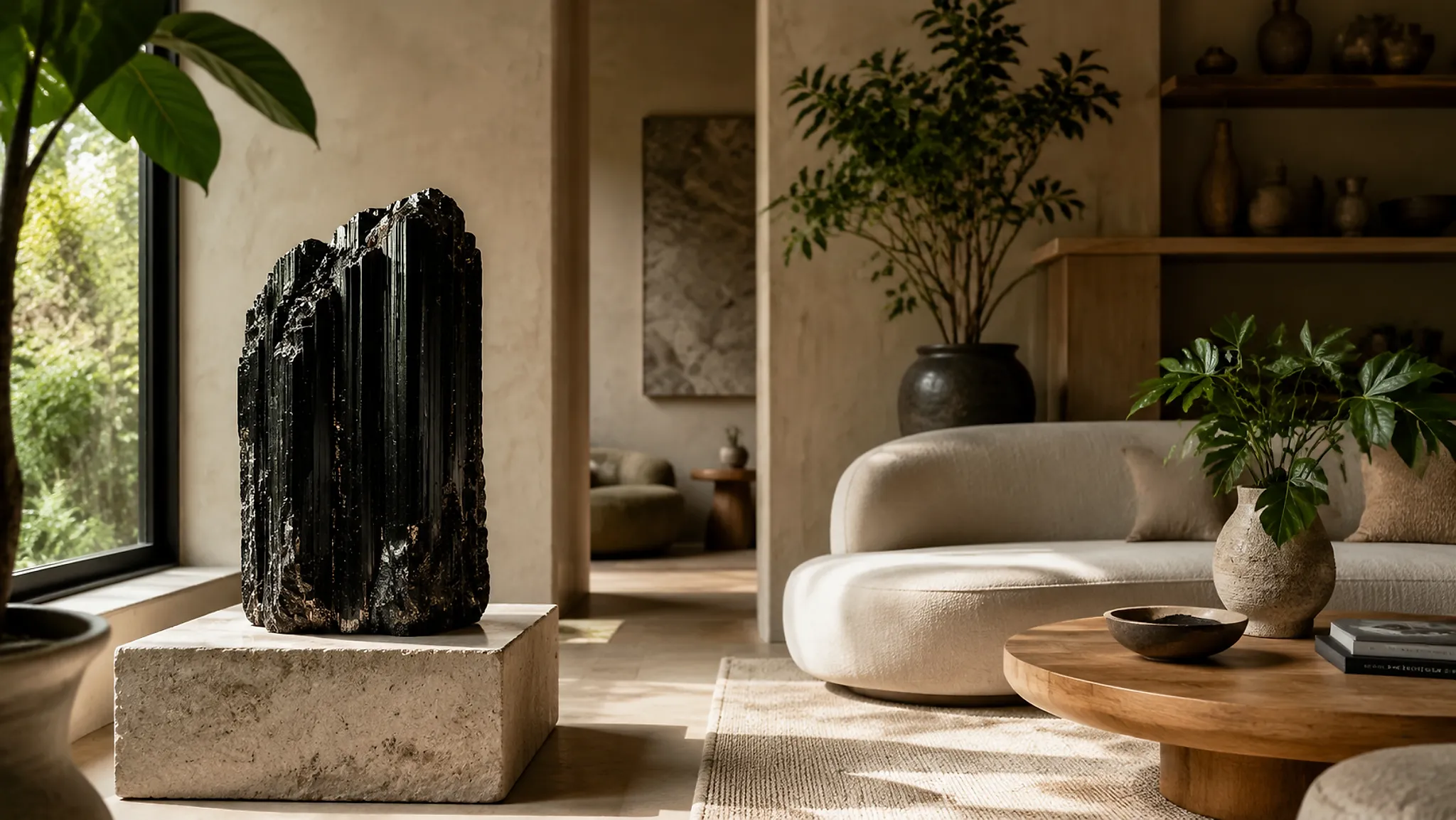
A heavy mineral form such as black tourmaline belongs in biophilic luxury design when it is treated as a sculptural material anchor, not as a charm with promised effects. Its design value comes from visible qualities: dark mass, striated surface, mineral luster, tactile density, and the way it changes a threshold, shelf, corner, or low plinth.
In a room shaped by timber, linen, plants, daylight, softened plaster, and sinuously undulating furniture, a black tourmaline specimen can give the eye a place to settle. That is the direct answer. The limit is just as important: the strongest support is aesthetic, symbolic, and spatial. The available source base does not support presenting the mineral as producing measurable health, protective, electromagnetic, or technical outcomes.
broader context
Start with the main black tourmaline page
This narrower page works best after the broader black tourmaline context page.
What Heavy Minerals Add to Organic Spaces
Organic spaces often rely on flow: curved seating, irregular timber grain, trailing plants, softened edges, and light that shifts through the day. Those choices can make a room feel less rigid, but they can also become visually weightless if every surface is pale, soft, or diffuse. Sculptural heavy minerals introduce counterweight.
Black tourmaline is useful in this language because schorl, the mineral name commonly associated with black tourmaline, is known for dark color, prismatic crystal habit, and lengthwise striations. The room does not need a mineralogy lecture to benefit from that. At interior scale, the important cues are direction, shadow, edge, and surface interruption. A striated crystal specimen can hold attention without becoming glossy ornament.
That matters in biophilic interiors because nature connection is not only about adding plants. Biophilic design frameworks commonly discuss materiality, natural forms, light, views, spatial transition, and the balance between openness and refuge. A mineral specimen can participate in that system when it relates to those variables: geological texture, dark contrast, a pause between zones, or a more tactile hand-height surface.
The mistake is letting the object carry too much meaning. A mineral on a console does not make a room biophilic by itself. The surrounding composition still decides the result: light path, circulation, sightline, proportion, texture, and physical support.
Where the Mineral Should Work in the Room
The strongest placements are not necessarily the most mystical ones. They are the places where mass, silhouette, and contrast already have a spatial job.
Thresholds
At a threshold, a heavy mineral form can mark transition. A black specimen on a stone plinth or timber console can clarify the move from public entry to private interior, especially when the next room is pale or softly textured. This is a design translation of language around boundary and protection: the room is not being shielded by the stone; the transition is being made visually legible.
Prospect and refuge
In a prospect-refuge interior, the same object can help balance openness and enclosure. Prospect gives a room outlook; refuge gives it contained backing. A dark mineral mass near a wall, niche, hearth, bookcase, or low corner can strengthen the refuge side while open seating, glass, or daylight maintains the sense of prospect.
Natural light
Near natural light, black tourmaline behaves differently from pale stone or soft ceramics. Its surface may read as matte, glassy, ridged, or fractured depending on the specimen and angle. Side light can reveal the crystal habit. A windowsill only works if the piece is stable, uncrowded, and not treated as a device. The design purpose is silhouette and surface.
Low plinths
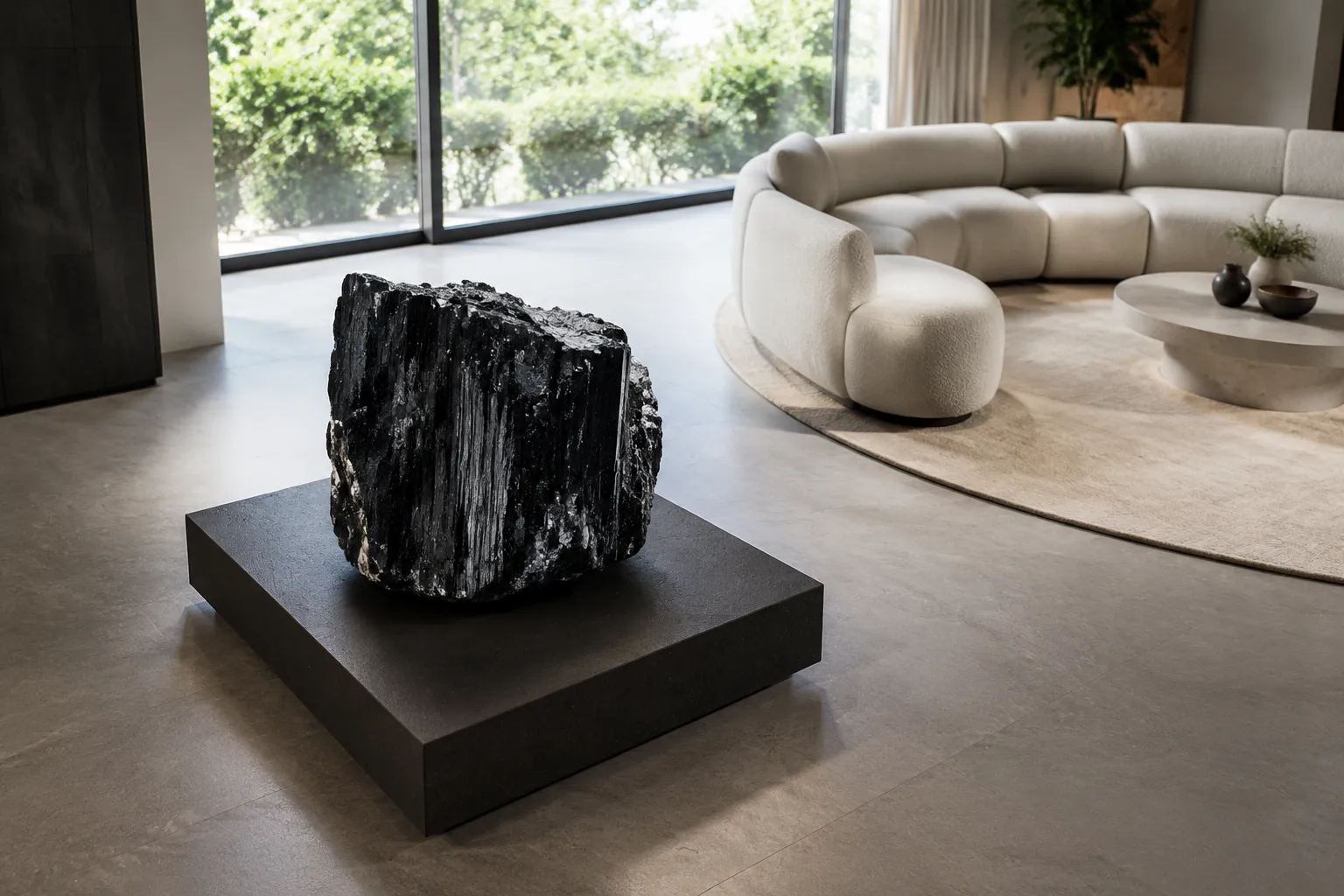
On a low plinth, the mineral becomes sculptural specimen decor rather than a small accessory. This is often the more convincing route in luxury organic interiors. Heavy mineral forms need negative space around them to be read as mass. Tucked among candles, bowls, and stacked books, their geological presence is reduced to styling clutter.
Pairing Dark Mineral Mass with Fluid Furniture
Sinuously undulating furniture and raw stone interiors can support each other, but only with restraint. A curved sofa, kidney-shaped table, softened lounge chair, or irregular timber bench already brings movement. A dark mineral specimen should give that movement a point of pause, not compete with it.
One clean pairing is contrast by rhythm: a vertical, striated crystal form near a low horizontal curve. The furniture gives the room flow; the mineral gives it a stop. Another is contrast by surface: rough black mineral beside brushed oak, honed limestone, wool, clay, or linen. If every nearby material is heavily figured, ridged, knotted, or veined, the hierarchy collapses.
Scale is the quiet test. A small black tourmaline piece may be beautiful up close, but in a larger organic sanctuary it can read as a token rather than an anchor. A larger specimen or grouped mineral composition carries more presence, yet it also raises practical questions about support, traffic flow, and exposed edges. The more massive the piece, the more it needs a real display strategy.
Dark contrast decor works best when it is echoed with care. One black mineral in a room of pale oak and cream upholstery can feel abrupt. A second dark note, such as a bronze lamp base, blackened steel shelf line, dark ceramic vessel, or shadowed stone hearth, can make the specimen feel integrated. The aim is not a black-themed room; it is a stable visual grammar.
Conditions That Change the Answer
The answer changes when the mineral is unstable, too small for the room, too visually busy for the setting, or placed where it interferes with movement. Heavy mineral forms are physical objects before they are symbols. Weight, edge, base contact, and display height matter.
A substantial specimen belongs on a surface that can carry it without wobble, bowing, or crowding. Plinths, consoles, shelving, and built-ins should be chosen with load and stability in mind. If a piece sits near a walkway, seating edge, pet route, or child-accessible zone, the design question becomes practical: can it tip, slide, scratch, catch fabric, or become an awkward obstacle?
This does not mean heavy minerals should be hidden away. It means they should be placed with the same seriousness as a bronze sculpture, ceramic vessel, or stone object. A dramatic specimen on a narrow shelf above seating may be less successful than a quieter piece on a stable plinth at the edge of circulation.
Moisture and maintenance also belong in the planning, though the available material does not justify broad promises about durability in use. Do not assume that all mineral specimens, mounts, adhesives, bases, or adjacent finishes tolerate the same conditions. If the piece is valuable, fragile, unusually large, or mounted in a mixed-material display, keep it away from wet zones and unstable surfaces unless the specific object and support have been assessed.
Common Confusion: Grounding Language Versus Design Effect
Many readers come to black tourmaline through words such as grounding, sanctuary, protection, calm, and visual security. Those words should not be dismissed. They often describe a real interior desire: a room that feels ordered, settled, and easier to read. The problem begins when emotional vocabulary is treated as evidence of a physical result.
In this design frame, “grounding” can be translated into mass, low placement, dark contrast, tactile surface, and a clear visual pause. “Protection” can be translated into threshold clarity, a stronger sense of enclosure, and fewer ambiguous transitions between public and private zones. “Sanctuary” can be translated into controlled light, natural materials, coherent circulation, refuge-backed seating, and a limited number of strong focal points.
That translation keeps the meaningful part of the language without overstating the object. Black tourmaline can be symbolically important to a homeowner, and symbolism can matter in interiors. It can mark a place of return, a boundary, or a quiet ritual of attention. Those meanings are personal or cultural associations, not verified room performance.
The same boundary applies to electronics placement. Commercial crystal content often places black tourmaline near devices, but that does not make it a technical shield. If it sits near a desk, let the reason be visual: a dark, tactile object can soften a workstation’s hard surfaces and give the composition a natural counterpoint.
A Short Placement Check
Before adding a sculptural heavy mineral to an organic room, ask four questions.
Does it have a spatial job?
A strong piece should mark a threshold, anchor a corner, support a refuge zone, balance a curved furniture line, or create a tactile focal point. If it only fills an empty spot, the room may not need it.
Can the surface carry it?
Check stability, load, base contact, and the chance of sliding or tipping. Heavy objects need serious support, especially on narrow consoles, open shelving, or furniture with curved profiles.
Does light reveal the material?
Black tourmaline can disappear in a dark corner. Side light, pale backing, or a nearby softer material can reveal striations and silhouette without forcing the specimen into a spotlight.
Is the meaning bounded?
It is reasonable to use the mineral for visual security, symbolic grounding, material contrast, and threshold emphasis. It is not reasonable to present it as a guaranteed source of wellbeing, home protection, or technical shielding.
The Bounded Design Answer
Sculptural heavy minerals work best in organic spaces when they create pause inside flow. Black tourmaline, understood first as schorl before symbolism, offers dark weight, directional striation, and tactile mineral surface. Used with restraint, it can deepen biophilic luxury design without turning the room into a crystal display.
Place it where the room already needs mass: an entry threshold, a refuge-backed corner, a plinth near curved seating, or a naturally lit shelf with enough space around it. Pair it with organic materials and fluid forms, but give it physical stability and visual breathing room. Its strongest defensible role is not to change the body or protect the home; it is to make material presence visible, grounded, and precise.