Pyroelectricity Explained: Unlocking Your Tourmaline with Heat
“Pyroelectric thermal activation” sounds dramatic, but in tourmaline it means something narrow and physical: when the stone’s temperature changes, its polarization and surface charge can shift. Tourmaline is a pyroelectric mineral, so a cool black tourmaline piece warming in your hand can, in principle, show this kind of response.
What it does not mean is that heat turns the stone into a battery, guarantees a sensation, or confirms detox, EMF, negative-ion, or far-infrared claims. The real effect is smaller and more specific: a temperature-driven change that may create a potential difference under the right conditions.
broader context
Black tourmaline context note
This narrower page works best after the broader black tourmaline context page.
What “thermal activation” means here
In crystal language, “activation” is often used loosely. For tourmaline, the grounded meaning is simple:
A temperature change can alter the crystal’s electrical polarization or surface charge.
That is pyroelectricity. The key trigger is not heat as a mystical force, but change in temperature. A tourmaline crystal held at a steady temperature is not doing the same thing as one that is warming or cooling.
An everyday example
- A black tourmaline stone sits in a cool room.
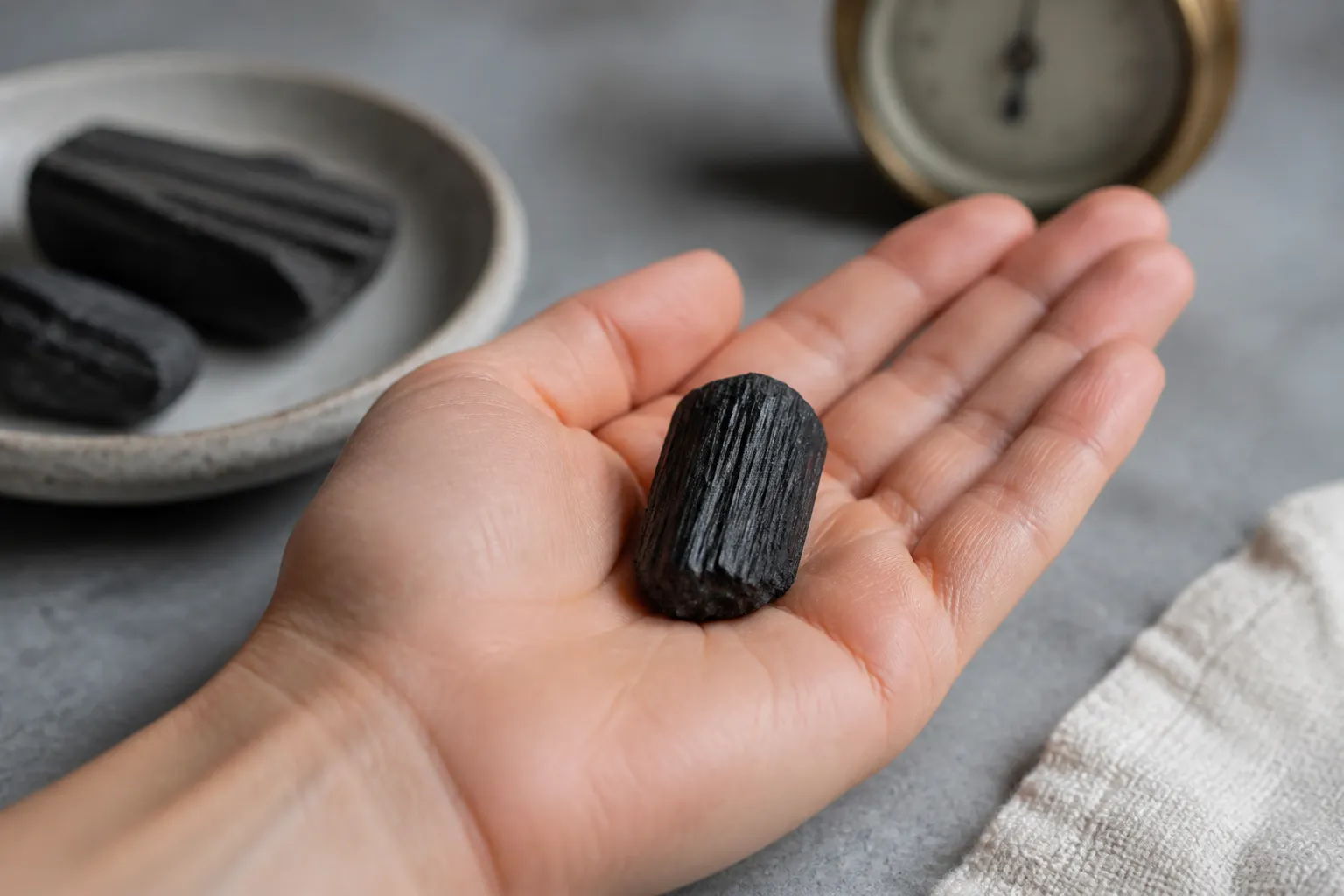
- You pick it up or wear it against skin.
- The stone gradually warms toward body temperature.
- During that shift, its surface charge or polarization may change.
Cooling matters too. Warming in the hand and then cooling back on a table are both temperature changes, and pyroelectric behavior is tied to that shift, not only to warmth itself.
So “unlocking your tourmaline with heat” is best read as a poetic way of describing a modest material response, not as proof that the stone stores usable energy.
Why tourmaline responds this way
Tourmaline has a polar crystal structure. In plain terms, its internal arrangement is not electrically uniform in every direction. That structure is what allows spontaneous polarization, and why a temperature shift can alter the surface charge.
For a gemstone reader, the important point is not the formula. It is the condition:
- Temperature changePyroelectricity is triggered by warming or cooling.
- Polar structureThe response is tied to the crystal’s internal directionality.
- Limited outputThe effect may create a potential difference, but ordinary handling does not make the stone a practical power source.
In the lab, researchers can measure pyroelectric coefficients, surface fields, and charge behavior under controlled conditions. In a loose stone, pendant, bracelet bead, or raw specimen, the result is less predictable. Surface condition, crystal orientation, humidity, polish, inclusions, and the heating rate all affect what can be measured.
That is why a real pyroelectric effect should not be stretched into a guaranteed everyday sensation. It may be physically present and still be too small, too brief, or too condition-dependent to notice.
Body heat and black tourmaline: what is realistic?
Body heat is a gentle example of thermal change. If black tourmaline starts cooler than your skin, warming in the hand can create the kind of temperature shift that matters here.
But body heat has limits
- it is mild,
- it warms the stone gradually,
- it may not heat the whole specimen evenly,
- the electrical response may be small,
- and it does not prove a lasting charge.
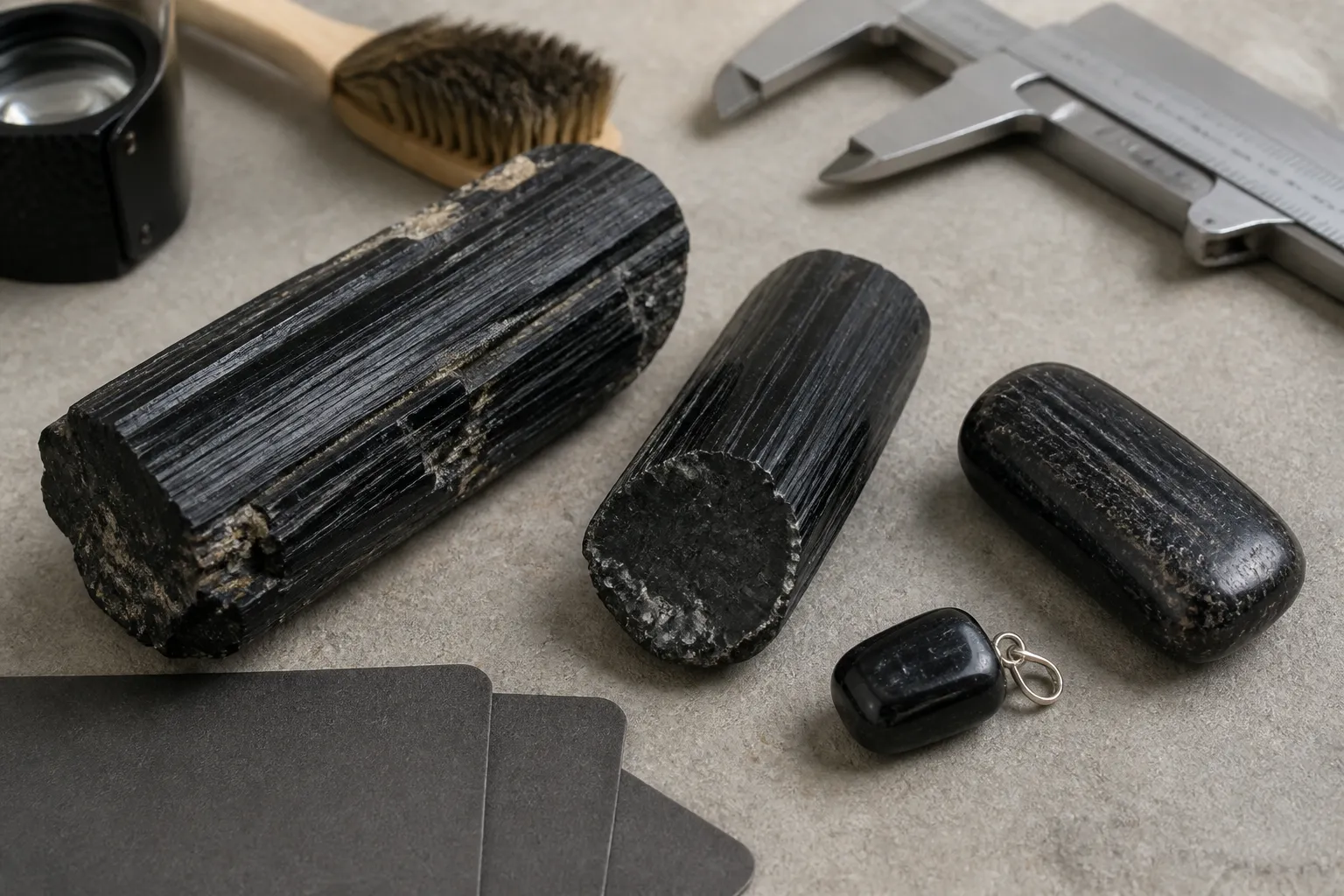
A bead, a polished palm stone, a raw point, and a single crystal may not behave the same way. Even if each is black tourmaline, the measured response can vary.
That is one reason the phrase “my stone should activate strongly in my hand” goes beyond what the evidence can support. Tourmaline is a mineral group with real pyroelectric behavior, but the exact response depends on the specimen.
What makes one specimen different from another?
Two pieces of black tourmaline can look similar and still differ in measurable behavior. Pyroelectric response is not just a label attached to the mineral name; it is shaped by the actual material and how it is tested.
Chemical composition
Tourmaline is a group of minerals, not one chemically identical substance. Black tourmaline is often schorl-rich, but natural specimens vary in Fe-Mg balance and other elements. Research on tourmaline pyroelectricity points to composition as one reason measured values differ.
Oxidation state
Iron and other cations can exist in different oxidation states. Available studies note that cation oxidation state can influence tourmaline’s pyroelectric response. Color or trade name alone cannot tell you exactly how a specimen will behave.
Crystal orientation
Pyroelectric behavior is directional. Tourmaline has a polar axis, and the way a crystal is cut, broken, polished, or contacted changes how the response is measured. A pendant or bead may not be oriented in a way that makes the effect easy to detect.
Surface condition
The surface matters. Polishing, weathering, coatings, fractures, moisture, dust, skin oils, and metal settings can all affect what happens at the surface. Older surface-field studies also show that the surrounding surface environment can matter in experiments.
Measurement method
Lab measurements are not the same as holding a stone. Electrodes, controlled heating rates, temperature gradients, sample orientation, and instrument sensitivity all shape the reported result. That is why measured response varies.
Pyroelectric, piezoelectric, thermoelectric: not the same thing
These terms are often blurred in consumer descriptions, especially when tourmaline is described as “charged” or “heat activated.” They are related, but they are not the same mechanism.
| Effect | Trigger | Plain-language meaning |
|---|---|---|
| Pyroelectricity | Temperature change | Polarization or surface charge changes as the material warms or cools |
| Piezoelectricity | Mechanical stress | Electrical response from pressure, compression, vibration, or bending |
| Thermoelectricity | Temperature difference across a material | Voltage can arise from a heat gradient in certain conductors or semiconductors |
Tourmaline may appear in broader materials-science discussions because of these electrical properties, but a black tourmaline pendant warming against skin is not the same as a lab-built pyroelectric device.
Where the overreach starts
The real science is interesting enough without stretching it. Tourmaline can show temperature-driven surface charge and polarization behavior. That does not establish claims about health outcomes, detoxification, EMF protection, negative-ion effects, or far-infrared benefits in ordinary crystal use.
The leap usually happens like this
- a real pyroelectric property is described as constant “energy emission,”
- a small surface-charge effect is framed as a strong protective field,
- body heat warming is treated as proof of a guaranteed effect,
- or laboratory material studies are applied to jewelry without the same setup.
A better reading is simpler: tourmaline is a polar crystal that can respond electrically to temperature change. That response may be measurable under controlled conditions, but ordinary body heat does not prove a specific effect you can rely on.
Gentle warmth is enough; stronger heat is not better
Because pyroelectricity involves temperature change, it can be tempting to assume that more heat means more activation. That is not a good rule for a gemstone.
Tourmaline can contain fractures, inclusions, internal stress, surface treatments, or jewelry settings that do not like abrupt temperature changes. For ordinary black tourmaline pieces, there is no need to use flame, boiling water, ovens, microwaves, rapid freezing, or hot-cold shock to “activate” the stone.
Body heat is the cleanest everyday example because it is gentle and realistic. Even then, it should be understood as a mild warming scenario, not a performance guarantee.
Bottom line
Pyroelectric thermal activation in tourmaline means that warming or cooling can change the stone’s polarization or surface charge because tourmaline has a polar crystal structure. Body heat can be a mild everyday trigger when a cool black tourmaline piece warms against skin.
The effect is real, but narrow. It does not make the stone a battery, does not guarantee a noticeable potential difference in ordinary wear, and does not support broad wellness, detox, EMF, negative-ion, or far-infrared claims. The measured response can vary with chemistry, oxidation state, orientation, surface condition, and measurement method.
So “unlocking your tourmaline with heat” is best understood as a grounded material idea: temperature change can prompt a small electrical response in the crystal. It is not proof that stronger heat or ritual heating produces a guaranteed result.