Schorl fracture note
Uneven Fracture vs. Cleavage: Why Your Raw Schorl Might Shatter
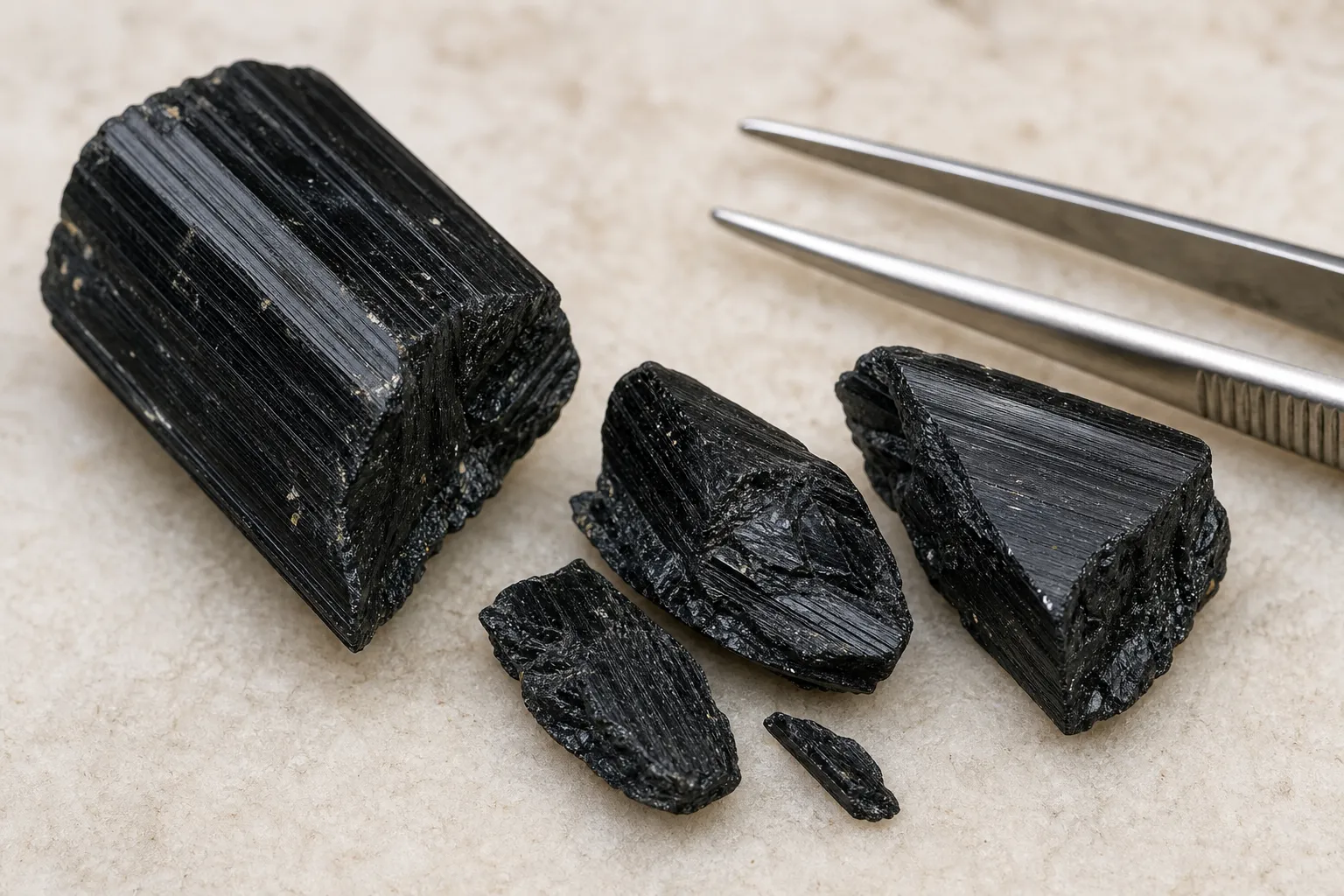
A raw schorl specimen can shatter because impact breakage is not the same thing as cleavage. Cleavage is a crystal’s tendency to split along particular internal planes. Fracture is the break surface left when the mineral does not separate along a clean cleavage direction.
For schorl, the practical point is simple: a black tourmaline crystal can look tough, feel hard, and still behave as a brittle mineral when dropped, struck, squeezed, or loaded at a weak point. In a Trigonal crystal fracture context, the crack path may look jagged, uneven, splintery, or sometimes curved in a conchoidal-looking way rather than forming a neat flat split.
That does not mean the piece is fake, poorly formed, or “supposed” to break in one perfect pattern. The broken surface tells you how that specimen failed under stress, not the whole identity of the mineral.
broader context
Start with the main black tourmaline page
This narrower page works best after the broader black tourmaline context page.
Cleavage is a preferred split; fracture is the rest of the break
Cleavage describes a repeatable tendency to break along planes of relative weakness in a crystal structure. A good cleavage break is usually directional, plane-like, and more consistent than a random chip. It is not just “any smooth surface.”
Fracture is the broader term for breakage that does not show a clear cleavage plane.
Uneven fracture
The break surface is rough, irregular, or non-planar.
Conchoidal fracture
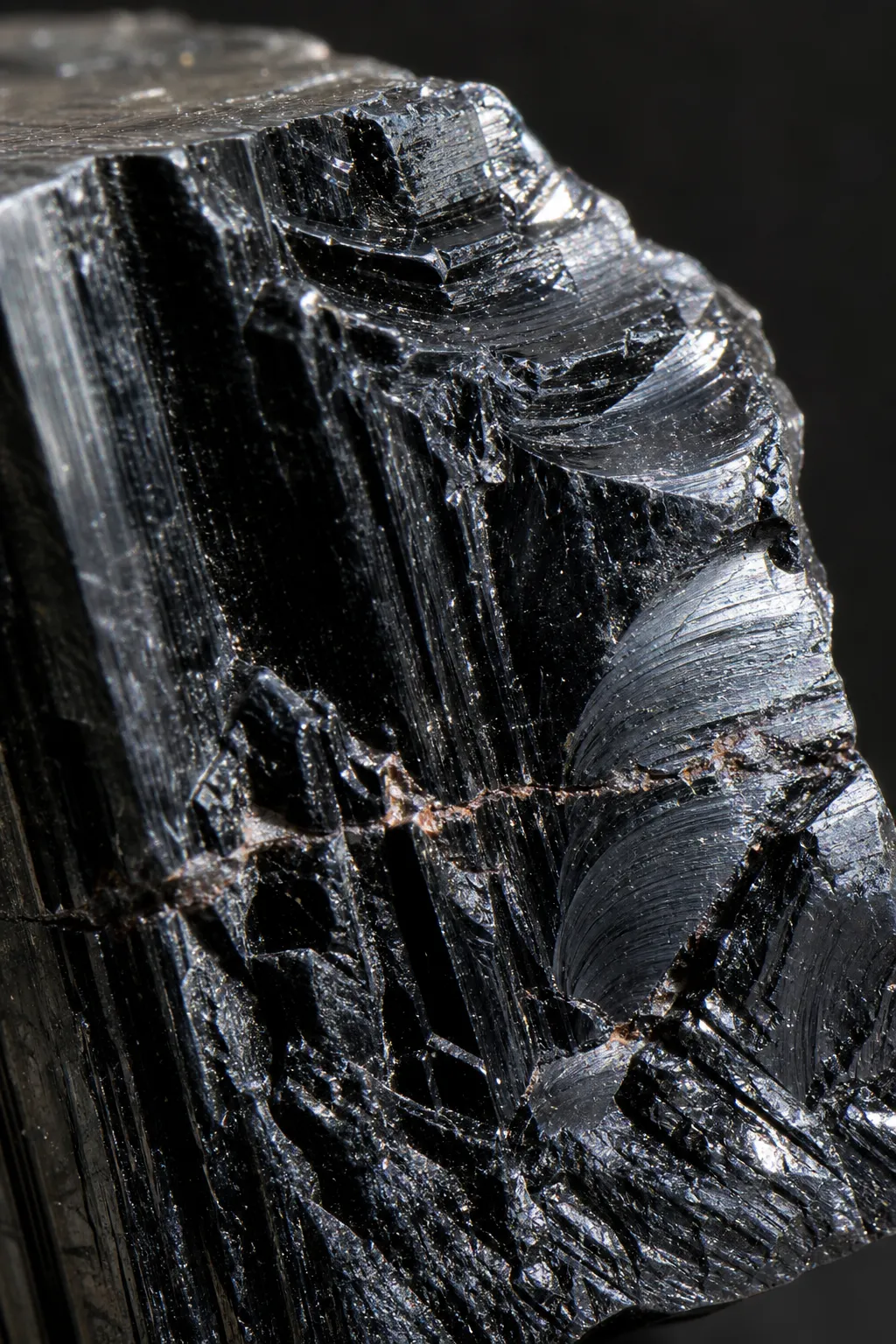
The surface has curved, shell-like arcs.
Shattering
This describes the event from the owner’s point of view, not a precise mineralogical property.
A damaged raw schorl crystal can show several surface textures at once. One part may be rough and splintery, another may have curved arcs, and another may follow an older internal crack. If the specimen broke into jagged pieces after a fall, the careful wording is usually “brittle breakage with uneven fracture surfaces,” not “it cleaved,” unless the surfaces show a consistent cleavage pattern.
Why a hard schorl crystal can still break suddenly
Hardness and break resistance are easy to confuse. In mineral identification, hardness means resistance to scratching. Tenacity describes how a mineral behaves when it is bent, crushed, struck, or otherwise stressed. A mineral can resist scratching and still break abruptly under impact.
A raw schorl specimen may have:
- Thin edges or exposed terminations.
- Natural cracks or healed-looking internal lines.
- Attached matrix that transfers force unevenly.
- Inclusions or growth zoning.
- Old chips hidden by the dark color.
- A single contact point where it hit a shelf, floor, or another stone.
Impact does not move evenly through a crystal. A blow at one edge can drive a crack through the easiest available path at that moment. That path may be shaped by crystal orientation, pre-existing flaws, surface geometry, and the speed of the crack. The result can look chaotic even though the mineral has an orderly crystal structure.
So raw schorl shattering is not automatically a contradiction. The outer crystal habit and the internal fracture path are related observations, but they are not the same thing.
Where “trigonal” helps—and where it does not
Tourmaline is commonly described in a trigonal structural context, and schorl belongs to the tourmaline group. Specialized crystallographic work also shows that schorl-related tourmalines can require more careful language in some cases, including symmetry-lowering discussions. That nuance matters because it prevents an oversimplified claim such as “every schorl specimen is trigonal in every possible crystallographic sense.”
For this page’s practical question, though, “trigonal” should not be treated as a crack-path calculator. Crystal system is background information. It does not let you look at broken pieces on a table and determine exactly why each crack turned where it did.
A better use of the idea is this: in crystalline minerals, orientation can matter. Fracture studies on other brittle trigonal minerals, especially quartz, support the general point that stress direction and crack propagation can influence break behavior. Those studies are not direct schorl evidence, so they should not be used as proof that tourmaline breaks in the same detailed way. They only support the limited mechanism: brittle crystals may fracture differently depending on orientation, flaws, and applied stress.
How to read the broken surface
Fresh breaks on black tourmaline can be hard to interpret. Schorl is dark, often striated, and may have natural surface grooves. The long lines on the outside of a crystal are growth features; they are not the same thing as cleavage.
Use the broken surface itself, not only the outer faces:
- Look for repeated flat directions. Cleavage is directional. One flat chip from impact is not enough by itself.
- Note rough, jagged, splintery, or irregular areas. These fit uneven fracture more than clean cleavage.
- Check for curved shell-like arcs. Those may be described as conchoidal or conchoidal-looking, but that describes surface shape, not the full mineral identity.
- Look for older cracks. Natural cracks in raw crystals can become starting points for later breakage.
- Do not try to confirm it by striking the specimen again. Impact can destroy the piece and leave sharp fresh edges. For identification, visual inspection, provenance, and non-destructive mineral observations are more useful than repeating the damage.
The break can tell you that the specimen behaved like a brittle mineral under stress. It cannot, by itself, confirm exact species, authenticity, treatment history, or a complete crystallographic explanation.
Common misunderstanding: “It shattered, so it cannot be real schorl”
That conclusion goes too far. Shattering is not, by itself, evidence against schorl. Many brittle minerals can break suddenly when dropped or loaded at a weak point, especially if the specimen already had internal cracks.
The opposite mistake is assuming that any flat-looking break must be cleavage. Impact can create relatively flat chips, especially where a crack meets an existing surface or follows an old weakness. Cleavage requires a more specific pattern: a tendency to split along defined crystallographic planes.
Seller language can add to the confusion. Words such as “natural crack,” “chip,” “damage,” “terminated,” “raw,” “fragile,” or “shattered” may describe condition or appearance, but they do not automatically explain the mineralogical cause of the break.
More accurate wording
“The piece shows brittle breakage with uneven fracture surfaces, with some areas that may appear conchoidal. The break alone does not confirm or rule out schorl.”
That wording is more useful than calling the specimen simply “cleaved,” “fake,” or “naturally broken.”
Evidence limit
The strongest schorl-specific source available here supports careful tourmaline crystal-structure language. It does not directly document everyday raw schorl shattering, handling behavior, cleavage quality, uneven fracture, conchoidal fracture, or brittle tenacity.
Broader fracture-mechanics sources can help explain how brittle crystals fail under stress, but quartz and other crystalline materials are not substitutes for direct schorl or tourmaline mineral-property references. For a fuller mineral entry, the next evidence spine should come from authoritative mineralogical or gemological references that list schorl or tourmaline crystal system, cleavage, fracture, tenacity, hardness, and handling context.
Within that limit, the answer stays clear: raw schorl may shatter because brittle impact fracture can dominate over clean cleavage expression. The broken surface is useful evidence, but it should not be overread as a complete identification.
Practical takeaway
If your raw schorl broke after physical impact, describe what you can actually see: uneven fracture, jagged breakage, possible conchoidal areas, fresh sharp edges, or breaks following older cracks. Do not assume the crystal “should” have split cleanly just because it is crystalline.
Cleavage is a specific mineral property. Shattering is the event. Fracture is the surface left when the break does not behave like a clean cleavage split.
For identification, use the break as supporting evidence only. Pair it with crystal habit, luster, heft, streak or other non-destructive observations where appropriate, and reliable provenance if the specimen matters. A raw schorl specimen can be structurally real and still break in an irregular, brittle way when impact finds the wrong point.