Design boundary
Hiding Tech in Plain Sight: Using Raw Minerals to Camouflage Smart Home Devices
Raw mineral aesthetics can make smart home devices feel less visually dominant, but only as a visual strategy. In Stealth Wealth Integration, the goal is not to make technology disappear in a technical sense. It is to help a speaker, hub, sensor, display, or control point read as part of the room’s material language.
That distinction is the whole answer. Rough stone texture, matte dark surfaces, mineral trays, shadow, and sculptural objects can make a device look calmer in a room. They do not prove that a stone shell, geode-like housing, recessed niche, or mineral cover is compatible with the device, suitable for heat or signal behavior, neutral for warranty, or appropriate for installation. Use mineral-led styling around smart devices, not unverified mineral modification of the devices themselves.
broader context
Black tourmaline context note
This narrower page works best after the broader black tourmaline context page.
What Raw Mineral Camouflage Can Actually Do
The strongest use of raw mineral styling is visual de-emphasis. Many smart home devices are designed to look clean and neutral, but they can still announce themselves as technology: a black disc on a console, a glowing rectangle on a wall, a white sensor in a corner, or a speaker that feels more like equipment than furniture.
Raw mineral aesthetics work because they bring irregularity, density, surface variation, and shadow. A rough black mineral specimen, a dark stone tray, a matte plinth, or a geode-adjacent sculptural form can shift attention away from the device as a standalone object. The device remains present, but it is no longer the sharpest visual signal in the grouping.
That is where smart surface design becomes useful. Instead of asking, “How do I hide this completely?” ask, “What nearby surfaces make this feel less like an interruption?” A dark shelf, textured wall plane, mineral-like base, or low-contrast object grouping can reduce contrast without turning the device into a hidden installation.
This approach suits rooms where the goal is discreet interior technology rather than a visible tech display. It works best when the device remains reachable, visible where it needs to be visible, and placed according to its own requirements. The mineral language belongs to the room, not inside the electronics.
Visual Camouflage Is Not Technical Concealment
A device can be visually quiet and still technically exposed. That difference matters.
Visual camouflage means the device is styled so it attracts less attention. It may sit near raw stone, on a mineral-textured surface, within a darker arrangement, or beside a sculptural object that does not block required openings. This is an interior styling move.
Technical concealment is different. It means the device is enclosed, built in, covered, recessed, wrapped, blocked, or physically altered so it becomes harder to see. Without device-specific documentation, electrical guidance, and installation review where needed, it is not responsible to assume that stone, minerals, crystal clusters, or dense decorative housings are appropriate for covering or enclosing smart devices.
The available source set for this page does not support claims that raw minerals preserve wireless range, improve sound, cool electronics, block unwanted signals, protect devices, satisfy installation requirements, or maintain warranty coverage. Those are performance and safety-adjacent claims, not aesthetic claims.
A useful line is this: if the mineral element changes only how the device is visually framed, it can stay in the design conversation. If it changes airflow, access, mounting, exposure, wiring, sound path, sensor view, heat behavior, or serviceability, it has moved into technical territory.
Where Mineral-Led Styling Works Best
Mineral texture interiors are most convincing when the styling does not look like a cover-up. The goal is not to disguise every smart object as a rock. The goal is to reduce the device’s visual importance through material balance.
A few restrained placements make more sense than theatrical concealment:
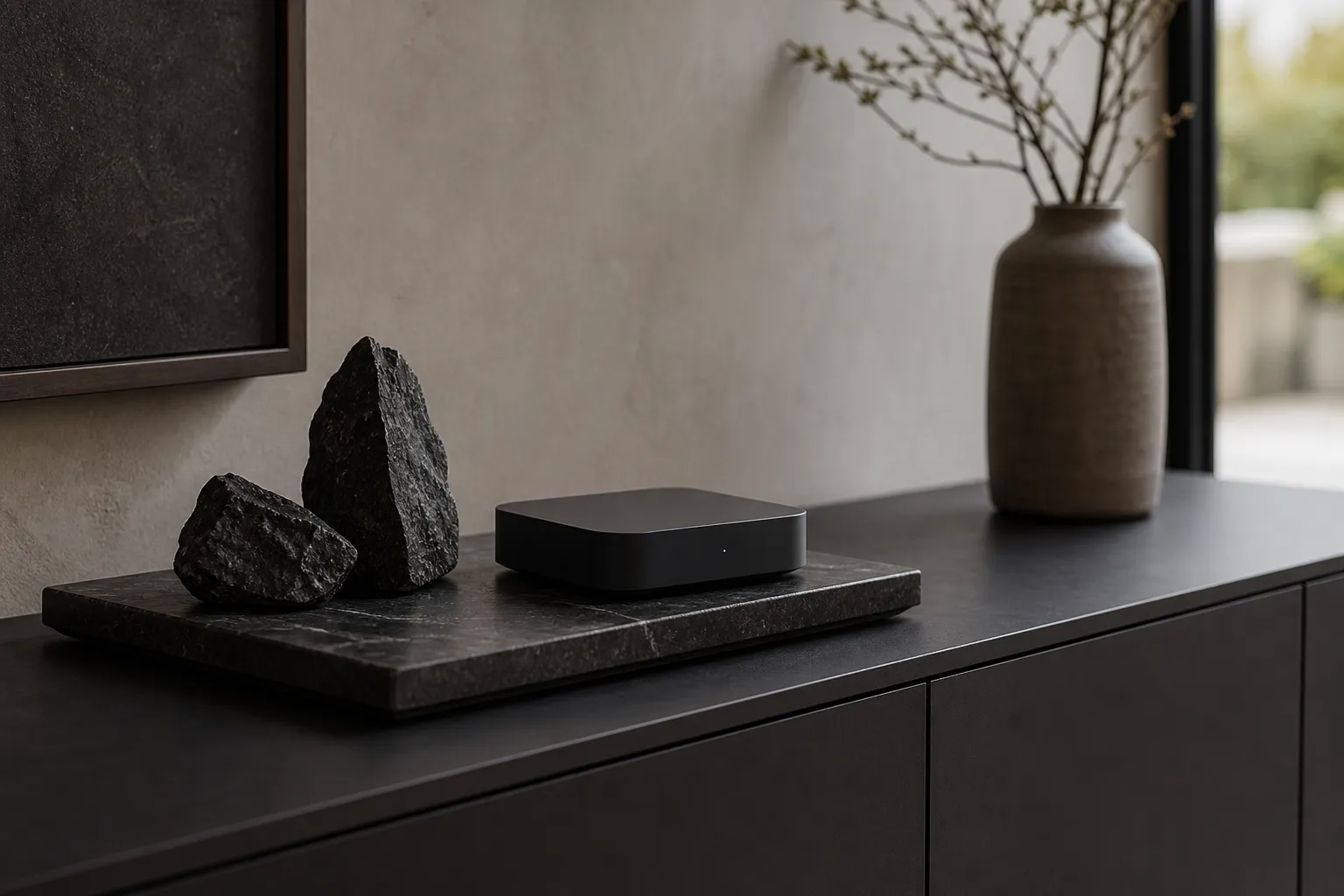
- A small hub on a dark stone tray with other quiet objects, while openings and controls remain unobstructed.
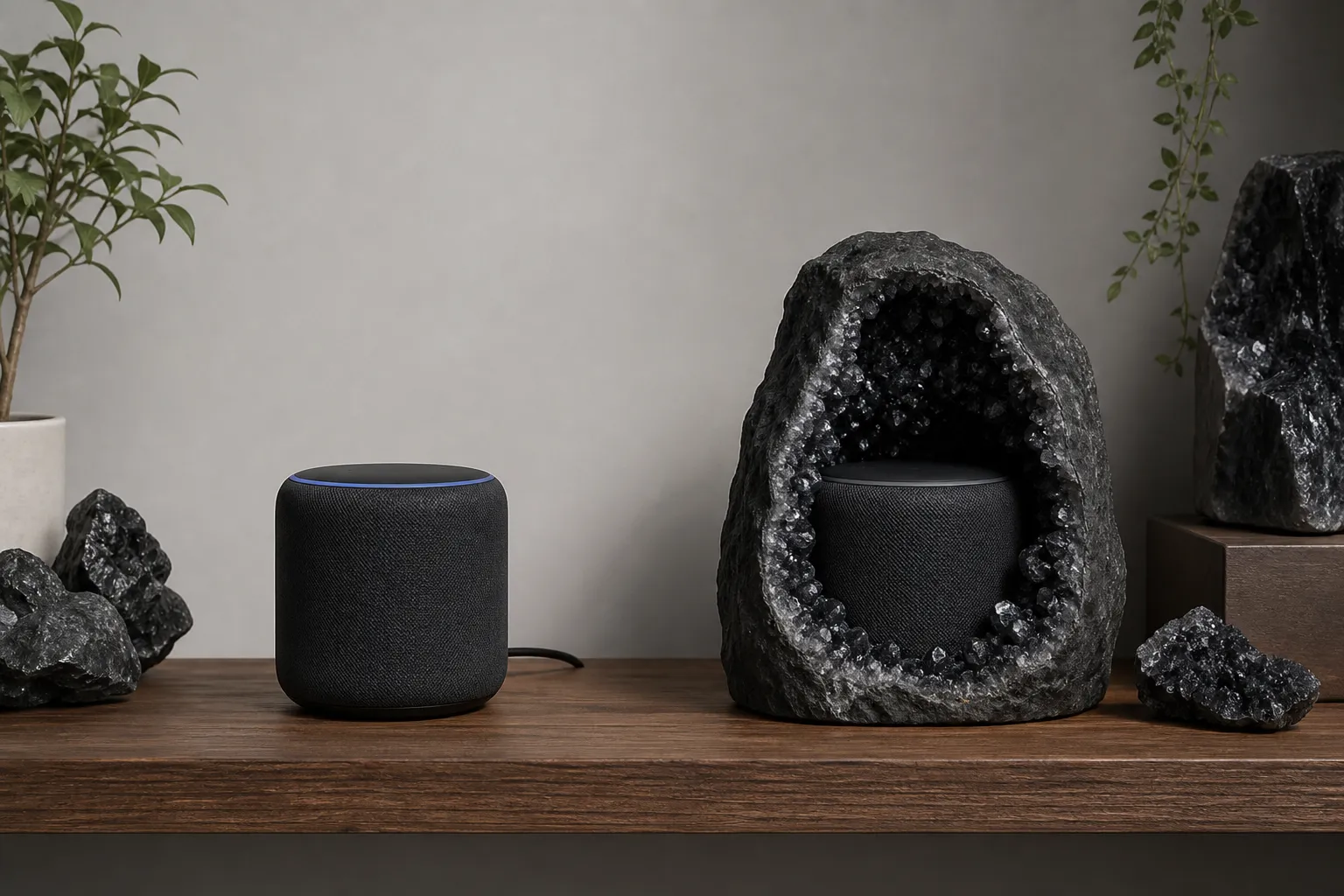
- A smart speaker near rough mineral forms, not buried inside them or pressed tightly against dense surfaces.
- A wall control on a matte, low-contrast wall plane rather than surrounded by glossy finishes.
- A sensor kept visibly clear while the nearby shelf, corner, or casing color reduces contrast.
- A display treated as one object in a sculptural arrangement, not the center of the vignette.
In these examples, the mineral element works through composition: weight, shadow, texture, and contrast. The device is still a device. It has not been turned into a hidden installation, and no claim is being made that surrounding stone improves how it functions.
Raw stone styling also works best when it feels intentional rather than crowded. One dark mineral piece can do more than a shelf full of decorative distractions. Geode-like decor forms may soften a device’s technical look, but too many reflective or dramatic pieces can make the arrangement feel staged. Matte surface design usually carries the idea more quietly than sparkle.
For black mineral styling, restraint matters. Dark objects can help small black devices recede, but they can also create a heavy cluster if every element has the same density. The more balanced move is usually to leave negative space around the technology, letting the palette calm the view without making the device hard to reach.
What Changes the Answer
The answer changes as soon as the device’s function depends on open space, visibility, sound movement, wireless behavior, heat release, or user access. Since this page does not have device-specific research, it should not make performance assumptions.
A few variables should guide the decision:
Device type
A control, speaker, router, camera, hub, and sensor do not have the same needs. Some may depend on line of sight, sound projection, wireless signal, or ventilation. Treat each device separately.
Nearby styling versus covering
Placing a mineral object beside a device is different from putting the device inside a stone box, behind a slab, under a cluster, or within a custom housing. Nearby styling is design. Enclosure is a technical change.
Heat and airflow
Powered devices may need open space around them. A raw mineral form can look stable and cool, but visual mass is not evidence of thermal behavior.
Wireless and sensor exposure
A device that looks better hidden may not perform the same way if its signal path, sensor view, microphone opening, camera view, or control surface is blocked. This page cannot verify which materials interfere, which do not, or by how much.
Mounting and permanence
Leaning a mineral object near a device is not the same as fastening stone, cutting into walls, recessing powered equipment, or modifying a fixture. Permanent work raises questions beyond styling.
Warranty and service access
A beautiful concealment idea can become impractical if the device cannot be reset, cleaned, updated, removed, or serviced. Manufacturer guidance should lead any decision that affects access or placement.
The cleaner rule is simple: style the view, but do not compromise the device.
Common Confusion Around Hidden Tech and Raw Stone
The most common misunderstanding is that “natural” or expensive-looking materials are automatically better for concealing technology. They are not. A raw mineral can make a device feel more grounded in the room, but it can also create problems if it becomes a physical barrier instead of a visual companion.
Another confusion is that heavier-looking objects always feel more discreet. Sometimes they do. A dark, irregular mineral surface can pull attention away from a smooth plastic device. But if the arrangement becomes too theatrical, the camouflage becomes the focal point. The room stops saying “quiet material composition” and starts saying “something is being hidden here.”
There is also a difference between hidden tech and de-visualization. Hidden tech suggests removal from sight. De-visualization is softer: the technology remains visible enough to function, but the room no longer organizes itself around it. For design-minded readers, that is often the more practical goal.
This matters in a stealth-wealth interior because the effect depends on ease. The technology should not look over-managed. Mineral-led styling works when it feels like the device happens to live among serious materials, not when it looks like a gadget has been forced into a decorative costume.
A Practical Styling Check
Before using raw mineral aesthetics for smart home device camouflage, pause over a few questions. These are not installation steps; they are a way to keep the design idea from drifting into unsupported assumptions.
- Can the device still be reached, reset, moved, cleaned, and identified?
- Are vents, openings, microphones, lenses, sensors, displays, buttons, and cables unobstructed?
- Does the mineral element sit near the device rather than enclosing or pressing against it?
- Would the arrangement still work if the device were replaced with a different size later?
- Is the visual effect coming from contrast, texture, and placement rather than from blocking function?
- If the idea involves wiring, mounting, recessing, heat, or permanent modification, has it moved beyond styling?
If the answer depends on how the device performs behind or inside a mineral form, this page cannot verify it. If the answer depends only on whether a textured surface, dark object, or sculptural grouping makes the device less visually loud, the idea remains within the design lane.
The Best Use of Raw Mineral Aesthetics
The best use of raw mineral aesthetics is adjacent, reversible, and honest. Let the mineral material carry the room’s mood: roughness against smooth plastic, matte depth against small LEDs, irregular form against manufactured symmetry, dark mass against lightweight device profiles. Keep the technology functional and accessible.
That is the practical version of Stealth Wealth Integration for smart home devices. It is not about pretending a router is a geode or turning a speaker into a stone sculpture. It is about making necessary technology less visually dominant through material context.
A smart home can feel calm without hiding every control point. Raw mineral styling gives the eye something slower and more tactile to read. Used carefully, it can make a device feel like part of the interior rather than an interruption. Used too aggressively, it crosses into claims about performance, installation, and device compatibility that are not supported here.
The most reliable answer is restrained: use mineral texture, shadow, matte surfaces, and object-like placement to quiet the look of smart home devices. Do not use raw minerals as a promise that the device will work better, sound clearer, run cooler, remain under warranty, or meet installation requirements. Visual camouflage is a design choice; technical concealment needs evidence, documentation, and, in some cases, qualified review.