Mindful Textures: How the Roughness of Raw Tourmaline Interrupts Anxious Thoughts
Raw black tourmaline can work as a small mindfulness cue because its rough surface gives attention something specific to land on: a ridge, a broken edge, a shadowed groove, a dull plane beside a glossier one. Here, Visual Micro-Orientation means using those tiny visible details as a present-moment anchor when anxious thoughts start looping.
The stone is not a medical anxiety treatment, and its mineral identity does not establish a special anxiety effect. The useful part is simpler: a particular object can interrupt abstraction. Instead of following another “what if,” you briefly study what is actually in front of you.
broader context
Broader schorl guide
This narrower page works best after the broader black tourmaline context page.
Why raw black tourmaline works well as an attention object
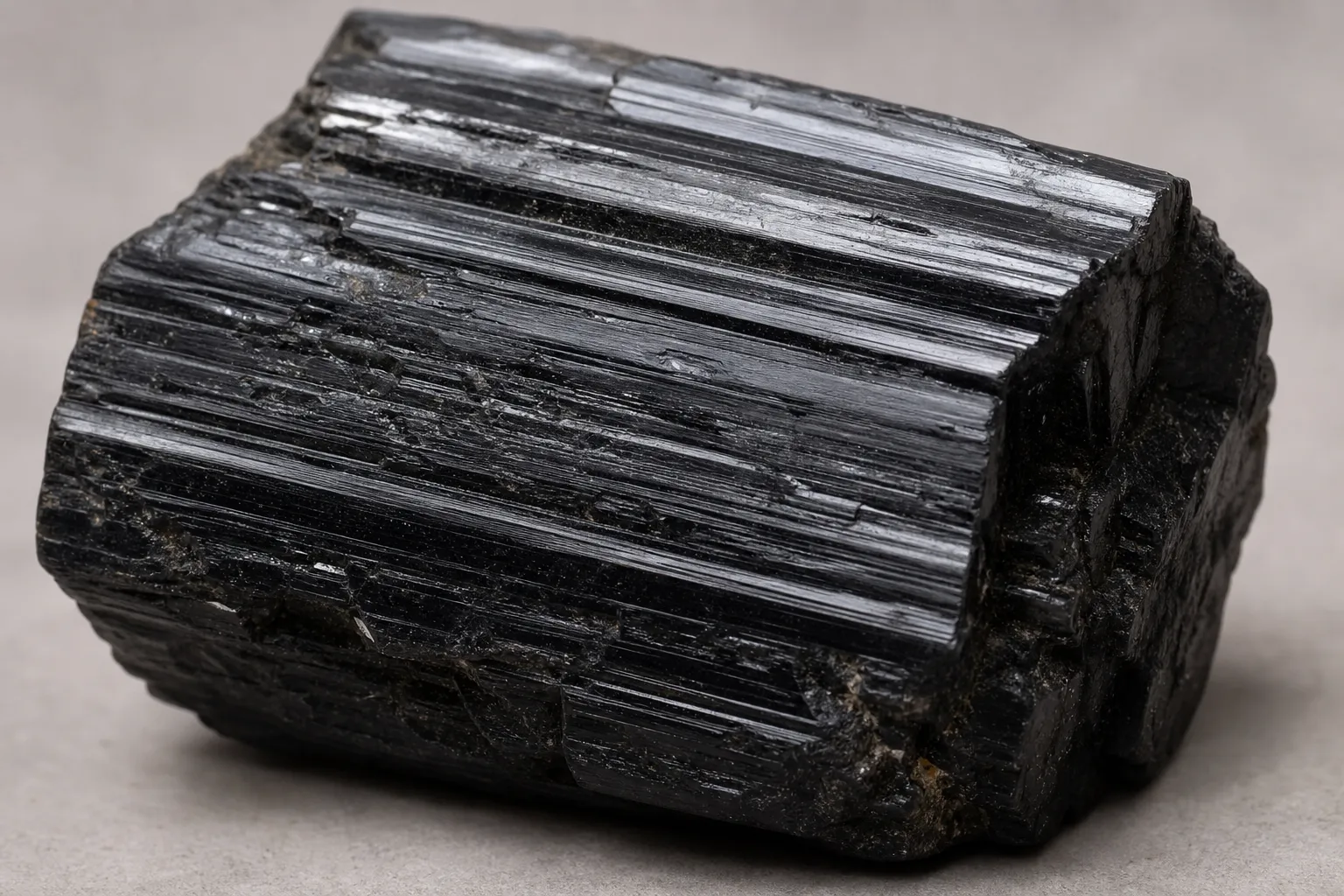
Raw black tourmaline has a different presence from a polished worry stone or a smooth decorative crystal. The common black variety is often discussed mineralogically as schorl, and in raw form it may show striations, fractures, broken terminations, chipped planes, and uneven surfaces. Those features matter because they give the eye and fingertips many small points of contact.
Anxious thought loops often pull attention into prediction, rehearsal, or self-monitoring. A rough stone cannot solve that pattern by itself, but it can become a practical interruption point. The mind is asked to do a simpler job: notice one visible feature, name it plainly, and return to the room.
That is the modest value of a rough stone mindfulness cue. It is not that raw black tourmaline is acting on anxiety. It is that its surface makes noticing easier. A polished stone may feel pleasant, but a very smooth surface can become vague after a few seconds: “smooth, cool, dark.” A raw piece offers more variation: “raised ridge, flat black face, gray scratch, triangular shadow, chipped corner.”
This is where geological aesthetics and mindfulness meet in a grounded way. The stone’s appeal does not need to be translated into claims about protection, energy, or guaranteed outcomes. Its dark, uneven form can simply be treated as a natural object with enough visual complexity to support a brief attention redirection practice.
A small Visual Micro-Orientation practice
This exercise is intentionally small. It is not a meditation program or a promise that anxiety will fade. It is a way to create a short pause when thoughts are moving too quickly.
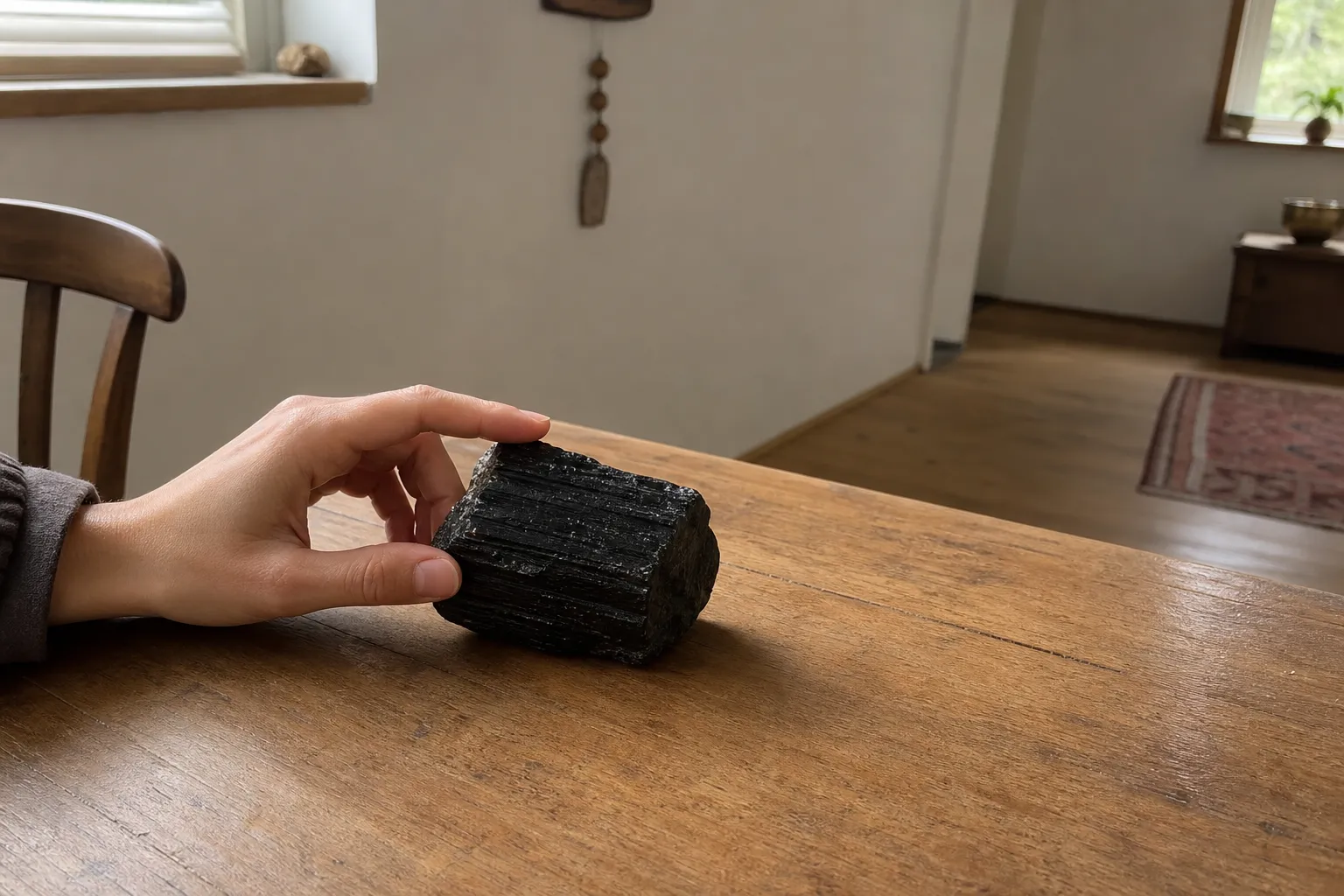
Place the raw tourmaline where you can see it clearly, or hold it gently if the edges are safe to touch. Then try this:
-
Choose one tiny area.
Do not study the whole stone. Pick one ridge, fracture, corner, or shadowed line.
-
Name only what is observable.
Use plain words: “black ridge,” “gray edge,” “matte surface,” “thin crack,” “small glint,” “dark hollow.” Avoid interpretation at first.
-
Let the eye trace the feature.
Follow one line from one end to the other. If the mind returns to the anxious topic, bring it back to the line without scolding yourself.
-
Add one breath without forcing calm.
Notice the inhale and exhale while still looking at the chosen detail. The goal is not to make the body feel a certain way. The goal is to reconnect attention with the present moment.
-
Widen the view.
After a few breaths, notice the table, your hand, the wall, the light in the room, or your feet on the floor. The stone is a doorway back to orientation, not the whole practice.
A useful internal phrase might be: “This is a ridge. This is a shadow. I am looking at this surface now.” That kind of wording keeps the exercise close to observable reality. It is different from telling yourself the stone will remove fear, absorb stress, or guarantee relief.
Why roughness can hold attention better than a smooth object
Roughness is not automatically better for everyone, but it can be helpful for this particular practice because it creates variation. Uneven stone surfaces contain small contrasts: high and low points, dark and lighter patches, straight lines interrupted by chips, ridges beside broken planes. The visual system has more to inspect, and the fingers, if used carefully, can detect changes in height, angle, and texture.
That variety supports an observable detail practice. Instead of asking the mind to become blank, the practice gives it a task:
Look here.
Notice this edge.
Track this shadow.
Find the point where glossy becomes dull.
Mindfulness education commonly describes practice in terms of attention, awareness, and returning to the present moment. The tourmaline is only an object within that broader idea. It may function like a leaf, a shell, a ceramic cup, a piece of bark, or a textured fabric. The difference is aesthetic and practical, not medically unique.
Rough versus smooth stones can also change the mood of the practice. Smooth stones often invite rubbing, repetition, and touch-based soothing. Raw tourmaline invites closer looking: the slow inspection of angles, shadows, and imperfect surfaces. For some people, that small shift from “comfort me” to “let me observe one real thing” is the interruption they are looking for.
What changes whether this helps in the moment
A raw black tourmaline texture cue is more likely to be useful when it is treated as a brief attention redirection object, not as a test of whether you can calm down.
The stone needs enough visible detail.
A very uniform or heavily coated piece may not offer much to study. Pieces with ridges, striations, chips, rough faces, and shadowed grooves are better suited to Visual Micro-Orientation because they provide multiple anchors.
Lighting matters.
A black surface can flatten visually in dim light. Side light often reveals more planes and texture. If the stone looks like a single dark mass, rotate it or place it near softer natural light so the edges and relief become visible.
Touch should be optional.
Some raw pieces are sharp, splintery, or crumbly. You do not need to rub the stone to use it. Visual attention alone is enough. If you do touch it, use a stable piece with edges that will not scratch skin.
The practice works best early in the loop.
A small mindfulness cue may be most useful when you first notice repetitive thinking. If anxiety has become intense, disorienting, or panic-like, a tiny object practice may be too small for the moment.
The wording should stay neutral.
If you turn the stone into a demand — “This has to calm me down” — the object may become another source of pressure. It is usually better to frame the practice as: “I am giving my attention one present thing to notice.”
Common misunderstanding: the stone is not the mechanism
Black tourmaline is often surrounded by cultural and market language about grounding, protection, and calm. Readers may arrive with those associations, and it is understandable that a dark, weighty, raw mineral can feel symbolically steady. But symbolism is not the same as evidence.
The supported claim is narrower: a textured object can be used as a mindfulness cue because it helps direct attention toward present-moment sensory detail. The available sources do not directly study raw tourmaline, schorl roughness, Visual Micro-Orientation, or self-guided crystal use for anxious thought loops.
That does not make the practice useless. It simply places it in the right category. It is a personal attention ritual, similar in scale to looking at a candle flame, tracing the grain of wood, noticing a plant leaf, or naming objects in a room. The object can matter aesthetically and emotionally, but the mechanism should be described modestly: it may help redirect attention for a moment.
This distinction also protects the practice from becoming fear-based. You do not need to believe the stone is absorbing anything or guarding you from anything. You can use it because its roughness is visible, touchable, and specific.
When to stop and choose more support
A rough stone mindfulness cue is small by design. It may help create a pause, but it should not be treated as enough support for persistent or severe distress.
Consider stepping away from the stone practice and seeking qualified mental-health support if anxiety is ongoing, worsening, interfering with daily life, connected with panic symptoms, or accompanied by thoughts of self-harm or not being safe. In an immediate danger situation, emergency or crisis support is more appropriate than any object-based practice.
Also stop or modify the exercise if close observation makes you more self-critical, tense, or fixated. If looking at the stone becomes another loop — checking, testing, waiting for relief — shift to a simpler orientation: name five objects in the room, feel your feet on the floor, or speak with someone you trust.
The point is not loyalty to the object. The point is returning to a workable relationship with the present moment.
The shortest version
Use the raw tourmaline as a cue, not a promise.
Look for one ridge.
Name one shadow.
Trace one edge.
Take one breath.
Return to the room.
That is the whole scale of Visual Micro-Orientation. The roughness of raw black tourmaline can interrupt anxious thoughts by giving attention a precise, physical detail to follow. It does not need to claim more than that to be useful.