Material comparison
Black Tourmaline vs. Onyx: How to Tell the Difference Scientifically
A polished black stone may be sold as black tourmaline, schorl, black onyx, or simply a black stone. Those labels are not interchangeable. Schorl is the mineralogical term for the black tourmaline species, while onyx belongs to the chalcedony and quartz context. Because both can appear dark, opaque, smooth, and reflective, appearance alone cannot reliably identify an unknown specimen.
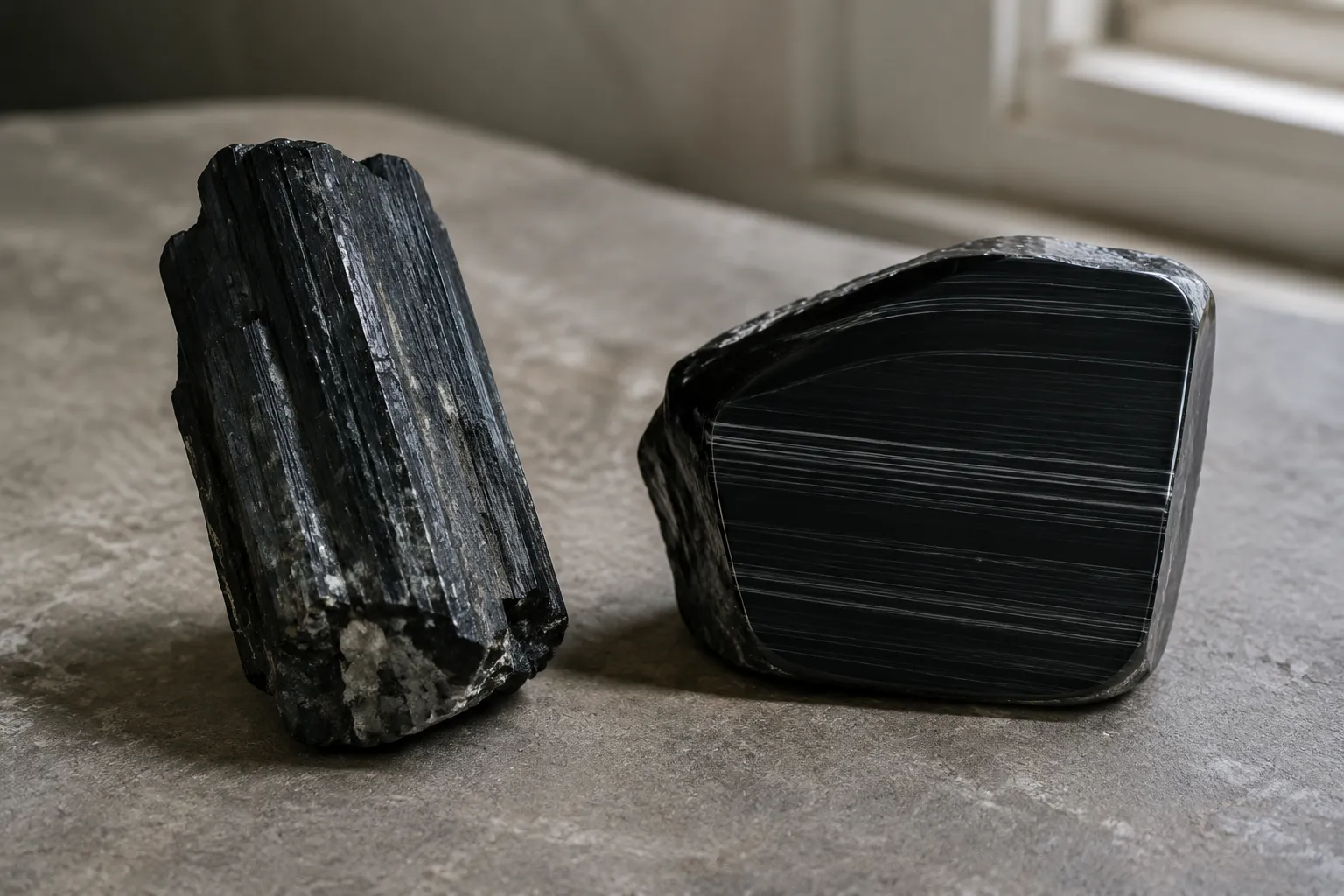
Schorl
A member of the tourmaline group, associated with black tourmaline.
Onyx
A banded form of chalcedony, a microcrystalline form of quartz, in gemological terminology.
Black onyx
A common market description that still needs specimen-specific context.
The Handbook of Mineralogy entry for schorl, GIA's onyx reference, and the USGS overview of quartz support this categorical difference. They do not, by themselves, establish the identity of an individual black stone from a photograph or retail label.
broader context
Black tourmaline context note
This narrower page works best after the broader black tourmaline context page.
The Main Difference: Schorl and Onyx Are Different Materials
Schorl belongs to the tourmaline-group minerals. Its mineral identity relates to composition, internal structure, crystal habit, and physical properties. In a rough specimen, elongated prismatic crystals and lengthwise striations may be visible. Cutting, tumbling, polishing, or wear can remove or obscure those features.
Onyx is discussed within the chalcedony and quartz family. Chalcedony consists of very small intergrown quartz crystals, and onyx terminology generally refers to patterned or parallel-banded chalcedony. A dark polished piece may show little of that structure from the viewing angle, especially when the visible face is uniform or heavily finished.
This is why “black crystal” and “black stone” are useful reader or retail terms but weak mineralogical descriptions. “Schorl” points to a mineral species; “black onyx” describes a material category whose exact interpretation still depends on the specimen and its treatment history.
Why Appearance Is Non-Diagnostic
Color creates the confusion. A dark schorl crystal and a dark onyx cabochon can both look black under ordinary indoor lighting. Polish can add a similar reflective surface, while camera exposure and background can change the apparent color in a photograph.
Visual observations may help form an initial hypothesis, but each observation has a clear limitation:
Observation
What it may suggest
Limitation
Lengthwise striations on a rough crystal
A tourmaline-like habit consistent with schorl
Polishing, breakage, and wear may hide the feature
Parallel color bands
An onyx or banded chalcedony context
A black finished piece may show weak or no visible banding
Uniform black color
A dark decorative material or black trade label
Uniform color is not a mineral identification
Glassy or waxy-looking polish
A surface luster observation
Finishing can alter how different materials appear
A heavy or light hand feel
A reason to investigate density-related properties
Hand weight is not measured specific gravity
A photograph is more limited still. Lighting, polish, camera processing, and image background can conceal inclusions, joins, banding, and surface treatments. Appearance can narrow the possibilities, but it should not be treated as a final identification.
Physical Clues and Their Limits
Mineral identification may consider crystal habit, hardness, fracture behavior, specific gravity, streak, luster, and other properties. Each is a clue within an examination, not a consumer pass-fail answer.
Crystal habit and striations
Rough schorl commonly appears as an elongated crystal with lengthwise striations. If those structures are preserved, they may be consistent with schorl rather than a typical polished onyx piece.
The condition matters. A bead, cabochon, tumbled stone, or worn fragment may no longer retain its original crystal form. The absence of striations does not make a specimen onyx, and their presence should still be considered alongside the material's other evidence.
Fracture identification
Fracture identification concerns how a mineral breaks, rather than how it separates along a repeated cleavage plane. Fracture behavior can contribute to mineral identification, but deliberately breaking a finished stone is not a proportionate casual test.
A broken edge may be difficult to interpret after cutting, abrasion, polishing, or accidental damage. The specimen may also be treated, composite, mounted, or valuable. For an intact object, fracture observation is best treated as a limited feature of an examination, not as a reason to damage the material.
Hardness
Hardness is often included in discussions of black tourmaline versus onyx because it can help distinguish minerals with similar appearances. A scratch result has several weaknesses, however:
- The surface may contain polish, residue, coating, or treatment.
- The mark may affect the finish rather than the underlying material.
- An unknown testing object may leave a misleading mark.
- A scratch can damage the specimen without resolving its identity.
- One result cannot account for composites, mixtures, or inaccurate labeling.
Hardness therefore belongs within a broader examination. The supplied material establishes it as a relevant property, but it does not provide a verified testing protocol or a specimen-specific threshold for a casual home decision.
Specific gravity
Specific gravity compares a material's density with the density of water. In a schorl-versus-onyx comparison, a measured density can be more informative than color or hand feel because it relates to the material itself.
Measurement still depends on the specimen and equipment. Surface condition, dimensions, porosity, hollow spaces, attached components, composite construction, and treatment can affect the result. A hand-held impression of weight is not specific gravity; it is only a subjective observation.
The available source set does not verify exact values or a complete measurement procedure for this page. Any numerical comparison should be checked against the full mineralogical and gemological references before it is used to make a decision about a particular specimen.
The Labels Are Part of the Confusion
Black-stone naming usually mixes three kinds of language:
- 1. Mineralogical terms: names such as schorl that identify a mineral species or group.
- 2. Gemological terms: material and variety names such as onyx and chalcedony.
- 3. Market language: broad descriptions such as black stone, black crystal, and black onyx.
A product listing may use the most familiar term for shoppers. That explains why visually similar pieces can carry different labels, but the label is not a substitute for examination.
“Black onyx” should therefore be read as a material description that requires context. It may be used for dark beads, cabochons, carvings, or interior objects, while the phrase alone says little about the exact specimen. The same limitation applies to “black tourmaline” when a listing offers no useful description of crystal habit, construction, locality, or examination.
The practical question is not which label sounds more convincing. It is what observable and measured evidence supports the label, and how much uncertainty remains.
A Bounded Way to Examine an Unknown Piece
For an everyday, low-value object, begin with non-destructive observations:
- 1. Record the label exactly as given: schorl, black tourmaline, onyx, chalcedony, or only black stone.
- 2. View the piece under neutral light and note crystal habit, striations, banding, inclusions, polish, seams, and visible joins.
- 3. Record whether it is rough, cut, drilled, tumbled, mounted, coated, or combined with another material.
- 4. Treat any hardness, fracture, or density-related result as limited evidence.
- 5. Compare the observations with mineralogical and gemological references, rather than relying on photographs alone.
Avoid destructive, chemical, heat-based, or otherwise risky testing when the piece may be valuable, treated, composite, or collectible. A specimen-specific examination may be appropriate when material identity affects value, provenance, treatment questions, or an irreversible testing decision.
The distinction between schorl and onyx is scientifically meaningful, but a source description is not an analysis of the stone in your hand. Without suitable equipment, intact material, and enough context, a visual comparison can remain only a reasoned possibility.
The Short Answer
To distinguish schorl from onyx, begin with their categories:
- Schorl is the black tourmaline mineral term.
- Onyx belongs to the chalcedony and quartz context.
- Black color, polish, translucency, hand weight, and a retail label cannot identify either material independently.
- Crystal habit, striations, fracture behavior, hardness, and specific gravity may provide useful clues, but each has conditions and limits.
- Professional examination may be appropriate when treatment, composite construction, value, provenance, or possible specimen damage matters.
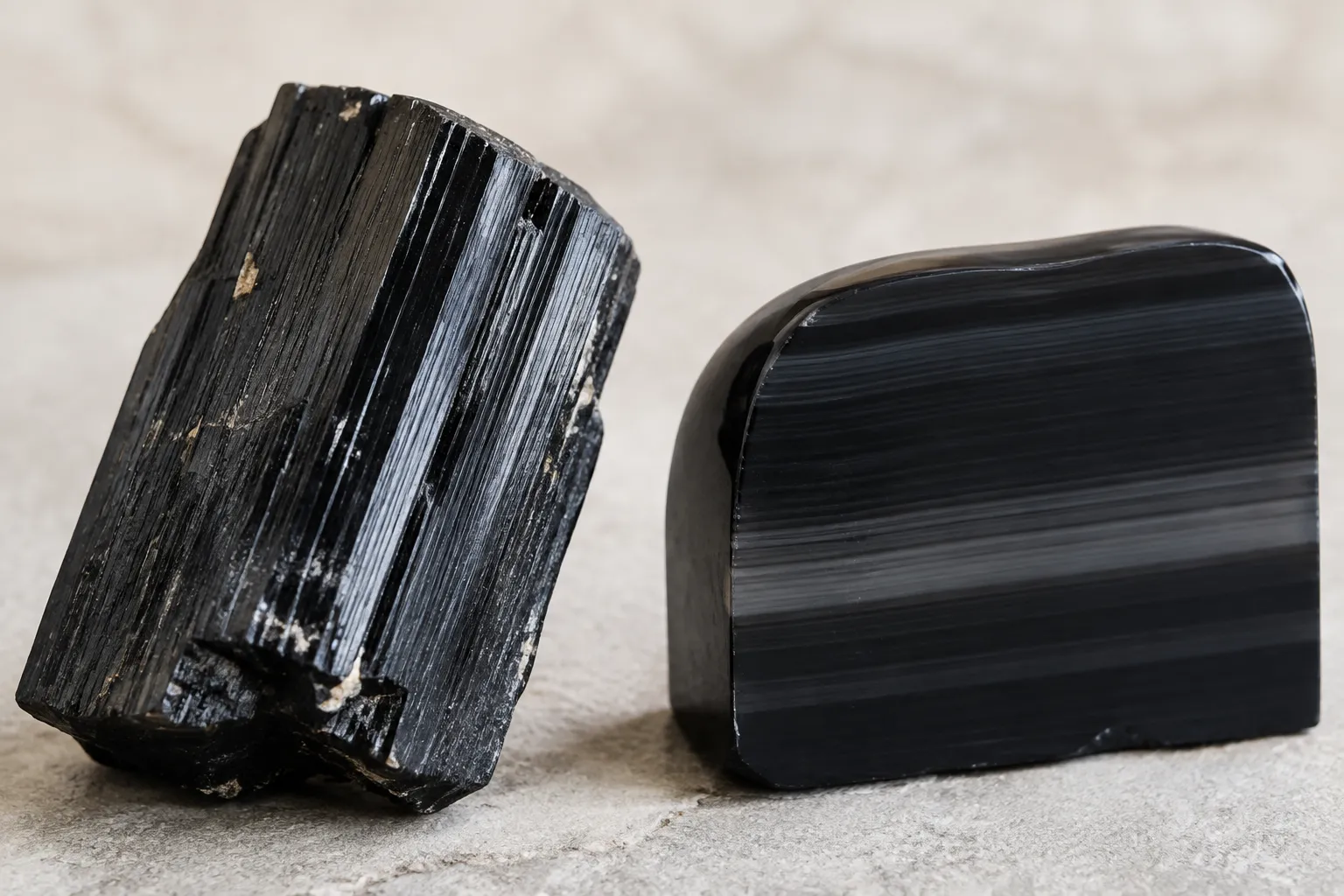
Schorl before symbolism keeps the question grounded in material evidence. Onyx terminology clarifies the quartz-side comparison; careful observation keeps a similar black surface from becoming a premature identification.