The Trauma-Informed Home: Creating 'Landing Pads' with Unyielding Minerals
A trauma-informed home does not need to look clinical, and a mineral object cannot make a room therapeutic. In Trauma-Informed Interior Architecture, a “landing pad” is better understood as a predictable, choice-preserving place to pause: a corner, surface, or small arrangement that is easy to find, physically manageable, and open to change.
An unyielding mineral such as black tourmaline may serve as one optional visual or tactile cue when its weight, texture, appearance, and personal meaning suit the person using the space. The useful question is not what the stone can do to someone. It is whether the surrounding arrangement supports privacy, orientation, sensory compatibility, perceived control, and the freedom to approach, move, remove, or ignore the object.
That distinction keeps mineral facts, symbolic meaning, and trauma-informed design from becoming one unsupported promise.
broader context
Black tourmaline context note
This narrower page works best after the broader black tourmaline context page.
What a “landing pad” means at home
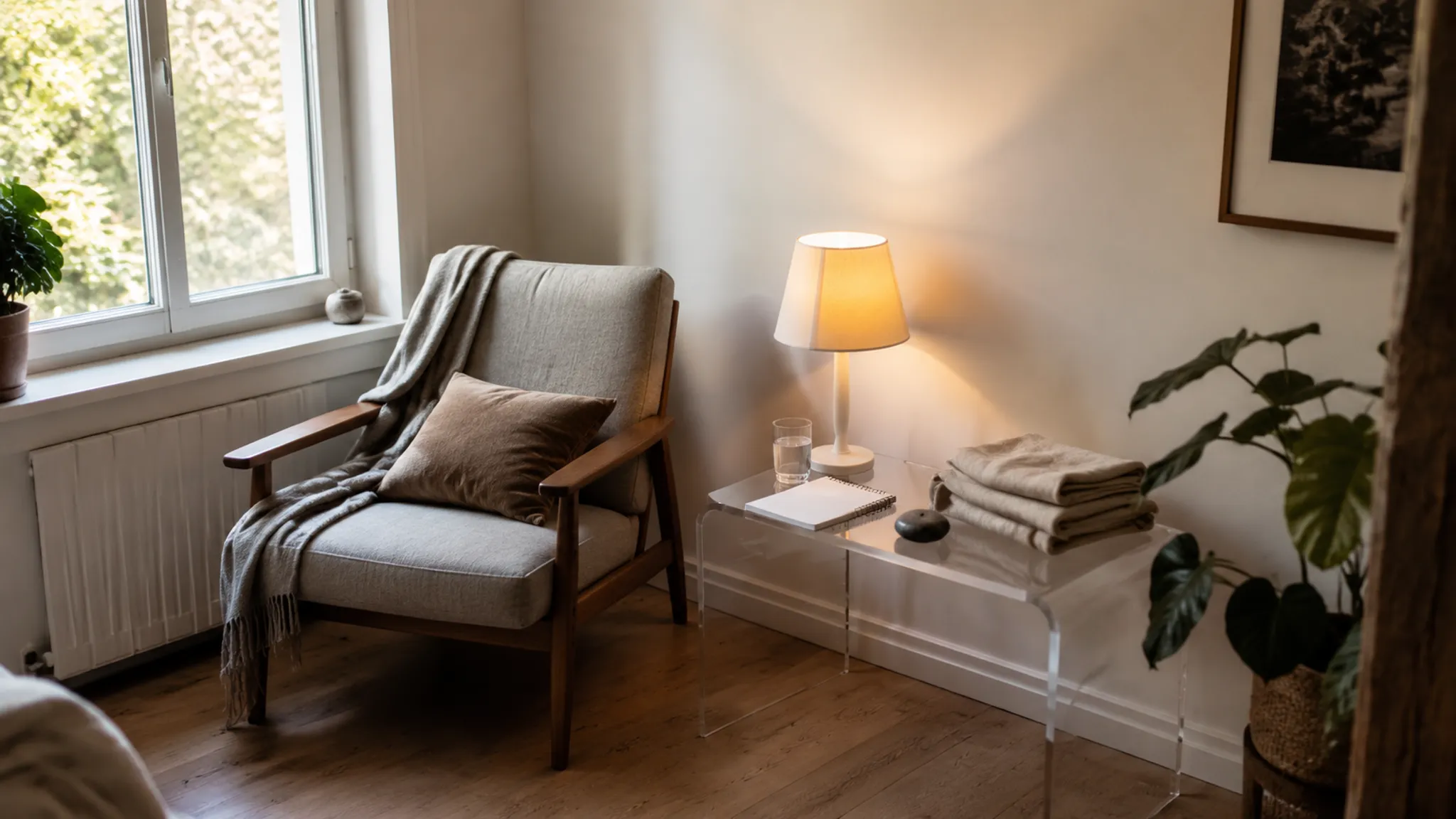
A landing pad is an environmental arrangement that gives a person a repeatable place to pause without prescribing what they should feel or do. It might be a chair beside a window, a clear section of a bedside table, a low shelf near an entryway, or a small surface with a lamp, notebook, fabric, water, or another familiar object.
Its value is in the arrangement’s legibility. The place is recognizable, its basic contents do not change unpredictably, and the person can decide whether to sit there, look at an object, touch it, or leave it alone. Nothing about the setup needs to be treated as a clinical exercise.
This is consistent with broad trauma-informed principles such as trust, collaboration, empowerment, choice, and predictability. Applied to a home, those principles mean the design should not force exposure, remove privacy, or turn one corner into a required emotional routine.
A landing pad names a kind of place, not a guaranteed psychological effect.
The conditions that make the arrangement usable
The mineral is the smallest part of the decision. Placement and control usually matter more.
Predictable placement
A landing pad works best when its location and basic composition remain stable enough to be recognized. A clear surface along a familiar route may be more usable than an elaborate display that is constantly rearranged.
Predictability does not require rigid order. It means the person can reasonably expect the same chair, shelf, light, or object to be available. Keep the arrangement visually legible. An object hidden behind clutter, sealed in a difficult container, or placed where it requires searching may be less practical.
The aim is not to create a ritual with rules. It is to make one possible place to pause apparent.
Choice and reachability
Access alone does not create choice. The person should be able to decide whether the object is visible, reachable, covered, moved, or absent. A heavy specimen placed permanently in the center of a shared room may be stable, yet still feel imposed.
- Visible from a seated position.
- Close enough to reach without stretching or navigating obstacles.
- Farther away if proximity feels intrusive.
- Stored in a drawer or box when visual presence is unwanted.
- Removable without asking another person for permission.
The setup should accommodate refusal. If the mineral becomes irritating, distracting, symbolically loaded, or physically inconvenient, removing it is a valid design decision. Continued use is not a measure of commitment.
Privacy and control
A pause space does not have to be isolated, but it should offer some control over observation and interruption. A chair angled away from a busy passage, a small screen, a curtain, or a position with a clear view of the doorway may change how exposed the space feels. These are contextual possibilities, not universal rules.
Shared homes require negotiation. One person’s meaningful object may be another person’s clutter, trigger, hazard, or unwanted symbol. Agree on where it can remain, who may move it, and how it can be stored. Collaboration matters more than visual consistency.
In domestic settings, trauma-informed built-environment principles become ordinary design questions: who controls the light, whether the route is clear, whether the door can close, and whether the person can leave the arrangement unchanged or alter it immediately.
Sensory fit
An object that looks grounding in a photograph may be uncomfortable in a real room. A dark surface can feel visually quiet to one person and heavy or stark to another. A ridged surface may invite touch or make touch unpleasant. Weight can make an object feel substantial, but it can also make it difficult to move.
Check the actual sensory relationship:
- Does the color blend with the room or demand attention?
- Is the surface comfortable to look at or touch?
- Does the object collect dust or require handling that feels unpleasant?
- Does its mass crowd the surface?
- Does the lighting reveal its form without glare?
- Can the person choose distance from it?
There is no universally soothing material. “Soothing environments” should describe a possible response, not a property guaranteed by a particular stone, color, or design style.
Where black tourmaline can fit
A mineral can act as a physical anchor in the narrow, observable sense: it is a stable object that occupies space, can be seen, and may be touched if the person chooses. It does not need a therapeutic explanation.
Black tourmaline is a mineral-group name, while schorl is a relevant mineralogical term for a commonly referenced black tourmaline species. GIA and Mindat can help keep those terms distinct, while also separating a specimen’s color, variety, and mineral identity from the meanings later attached to it.
For interior use, the practical qualities are simpler:
- A clearly defined shape.
- A surface that is tolerable for the intended user.
- Enough stability for the chosen location.
- A size that does not obstruct a route or usable surface.
- Visibility that can be adjusted.
- Personal meaning that remains optional.
“Unyielding” can describe the object’s material presence: dense, solid, and resistant to casual deformation. It should not be turned into a claim that the object creates emotional strength, blocks danger, or changes a person’s internal state. Durability describes the material; it does not establish a mental-health effect.
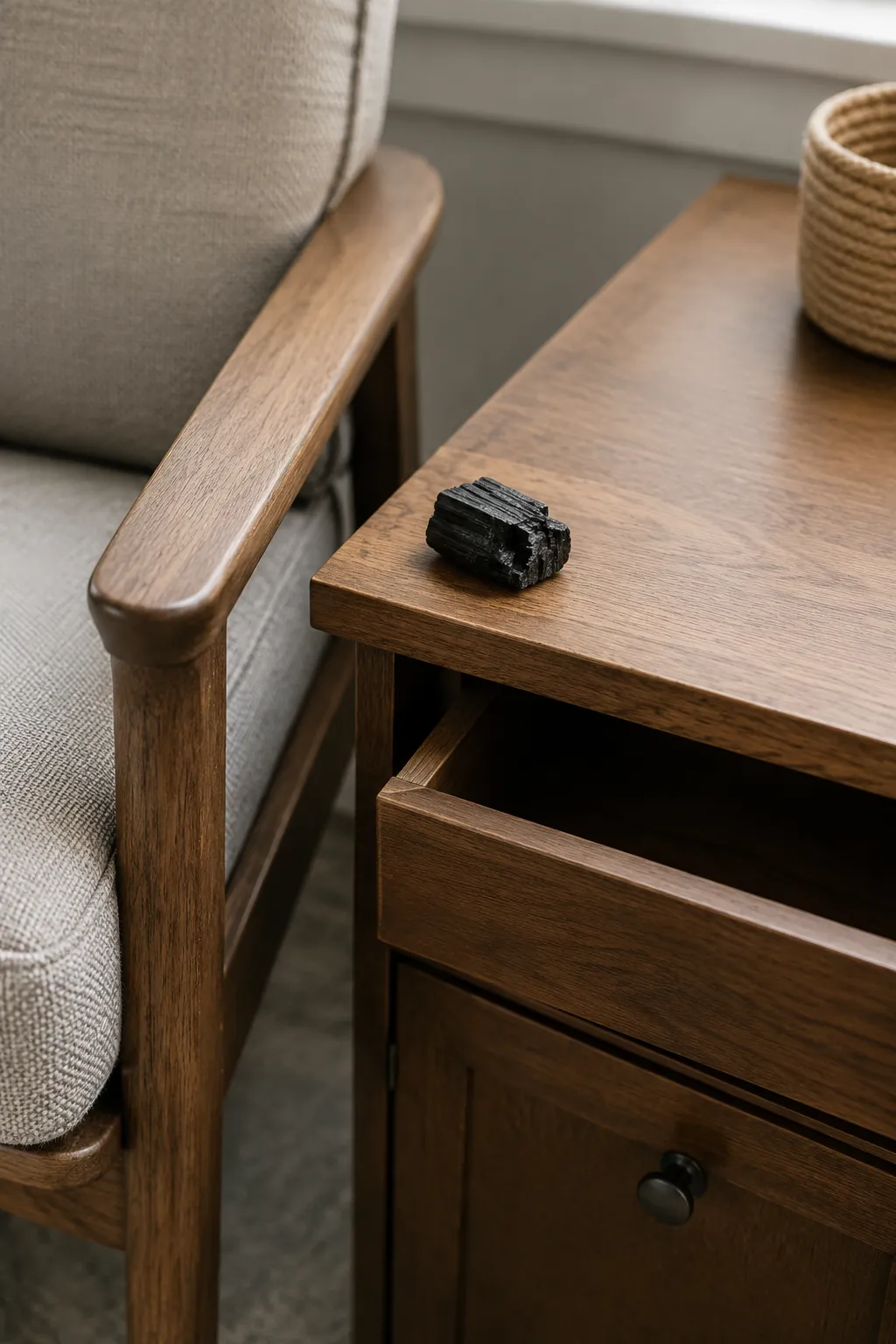
One person might keep a small specimen on a side table beside a chair, where it is visible but out of the way. Someone else might prefer it in a pocket, drawer, or closed cabinet, making it available without placing it in the room’s visual field. Both arrangements can fit a trauma-informed interior approach because control over contact remains with the user.
What changes the answer
The same object can support one person’s sense of orientation and make another feel watched, crowded, reminded, or pressured. Personal associations matter, but they are not automatically shared by everyone who enters the room.
The room’s function also changes the decision. An entryway arrangement may help organize arrival and departure through familiar placement. A bedroom may call for greater privacy and lower visual stimulation. In a shared living room, negotiation may be the central issue. In a narrow hallway, physical clearance comes first.
Reconsider the arrangement when:
- The object is always in the way.
- The person cannot move it freely.
- Other household members assign unwanted meaning to it.
- The setup attracts attention or questions.
- Its visual or tactile qualities become overstimulating.
- The landing pad starts to feel like a required performance.
- The object is being used to avoid needed professional or social support.
These are signs that the arrangement no longer fits the person, room, or household. They are not evidence that the mineral itself has succeeded or failed.
Common confusion: material fact versus meaning
Mineral objects are discussed through several overlapping vocabularies. Mineralogy describes composition and classification. Gemology may discuss appearance and variety. Interior design considers scale, texture, contrast, and placement. Spiritual or wellness markets may assign symbolic meanings.
Those languages should remain separate.
It is reasonable to say that someone personally associates a black mineral with steadiness, privacy, or a threshold between activities. It is not reasonable to present that association as universal, clinically meaningful, or established by the mineral’s physical identity. A stone’s classification does not validate a spiritual interpretation, just as symbolic meaning does not identify a specimen.
A visible object may be part of a person’s chosen environment for pausing and reorienting, but the available material does not establish that minerals prevent dissociation, relieve trauma-related symptoms, or regulate the nervous system. A room arrangement should not be presented as a substitute for therapy, medical care, crisis support, or professional assessment.
A small decision check before placing the object
Can the person choose whether it is present?
It should be possible to display, cover, relocate, or remove the object.
Is the location predictable without becoming restrictive?
The object should be easy to find while the arrangement remains adaptable.
Does it fit the sensory environment?
Consider color, shine, texture, weight, temperature, and visual prominence.
Does it preserve privacy and movement?
It should not obstruct a route or force interaction in a shared space.
Is its meaning clearly personal rather than universal?
Symbolism may matter to the user, but it is not a fact about the mineral.
What is the exit option?
Decide how the arrangement can change if it becomes uncomfortable.
The most useful verification point is simple: ask the person who uses the space, not the object, whether the arrangement remains tolerable and controllable. Preferences can change from day to day.
A trauma-informed home is built less around special materials than around agency made visible in the room. A schorl specimen can occupy one small role: a durable, tactile, personally meaningful cue within a predictable place to pause. Its usefulness remains experiential and conditional. The larger design work is carried by visibility, reachability, privacy, sensory fit, and the freedom to reject the arrangement entirely.