Schorl physical maintenance
Why Ultrasonic Cleaners Destroy Black Tourmaline's Internal Structure
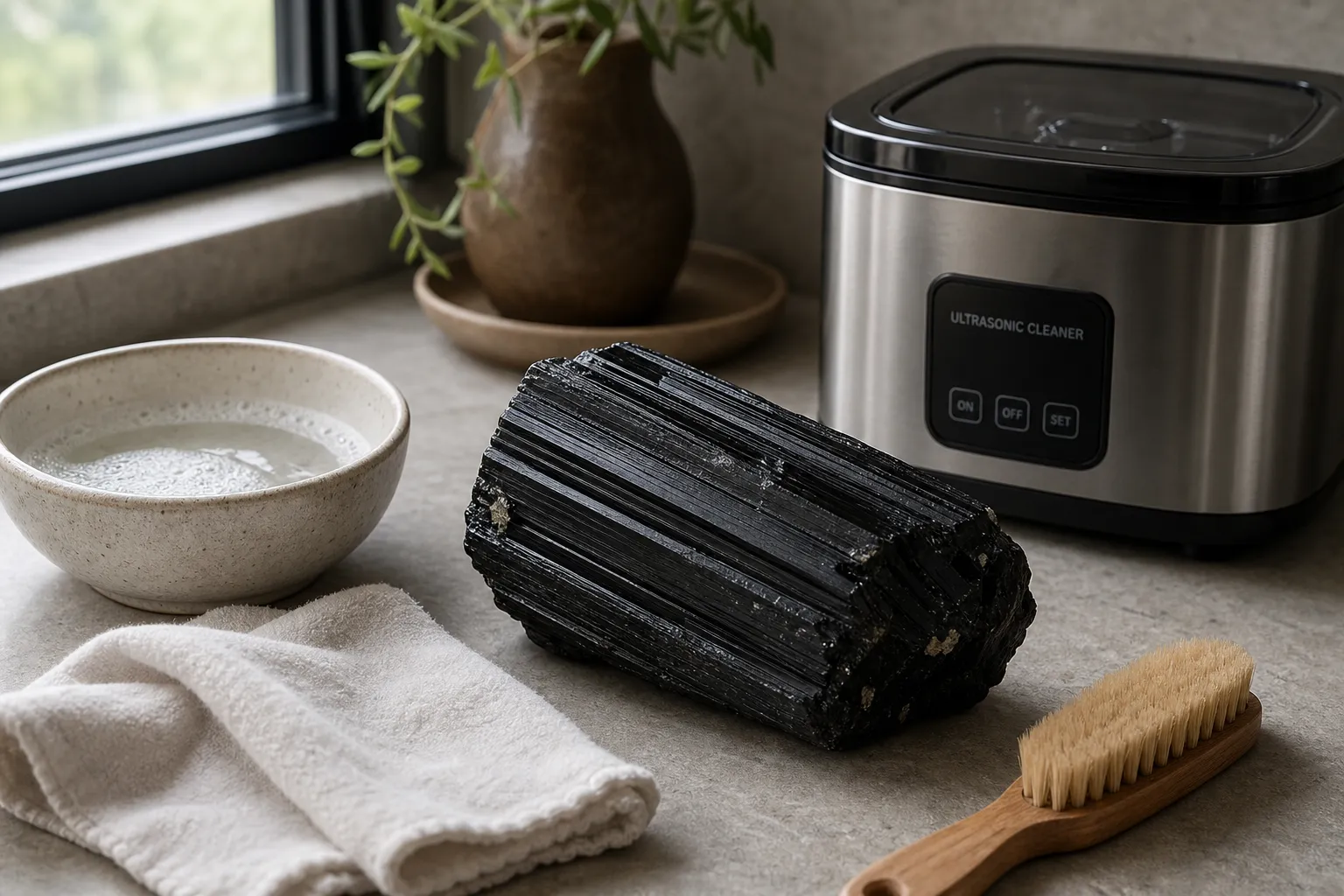
Black tourmaline can look tougher than it really is for cleaning. A schorl crystal may be dark, dense, ridged, and hard enough to resist many ordinary scratches, yet still carry weak points inside the stone. For Schorl physical maintenance, that is the key distinction: ultrasonic cleaning is risky because internal fractures, micro-cracks, fragile inclusions, liquid inclusions, filled areas, heat sensitivity, and stress around repairs can matter more than Mohs hardness.
The practical answer is simple: do not assume a hard-looking black tourmaline specimen is ultrasonic-safe. The better supported routine method for tourmaline is warm soapy water, especially when the stone is included, cracked, mounted, sentimental, treated, or of unknown history.
broader context
Broader schorl guide
This narrower page works best after the broader black tourmaline context page.
The Problem Is Not Hardness Alone
Tourmaline is commonly listed at Mohs 7 to 7.5. That number describes scratch resistance; it does not tell you how a particular stone will respond to vibration, warmth, pressure changes in a cleaning bath, or stress concentrated around inclusions.
This is where black tourmaline can mislead the eye. Schorl often forms in strong-looking columns with striations and a matte-to-glassy surface. A rough piece may feel solid in the hand, while a polished bead or pendant may look uniform under room light. Neither impression proves the interior is clean, unfractured, untreated, or free of liquid inclusions.
An ultrasonic cleaner does more than wipe the surface. It exposes the stone and setting to rapid mechanical activity in liquid, often with warmth from the solution or machine cycle. The available public care guidance does not prove that every ultrasonic cleaner will break every black tourmaline piece. The risk is conditional: when a stone already has cracks, fragile inclusions, filled fractures, or heat-sensitive features, aggressive cleaning may aggravate weaknesses already present.
Mohs hardness helps explain why tourmaline may resist scratching. It does not guarantee resistance to internal stress.
Why Black Tourmaline Can Fail From Inside
A clean-looking black surface can hide a complicated interior. In schorl physical maintenance, the better question is not “Is this stone hard?” but “Where could stress collect?”
Micro-cracks and fractures
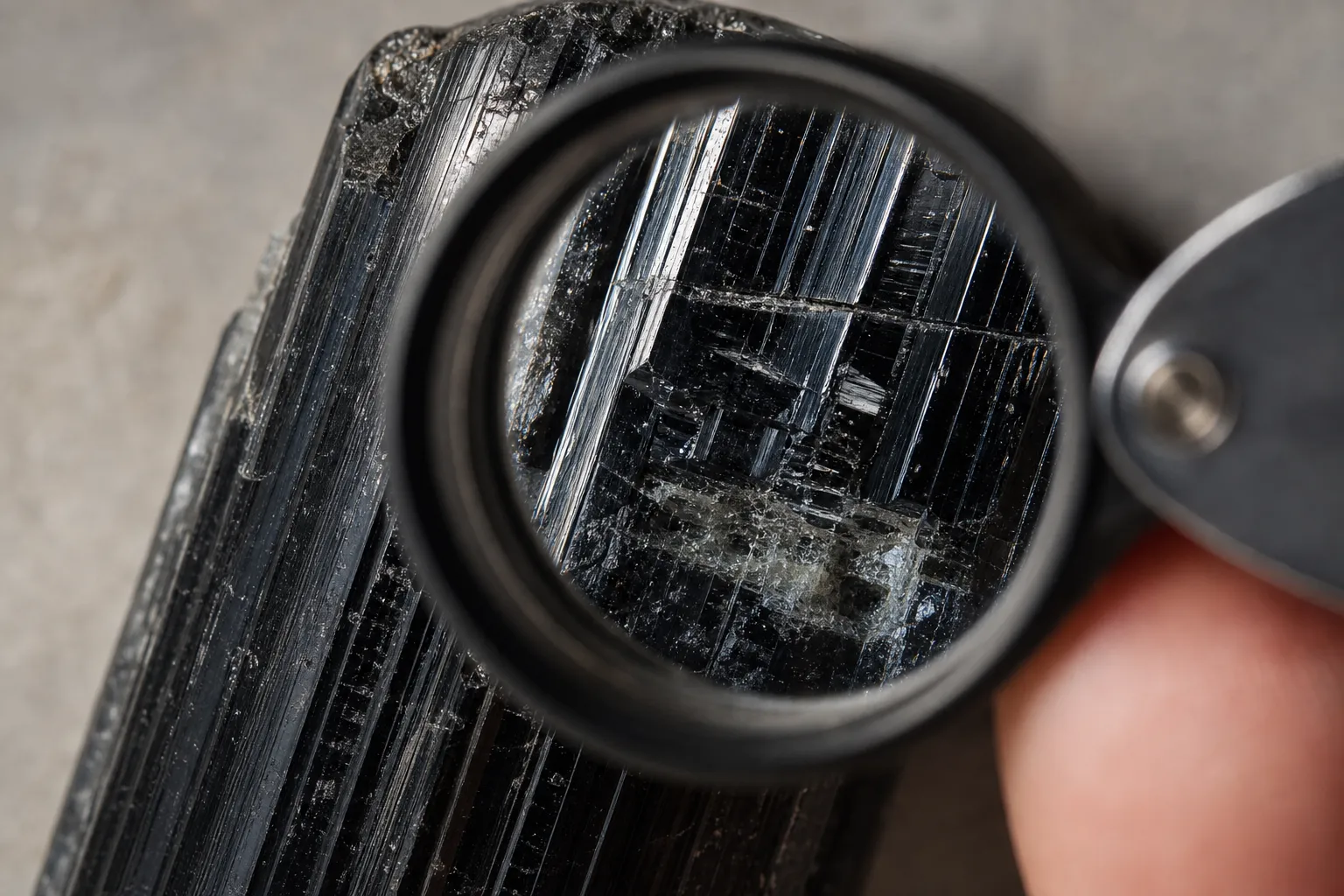
Micro-cracks are small separations that may be hard to see without magnification. Visible cracks are easier to notice, but black body color can hide contrast. Once a crack exists, cleaning stress does not need to create a new flaw from nothing; it may only need to extend a pathway already there.
Stress concentration
A fracture can become a line where stress concentrates. During careful hand cleaning, that line may never matter. In a more forceful cleaning environment, it becomes a reason to pause.
Inclusions and liquid inclusions
Some inclusions are solid mineral features; others may be fragile, irregular, or connected with tiny internal spaces. Liquid inclusions deserve special caution because tourmaline care guidance notes heat sensitivity and vulnerability where abundant liquid inclusions are present.
Filled areas and unknown treatments
A stone may have been stabilized, repaired, glued, or otherwise worked before it reached the owner, especially in jewelry or broad marketplace pieces. That does not mean all black tourmaline is treated. It means unknown history makes ultrasonic cleaning harder to justify.
The available evidence supports cautious wording here: ultrasonic cleaning may worsen existing internal damage, especially in included or fractured stones, but it does not establish a predictable failure rate for black tourmaline. For a dark stone with inclusions, fractures, repairs, or unclear treatment history, the conservative choice is manual cleaning.
When Ultrasonic Cleaning Is Hardest To Defend
Skip ultrasonic cleaning when any of these conditions apply:
- The stone has visible cracks, chips, open seams, or rough break lines.
- The interior shows strong inclusions, cloudy zones, reflective planes, or uneven texture.
- The specimen is mounted in jewelry and its repair or treatment history is unclear.
- The stone may have filled fractures, resin, oiling, glue, or repaired settings.
- The piece has abundant liquid inclusions or a seller description that emphasizes inclusions.
- The object is sentimental, difficult to replace, or part of a room arrangement where a faster clean offers little benefit.
This applies across common forms of black tourmaline: rough schorl, tumbled stones, polished beads, pendants, rings, mixed-mineral specimens, and decorative pieces used in biophilic interiors. The form changes the handling details, but not the main boundary. If the interior is uncertain, the ultrasonic cleaning risk is not balanced by much reward.
Mounted jewelry needs extra caution because the tourmaline is not the only material in the piece. Prongs, glue, repaired areas, nearby gems, and residue under settings can all complicate cleaning. A jeweler or gemologist may inspect a piece more directly than a home owner can under ordinary light, but inspection still reduces uncertainty rather than removing it completely.
The shortest rule is this: the less you know about the stone’s internal condition, the less sense an ultrasonic cycle makes.
Why Steam Is Not The Better Fallback
Some owners avoid ultrasonic cleaning and reach for steam instead, assuming heat and pressure are cleaner because there is no vibrating bath. For black tourmaline, that is not a safer substitution.
Tourmaline care guidance treats heat sensitivity as a real concern. Heat can damage tourmaline, and gems with many liquid inclusions may respond poorly to heating. Steam cleaning brings heat directly into the cleaning decision, which is the wrong direction when the stone may contain internal fractures, liquid inclusions, or unknown filled areas.
Thermal shock is the plain-language concern: a stone, fracture, or inclusion system may not respond well to quick temperature change. The available evidence does not support a guaranteed cracking sequence for every steam cleaner. It does support a conservative care boundary: if you are avoiding ultrasonic cleaning because the stone may be internally vulnerable, do not treat steam as the safer professional-sounding option.
Warm soapy water is less dramatic, but it fits the evidence better. Use mild soap, warm water, and a soft cloth or soft brush where appropriate. Rinse carefully, dry fully, and avoid soaking mounted pieces if you suspect glue, repair, or unstable settings. The point is not that black tourmaline is fragile in every context; it is that cleaning should match the stress the mineral can reasonably tolerate.
The Common Misunderstanding: Hard Does Not Mean Machine-Safe
The mistake comes from compressing gem care into one number. A reader sees Mohs 7 to 7.5 and thinks: tourmaline is hard, so a jewelry cleaner should be fine. That shortcut confuses surface abrasion with internal structure.
Two different questions
Scratch resistance
Can one material mark another?
Ultrasonic cleaning
Is the stone internally fractured, liquid-included, filled, repaired, mounted with other materials, or vulnerable to heat and repeated stress?
Those questions are especially relevant for black tourmaline because its deep color can hide small structural cues. A pale transparent gem may reveal feathers, liquid inclusions, or fractures more readily. A dark schorl crystal may need brighter light, a loupe, or professional inspection before the same clues become visible.
Quick commercial cleaning lists often reduce the advice to “do not use ultrasonic cleaners on tourmaline.” That rule can be useful, but the material reason is more precise: tourmaline’s care risk depends on internal condition and heat sensitivity, not only on hardness.
The corrected version is not “black tourmaline is too soft.” It is: black tourmaline can be hard and still be a poor candidate for ultrasonic cleaning.
A Safer Check Before Cleaning
Before cleaning black tourmaline, inspect it slowly in bright, indirect light. Turn the stone rather than staring at one face. Look for open cracks, pale fracture lines, chipped edges, cloudy patches, reflective internal planes, filled-looking seams, or dirt that appears to sit inside a break rather than on the surface.
Rough schorl
Respect the crystal habit. Striations, ridges, terminations, and natural break surfaces can hold dust, but they also create places where a brush or machine cycle can catch. Use a soft brush lightly, not a stiff tool.
Polished pieces
Check drill holes, bead edges, and setting contact points, where stress and residue often become visible first.
Mounted jewelry
Think beyond the tourmaline itself. The setting may include adhesives, repaired prongs, soldered areas, or other gems with different care limits.
A dark tourmaline in a mixed-material piece is not automatically safe because the main stone looks durable. If the piece is valuable to you, used as a steady visual object on a desk or shelf, or part of a nervous-system-aware room arrangement, there is little reason to choose a more aggressive cleaning method. Dust, skin oil, and ordinary handling marks usually do not require machine cleaning. Warm soapy water and careful drying keep the decision proportional.
What The Evidence Supports
The strongest public factual boundary here is gemological care guidance for tourmaline: Mohs 7 to 7.5, the limited meaning of hardness, heat sensitivity, liquid-inclusion vulnerability, and warm soapy water as the preferred cleaning method. That is enough to support a cautious recommendation against ultrasonic and steam cleaning for vulnerable black tourmaline.
It is not enough to claim that ultrasonic cleaners always break schorl, that cavitation damage occurs in every specimen, or that a specific home machine will produce a predictable fracture pattern. No supplied source provides a controlled black-tourmaline ultrasonic failure study or a universal failure rule.
That limit matters. A leaf page should answer the practical question without pretending the evidence is stronger than it is. The careful conclusion is this: ultrasonic cleaning raises concern for stones with cracks, inclusions, liquid inclusions, filled fractures, unknown treatments, repairs, or heat sensitivity. Since many black tourmaline pieces cannot be fully assessed at home, warm soapy water is the better default.
Practical Answer For Black Tourmaline Owners
Do not put black tourmaline in an ultrasonic cleaner if the stone is included, visibly cracked, repaired, filled, mounted, sentimental, or of unknown treatment history. Do not use steam cleaning as the backup method. Clean it with warm soapy water, a soft cloth, and light handling, then dry it completely.
If the stone is a clean, professionally inspected tourmaline in a secure setting, a jeweler may make a more specific call. For most owners looking at a dark schorl crystal, pendant, bead, or room object at home, the maintenance decision is simpler: preserve the internal structure you cannot fully see. Keep the cleaning quiet, warm, and manual.